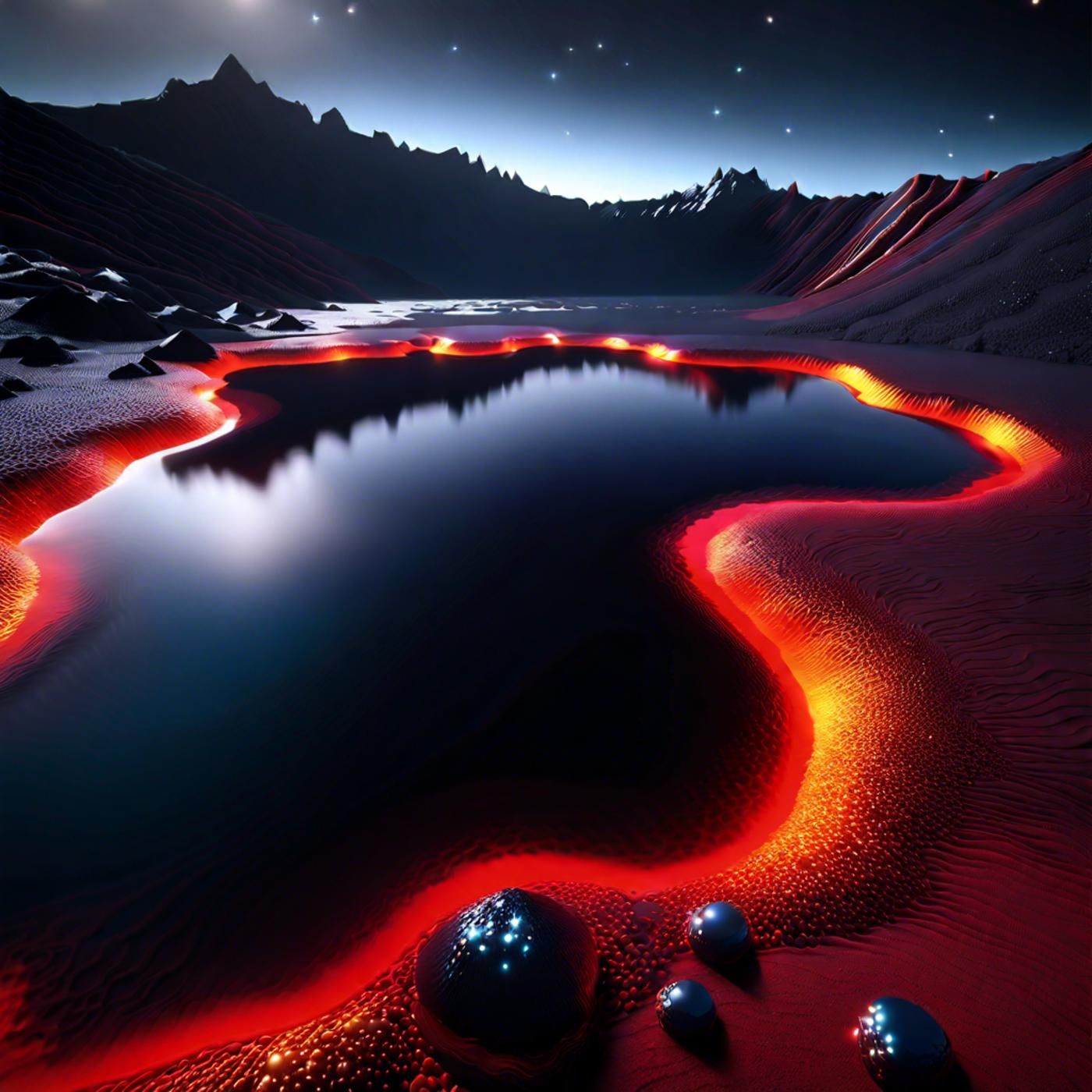
S03E30: Hubble's Hidden Haul & Magnetic Mysteries: Decoding Exoplanet Atmospheres
In this episode
In today's e[isode, we set sail through the cosmic seas beginning with the Hubble Space Telescope's 19-year odyssey, cataloging a flurry of elusive asteroids in a monumental cosmic census. Our journey takes a magnetic turn as we uncover how stellar magnetic fields are reshaping our understanding of exoplanet atmospheres, with a spotlight on the distant world of WASP 39 b. We then descend upon the mysterious ice of Ceres, where young, dynamic ice layers defy our expectations of these shadowy craters. Our quest for extraterrestrial life takes an unexpected twist with the potential of purple bacteria, offering a new palette in the search for life beyond Earth. For our grand finale, we soar over Jupiter's volcanic moon Io, with NASA's Juno mission revealing its fiery heart and enigmatic surface features like never before. Join us as we navigate these cosmic revelations, unraveling the secrets of the universe piece by piece.---
**Featured Topics:**
1. **Hubble's Cosmic Census:** A 19-year journey through Hubble's archives uncovers over 1700 asteroid trails, enriching our understanding of the solar system.
2. **Stellar Magnetic Fields:** Exploring the magnetic influence on exoplanet atmospheres and its impact on our interpretations of distant worlds like WASP 39 b.
3. **Ceres' Ice Mysteries:** Delving into the surprising youthfulness of ice deposits on Ceres, challenging our perceptions of water in the asteroid belt.
4. **The Color Purple in Astrobiology:** Considering purple bacteria as a potential key to detecting alien life, expanding our search beyond Earth's greenery.
5. **Juno's Insights on Io:** An exhilarating close-up look at Io's volcanic activity and surface features, thanks to NASA's Juno mission flybys.
---
**Additional Information:**
Continue your cosmic journey with us at astronomydaily.io, where you can relive past episodes, stay updated with our space news feed, and subscribe to our free daily newsletter. Engage with fellow space enthusiasts and share your thoughts by leaving us a message. Keep the conversation going on X (formerly Twitter) by following us at @AstroDailypod. Your support and curiosity drive our voyage through the stars—until next time, this is Charlie, reminding you to keep looking up.
---
**Host Sign-off:** Charlie: As we conclude today's journey across the universe, I'm Charlie, thanking you for joining us on Astronomy Daily - The Podcast. Keep your eyes to the skies and your wonder alight, as there's always more to uncover in the vastness of space. Visit astronomydaily.io for more, and until our next cosmic encounter, clear skies and stellar dreams to all.
Become a supporter of this podcast: https://www.spreaker.com/podcast/astronomy-daily-latest-space-news--5648921/support.
Sponsor Details:
Ensure your online privacy by using NordVPN. To get our special listener deal and save a lot of money, visit www.astronomydaily.io/nordvpn. You'll be glad you did!
Get the best secure and private email on the planet. Stop your Government, google and who knows who else spying on every email you write. Do what we did and use ProtonMail. They beleive in privacy and there are no ads in their business model...yet they still provide a free forever service. Check them out and get out special deal at www.astronomydaily.io/protonmail
Become a supporter of Astronomy Daily by joining our Supporters Club. Commercial free episodes daily are only a click way... <a...
Welcome to Astronomy Daily, the podcast your daily guide to the cosmos. In today's episode, we're embarking on a fascinating journey across space and time. We'll start with how NASA's Hubble Space telescope has turned its gaze to the asteroid belt, cataloging a flurry of small, elusive space rocks in an impressive nineteen year cosmic sensus. Then we'll explore the unconventional role of stellar magnetic fields and how they're reshaping our understanding of distant exoplanet atmospheres, helping us paint a more accurate portrait of worlds like whilst the Third nine b far beyond our solar reach.
We'll also ponder the intriguing discoveries on series where shadowy craters have revealed a young and dynamic layer of ice, challenging our expectations of these ancient celestial bodies. Additionally, we consider the surprising potential of purple bacteria, which may hold the key to detecting alien life forms. As we refine our search beyond the green hues so familiar on our home planet, and for our final frontier, we'll get an exhilarating close up look at Io, one of Jupiter's moons, where recent NASA Juno mission flybys have provided new insights into the Moon's volcanic vigor and enigmatic surface features like never before.
Stay with us as we navigate through these cosmic revelations and unravel the secrets of the universe piece by piece. Let the odyssey begin. Exit the Astronomy d podcast. Imagine sifting through a cosmic photo album spread across nineteen years, filled with thirty seven thousand snapshots taken by none other than the Hubble Space Telescope, our eye in the sky. This is exactly what astronomers and an army of citizen scientists have done in a groundbreaking asteroid hunt. Their quarry over one thousand and seven one hundred trails of space rock, with one thousand thirty one of these asteroids previously unknown until now, skirting through the main belt between the orbits of Mars and Jupiter.
This pursuit wasn't just a matter of pointing and shooting, Oh No, it required discerning eyes to spot the tiny trails left by these celestial wanderers as they zip past the camera. About four hundred of these new found objects are smaller than a kilometer in diameter, elusive, faint, and fast moving. Yet what truly made this collective quest remarkable was the blending of human curiosity and algorithmic precision. Volunteers from around the world worked hand in hand with machine learning to sift through the vast expanse of Hubble's archived imagery, proving that the quest to map our soular neighborhood is not just a task for robotic telescopic eyes, but also a human endeavor, one that you too could join in on.
This cosmic treasure hunt not only enriches our catalog of Celeste Steel objects, but also sheds light on the origins and evolution of our Solar system. So next time you gaze up at the stars, remember that there's still a whole universe out there waiting to be discovered. Asteroid by asteroid. Peering deeply into the cosmos, astronomers face a challenge as they seek to uncover the secrets of distant exoplanets like the gas giant Wasp thirty nine B nestled in the constellation Virgo Here, some seven hundred light years from Earth.
Traditional models stumble, revealing discrepancies that have puzzled scientists until now. Current research suggests the critical piece we've been missing the influence of a star's magnetic field. While we may understand an exoplanet's size and other characteristics from the variations in brightness of its host star, the magnetic field of that star shapes the light curve in ways unseen before. Up until recent investigations, interpretations of data from exoplanets have skipped over the stars magnetic influence on limb darkening, the phenomenon where the star's edge appears darker than its center.
Innovative studies suggest that a star with a strong magnetic presence exhibits a more muted limb darkening effect as opposed to one with a weaker field. This magnetic trait could be the vital clue to account for the inaccuracies in modeling of stellar atmospheres. Understanding the stellar limb darkening is not merely academic. It sharpens the dimming effect in the light curve caused by transiting exoplanets. As a result, incorporating stellar magnetism into our calculations propels us closer to unveiling the true nature of these far off worlds.
It means telescopes like James Webb could more precisely interpret these curves, turning the magnetic mysteries of exoplanets from riddles into revelations. In an astonishing turn of events, recent studies have revealed that the ice deposits nestled within the shadowy craters of the Dwarf Planet series are not the ancient relics we once believed them to be. These icy enclaves, shielded from the Sun's touch, were presumed to be as old as the craters themselves, thought to date back millions of years.
However, astronomers have now uncovered evidence that these ice deposits are in fact mere youngsters on the cosmic timescale, with an age of just a few thousand years. What's more, not all craters appear to play host to these icy features. This selectiveness of ice distribution on the dwarf planet's surface raises the question from where does the ice hail and by what mechanisms is it replenished. As the Dwarf planet series orbits within the asteroid belt devoid of significant atmospheric protection, the mystery deepens around the life cycle of its water ice.
The implications of this finding are profound, challenging our understanding of water, ice formation, and persistence in the vast expanse of our Solar system. It may well prompt a re evaluation of the can conditions necessary for water to exist, persist, and potentially nurture life even in the most unexpected of places. As we continue to gaze into the heavens, piecing together the puzzle of our celestial neighborhood, Sarahs stands as yet another testament to the dynamic and ever changing universe in which we find ourselves.
In a galaxy teeming with planets, the search for alien life is one of the most profound endeavors. Traditionally, when astronomers peer into the cosmos searching for signs of life, they look for the green tint of chlorophyll, the engine driving photosynthesis here on Earth. But now this search is being painted with a new hue, the color purple. A group of visionary researches contends that we expand our color spectrum in the search for life beyond our planet, shining the spotlight on purple bacteria.
These resilient microorganisms, believed to have thrived on primordial Earth, are adept at flourishing under a ye array of conditions, particularly around red dwarf stars, which are dimmer and cooler than our sun. Could these stars feeble rays nurture worlds swathed in purple rather than green. The implications are tantalizing, as the capability of purple bacteria to harness light using retinal instead of chlorophyll means that interplanetary life might not just mimic the familiar biochemistry of our home planet.
The unique metabolic pathways of these purple organisms may leave discernible signatures that future telescopes could detect, exponentially widening our cosmic net. As we prepare to scan distant exoplanets for these purple fingerprints, we rekindle the age old question what forms of life a weight discovery amongst the stars? Perhaps in the grand tapestry of the universe, purple is the color of life on other worlds, waiting to be revealed by the eyes of science. The Astronomy Daily podcast Have you ever dreamed of soaring over Io, peering into its fiery heart from the heavens?
Thanks to the Juno spacecraft, such dreams virtually come true as scientists draw back the veil on the tumultuous geophysical ballet taking place on Jupiter's innermost moon. Recently, Juno skimmed a mere nine hundred and thirty miles above Io's volatile surface to capture astonishing phenomena a mighty mountain and an expansive, tranquil lava lake known as Loki Pitterra. Envision a lake that mirrors the sky, not with water, but with a sheen of molten rock so glassy and still it could pass for obsidian laid by nature's artisan hand.
This is the spectacle Juno's senses unveiled, providing us with an almost tactile sense of Io's landscape. Bizarre islands floating in a sea of cooling lava ringed by fiercely glowing liquid stone. It's as if one were observing intricate artwork, rather than the chaotic eruptions expected on such a volcanically active body. Not to be outdone, the Moon's poles reveal a stark difference to its equatorial fervor. In contrast to the heat engulfed equatorial regions, Io's poles, as detected by Juno's microwave radiometer, embrace an unexpected chill.
These are quiet, cold polar deserts, starkly juxtaposed with the pandemonium erupting elsewhere. These close flybys are constituting a new chapter in our understanding of Io's fiery nature. Each pass of Juno provides a more refined view of Io's volcanic planes and craggy peaks, serving as natural laboratories for studying geological processes similar yet worlds apart from those on Earth. As we glimpse these alien terrains shaded by Jupiter's massive presence, Juno extends our reach and deepens our perception of the ceaseless dance of celestial bodies.
Thank you for joining us on this celestial journey through the universe. Your curiosity fuels our exploration and we're grateful to have you aboard as we traverse the cosmos, seeking knowledge and understanding amongst the stars. Remember to follow Astronomy Daily the podcast, for a daily dose of intriguing space insights that span the gamut from the icy planes of dwarf planets to the fiery choreography of volcanic moons. It's an endless universe out there, teeming with wonders waiting to be discovered, and together we can unwrap the mysteries of the Cosmos, Stay curious, stay starstruck, and don't miss a single update.
Visit our website at Astronomy Daily dot io, where you can indulge in past episodes, immerse yourself in the latest space news on our constantly updating feed, and subscribe to our free daily newsletter. It's your one stop destination for all things astronomical. And that's not all. We're also a message away. Engage with fellow celestial enthusiasts and share your thoughts, ideas, or even just your favorite space fans. Let's build a community that's passionate about the universe. Last, but not the least, keep the conversation going on x Just search for astro Daily Pod on the platform formerly known as Twitter and hit that follow button.
It's one small click for you, but one giant leap in staying connected with the pulsive space exploration. Until next time, keep your eyes to the sky and your wonder alight. This is Charlie for Astronomy Daily, the Podcast, signing off clear skies and stellar dreams to all the Astronomy Daily Podcast

 Apple Podcasts
 Spotify
 Pocket Casts
 Castbox
 Overcast
 Podbean
 iHeartRadio
 Castro
 Goodpods
 Moon FM
 Podcast Addict
 Podcast Republic
 YouTube