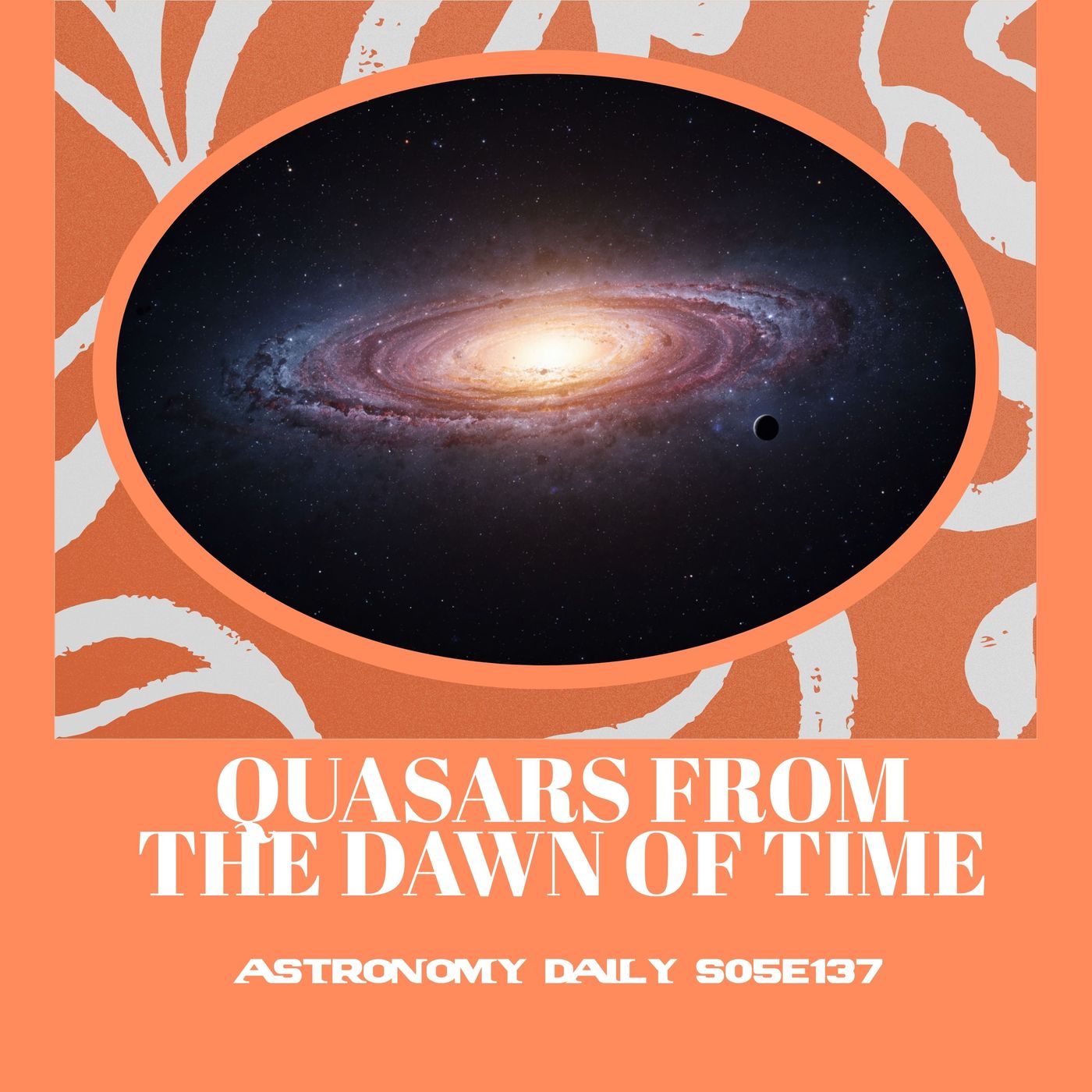
Euclid Finds 31 Ancient Quasars — Plus a "Snowman" Asteroid and Roman Telescope Update
In this episode
S05E137: Euclid uncovers 31 ancient quasars including the two most distant ever observed, Roman Space Telescope reaches a major pre-launch milestone at Kennedy Space Center, China details its plans for a sunward asteroid early-warning network, Hayabusa2 reveals asteroid Torifune is a two-lobed “snowman” contact binary, NASA's GRITSS CubeSat launches to sharpen global positioning precision, and we close with tonight's Moon-free skywatching window. Sources • Euclid Consortium / ESA — “Euclid discovers the most ancient quasars in the Universe,” Astronomy & Astrophysics, July 6, 2026 • NASA Science — “NASA's Roman Launch Preparations Proceed,” science.nasa.gov/blogs/roman, July 9, 2026 • Space.com — “China announces plan to build early-warning system for dangerous asteroids,” July 9, 2026 • JAXA — “Hayabusa2 captures images of asteroid Torifune,” global.jaxa.jp, July 6, 2026 • NASA / SatNews — “NASA and ISISPACE Deploy GRITSS CubeSat to Advance Orbital Reference Frame Precision,” July 9, 2026 • Astronomy.com — “The Sky This Week, July 10–17, 2026”Become a supporter of this podcast: https://www.spreaker.com/podcast/astronomy-daily-latest-space-news--5648921/support.
Sponsor Details:
Ensure your online privacy by using NordVPN. To get our special listener deal and save a lot of money, visit www.astronomydaily.io/nordvpn. You'll be glad you did!
Get the best secure and private email on the planet. Stop your Government, google and who knows who else spying on every email you write. Do what we did and use ProtonMail. They beleive in privacy and there are no ads in their business model...yet they still provide a free forever service. Check them out and get out special deal at www.astronomydaily.io/protonmail
Become a supporter of Astronomy Daily by joining our Supporters Club. Commercial free episodes daily are only a click way... Click Here
This episode includes AI-generated content.
Anna: Hello and welcome to Astronomy Daily. I'm Anna. Avery: And I'm, um, avery. It's Friday, July 10, 2026, and we've got quite the lineup for you today. Anna: We're talking about quasars from the dawn of time. A telescope getting hoisted onto its launch platform, an asteroid hunting satellite constellation, a space snowman, and a tiny cubesat that wants to redraw the map of Earth itself. Itself. Avery: It's a big one. Let's not waste any time. Straight into it. And Anna, uh, how do you feel about looking back nearly 13 billion years?
Anna: Honestly, a little dizzy. But that's exactly what the European Space Agency's Euclid telescope has just done. Astronomers have used it to find, uh, 31 quasars from the universe's first billion years of existence. Avery: And quasars, for anyone who needs the refresher, are the blazing cores of galaxies. Supermassive black holes gorging on gas and dust so violently that they can outshine every star in their host galaxy combined. Anna: Right. And two of these 31 are record breakers. Their light left them when the universe was just 670 million years old.
That's about 5% of its current age. Avery: 5%. That's like finding a photo from someone's first birthday and using it to figure out how they run a company 40 years later. Anna: Which is basically the mystery here. These black holes are already around a billion times the mass of our Sun. Nobody has a clean explanation for how they packed on that much mass so early. Avery: The new record holder is cataloged as Eucl J17, uh, 292.75641.8.1. And it beats the previous most distant quasar by about 15 million years, which, in cosmic terms, is basically nothing.
Anna: The team, led by Daming Yang at Leiden University, published the find in Astronomy and Astrophysics. And here's a fun detail. Finding 31 rare objects buried in a survey of billions of galaxies is a genuine needle in a haystack bobblem. Avery: So how'd they do it? Anna: Bayes Theorem. Um, centuries old statistics repurposed for one of the largest astronomical data sets ever assembled. Old math, brand new universe. Avery: I love that. Euclid's still got a long way to run, too. This is from just its wide survey, which will eventually cover more than one third of the entire sky.
Anna: So consider this the opening chapter. There's a lot more of the early universe still defined now, from the deep past to the very near future. NASA's Nancy Grace Roman Space Telescope just took another step toward launch. Avery: This is the big dark matter dark energy exoplanet hunting flagship. Right? Anna: That's the one. NASA confirmed this week that inside the payload hazardous servicing facility at Kennedy Space center, technicians used cranes to lift the 18,000 pound observatory onto a specialized work platform called the Pantheon.
Avery: 18,000 pounds hanging in mid air on a crane. That's not a moment I'd want to be standing underneath. Anna: Nerve wracking to watch, I'd imagine. But it's a routine and carefully choreographed step. It moves Roman from its padded shipping configuration into its proper operational setup, ready for integration and testing. Avery: And they've already powered it up for system checkouts to make sure everything survived the trip from Goddard in one piece. Anna: Exactly. Roman is targeting no earlier than Sunday August 30th for launch on a SpaceX Falcon Heavy from Launch Complex 39A.
Avery: Once it's up, it's heading out to the sun. Earth L2 point. About a million miles from Earth where it'll have an unobstructed view of the cosmos. Anna: From there it'll hunt for dark matter, probe dark energy and directly image exoplanets around nearby stars. A proper Swiss army knife of an observatory. Avery: Less than two months to go now. We'll be keeping a close eye on this one. Now Anna, another quick question. Where's the one direction in the sky where we're basically blind to incoming asteroids?
Anna: Straight at the Sun. Anything approaching from that direction gets lost in the glare for any ground telescope. Avery: Which is exactly how the 2013 Chelyabinsk meteor snuck up on everyone. It came in from near the sun and wasn't spotted until it was already in the atmosphere over Russia. Anna: China's now laying out detailed plans to close that gap. Chief Scientist Li Mingtao has confirmed a ah combined ground and space monitoring network. And new reporting this week reveals just how detailed the space side of the plan already is.
Avery: Give me the details. Anna: A paper from June co authored with Wu Wei Ren, chief designer of China's lunar exploration program, lays out four candidate orbits for the space based telescopes. The Sun, Earth L1, Lagrange Point, an Earth leading or trailing orbit, a Venus like heliocentric orbit orbit, and something called an Earth companion distant retrograde orbit. Avery: That's a lot of orbital real estate to be considering. Anna: It is. And each one's being evaluated for how well it actually watches that sunward blind spot.
Right now more than 40,000 near Earth asteroids are cataloged and we've found over 95% of the kilometer plus ones that could cause global damage. But. But only around 45% of the smaller 140 meter class asteroids have been found and those are still big enough to flatten a small country. Avery: So this network is specifically going after the ones we're most likely to miss. Anna: Exactly. The idea, round the clock, no blind spots. Coverage. Combining ground telescopes for the night sky with space based eyes watching the direction Avery: the sun blocks, planetary defense, filling in, um, the gaps one orbit at a time.
Anna: Time for my favorite kind of space story, the ones that come with genuinely gorgeous pictures. As we reported over the last couple of episodes, JAXA's Hayabusa2 spacecraft has just flown past the asteroid Tory Foon. And the images that have been sent back so far are wonderful. Avery: This is the same Hayabusa 2 that brought us those Ryugu samples back in 2020? Anna: The very same. Now out on an extended mission. On July 5, it screamed past Tory Foon at about 5 kilometers a second, coming within roughly 800 meters of the surface.
Avery: And what did it find? Anna: Tory Foon turns out to be a contact binary. Two separate asteroids that drifted together over time and fused into 1 elongated 2 lobed shape. Scientists are calling it a snowman. And once you see the image, you can't unsee it. Avery: Ground based observations had hinted it might be elongated, but this is the first time anyone's actually confirmed the double lobe structure. Anna: Right. Using its optical camera, Thermal infrared Imager, Near Infrared Spectrometer and lidar, all within about an hour of closest approach.
That's a lot of instruments working overtime. On a single high speed pass. Avery: Corey foons, about 450 meters across, orbits the sun every 383 days and spins once every five hours. It belongs to the Apollo Group, the near Earth asteroids whose paths cross our own. Anna: Hayabusa2 isn't done yet either. Backstop is 1998 KY26 in 2031, an asteroid only about 11 meters across, which would make it the smallest asteroid ever visited by a spacecraft. Avery: From a cosmic snowman to visiting something the size of a house, this mission just keeps giving.
Our next story is proof that not every exciting mission needs to leave Earth orbit. Sometimes it's all about measuring the planet we're already standing on. Anna: This is grits, the Geodetic Reference Instrument transponder for small satellites. It launched July 7th aboard SpaceX's Transporter 17 rideshare mission out of Vandenberg. Avery: A cubesat, no less. How small are we talking? Anna: A, uh, 12U cubesat, about the size of a large shoebox built by the Dutch company ISAS Space, working with NASA Goddard and the University of Massachusetts, Lowell.
Avery: So what's the actual job here? Anna: It's tackling a really specific, unglamorous, but important problem. Right now we measure Earth's precise shape and position using three separate systems. GPS satellites, radio telescopes, doing something called very long baseline interferometry and laser ranging stations on the ground. Avery: And those three systems don't always agree with each other. Anna: Exactly. Tying them together traditionally relies on physical ground based surveying, which introduces tiny errors.
Brits acts as a single satellite that all three systems can see and measure at once, effectively becoming a shared reference point in the sky. Avery: So instead of three separate rulers that, uh, don't quite line up, you get one ruler everyone agrees on. Anna: That's the idea. It upconverts incoming GPS signals and rebroadcasts them so ground based radio telescopes can track it too, while a mounted laser reflector lets ground stations range it directly. Avery: And the payoff is millimeter accuracy in what's called the international terrestrial reference frame.
Basically the master coordinate system the whole world uses for mapping, navigation and tracking sea level rise. Anna: It sounds small, but that kind of precision underpins everything from your phone's GPS to climate science. A, uh, shoebox in orbit, quietly making the whole planet easier to measure. Let's finish today somewhere a little more relaxed. If you're the sort of person who likes to just step outside and look up tonight, you're in luck. Avery: Why's that? Anna: There's no moon in the sky at all this evening, which means no wash of moonlight drowning out the fainter stuff.
It's genuinely one of the best nights of the month for chasing dimmer objects with a telescope or a decent pair of binoculars. Avery: And for anyone wanting an easier target with the naked eye, Venus is still keeping close company with Regulus, the brightest star in Leo, low in the evening twilight. Anna: That pairing's been a lovely one this week. And Venus is on track to meet up with a slender crescent moon around the 17th, so keep half an eye on the western sky over the coming days. Avery: A dark sky tonight.
A, uh, planet and star pairing to enjoy right now. And a moon Venus meetup to look forward to. Not a bad way to close things out. Anna: Not bad at all. Get outside if you can. The sky's putting on a show either way. Avery: That's it for today. Quasars from the dawn of time. Roman's launch getting closer. A sunward asteroid watch. A snowman in the asteroid belt. And a cubesat remeasuring the Earth. Anna: Thanks for spending part of your day with us. We'll be back tomorrow with more from across the universe.
Until then, Clear skies. Avery: Astronomy day. Mhm stories.

 Apple Podcasts
 Spotify
 Pocket Casts
 Castbox
 Overcast
 Podbean
 iHeartRadio
 Castro
 Goodpods
 Moon FM
 Podcast Addict
 Podcast Republic
 YouTube