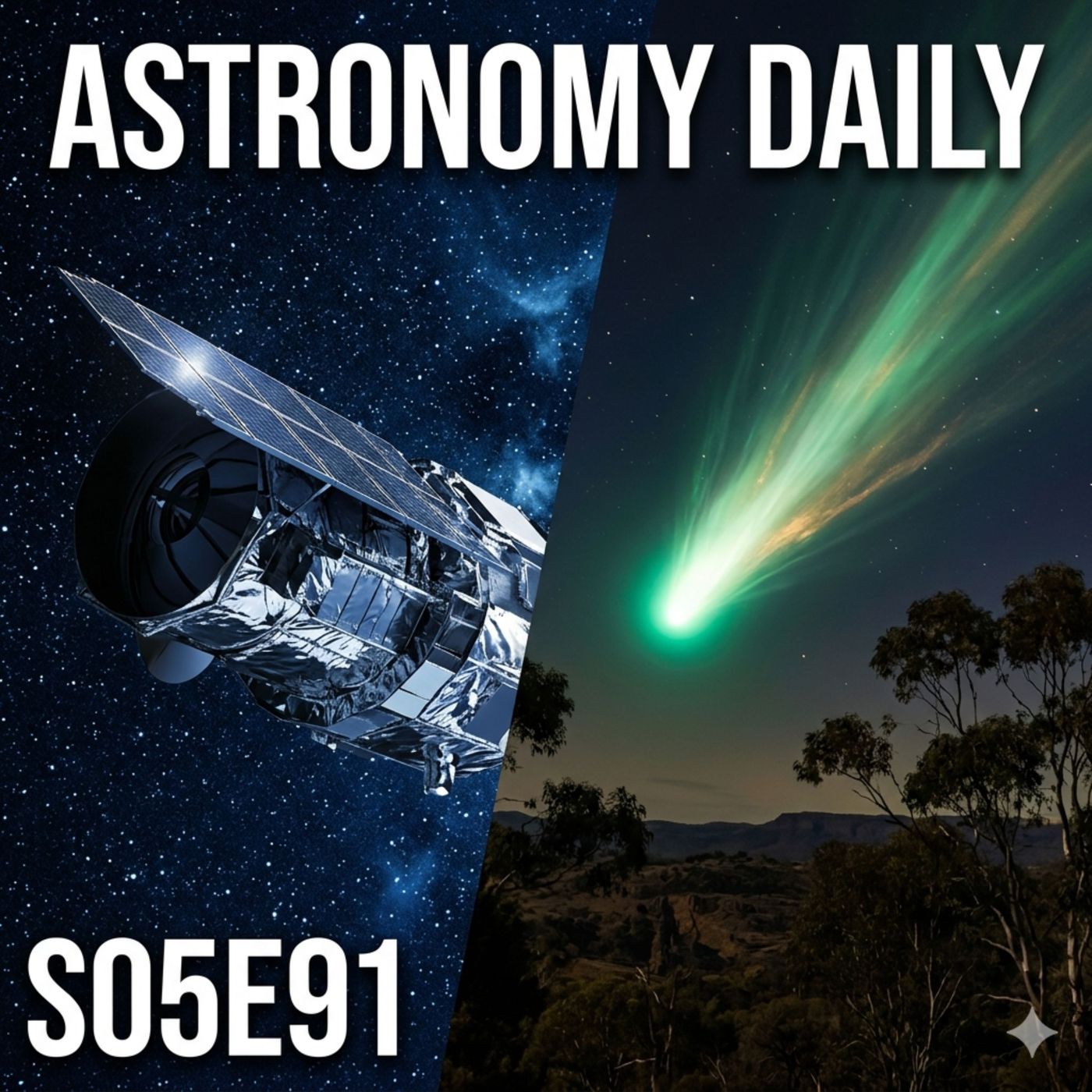
Roman Telescope Gets September Launch Date, Hidden Moons Around Uranus & Comet Alert for Southern Skies
In this episode
Sponsor Link:To grab our special NordVPN listener deal, Click Here
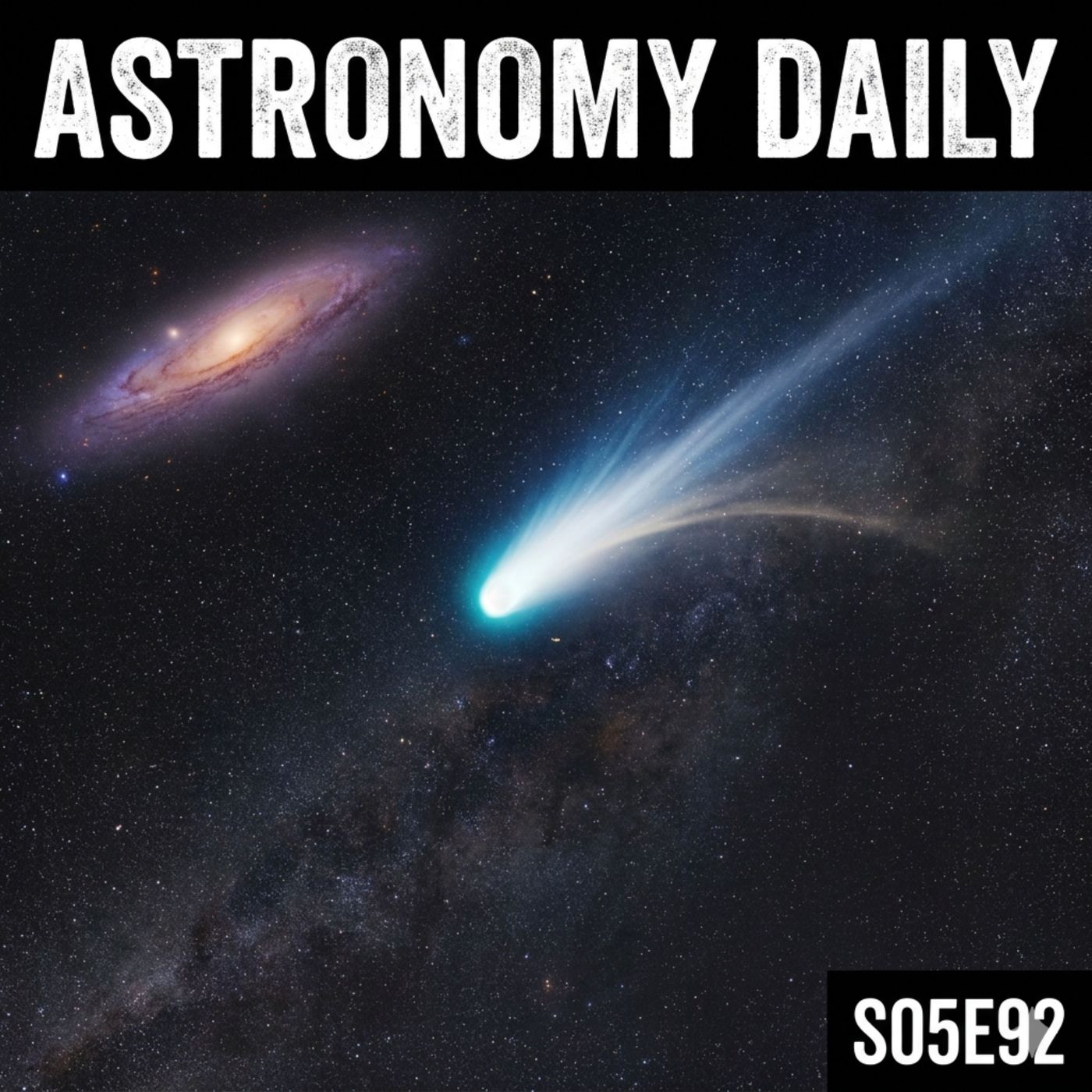
Welcome to Astronomy Daily, Season 5 Episode 91 — Thursday 23 April 2026. Hosted by Anna and Avery for the Bitesz.com Podcast Network. Today: NASA's Roman Space Telescope locks in a September 2026 launch date eight months ahead of schedule; new research reveals Uranus's rings are hiding secrets — and possibly hidden moons; Hubble returns to the Trifid Nebula nearly 30 years on; Jordan becomes the 63rd nation to sign the Artemis Accords; the Artemis III rocket core stage ships to Kennedy Space Center; and Southern Hemisphere skywatchers get their best shot at Comet C/2025 R3 PanSTARRS this week. Story Summaries 1. Roman Space Telescope — September 2026 Launch Confirmed NASA's Nancy Grace Roman Space Telescope is now targeting a September 2026 launch — eight months ahead of its formal May 2027 deadline, and under budget. The 300-megapixel infrared observatory will survey the cosmos with a field of view at least 100 times wider than Hubble's, observing over a billion galaxies and discovering more than 100,000 new worlds in its first five years. It will travel to the Sun-Earth L2 point aboard a SpaceX Falcon Heavy rocket. 2. Uranus's Mysterious Rings Hint at Hidden Moons A study published in the Journal of Geophysical Research: Planets, using combined data from Keck Observatory, Hubble and JWST, has produced the first complete reflectance spectrum of Uranus's two outermost rings. The mu-ring is made of water ice sourced from moon Mab; the nu-ring contains carbon-rich organic compounds from unseen rocky bodies — suggesting undiscovered moonlets may orbit Uranus. Researchers say a dedicated spacecraft mission will be needed to solve the mystery fully. 3. Hubble Revisits the Trifid Nebula NASA's Hubble Space Telescope has re-imaged the spectacular Trifid Nebula, approximately 5,000 light-years away, nearly three decades after its original 1997 image. By comparing the two images, astronomers have tracked measurable changes in young stellar behaviour — demonstrating the power of long-lived space observatories as cosmic time-lapse cameras. 4. Jordan Signs the Artemis Accords The Hashemite Kingdom of Jordan signed the Artemis Accords today at NASA Headquarters in Washington DC, becoming the 63rd nation to commit to the framework for peaceful space exploration. The Accords — established in 2020 — cover transparency, interoperability, data sharing, heritage preservation and resource extraction principles for Moon, Mars and beyond. 5. Artemis III Rocket Core Stage on the Move Just ten days after Artemis II's historic lunar flyby concluded, NASA rolled out the core stage of the Artemis III SLS rocket from Michoud Assembly Facility in New Orleans onto the Pegasus barge for shipment to Kennedy Space Center. Artemis III is targeting 2027 for an Earth-orbit crewed rendezvous and docking test with commercial lunar landers, with a Moon landing pushed to Artemis IV in 2028. 6. Comet C/2025 R3 PanSTARRS — Southern Hemisphere Viewing Window Comet C/2025 R3 PanSTARRS reached perihelion on April 19 and is now entering its best viewing window for Southern Hemisphere observers. From late April through early May, the comet will appear in the evening sky after sunset, potentially reaching magnitude 3.5 or brighter. Its orbit may be hyperbolic — meaning this could be humanity's only ever encounter with this object. Closest Earth approach: April 26, at approximately 73 million kilometres. Links & Resources: • Nancy Grace Roman Space Telescope: roman.gsfc.nasa.gov • Artemis Accords signatories: nasa.gov/artemis-accords • Comet C/2025 R3 tracking: theskylive.com/c2025r3-info • New research — Uranus rings: doi.org/10.1029/2025je009404 • Astronomy Daily: astronomydaily.io | @AstroDailyPod
Become a...
Speaker 1: If you've been stepping outside after dark lately and wondering what that fuzzy smudge low on the horizon might be, stay tuned, because by the end of today's show, you're going to know exactly what it is, exactly when to look, and exactly why you might only ever get one shot at seeing it. Welcome to Astronomy Daily.
Speaker 2: I'm Anna and I'm Avery. This is season five, episode ninety one of Astronomy Daily, your daily guide to everything happening in space and beyond.
Speaker 1: It is Thursday, the twenty third of April twenty twenty sixth and we have a cracking episode lined up. Six stories across the board today, from a game changing telescope that just locked in a launch date, to a decade's old cosmic photograph getting a stunning update, to a signing ceremony happening literally as we record this.
Speaker 2: And we'll close out with that comment you just tease Dana, which our Southern Hemisphere listeners in particular are going to want to hear about trust uses.
Speaker 1: Let's get into it.
Speaker 2: We touched on the Roman Space telescope earlier this week when NASA hosted its big unveiling event at Goddard Space Flight Center. But since that story ran, something significant has become clear the launch date, So let's give this the update it deserves.
Speaker 1: Right and the headline here is genuinely exciting. The Nancy Grace Roman Space Telescope is now targeting a September twenty twenty six launch. That's eight months ahead of its formal deadline of May twenty twenty seven. Eight months, and it came in under budget. In government space projects, that is practically unheard of.
Speaker 2: To put this in perspective for anyone just catching up, Roman is massa's next flagship space observatory. Think of it as Hubble's younger sibling, same size mirror about two point four meters, but a field of view that is at minimum one hundred times wider than Hubbles. The images it will capture are so large there is literally no screen currently in existence big enough to display them at full resolution.
Speaker 1: And NASA administrator Jared Isaacman made a striking comparison at this week's press event. What would take Hubble two thousand years to survey Roman can do in a single year, two thousand years versus one let that sink in.
Speaker 2: The science objectives are vast Roman will hunt for exoplanets, potentially more than one hundred thousand new worlds in its first five years. It'll survey billions of galaxies, and critically, it will probe too of the deepest mysteries in modern physics, dark matter and dark energy. We don't know what either of those actually are, and Roman's wide field infrared vision is designed specifically to pull back the curtain.
Speaker 1: It's also carrying the Coronograph Instrument, a technology demonstrator that will attempt to directly photograph planets around nearby stars that could be a transformative cypability for the search for Earth like worlds.
Speaker 2: Will travel to the Sun Earth l two point, the same orbital neighborhood as the James Webb Telescope, about a million miles from Earth. Once there, it begins a five year primary mission. If September holds, we could see first light before the end of this year.
Speaker 1: Sixteen years after astronomers ranked it as the single highest priority for the next decade of space science. Four separate attempts to cancel the mission, and here we are, eight months ahead of schedule, watching it ship to Kennedy Space Center this summer. Some stories really do have a good ending.
Speaker 2: A feel good story indeed.
Speaker 1: Right story two, and this one involves Uranus, which is having quite a moment scientifically lately.
Speaker 2: Uranus is the gift that keeps giving, the ice giant, seven planets out from the Sun, famously tilted on its side, with twenty nine known moons and a system of thirteen rings. And it's those rings at the center of new research published this week in the Journal of Geophysical Research.
Speaker 1: A team led by ENK. Depotter at UC Berkeley has combined data from three of the world's most powerful observatories, the WMKEX Observatory in Hawaii, the Hubble Space Telescope, and the James Webb Space Telescope to build the first complete reflectant spectrum of Uranus's two outermost rings, known as the Mew Ring and the New Ring.
Speaker 2: And what they found is that these two rings, sitting side by side in the Uranian system, are made of completely different stuff, which raises an obvious question.
Speaker 1: How The Mew Ring, it turns out, is composed of water ice particles, tiny frozen grains being knocked loose from a small moon called Mab by micrometeorite impacts. Mab is only about twelve kilometers across, barely a pebble on cosmic scales, but it's generating an entire ring of ice debris as it orbits.
Speaker 2: The only other blue ring like this in our Solar system is Saturn's E ring, produced by volcanic activity on Enceladus. The mechanism is different, but the result is remarkably similar. Major finding the same solution twice.
Speaker 1: Now the new ring is where things get really strange. It's not made of ice. Instead, it's composed of rocky material laced with organic compounds carbon rich molecules, and crucially, there's no known moon nearby that could be the source.
Speaker 2: The researchers believe there must be unseen rocky bodies, possibly small moon lids, tucked between the known moons, getting bombarded by micrometeorites and feeding material into the ring. In other words, Urinus likely has more moons than we know about.
Speaker 1: Mark Showalter from the Seti Institute, a co author on the study, was pretty direct about it. He said, solving the full mystery will probably require a spacecraft mission to Uranus. One is in the planning stages. It was the top priority in the most recent National Academy of sciences, planetary science, decatal survey, though funding remains the critical question.
Speaker 2: There's one more wrinkle worth mentioning the mew ring appears to be changing in brightness over time subtly but measurably. What's causing that? Nobody knows. Another mystery for a mission that fingers crossed eventually gets off the ground.
Speaker 1: Uranus, deeply weird, deeply fascinating, and apparently still full of secrets. This story is going to keep developing.
Speaker 2: Story three, and this one's a treat for anyone who loves cosmic imagery with a sight of Time Lap's astronomy.
Speaker 1: The Hubble Space Telescope has gone back to one of its classic targets, the Triffid Nebula, and the comparison between the original image and the new one is genuinely remarkable.
Speaker 2: For those I'm familiar. The Triffid Nebula is a star forming region in the constellation Sagittarius, about five thousand light years from Earth. Its name comes from the Latin for divided into three. It split into three distinct lobes by dark dust lanes, giving it the striking trilobate appearance. It's one of Hubble's most celebrated early targets.
Speaker 1: Hubble first imaged the triffied back in nineteen ninety seven, nearly three decades ago. The new image, captured with upgraded instruments, covers essentially the same field, and by placing the two side by side, astronomers have been able to track real measurable changes in how young stars in the region behave and evolve.
Speaker 2: Now twenty nine years sounds like a long time to us. On cosmic scales, it's barely an eyeblink, but young stars still in the process of forming, still shedding material, still igniting, can show perceptible changes on human time scales, and that's exactly what the comparison reveals.
Speaker 1: What Hubble is doing here is functioning as a kind of cosmic time lapse camera, the same telescope, returning to the same subject decades apart, and documenting how the universe has shifted in the interim. It's one of the most powerful aspects of having a long lived observatory in space.
Speaker 2: And of course, visually, the new Triffid image is spectacular, the deep magentas electric blues and soft golden hues of active stellar nurseries. If you haven't seen it yet, it's worth seeking out. We'll link it in the show notes.
Speaker 1: The trifid Nebula thirty years older and if anything more beautiful than ever, proof that some things genuinely improve with age.
Speaker 2: Like us. Maybe Anna story.
Speaker 1: Four now, and this one is happening today. Right now as we record at NASA Headquarters in Washington, DC, the.
Speaker 2: Hash of my Kingdom of Jordan is signing the Artemis Accords, becoming the sixty third country to commit to the Framework for Peaceful and Responsible Space Exploration. NASA Administrator Jared Isaacman is hosting Ambassador Dina Kauer for the ceremony.
Speaker 1: Now we should explain what the Artemis Accords actually are for anyone who joined us more recently. The Accords were established in twenty twenty during the first Trump administration by NASA and the State Department, initially with seven other founding nations, including Australia. They're a set of practical principles covering how countries should conduct themselves in space, transparency, interoperability, data sharing, protecting historic sites, safe zones around operations, and the responsible extraction of resources.
Speaker 2: They're built on top of the nineteen sixty seven Outer Space Treaty, but they add specificity that the original treaty lacked, and critically, they're open to any nation that wants to participate in the broader Artemis program of Moon exploration.
Speaker 1: What's interesting about the timing here is that just three days ago, on Monday, Latvia signed as the sixty second nation. Though we've seen two signatories in one week, right on the heels of Artemis two's successful return to Earth.
Speaker 2: There is a momentum story here. Artemis two returns from the Moon and within days the international community is literally lining up to join the framework. Jordan notably has genuine aspirations in the space sector. The country has invested in satellite technology and space science education in recent years. This isn't just symbolic.
Speaker 1: Sixty three nations. The list now spans every inhabited continent, with twenty nine European nations, fifteen across Asia, and representation from the Americas, Africa, and Oceania. The Artemis program is increasingly a genuinely global endeavor.
Speaker 2: Congratulations to Jordan, welcome to the coalition.
Speaker 1: Before we move on to our next story, I'll just jumpin and give you a reminder about our sponsor, NordVPN. They're the ones who are helping us keep the lights on this week. But if you're looking to make your online presence really secure from snooping eyes, and that includes governments, then you need NordVPN. They're the one we use and can highly recommend check them out via the link in the show notes, and I think you'll be amazed at the incredible deals they have in place for Astronomy Daily listeners.
Speaker 2: All right, story five. And if you're wondering how quickly NASA moves after a successful mission, wonder no more.
Speaker 1: It was just ten days ago that the Artemis two crew splashed down in the Pacific. Four astronauts home safe after the most distant human spaceflight in history, and NASA is already rolling out the hardware for the next one.
Speaker 2: On April twentieth, just a week and a half post splashdown, engineers at NASA's Misshout Assembly facility in New Orleans, loaded the core stage of the Artemis three Space launch System rocket onto the agency's Pegasus barge. It's currently en route to Kennedy Space Center in Florida, where final integration and outfitting will take place.
Speaker 1: The core stage is enormous. When fully integrated, it'll stand two hundred and twelve feet tall around sixty five meters. What rolled onto the barge is the top four fifths of that structure, the liquid hydrogen tank, liquid oxygen tank, intertank, and forward skirt. The engine section with its four RS twenty five engines will be attached at Kennedy Now.
Speaker 2: Artemis please mission profile has evolved since the program was first announced. The original plan landing astronauts at the lunar South Pole has been pushed back to Artemis four, now targeting the first half of twenty twenty eight. Artemis three, scheduled for twenty twenty seven, will instead test rendezvous in docking procedures in Earth orbit, with the Orion spacecraft linking up with one or both of the contracted lunar landers from SpaceX and Blue Origin.
Speaker 1: It's a sensible reconfiguration. Test the systems in Earth orbit first, where rescue is possible if something goes wrong, then send people to the Moon.
Speaker 2: And there's an added layer of significance here. One of those landers, Blue Origins Blue Moon, was supposed to launch on a new Glen rocket. That rocket is currently grounded following last week's upper stage mishap, so there's some pressure on Blue Origin to resolve that situation quickly. NASA Administrator Isaacman has expressed confidence publicly, but the clock is ticking.
Speaker 1: The momentum of the Artemis program feels very real right now. One mission just returned, the next one is literally on a barge. The one after that is already in planning. This program is moving.
Speaker 2: Next something for our skywatchers.
Speaker 1: That's right. The story I teased in the opener summary, and this one is especially for our listeners in Australia, New Zealand and across the Southern Hemisphere.
Speaker 2: Commet see twenty twenty five R three pan Stars. It's been generating buzz for months. Some corners of the Internet have called it the potential great comment of twenty twenty six, and right now this week is when Southern Hemisphere skywatchers get their best shot at it.
Speaker 1: Let's set the scene. This comment was discovered in September twenty twenty five by the Pan Stars Survey telescope in Hawaii. At that point, it was a faint nineteenth magnitude speck, visible only to the most sensitive detectors. It's been brightening steadily ever since.
Speaker 2: It reached perihelion. Its closest approach to the Sun on April nineteenth, passing within about seventy five million kilometers of the Sun. And here's where it gets particularly interesting for our Southern Hemisphere listeners. While Northern Hemisphere observers have now largely lost it in the Sun's glare, the geometry is turning in your favor.
Speaker 1: From late April through early May, the comet will appear in the evening sky for Southern Hemisphere viewers, moving progressively higher after sunset. At its brightest estimates, it could reach magnitude three point five, comparable to the stars of the Southern Cross, and potentially brighter. There's even an optimistic scenario where it approaches magnitude zero, which would make it one of the most striking naked eye comets in years.
Speaker 2: Now. Comets are famously unpredictable. We can model their orbits beautifully, but their brightness depends on how the icy nucleus responds to solar heating, and that's harder to forecast. The magnitude three point five estimate is a solid baseline, but don't be surprised if it over or under delivers.
Speaker 1: The closest approach to Earth happens on April twenty sixth, just three days from now, when it passes within about seventy three million kilometers. Look low in the western sky after sunset in the direction of the constellations Pisces and Pegasus. Binoculars will certainly help, but under dark skies you might find it with the naked eye.
Speaker 2: And here's the detail that gives this story real weight. The comets orbit may be hyperbolic. That means it may have come from interstellar space. We'll swing past the Sun once and then head back out, never to return. If that's confirmed, April and May twenty twenty six could be the only time in all of human history that anyone ever sees this object ever.
Speaker 1: So get outside this week dark sky western horizon after sunset you might be watching something no human has ever seen before and no human ever will again.
Speaker 2: Before we wrap up, time for your daily dose of cosmic trivia.
Speaker 1: Today's question. The Nancy Grace Roman space Telescope shares its primary mirror size with a famous existing space telescope. Which one and where did the mirror originally come from?
Speaker 2: I'll give you a second or two to think about it.
Speaker 1: Answer. Roman's two point four meter mirror is the same size as the Hubble Space telescopes. And here's the remarkable backstory. The mirror was actually donated to NASA by the National Reconnaissance Office. It was originally built for a classified intelligence satellite. NASA repurposed surplus spy satellite hardware into what will become one of the most powerful astronomical instruments ever launched.
Speaker 2: From watching Earth from above to watching the Universe from afar, not a bad career change for a mirror.
Speaker 1: And that is your Astronomy Daily for Thursday, the twenty third of April twenty twenty six. Six Stories, one Extraordinary Universe. Thank you so much for spending part of your day with us.
Speaker 2: Find us everywhere. Podcasts are found on YouTube and at Astronomy Daily dot io. Leave us a review if you're enjoying the show. It genuinely makes a difference, and follow us on social media at astro Daily pod.
Speaker 1: And for our Southern Hemisphe your listeners get outside this week. That comment is waiting for.
Speaker 2: You until tomorrow. Keep looking up cleer s guys, everyone Sunday Stars to Star is
 Apple Podcasts
 Spotify
 Pocket Casts
 Castbox
 Overcast
 Podbean
 iHeartRadio
 Castro
 Goodpods
 Moon FM
 Podcast Addict
 Podcast Republic
 YouTube