The Weekend Wrap Debuts — Soyuz 5, Artemis II Revisited & Roman Telescope
In this episode
Sponsor Link:When you're ready to upgrade your online security, get NordVPN just like we did. And we can save you a lot of money with our special deals. For details Click Here
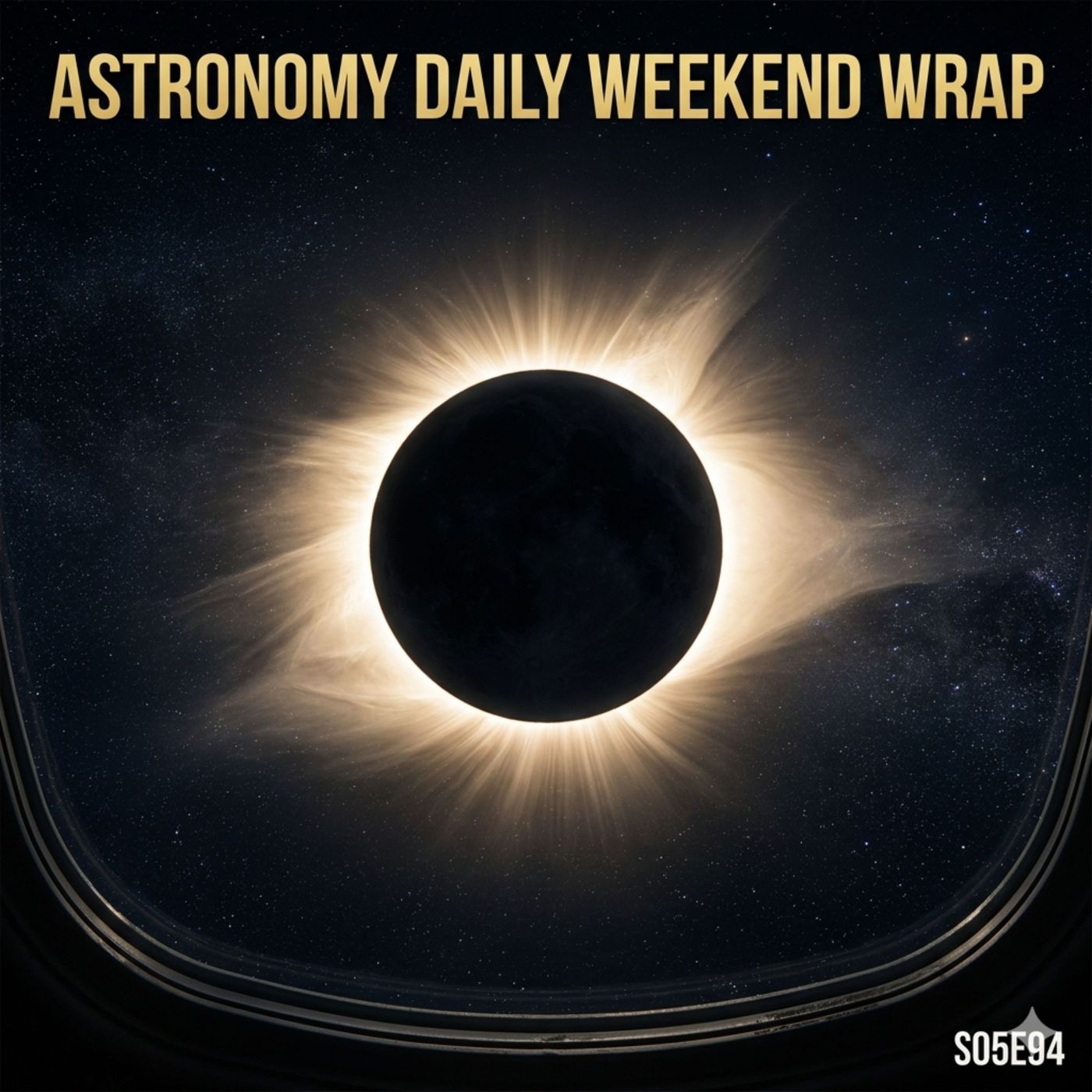
Welcome to Astronomy Daily S05E94 — our first ever Weekend Edition! Today we debut the Astronomy Daily Weekend Space and Astronomy News Wrap, featuring two fresh stories plus a roundup of the four biggest and most important space stories from across the past week. Today's Stories • Story 1: Russia's Soyuz 5 rocket completes its first successful suborbital test flight from Baikonur Cosmodrome. After nearly a decade of development, Russia's homegrown answer to the Zenit finally flew — a milestone for Roscosmos, even as questions remain about its competitiveness in a reusability-driven market. • Story 2: May's Flower Moon peaked on May 1st — and May 2026 is a double-micromoon month, with both the Flower Moon and the May 31 Blue Moon occurring near lunar apogee. Southern Hemisphere skies are perfect for viewing this weekend. Weekend Wrap — The Week's Four Biggest Stories • Wrap 1: Artemis II — The Full Picture. 694,481 miles, 252,756 miles from Earth at farthest, 57-minute eclipse from beyond the Moon, heat shield performance significantly better than Artemis I. The numbers of a mission for the history books. • Wrap 2: The Eclipse Only Four Humans Have Ever Seen. During the April 6 lunar flyby, the Artemis II crew experienced a 57-minute total solar eclipse from beyond the Moon — the first time in human history. Victor Glover's descriptions were extraordinary. • Wrap 3: Roman Space Telescope locks in September 2026 launch — 8 months ahead of schedule and under budget. With a field of view 100x larger than Hubble's, Roman is poised to become the most powerful survey telescope in history. • Wrap 4: Artemis III hardware arrives at Kennedy Space Center. The SLS core stage was offloaded from the Pegasus barge on April 27-28 — just as the Artemis II Orion capsule returned for post-flight analysis. The next mission is already assembling. Skywatching This Weekend • The Flower Moon is still at 99% illumination tonight — beautiful in Southern Hemisphere autumn skies. Look for it between Antares (Scorpius) and Spica (Virgo). • Venus and Jupiter are prominent in the western evening sky, slowly closing toward a June 9 conjunction. • Asteroid Vesta is at opposition today, May 2 — best viewed with binoculars or a small telescope from a dark site. • The Eta Aquariid meteor shower peaks the night of May 5-6 — an excellent show from Southern Hemisphere locations.
Become a supporter of this podcast: https://www.spreaker.com/podcast/astronomy-daily-latest-space-news--5648921/support.
Sponsor Details:
Ensure your online privacy by using NordVPN. To get our special listener deal and save a lot of money, visit www.astronomydaily.io/nordvpn. You'll be glad you did!
Get the best secure and private email on the planet. Stop your Government, google and who knows who else spying on every email you write. Do what we did and use ProtonMail. They beleive in privacy and there are no ads in their business model...yet they still provide a free forever service. Check them out and get out special deal at www.astronomydaily.io/protonmail
Become a supporter of Astronomy Daily by joining our Supporters Club. Commercial free episodes daily are only a click way... <a...
Anna: Hello and welcome to Astronomy Daily, your daily guide to the cosmos. I'm Anna. Avery: And I'm Avery. Happy Saturday, everyone. And what a Saturday it is. Because today we're launching something brand new here on Astronomy Daily. Anna: That's right, today marks the debut of our weekend space and Astronomy news wrap. Every Saturday, we'll bring you two fresh stories from the past 24 hours, plus a deep dive into the four biggest and most important stories from across the entire week. Avery: Think of it as the week in Space, condensed, considered, and with some new angles you might not have heard yet.
We've been doing six episodes a week all season, and this is our way of making sure Saturday feels a little different. Anna: So here's today's format. We'll start with two fresh stories first, then we'll ring in the very first Astronomy Daily weekend wrap. Four stories, the week's biggest right here. Avery: Let's get into it. Anna: Our first story today is a rocket launch story with some real geopolitical texture to it. Russia's brand new Soyuz 5 rocket lifted off on Thursday, April 30 from the Baikonur Cosmodrome in Kazakhstan on its very first flight.
And it went well. Avery: This has been coming for a long time, anna. The Soyuz 5, also known as Sunkar, which means Falcon in Kazakh, has been in development for nearly a decade. There were multiple delays, funding hurdles and geopolitical complications along the way. But On Thursday at 2pm Eastern time, it finally flew. Anna: It was a suborbital test flight, essentially a shakeout cruise for the new vehicle. The rocket carried a mass dimensional mockup as payload. Both stages performed nominally and the payload followed its intended trajectory before splashing down in the Pacific Ocean in a pre designated area.
Roscosmos declared it a, uh, success. Avery: Now let's talk about why this rocket exists. Russia lost access to Ukrainian rocket expertise after the 2022 invasion of Ukraine. And Ukraine had long been a powerhouse in rocket design and manufacturing. The Soyuz 5 was designed specifically to replace the Zenit rocket, which was Ukraine built, and to give Russia a fully homegrown medium lift capability. Anna: In terms of specs, it's a two stage vehicle powered by the RD171 MV M engine, which Roscosmos describes as the world's most powerful liquid fueled engine.
It can lift up to 17 metric tons to low Earth orbit, which puts it in the same general class as SpaceX's Falcon 9. Avery: But here's the key difference, and it's a significant one. Falcon 9's first stage lands itself and is reused. Soyuz 5 is fully expendable. Every launch burns through a brand new rocket. In a launch market that has increasingly moved towards reusability and reduced costs, that's a genuine competitive disadvantage. Anna: It's also unclear if the rocket will attract international customers.
Russia has lost most of its commercial launch partnerships since 2022, and the Soyuz 5 doesn't appear to represent a big enough leap to reverse that trend. Longer term, the rocket is intended to serve as a building block for a, uh, future super heavy launch system, part of Russia's stated ambitions for deeper space missions. Avery: For now, though, it's a debut, and for Roscosmos, a symbolic one. The next test flights are planned across 2026 and 2027, with full operational status anticipated by the end of the decade.
A long road ahead, but at least Thursday's first step was a successful one. Anna: Brushes Soyuz 5 finally off the pad and on to the next test. Avery: Now for something a little closer to home, or more precisely, something in our sky right now. Last night, May 1, the full flower moon reached peak illumination. Anna: And May 2026 is a genuinely special month for moon watchers. Avery: Tell us more, Anna. Anna: So May this year has two full moons. The flower moon peaked on May 1, and a second full Moon, a blue Moon, will arrive on May 31.
Two full moons in a single calendar month is already a relatively rare occurrence, happening roughly every two to three years. But there's an extra twist this year. Both of them are micromoons. Avery: Exactly. A, uh, micromoon is the opposite of a supermoon. It occurs when a full Moon happens near the point in the Moon's elliptical orbit where it's farthest from Earth, what astronomers call apogee. At that distance, the moon appears around 14% smaller and about 30% dimmer than it does at its closest approach.
Not a huge difference to the naked eye, but it's a genuine physical distinction, though. Anna: Why are both May full moons micro moons? It comes down to orbital timing. The moon's apogee circles around relative to our calendar, and this month they happen to align twice, giving us a double micro moon. May. Avery: For listeners in Australia and New Zealand, you've got great autumn skies right now. And the flower moon last night would have been beautiful as it arced across your northern sky. It sat between the red star Antares in Scorpius and blue white Spica in Virgo.
Quite a tableau if you missed it. Don't worry. At 99% illumination tonight, it still looks essentially full. Anna: And for the blue moon, on May 31st, that's your next event to mark in your calendar. It won't look blue. Of course the name comes from a 16th century idiom for something rare. But two full moons in one month is always worth stepping outside for. Avery: The month of May is also great for planets right now. Venus and Jupiter are both prominent in the evening sky. With the two planets slowly closing toward a conjunction on June 9th.
Saturn and Mars are re emerging in the pre dawn east. A uh, busy sky for May. Anna: Alright, now it's time for something completely new. Avery, let's do it. Avery: And now the Astronomy Daily weekend wrap your guide to the week's biggest stories from across the cosmos. I'm Avery. Anna: And I'm Anna. This week in space was frankly extraordinary. We had history made, hardware delivered, a telescope confirmed, and a cosmic spectacle that no human had ever witnessed before. Let's do this. Avery: Our first wrap story is a step back, a full exhale to appreciate what NASA and its partners pulled off with Artemis 2.
Because it's been a few weeks now Since Splashdown on April 10th and we have the full picture and it is genuinely staggering. Anna: The headline numbers 694,481 miles traveled in total, a peak velocity of 24,664 miles per hour. A farthest distance from Earth of 252,756 miles, surpassing the record previously held by Apollo 13 in 1970. And a closest approach to the lunar surface of 4,067 miles. The crew were farther from Earth than any humans in history. Avery: The mission launched on April 1st. Yes, April Fool's Day.
Carrying Commander Reid Wiseman, pilot Victor Glover, Mission Specialist Christina Koch and Canadian Space Agency astronaut Jeremy Hansen. Their spacecraft, which the crew named integrity, flew a 10 day free return trajectory around the moon and back. Anna: One of the most watched elements of the mission was the heat shield. Artemis I had shown some unexpected erosion of the AVcode ablative material. And there was significant debate before the mission about whether to fly with the uh, existing design.
Engineers and NASA administrator Jared Isaacman ultimately decided to proceed. And the data coming back now shows char loss was significantly reduced compared to Artemis I. And consistent with ground testing predictions, a uh, huge relief. Avery: Orion splashed down just 2.9 miles from its target site. Entry velocity was within 1 mph of predictions. Rick Henfling, the entry flight Director put it simply. A quarter of a million miles to the moon and back and they hit a less than 1 degree entry angle on the way home.
That is not luck. That is a thousand people doing their jobs. Anna: The crew are now in post flight Reconditioning at Johnson Center. And in their own words, they were moved. Commander Reid Wiseman, Victor, Christina and Jeremy, we are bonded forever. And no one down here is ever going to know what the four of us just went through. And it was the most special thing that will ever happen in my life. Avery: Christina Koch described the experience of seeing Earth tiny through Orion's window, surrounded by blackness, as one of the most overwhelming moments of her life.
Victor Glover said the gratitude he felt was too big to fit in one body. And Jeremy Hansen, as the crew broke the distance record, spoke directly to the next generation. We challenge this generation and the next to make sure this record is not long lived. Anna: Host flight assessments are well underway at, uh, Kennedy Space center, where the Orion capsule has returned. All 186 Avocote heat shield blocks for Artemis III, the upgraded version have already been installed, cured, and inspected. The next mission is already in motion.
And that leads to our fourth RAP story. Avery: But first, of all, the extraordinary things that happened during Artemis 2, there is one moment that stands alone. On April 6, as the crew flew around the far side of the Moon, they witnessed something that no human being had ever experienced in the history of our species. A total solar eclipse observed from beyond Anna: the Moon on Earth. A total solar eclipse, when the Moon completely blocks the sun and reveals its corona, lasts a few minutes at most.
For the Artemis 2 crew, totality lasted 57 minutes. 57 minutes of watching the Sun's outer atmosphere glowing around a, uh, completely black lunar disk from a vantage point 4,000 miles above the surface. Avery: Victor Glover's descriptions from inside the spacecraft were extraordinary. He called the Moon a black orb against the gray that drifted into blackness. He describes seeing Earth shine. The light reflected from Earth, illuminating the dark lunar surface as very distinct and creating quite an impressive visual illusion.
And then as the solar corona began to emerge from the edges of the Moon, he described the streamers as looking like what the Luxor spotlight in Las Vegas wants to be when it grows up. Anna: The crew made genuine scientific observations during those 57 minutes. They searched for lofted lunar dust, a phenomenon some Apollo crews reported and watched for micrometeoroid impacts on the darkened lunar surface. They reported seeing at least five impact flashes. They observed zodiacal light. They photographed the corona in unprecedented detail.
Christina Koch described the experience simply. I just had an overwhelming sense of being moved by looking at the Moon. Avery: The images NASA has since released are breathtaking. The glowing halo of the solar corona against the black lunar disk, with Earthshine illuminating the Moon's face. Venus and Saturn visible as pinpoints of light in the frame. Scientists are still analyzing whether the halo effect is pure corona, zodiacal light, or a combination. Anna: Victor Glover perhaps said it best.
I know this observation won't be of any scientific value, but I'm really glad we launched on April 1, because without that specific launch date, the geometry simply wouldn't have worked. Four people in the right place at the right moment to see something no human had ever seen. That was Artemis 2. Avery: Our third rep story is about the next great space telescope, and it comes with a headline that NASA doesn't get to write very often. Ahead of schedule and under budget, the Anna: Nancy Grace Roman Space Telescope, Roman for short, has a confirmed September 2026 launch target.
NASA Administrator Jared Isaacman announced this at a press conference at Goddard Space flight Center on April 21. Standing in front of the completed telescope eight months ahead of NASA's committed deadline, under budget and fully assembled, let's talk Avery: about what this telescope will actually do because the numbers are mind bending. Roman's primary mirror is the same 2.4 meter diameter as Hubble's, but its field of view is 100 times larger. What Hubble would take 2000 years to survey Roman can do in a year.
Isaacman put it this Roman will give the Earth a new atlas of the universe. There is not a screen in existence large enough to display a single Roman image at full resolution. Anna: In its five year primary mission, Roman is expected to discover over 100,000 distant worlds, hundreds of millions of stars and billions of galaxies. It will conduct three core surveys focused on dark energy, dark matter and wide field cosmology. It also carries a coronagraph instrument that can directly image exoplanets by blocking out the glare of their host stars.
A technology demonstrator that could change how we search for worlds like our own, Avery: the telescope is now undergoing final tests at Goddard. It will ship to Kennedy Space center in mid June for launch preparations before riding a SpaceX Falcon Heavy to its final destination, the Sun. Earth L2 Lagrange point, about a million miles from Earth, same address as James Webb. Anna: The Roman telescope is named for Dr. Nancy Grace Roman, NASA's first chief of Astronomy and one of the key architects of the Hubble Telescope.
Known as the Mother of Hubble, she spent her career making the case for space based astronomy. September 2026 her namesake telescope joins the fleet. We cannot wait. Avery: And our final wrap story brings us back to the Moon because even as Artemis 2 was being celebrated, Kennedy Space center was already turning the page. Anna: On April 27th and 28th, while the Artemis 2 Orion capsule was being unloaded on one side of Kennedy Space center for post flight analysis. The Artemis II ISLS core stage was arriving on the other side via uh, the Pegasus barge from New Orleans.
Two missions, one spaceport, one extraordinary week. Avery: The core stage is the backbone of the SLS rocket, 212ft tall, containing the liquid hydrogen and liquid oxygen tanks that hold more than 733,000 gallons of propellant. It will be joined with its engine section and solid rocket boosters in the vehicle assembly building over the coming months ahead of the 2027 launch. Anna: Now Artemis 3 has a revised mission profile compared to what was originally planned under changes announced by Administrator isaacman in February, Artemis 3 is no longer a lunar landing mission.
Instead it's been redesigned as a crewed Earth orbit test. Docking the Orion spacecraft with one or both of the commercial human landing system vehicles, Face X's Starship HLS and Blue Origin's Blue Moon Lander. Avery: Think of it as Apollo 9 for the Artemis era, a critical step in validating the docking procedures and systems that will be needed before astronauts can actually descend to the lunar surface. The first crewed landing is now Artemis 4 targeted for 2028. Anna: The Artemis III Orion crew module is already at Kennedy undergoing functional tests.
All 186 upgraded AVCOT Heat shield locks, the improved version informed by Artemis 2 data, are installed and inspected. The four RS25 engines for the core stage are due to arrive from Stennis Space center by July. Avery: The Crew for Artemis 3 hasn't been announced yet, but they're out there somewhere knowing that their moment is approaching. Anna: From Artemis 2 splashing down to Artemis 3 hardware through the door. This was a week that showed NASA is not pausing for breath. Onwards to the moon.
Avery: And that is our first ever Astronomy Daily weekend wrap. Six stories One extraordinary week. Russia launched a new rocket. Maze Moon is doing something rare. Artemis 2 left us speechless. The Roman telescope is almost ready to fly and Artemis 3 is already assembling in the VAB. Anna: This is why we do this show. Thanks so much for spending some of your weekend with us. If you enjoyed today's format, let us know. Find us at astronomydaily IO or on social media astrodailypod. Your feedback genuinely shapes the show.
Until next time, keep looking up clear skies everyone. Avery: This is Astronomy Daily.

 Apple Podcasts
 Spotify
 Pocket Casts
 Castbox
 Overcast
 Podbean
 iHeartRadio
 Castro
 Goodpods
 Moon FM
 Podcast Addict
 Podcast Republic
 YouTube