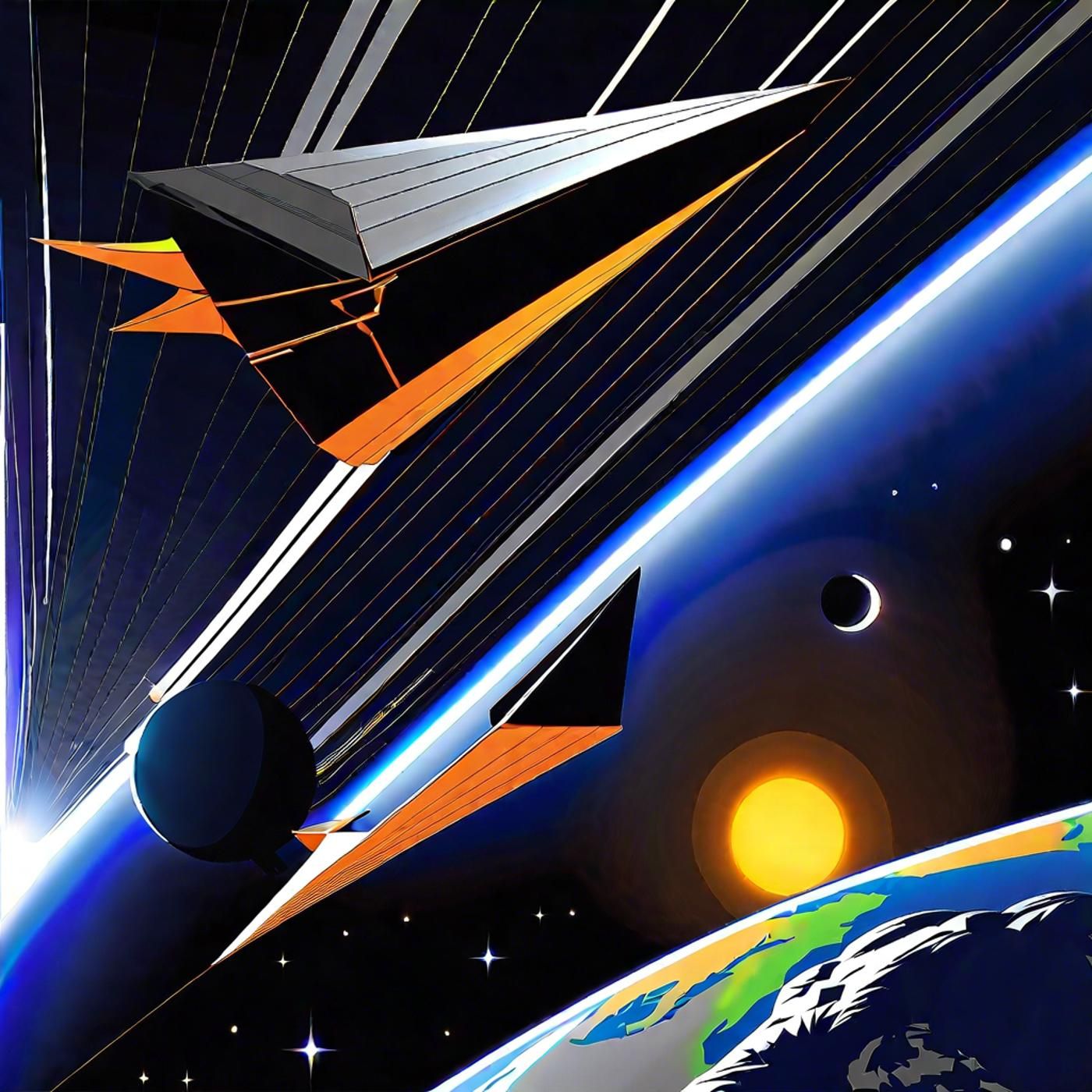
S03E29: Sailing on Sunlight & Russia's Rocket Renaissance: The Angara A5M's Ascent
In this episode
On today's stellar episode of Astronomy Daily - The Podcast, we cast our gaze skyward to marvel at the latest breakthroughs in space exploration and technology. We kick off with NASA's revolutionary solar sail system, set to glide on sunlight from New Zealand's shores, heralding a new age of propellant-free space travel. We'll then rocket to Russia's ambitious Angara A-5M project, a powerhouse launcher designed to thrust the nation's space dreams into orbit. The episode then orbits back to the ISS, where NASA's NICER Telescope awaits a critical spacewalk repair to continue its quest in unraveling the mysteries of neutron stars and black holes. As China's Shenzhou 18 mission readies for liftoff, we discuss its significance in humanity's orbital aspirations. Finally, we'll peer through the perfectly tuned optics of the Nancy Grace Roman Space Telescope, inching closer to capturing the cosmos's grand spectacles, and wrap up with Boom Supersonic's XB-1, as it prepares to redefine the skies with FAA-approved test flights. Prepare for a journey that transcends the bounds of Earth and reaches into the very fabric of the universe.---
**Featured Topics:**
1. **NASA's Solar Sail System:** The Advanced Composite Solar Sail System set to demonstrate the practicality of solar propulsion beyond the ISS.
2. **Russia's Angara A-5M Rocket:** A deep dive into Roscosmos' plans for this advanced rocket, set to redefine Russian space travel.
3. **NICER Telescope Repair Mission:** A look at the upcoming spacewalk that aims to fix a light leak affecting X-ray observations on the ISS.
4. **China's Shenzhou 18 Mission:** Anticipating the next crewed adventure to the Tiangong space station and its implications for long-term space habitation.
5. **Nancy Grace Roman Space Telescope:** Celebrating the successful optics alignment, bringing us closer to exploring dark energy and distant galaxies.
6. **Boom Supersonic's XB-1:** The FAA's green light for supersonic test flights that could cut travel times in half and revolutionize air travel.
---
**Additional Information:**
Continue your celestial journey with us at astronomydaily.io, where you can dive into a universe of content, from our space news feed to fascinating blog articles. Don't miss out on the latest episodes and cosmic wonders—subscribe to our free daily newsletter. For thoughts, questions, or a shared passion for the stars, leave us a message, and follow us on X (@AstroDailypod) for real-time updates. Navigate the constellations of online security with our sponsor Nordpass; find all the details on our website. Your support propels us through the cosmos—until next time, this is Charlie, reminding you to keep looking up.
---
**Host Sign-off:** Charlie: As we conclude today's cosmic voyage, I'm Charlie, thanking you for joining us on Astronomy Daily - The Podcast. Remember, the universe is brimming with wonders just waiting to be discovered. So keep your eyes on the skies and join us again as we decode the marvels of the night. Visit astronomydaily.io for more, and until our next stellar encounter, goodbye and may your curiosity be as boundless as the universe!
Become a supporter of this podcast: https://www.spreaker.com/podcast/astronomy-daily-latest-space-news--5648921/support.
Sponsor Details:
Ensure your online privacy by using NordVPN. To get our special listener deal and save a lot of money, visit www.astronomydaily.io/nordvpn. You'll be glad you...
Welcome to Astronomy Daily, the podcast the beacon for all space enthusiasts and the curious minds who look towards the heavens for answers. In every episode, we delve into the vast ocean of stars and planets, unraveling the tapestry of the universe with each headline and discovery. So whether you're an armchair astronaut or a seasoned stargazer, join us as we dissect the latest advancements and ponder the intriguing theories that are propelling us to new frontiers. Keep your eyes on the skies and your ears with us as we embark on today's cosmic journey the Astronomy Podcast.
As NASA stands on the cusp of a new adventure, an innovation has reached the launch pad, ready to cut through the barriers of traditional space travel. Next week, the Advanced Deposit Solar Sale System Station will cast off its earthly bounds aboard a rocket Lab Electron rocket. This visionary craft, developed by NASA's Aims Research Center, will rise from the picturesque Launch Complex one on New Zealand's Mahia Peninsula, bound for the space over six hundred miles above US, surpassing even the domain of the International Space Station.
The prime mission the deployment of a reflective cube SAT equipped with a solar Sale into Earth's orbit. Now imagine the pressure of a paper clip resting on your palm. This minuscule force is akin to the sunlight pressure that the Sale will harness to maneuver in the Great Cosmic Sea without conventional rocket fuel. After a meticulous two month review of its subsystems, the cube sat aims to showcase its sunlit ballet, a testament to the potential and practicality of solar sale propulsion. Let's unfold the fabric of this technology a bit further composed at Langley Research Center.
The deployable composite booms and the solar Sale itself are but parts of a whole that could see future voyages reaching toward the Moon or Mars more cost effectively. A NASA crafted camera system adds eyes to this endeavor, capturing diagnostic images that will help the team learn and adapt as the mission progresses. The involvement of Rocket Lab USA incuinpendulates this journey further toward reality. Their long Beach Origin service, the very bridge between conception and the Cosmos much awaits this daring mission.
Keep in mind the impact of this undertaking could genially ripple through our understanding of space travel. Painting a picture where vessels ride on beams of light, an echo from science fiction transformed into the hum of scientific progress in the ever evolving arena of space exploration. Russia is not one to be left behind. As we speak, the country's space agency, ros Cosmos, is gearing up to launch a bold new chap to in its space program with the modernized Angara A five M rocket. Touted as a more powerful successor to its predecessors, This rocket is not just a mere update, but a significant leap forward in capability.
Yuri Borisov, the head of ros Cosmos, recently lit up the news with his announcement that the Angara A five M with its enhanced propulsion engine, is currently under creation by none other than the agency's own stellar team of engineers and scientists. Their meticulous efforts are not only aiming for the stars, but are aligned with the strategic objective to make the Angara afive M a pivotal asset in launching next generation manned spacecraft and modules into the Cosmos. The narrative around the angera A five m is one of anticipation and strategic importance, as it's set to become central to Russia's venture into space in the coming decade.
The plan to launch this advanced rocket in twenty twenty seven is a clear testament to the nation's ongoing care comitment and investment in space technology. What this means is that Russian cosmonauts may soon find themselves embarking on missions propelled not just by a rocket, but by the aspirations of a nation looking to assert itself as a leader in exploring the great beyond. This advancement solidifies Russia's placement in the international space race and adds a new dimension to the dynamic of interstellar exploration.
As developments continue with the Angara A five m roscosmos is setting the pace for a future where space is not only a frontier to be challenged, but also a domain where Russian engineering might soar to new heights. Quite literally, with the world as their witness, Russia's Angerer A five m rocket is bound to etch its name among the stars as the backbone of the country's space endeavors. In a thrilling development in space exploration, NASA has orchestrated a meticulous repair mission for the NISA Neutron Star in Tier Composition Explorer telescope perched on the International Space Station.
This spacewalk later this year isn't just routine maintenance. It's a pivotal move to keep one of astronomy's sharpest eyes clear and focused on the enigmatic universe around US. Nics's mission has encountered a snag, a so called light leak with unwonted sunlight seeping in, which has begun to hamper its ability to glean X ray measurements during the station's daylight hours. The stature of this concern can't be understated. Armed with the capability to observe cosmic phenomena like the rhythmic pulses of neutron stars or the light echoes of distant flaring black holes, nissa's scientific contributions are invaluable, Imaginably safeguarding the integrity of these observations, NASA's team has rallied to design an intricately engineered patch up fix, putting the telescopes uninterrupted around the clock operation back on the cards.
D Zaevonarzemanian has highlighted that while the nighttime observations retain their precision. Patching up the light breach is vital to return Nicer to its original, full capacity operational glory. What's on the cards isn't merely a cosmetic fix. The proposed solution involves the installation of five custom shaped patches, equipping the sun shades specifically where the damage by its deepest. Ingeniously utilizing existing tools available on the space station, NASA's astronauts will snugly lock these patches into place.
It's a testament to the versatility and resourcefulness harboured within the human spirit, where solutions are fashioned against the vast canvas of space. Picture it a spacewalk unfolding as a delicate dance, where astronauts, equipped with their technical prowess, will meticulously fit each piece to fortify our scientific bastion in the void. Each segment a silent sentry, sinking with the universal rhythm, reinforcing nysa's lens. This operation is not just about maintaining a piece of technology.
It's about ensuring the continuity of human curiosity. It's about preserving the portal to our cosmic backyard through which we seek to unlock the secrets of the universe's most extreme environments. This commitment to keeping Nissa's vision clear resonates with our intrinsic need to explore, to understand, and moreover, to ensure that the legacy of knowledge is unimpeded by the smallest of obstacles, even a sliver of light. China's space program is taking another bold leap forward with the Sheenzo eighteen mission, showcasing the nation's growing prowess in human spaceflight.
The mission will be sending a team of tykonots to the Tiangong Space Station, continuing a series of expeditions that are not only enhancing China's capabilities in space, but also contributing to the international scientific community. In what promises to be a suite of complex operations, the Sheenzo eighteen cru spacecraft is poised on the verge of breaking Earth' sponds as final preparations are underway at the Juquan Satellite Launch Center. This remote site in the vastness of the Gobi Desert has been a hive of activity, with engineers and technicians meticulously carrying out the final inspections on both spacecraft and its carrier rocket.
The long March two f With this impending launch, China will execute its thirteenth manned mission, signifying the first crude deployment to Tiangong for the year. The identities of these space bound pioneers have yet to be announced, but the anticipation is palpable as they gear up to take the baton from their predecessors, who have been residing in the orbital outpost since the previous October. The transfer of cruise is a delicate dance of orbital mechanics and human endeavor. With the outgoing astronauts set to complete a half year in orbit, their experiences and the data gathered during this period will be invaluable, contributing to our deeper understanding of not only the technical aspects of prolonging human presence in space, but also the physiological ones as they live and work in the weightless environment of space.
China's assertive steps in its manned space mission agenda are a testament to the nation's dedication to establishing a continued human presence in orbit. As the Shenzho eighteen mission enters its final countdown, the world watches with keen interest. This mission is more than just a journey to an orbital station. It's a symbol of mankind's enduring aspiration to reach beyond our earthly confines and secure a place among the stars. Astronomy five cats turning skyward, we witness a leap towards greater cosmic clarity, as the Nancy Grace Roman Space Telescope, a forthcoming observatory that promises to broaden our astronomical horizon, triumphs in its recent array of tests.
With its optics assembly the very heart of the telescope's vision now carefully aligned. Engineers at El three Harris Technologies have confirmed that the graceful dance of light through Roman's sophisticated mirror system decidedly meets the exacting precision that is crucial for harvesting crisp images from the depths of space. Of course, crafting such an intricate instrument was no small feat. Each of the ten mirrors involved underwent individual and rigorous scrutiny before they could be assessed collectively, a process akin to tuning a grand orchestra of reflecting surfaces.
The alignment task was as meticulous as it was essential. The mirrors had to channel light with unmatched control. Any deviation could blur the universe's distant vistas that Roman seeks to render in stunning detail. Imagine the finesse required. Every mirror had to be aligned to a hair's breadth. This precise configuration allows Roman to peer into phenomena like distant galaxies and enigmatic dark energy, filling its bold scientific mission. Even post launch, the tale of adjustments continues.
Actuators an engineer's nod to precision, will stand by to usher a touch of fine tuning as the Roman Space Telescope sets its gaze upon the celestial canvas. What's next for Roman? It faces the rigors of vibration and harsh acoustic trials to simulate the tumultuous journey to space should it emerge unscathed. A final eye exam awaits the optics assembly tested in a frigid vacuum, mirroring the space environment. Engineers with bated breath will monitor the assembly's transition to these cold, almost unearthly conditions.
This intricate series of steps brings to light the diligence and ingenuity of those behind the Nancy Grace Roman Space Telescope. Each successful trial, each confirmation of function, draws us closer to that celestial reveal with Roman, We're ready to confront the grand spectacles of the cosmosding over secrets shrouded by the vast darkness of space, one photon at a time. In an exhilarating leap for aviation technology, Boom SuperSonics XB one has recently received the green light from the US Federal Aviation Administration to soar beyond the speed of sound.
This pioneering approval marks a new error for supersonic test flights as Boom's XB one prepares to stretch its wings inside the Black Mountain Supersonic Corridor in Mojave, California. Boom Supersonic is not just about breaking sound barriers. It signifies an ambitious reimagining of how we might travel in the not too distant future. The XB one's sleek, delta shaped design and cutting edge engineering have captured imaginations worldwide. As the test flights aim to validate the safety and efficacy of supersonic travel.
It promises a paradigm shift where journeys could be harved in duration, propelling us into a faster paced global lifestyle. The excitement began to build on March twenty second, twenty twenty four, when the XB one jet first took off from Mojave Air and Spaceport, test pilots guided this technological marvel through the skies with safety under diligent observation by Chase Aircraft. Now the teams at Boom Supersonic are buzzing with anticipation for this aircraft to push the very limits of velocity, culminating in historic flights that will see the XB one push through mac On and onwards, achieving speeds previously reserved for the likes of fighter jets.
These upcoming flights are meticulously planned to examine the XB ones hardware, including its landing gear and handling qualities, through a range of supersonic conditions. With the FAA's approval, Boom Supersonic is laying down the runway for future commercial supersonic jets that could revolutionize travel for generations to come. Let's not shy away from such ambitious ventures that stretch the bounds of human ingenuity and technological advance. As we keep an eye on the horizon for Boom's landmark supersonic flight, we can't help but feel that we're on the cusp of a new chapter in aerospace, a chapter filled with the roar of engines and the allure of the skies, traveled quicker than ever before.
That's all for today's episode. Thank you for joining us here at Astronomy Daily, the podcast. We hope to have satiated your galactic curiosity for now, but the stars never cease their dance, and neither do we. For a deeper dive into the universe's mysteries, visit our website at Astronomy Daily dot io. There you'll find more engaging content. Can access our constantly updating space news feed and read fascinating articles on our blog. Stay informed on our latest episodes and the wonders of the cosmos by subscribing to our free daily newsletter.
And if you have thoughts, questions, or just want to share your love for the stars, don't hesitate to leave us a message. Don't forget to follow us on x What you knew is Twitter For real time updates and insights, you can find us by the handle at astro Daily Pod. Navigate the constellations of online security with ease and check out our special deal with our sponsor, nord Pass. All the links and details are readily available on our website. Your support means the world to us as we journey through the cosmos together until we traverse the stars again.
This is Charlie's signing off, and remember keep looking up the Astronomy Daily podcast


 Apple Podcasts
 Spotify
 Pocket Casts
 Castbox
 Overcast
 Podbean
 iHeartRadio
 Castro
 Goodpods
 Moon FM
 Podcast Addict
 Podcast Republic
 YouTube