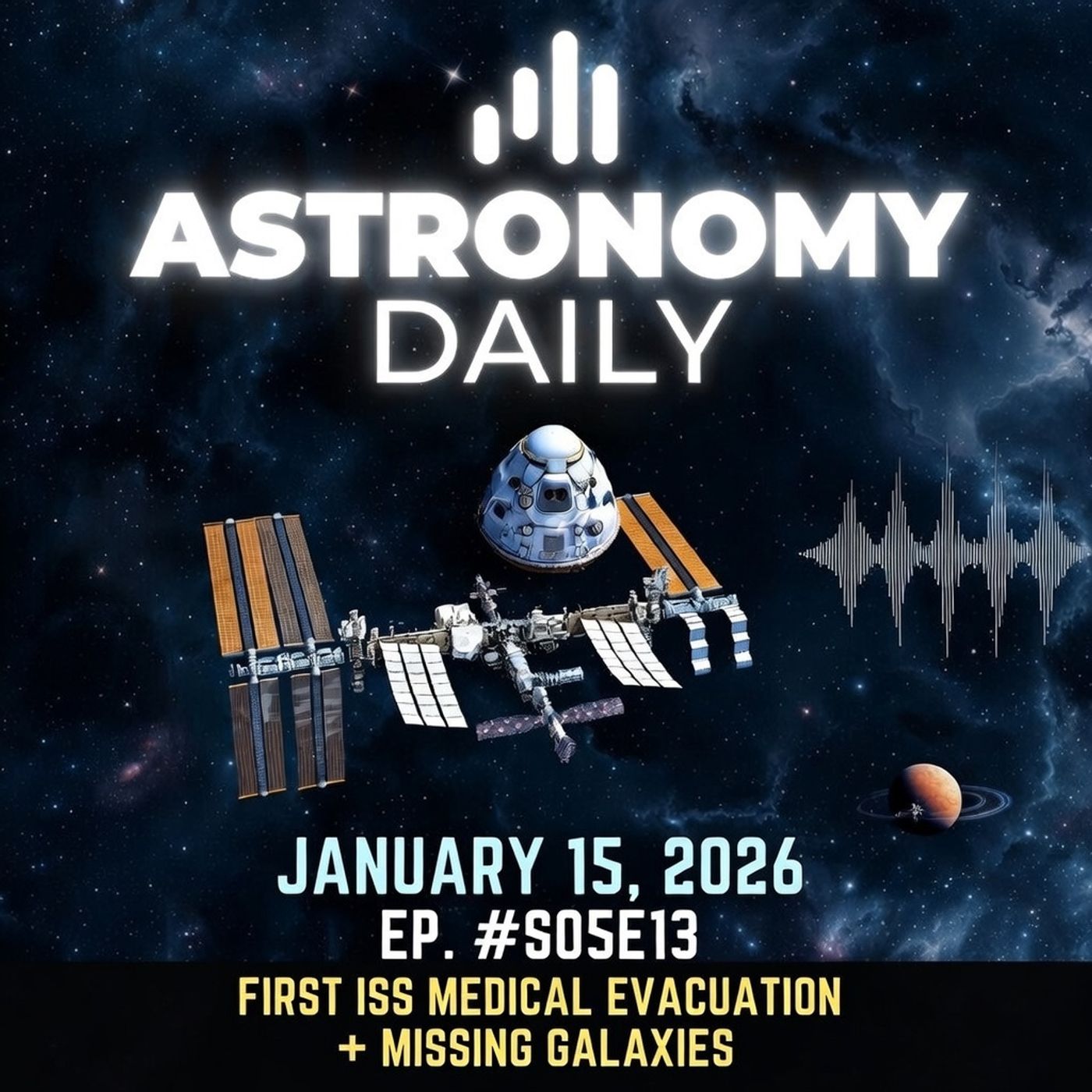
In this episode
From historic medical evacuations to missing galaxies and stunning new images of the Milky Way, today's episode covers the latest breaking news from space exploration and astronomy. Join Anna and Avery as they discuss six fascinating stories from across the cosmos.---
## Episode Timestamps
**[00:00]** Intro
**[01:15]** Story 1: ISS Medical Evacuation
**[04:45]** Story 2: The Mystery of Missing Tiny Galaxies
**[08:30]** Story 3: NASA's MAVEN Spacecraft in Trouble
**[11:45]** Story 4: Viruses Behave Differently in Microgravity
**[14:30]** Story 5: Two New Exoplanets and Redefining Habitable Zones
**[17:00]** Story 6: Stunning New Radio Image of the Milky Way
**[19:30]** Outro
---
## Stories Covered
### 1. Historic First Medical Evacuation from ISS
Four International Space Station crew members successfully completed the first-ever medical evacuation in the ISS's 26-year history, splashing down safely in the Pacific Ocean off San Diego.
**Key Points:**
- SpaceX Crew-11 returned early after 5 months in space
- Crew included US astronauts Mike Fincke and Zena Cardman, Russian cosmonaut Oleg Platonov, and Japanese astronaut Kimiya Yui
- Splashdown occurred at 12:41 AM ET on January 15, 2026
- Affected crew member remains in stable condition
- Three crew members remain aboard ISS to continue operations
- Demonstrates importance of medical protocols in long-duration spaceflight
**Read More:**
- [Phys.org: ISS astronauts splash down on Earth after first-ever medical evacuation](https://phys.org/news/2026-01-iss-astronauts-splash-earth-medical.html)
---
### 2. The Universe's Missing Tiny Galaxies
New research using the James Webb Space Telescope suggests there may be far fewer small galaxies in the early universe than predicted by current models, challenging our understanding of cosmic evolution.
**Key Points:**
- Study led by Xuheng Ma from University of Wisconsin-Madison
- Used JWST's UNCOVER program to study galaxies through gravitational lensing
- Observed the Epoch of Reionization (12-13 billion years ago)
- Discovery of "faint-end suppression" - galaxy numbers drop off at smaller sizes
- Suggests intense radiation from early massive stars prevented small galaxies from forming
- May require rethinking models of cosmic reionization
- Used Abell 2744 galaxy cluster as a natural gravitational lens
**Why It Matters:**
This finding has major implications for our understanding of how the universe evolved from the "cosmic dark ages" to its current transparent state.
**Read More:**
- [Space.com: The universe should be packed with tiny galaxies — so where are they?](https://www.space.com/astronomy/galaxies/the-universe-should-be-packed-with-tiny-galaxies-so-where-are-they)
- Research paper on arXiv (preprint database)
---
### 3. NASA Pessimistic About Recovering MAVEN Mars Orbiter
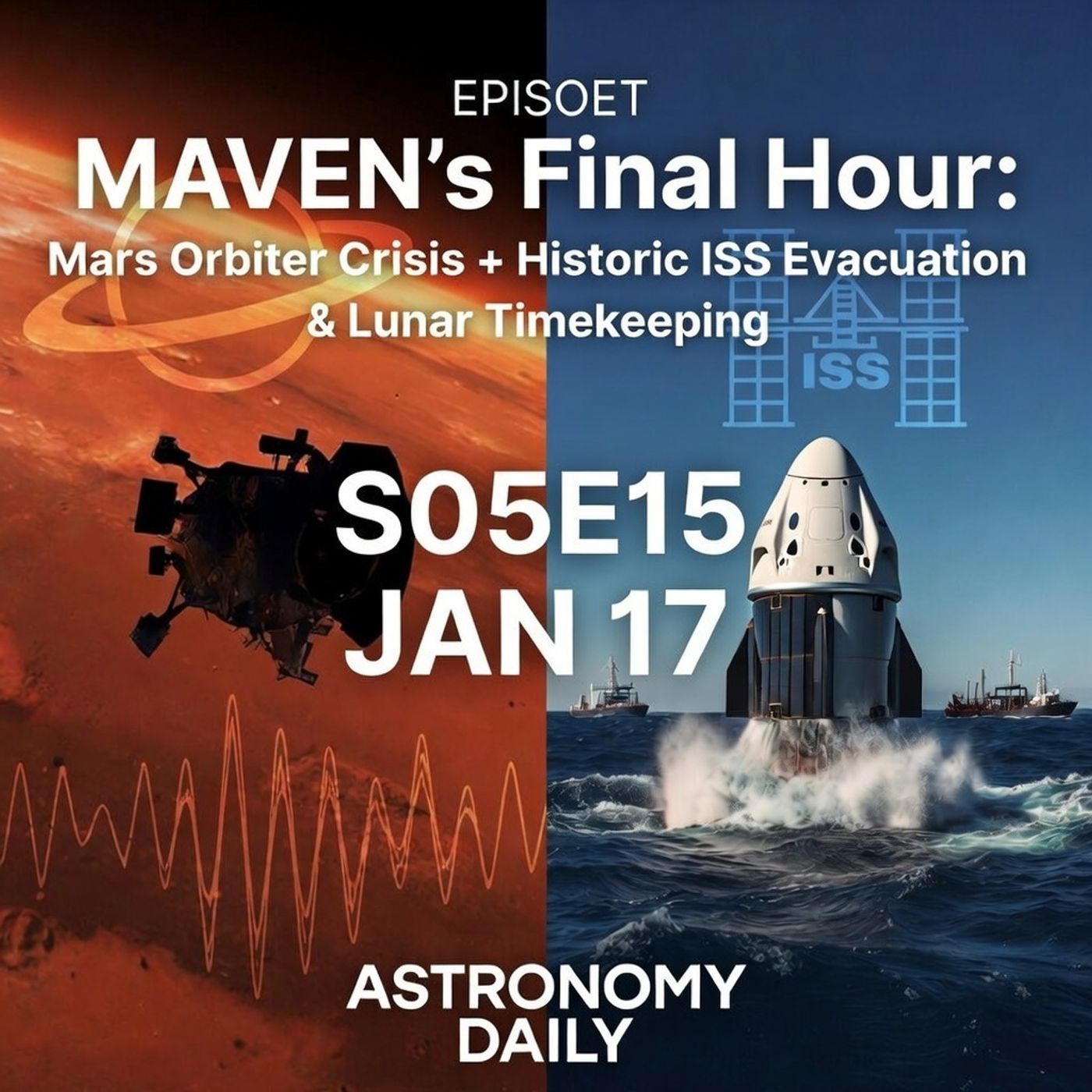
NASA officials acknowledge it's "very unlikely" they'll recover the MAVEN spacecraft, which has been silent since December 6, 2025, marking a potential end to a highly productive Mars mission.
**Key Points:**
- MAVEN (Mars Atmosphere and Volatile Evolution) launched November 2013, entered Mars orbit September 2014
- Last communication: December 6, 2025
- Telemetry indicates spacecraft is tumbling and orbit may have changed
- Solar conjunction (Mars and Earth on opposite sides of Sun) complicated recovery efforts
- Attempts to photograph spacecraft with Curiosity rover were unsuccessful
- Other orbiters (Mars Reconnaissance Orbiter, Mars Odyssey, ExoMars Trace Gas Orbiter) can maintain communications relay
- Spacecraft studied Mars atmospheric loss and recently observed interstellar object 3I/ATLAS
**Mission Legacy:**
Despite the likely loss, MAVEN has provided over a decade of groundbreaking...
Anna: Hey there, space enthusiasts. Welcome to Astronomy Daily, your source for the latest news from the cosmos. I'm Anna. Avery: And I'm, um, Avery. We've got another packed show today with some fascinating storeys from both near and far. Anna, uh, what are we covering? Anna: Well, Avery, we're starting close to home with some breaking news from the International Space Station. Four astronauts just completed the first ever medical evacuation from the ISS and splashed down safely back on Earth. Avery: That's quite significant.
We'll also be diving, diving into a cosmic mystery about missing galaxies. Getting an update on NASA's troubled MAVEN spacecraft orbiting Mars, and exploring some surprising findings about how viruses behave in microgravity. Anna: Plus, we'll discuss two newly discovered exoplanets that are challenging how we think about habitable zones. And we'll wrap up with an absolutely stunning new radio image of the Milky Way that's revealing hidden structures we've never seen before. Avery: Lots to get through, so let's jump right in.
Anna: Alright, Avery, start with Our top storey. 4 International Space Station crew members successfully splashed down in the Pacific Ocean off the coast of San Diego early this morning, marking a historic first for the orbital laboratory. Avery: Yeah. This was the ISS's first ever medical evacuation in its 26 years of continuous operation. The crew members included American astronauts Mike Fink and Zina Cardman, Russian cosmonaut Oleg Plutonov and Japanese astronaut Kimiya Yui. Anna: The capsule touched down at 12:41 Eastern Time after spending five months in space.
Now, NASA has been pretty tight lipped about the specific medical issue that prompted this early return, which is understandable given privacy concerns. Avery: Right. What they have said is that the affected crew member was and continues to be in stable condition. Mike Fink, who was the pilot for SpaceX Crew 11, posted on social media earlier this week, reassuring everyone that the crew is okay and that this was a deliberate decision to allow proper medical evaluations on the ground. Where full diagnostic capabilities exist, that makes sense.
Anna: James Polk, NASA's chief health and Medical Officer, mentioned there was a lingering risk and uncertainty about the diagnosis that led to the decision to bring the crew back earlier than originally scheduled. They were supposed to stay until mid February. Avery: It's worth noting that three other crew members remained on the iss. American astronaut Chris Williams and Russian cosmonauts Sergey Kud Sverchkov and Sergey Mikhashev arrived, uh, at the State Station in November aboard a Russian Soyuz spacecraft.
So station operations continue normally. Anna: This really highlights the importance of having trained medical protocols in place. The evacuated crew members had been trained to handle unexpected medical situations. And according to senior NASA official Amit Kshatriya, they handled everything extremely well. Avery: Absolutely. And this serves as a good reminder that despite all the incredible engineering and planning that goes into spaceflight, we're still dealing with human bodies. In an extreme environment, things can and do happen.
Anna: Well, we're glad everyone is safe and receiving the care they need back on Earth. Avery: Alright, Anna. Our next storey takes us much further out into space and much further back in time. For years, astronomers have assumed that if they looked hard enough into the deep cosmos, they'd find an almost infinite supply of tiny, dim galaxies hiding in the darkness. Anna: Right. The prevailing theory has been that the smaller the galaxy, the more of them there should be. It's kind of like a pyramid where you have a few massive galaxies at the top and exponentially more small ones as you go down.
Avery: Exactly. But a new study led by Xu Heng Ma from the University of Wisconsin is challenging that assumption. Using data from the James Webb Space Telescope's Uncover programme, the team looked through a massive galaxy cluster called Abel 2744, which acts as a natural gravitational lens. Anna: Oh, that's clever. The gravity from this cluster literally warps space time and acts like a cosmic magnifying glass, right? Avery: Precisely. It bends and brightens light from more distant objects, allowing us to see galaxies from the epoch of reionization, roughly 12 to 13 billion years ago.
This was a transformative era, when the first stars and galaxies were flooding the universe with ultraviolet light. Anna: So what did they find that was so surprising? Avery: Well, when researchers count galaxies of different brightnesses, they normally use what's called a luminosity function. It's basically a cosmic bar chart showing how many bright versus dim galaxies exist. And for study after study, the chart kept going in one direction. More small think galaxies than bigger, brighter ones. Anna: But that's not what they found this time.
Avery: Nope. Instead of continuing to climb, the numbers peaked and then started to drop off. They're calling this faint end suppression, which means that below a certain brightness, the population of galaxies actually starts to thin out. Anna: So where did all these tiny galaxies go? Did they just disappear? Avery: In a sense, yes. The study suggests it's a case of cosmic bullying. In the early universe, the intense radiation from the first big stars could have heated up the surrounding gas so much that small, low mass galaxies couldn't hold onto it.
Without gas, they couldn't form new stars. And without stars, they stayed dark, essentially becoming cosmic ghosts. Anna: That's fascinating, but it also creates a problem, doesn't it? I thought these tiny galaxies were supposed to be the main drivers of reionization. Avery: You're absolutely right. This finding suggests we might need to rethink our models. If these ultra faint galaxies are missing, they can't be the ones doing all the heavy lifting during reionization. We might need to look at slightly bigger, more established galaxies to explain how the universe became transparent.
Anna: This is why I love space science. Every answer creates 10 new questions. Avery: Couldn't agree more. And they'll need more data from JWST in upcoming surveys to see if this is a universal pattern or just a quirk of this particular region of space. Anna: Okay, Avery, let's head to Mars now for an update on NASA's MAVN spacecraft. And unfortunately, it's not good news. Avery: No, it's not. NASA officials are now saying it's very unlikely they'll be able to recover the Mars Atmosphere and Volatile Evolution orbiter, which has been silenced since December 6th.
Anna: Maven has been orbiting Mars since September 2014, studying the planet's upper atmosphere and how solar wind strips it away. It's also served as a crucial communications relay between Mars rovers and Earth. Avery: Right. The spacecraft was supposed to pass behind Mars as seen from Earth, A routine occurrence. But when it emerged, NASA's Deep Space Network didn't observe any signal. That was over a month ago now. Anna: And the telemetry they did manage to recover from December 6th wasn't encouraging, was it?
Avery: Not at all. Analysis of a brief fragment of tracking data From a radio science experiment indicated the spacecraft was tumbling and no longer in its planned orbit. That's a really bad sign, because if the spacecraft is tumbling, Its antennas aren't pointing toward Earth, which makes communication basically impossible. Anna: They even tried using the Curiosity rover's camera to take pictures of MAVEN as it passed overhead, assuming it was still in its expected orbit. But they didn't detect it.
Avery: Yeah, on December 16th and 20th. The fact that they couldn't spot it suggests its orbit has indeed changed significantly. Louise Proctor, director of NASA's Planetary Science Division, Said it plainly during a meeting earlier this week. We will start looking again, but at this point, it's looking very unlikely that we are going to be able to recover the spacecraft. Anna: The timing has been particularly challenging, too, hasn't it? Avery: Absolutely. Mars went into solar conjunction on December 29, which is when Mars and Earth are on opposite sides of the sun.
During this period, the sun interferes with radio communications, so NASA paused all communications with Mars missions. That blackout period just ended on January 16th. So they can resume attempts, but the outlook is grim. Anna: Um, the good news is that Maven isn't the only communications relay at Mars, right? Avery: That's correct. Proctor mentioned that other orbiters like Mars Reconnaissance Orbiter and Mars Odyssey can pick up the slack. She said Maven was not a major part of the Mars relay network and they're taking steps to ensure they can still retrieve data from rovers on the surface.
Anna: Dill, it's sad to potentially lose a spacecraft that's been so productive for over a decade. Avery: Definitely. Maven has made groundbreaking discoveries about Mars atmospheric loss and even observed an interstellar object called 3i ATLS late last year. Its contributions to planetary science have been immense. Anna: Our next storey is taking us back to the International Space Station, but this time we're looking at some much smaller inhabitants. Bacteria and the viruses that infect them. Avery: Oh, this is fascinating research.
A new study from the University of Wisconsin, Madison used E. Coli bacteria and a virus called bacteriophage T7 to study how microgravity affects the evolutionary relationship between viruses and their hosts. Anna: Though they sent bacteria and viruses to space. Avery: Exactly. They prepared parallel sets of E. Coli cultures infected with T7. One set stayed on Earth as a control and the other went to the ISS to experience microgravity. Then they compared what happened to both. Anna: Groups and I'm, um, guessing things didn't play out the same way in both environments.
Avery: You guessed right. The analysis showed that T7 infection still occurred on the ISS, but it only proceeded after an initial delay. So spaceflight appears to slow down the early stages of virus host encounters without completely blocking infection. Anna: That's interesting on its own, but I imagine they dug deeper. Avery: They did. They performed whole genome sequencing and found that both the viruses and bacteria accumulated distinctive patterns of mutations in space compared to their counterparts on Earth.
The viruses evolved specific changes that appear to improve their ability to bind to and infect bacterial cells. Anna: And what about the bacteria? Were they just sitting drugs? Avery: Not at all. The space flown E. Coli populations acquired mutations that may strengthen their defences against virus attack and enhance their chances of surviving in near weightless conditions. It's like they were engaged in an evolutionary arms race, but the rules of the race were different in space. Anna: So microgravity is actually changing how evolution works?
Avery: In a sense, yes. The study shows that spaceflight not only changes the physiology of microbes, but also the physical environment in which viruses and bacteria encounter each other. This alters the rules of their evolutionary interaction. Anna: Okay, but beyond the pure science fascination, does this have any practical applications? Avery: Absolutely. Here's where it gets really cool. They conducted follow up experiments on Earth and found that the microgravity associated mutations actually increase the virus's activity against disease causing E. Coli strains that normally resist T7 strains that are implicated in urinary tract infections and are often drug resistant.
Anna: So by studying viral evolution in space, we might actually discover new ways to fight antibiotic resistant bacteria here on Earth. Avery: That's exactly what the researchers are suggesting. According to the authors, these space adapted viruses can be harnessed to engineer improved bacteriophages for use in human health applications. Anna: That's incredible. The International Space Station continues to prove its worth as a unique research platform. Avery: Will do for a little while yet. Anna: Alright, Avery, let's travel to some distant star systems.
Now, astronomers have discovered two new exoplanets that are prompting scientists to rethink how we define habitable zones. Avery: Yeah, this is really interesting work. The research introduces the concept of a temperate zone, which is broader than the traditional habitable zone we usually talk about. Anna: Can you explain the difference? I think a lot of people assume habitable zone and temperate, um, mean the same thing. Avery: Good question. The traditional habitable zone is pretty narrowly defined.
It's the distance range from a star where liquid water could exist on a planet's surface. But this new research led by Madison Scott from the University of Birmingham and Georgina Dransfield from the University of Oxford, expands that to include what they call the temperate zone. Anna: And how is that defined? Avery: The temperate zone is defined by something called insolation flux, which describes the amount of solar energy reaching a planet's surface. They're using a range between about 136 watts per square metre and 6805 watts per square metre.
Earth receives about 1,361 watts per square metre. Just for reference. Anna: So it's much broader than the conservative habitable zone. Avery: Exactly. The point is to identify planets that receive moderate levels of stellar radiation. They might not be perfect for life as we know it, but they're worth studying because as our understanding of habitability evolves, some of these planets might turn out to be more interesting than we initially thought. Anna: So, uh, what are these two new planets? Avery: The first is TOI 6716 b, which is roughly Earth, sized between 0.91 and 1.05 Earth radii and most likely rocky.
The second is TOI 7384 b, which is a sub Neptune measuring about 3.37 to 3.77 Earth radi. This one probably has a rocky core with a thick hydrogen and helium envelope. Anna: And they're both orbiting red dwarf stars. Avery: Correct. They're orbiting what are called mid to late type M dwarfs, which are small, dim, cool stars. These types of stars are really important for this kind of research because temperate planets orbiting them are much more likely to transit in front of their stars from our point of view, making them easier to detect and study.
Anna: So the goal is to build up a catalogue of planets that we can actually study in detail. Avery: Exactly. TOI6716B has a predicted transmission spectroscopy metric similar to the famous Trappist 1 planets, which makes it a good candidate for JWST observations if it has retained its atmosphere. The researchers conclude that these discoveries show the power of combining test data with ground based observations to build a catalogue of temperate planets for atmospheric studies in the coming decade.
Anna: It's exciting to think we're moving beyond just counting exoplanets to actually being able to study their atmospheres in detail. Avery: And for our final storey today, we're coming back home to our own galaxy. Astronomers in Australia have just released the most detailed low frequency radio image of the Milky Way ever produced. Anna: This image is absolutely stunning. It was captured by the Murchison Wildfield Telescope in Western Australia and reveals thousands of structures across the galaxy's southern sky that we've never seen in this kind of detail before.
Avery: And the numbers behind this are pretty impressive. It took over 1 million CPU hours to process the data, which was collected across 141 nights between 2013 and 2020. Anna: And this isn't just a prettier version of something we already had. Right. This is genuinely new science. Avery: Absolutely. According to the International Centre for Radio Astronomy Research, this updated release from the GLEAM X survey delivers twice the resolution and ten times the sensitivity of earlier efforts. Plus it covers twice as much of the sky.
Anna: What kinds of things can we see in this image? Avery: Well, Silvia Montovani, a, uh, PhD student at Curtin University who led the project, explains you can clearly identify remnants of exploded stars represented by large red circles in the image. The smaller blue regions indicate stellar nurseries where new stars are actively forming. Anna: So it's showing us both the birth and death of stars. Avery: Exactly. One of the major focuses of this survey is finding supernova remnants, which are notoriously difficult to spot in the cluttered background of the Milky Way.
Hundreds are already catalogued, but astronomers believe thousands more are still hidden. With this new level of resolution, those cosmic scars from ancient stellar explosions are easier to identify. Anna: The image also helps with pulsar studies, doesn't it? Avery: Yes. Measuring pulsar brightness across different radio bands could improve our understanding of how these spinning neutron stars function and where they live in the galaxy. The survey has catalogued over 98,000 radio sources in total.
Anna: That's an incredible number. And I read that this is setting the stage for an even more powerful telescope. Avery: Right. The Murchison Wildfield Array will eventually be surpassed by the SKA Low Array, which is currently under construction in the same region of Western Australia. Once the SKA observatory is operational, it'll deliver even sharper and deeper views of the universe. Anna: But for now, we have this remarkable foundation. Associate Professor Natasha Hurley Walker, who leads the GLEAM X survey, called this an exciting milestone in astronomy, since no low frequency radio image of the entire southern galactic plane has been published before.
Avery: And it's not just about the Milky Way. The catalogue includes distant galaxies as well. So it's a dense, glowing map of our cosmic neighbourhood that future generations of astronomers will use, refine and expand upon. Anna: Well, that wraps up today's episode of Astronomy Daily. We covered quite a bit of ground today, from the first medical evacuation from the ISS to missing dwarf galaxies, a, uh, troubled Mars orbiter, viruses evolving in space, newly discovered exoplanets, and a spectacular new view of our home galaxy.
Avery: It really shows the incredible breadth of space science happening right now. Whether it's 300 miles above our heads on the ISS, millions of miles away at Mars, or billions of light years away in the early universe, there's always something new to discover. Anna: Thanks so much for joining us today. If you enjoyed the show, please subscribe and leave us a review. It really helps other space enthusiasts find us. Avery: And if you have any questions or topics you'd like us to cover, reach out to us on social media.
You'll find us on all the major platforms. Just search for AstroDaily Pod. We love hearing from our listeners. Anna: Until next time, keep looking up Clear skies, Everyone.
Storeys.

 Apple Podcasts
 Spotify
 Pocket Casts
 Castbox
 Overcast
 Podbean
 iHeartRadio
 Castro
 Goodpods
 Moon FM
 Podcast Addict
 Podcast Republic
 YouTube