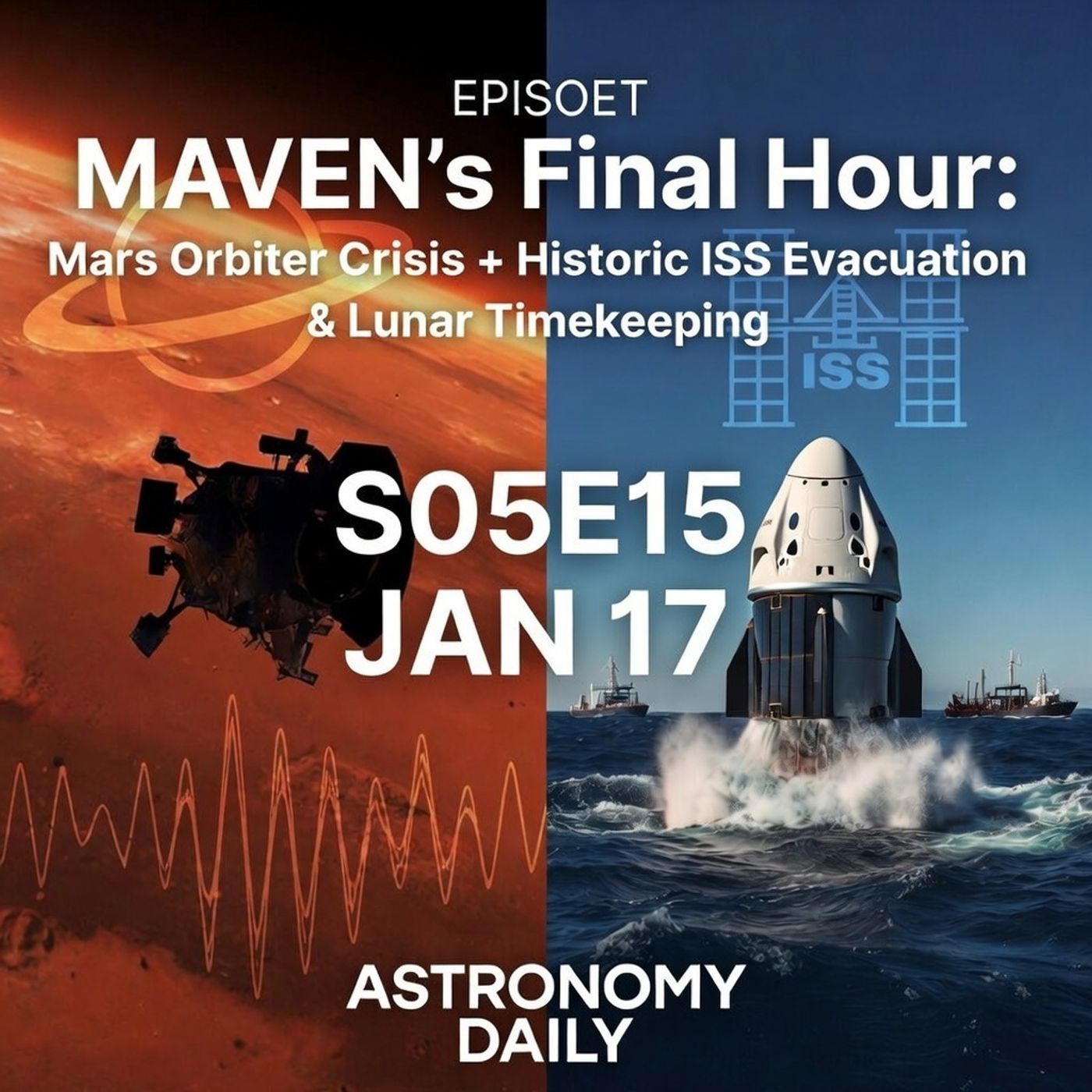
In this episode
NASA attempts to contact the silent MAVEN Mars orbiter after 40 days—but prospects look grim. Plus: the first-ever ISS medical evacuation succeeds, Europe debuts its powerful Ariane 64, scientists crack asteroid defense secrets, China releases lunar timekeeping software, and Hubble reveals where planets are born. Your daily space news for January 15, 2026.### Extended Episode Description (for podcast websites/apps)
After more than a month of silence, NASA is making what may be its final attempt to contact the MAVEN Mars orbiter. Mission leaders are pessimistic, but the veteran spacecraft has surprised them before. We break down what happened, what's at stake, and what MAVEN's potential loss means for Mars exploration.
On a brighter note, the SpaceX Crew-11 astronauts have safely returned to Houston following the first-ever medical evacuation from the International Space Station—a historic operation that went flawlessly. We explore how NASA executed this unprecedented mission.
Europe's taking a major step forward with the announcement that the first Ariane 64 rocket will launch February 12th. This four-booster beast can carry more than double the payload of its predecessor, and its debut mission will deploy 32 satellites for Amazon's Kuiper constellation.
Scientists using CERN's particle accelerators have discovered that iron-rich asteroids are tougher than we thought—and they actually get stronger under stress. This surprising finding could reshape how we approach planetary defense.
China has released the world's first practical software for keeping time on the Moon. It sounds like science fiction, but lunar timekeeping is becoming essential as multiple nations prepare for sustained lunar operations.
And after 35 years in orbit, the Hubble Space Telescope is still delivering stunning science, with a new gallery of images showing protoplanetary disks where planets are being born around young stars.
Become a supporter of this podcast: https://www.spreaker.com/podcast/astronomy-daily-latest-space-news--5648921/support.
Sponsor Details:
Ensure your online privacy by using NordVPN. To get our special listener deal and save a lot of money, visit www.astronomydaily.io/nordvpn. You'll be glad you did!
Get the best secure and private email on the planet. Stop your Government, google and who knows who else spying on every email you write. Do what we did and use ProtonMail. They beleive in privacy and there are no ads in their business model...yet they still provide a free forever service. Check them out and get out special deal at www.astronomydaily.io/protonmail
Become a supporter of Astronomy Daily by joining our Supporters Club. Commercial free episodes daily are only a click way... Click Here
This episode includes AI-generated content.
Anna: Welcome to Astronomy Daily, your source for the latest space and astronomy news. I'm Anna. Avery: And I'm, um, avery. It's Saturday, January 17, 2026, and we've got an absolutely packed episode for you today. Anna: We really do. And we're leading with some bittersweet news from Mars. NASA's making what might be their final attempt to contact the Maven Orbiter, which has been silent for over a month now. It's looking increasingly unlikely that they'll be able to recover the spacecra. Avery: That's tough news, but we've also got some incredible human achievements to celebrate.
The SpaceX crew, 11 astronauts have safely returned to Houston following the first ever medical evacuation from the International Space Station. We'll get into the details of how that historic operation unfolded. Anna: Europe's stepping up its launch game too. Arianespace has announced they'll be launching the first Ariane 6.4 Rocket on February 12th. That's the more powerful 4 booster version. This is a big deal for European space capabilities. Avery: We're also diving into some fascinating research today.
Scientists have been using CERN's particle accelerators to simulate asteroid impacts. And what they discovered about iron rich space rocks could change how we approach planetary defense. Anna: Then we've got something that sounds like science fiction, but is very real. China has released the world's first practical software for keeping time on the Moon. Yes, lunar timekeeping is now a thing and it's more important than you might think. Avery: And we'll wrap up with some stunning new images from from Hubble.
Even after 35 years in orbit, it's still showing us where planets are born in protoplanetary disks around young stars. Anna: Lots to cover. So let's get started. Avery: Let's start with that Mars story. Anna. NASA's Maven orbiter has been one of our most valuable assets at Mars for over a decade. What's the latest on the recovery efforts? Anna: Well, it's not looking good, I'm afraid. Maven, that's the Mars Atmosphere and Volatile Evolution Orbiter went silent on December 6, 2025, and NASA has unable to re establish contact ever since.
The spacecraft has been orbiting Mars since 2014, providing invaluable data about the Martian atmosphere and serving as a critical communications relay for the Curiosity and Perseverance rovers. Avery: So what exactly happened? I mean, communications blackouts aren't completely unusual for Mars missions, right? Anna: You're right, they're not. In this case, Maven passed behind Mars, which temporarily blocks communication. That's a routine occurrence. But when it should have emerged on the other side, NASA's Deep Space Network couldn't regain contact.
What makes it worse is that this happened right before a solar conjunction. Avery: That's when the sun sits directly between Earth and Mars, correct? Anna: Exactly. During solar conjunction, which occurs roughly every two years, solar particles interfere with radio signals. NASA, uh, temporarily halts all communications with Mars missions during this period to avoid sending corrupted commands or receiving incomplete data that could damage spacecraft. Though the conjunction basically meant NASA had to wait before they could even try to recover Maven.
Avery: And, um, that conjunction period just ended. Anna: Right? NASA said they wouldn't have contact with any Mars missions until Friday, January 16th. So as of today, they're making renewed attempts to contact Maven. But here's the concerning part. Louise Proctor, the director of NASA's Planetary Science Division, said on January 13, and I quote, we'll start looking again, but at this point, it's looking very unlikely that we are going to be able to recover the spacecraft. Avery: That's pretty pessimistic language from NASA.
Do we know what might have caused the initial failure? Anna: The leading theory is that Maven started rotating unexpectedly after passing behind Mars. This would have shifted the spacecraft out of its planned orbit and potentially moved its antenna away from Earth. But here's where it gets more complicated. Maven has had aging hardware issues for years now. Avery: What kind of issues are we talking about? Anna: The spacecraft has had problems with its onboard inertial measurement units, or IMUs, which are essential for orientation in space.
Back in 2022, Maven spent about three months in safe mode. Because of IMU problems, the mission team had to rely on backup systems that have experienced accelerated wear and tear. They even developed an alternative all stellar navigation mode that uses stars for orientation instead of relying on the imus. Avery: So it sounds like Maven has been living on borrowed time for a while now. Anna: In some ways, yes. The spacecraft's inability to fully recover from those 2022 outages led to missed observations of significant solar flares and disrupted its communications relay role.
That said, Maven still has enough fuel to remain in orbit until at least 2030. So the hardware could theoretically keep working if they can just re establish contact. Avery: What's the impact going to be if they can't recover it? I imagine the rovers depend on these orbiters for communications. Anna: That's a great point. Maven has been, uh, a key communications relay for the Curiosity and Perseverance rovers. With Maven offline, NASA has had to shift more of that burden to other orbiters, specifically Mars Reconnaissance Orbiter and Mars Odyssey.
This puts increased pressure on those Spacecraft to maintain communications and support surface science. Avery: Activities and scientifically, what are we losing? Anna: Maven's scientific contributions have been enormous. It's helped us understand how Mars lost its once thick atmosphere and became the cold dry world it is today. The data it collected on Martian weather patterns, dust storms and auroras provided insights into the planet's climate system and potential habitability. Without Maven, we'd have critical gaps in our ongoing atmospheric studies of Mars.
Avery: So fingers crossed that these new contact attempts work out. When um, will we know more? Anna: NASA should have results from their latest attempts very soon, but given the pessimistic tone from their leadership, I think we need to prepare for the possibility that Maven's remarkable decade long mission may have come to an end. It would be a sad conclusion to such a successful spacecraft, but it's given us more than 10 years of groundbreaking science. Avery: Absolutely. And that's well beyond its original design life, right?
Anna: Oh, definitely. Like so many NASA missions, it far exceeded expectations. Let's hope there's one more surprise left in it. Here's hoping. Moving from Mars back to closer to home. Let's talk about that historic ISS medical evacuation. Avery, this was really unprecedented. Avery: It absolutely was. The four astronauts of SpaceX's Crew 11 mission are now safely back in Houston after splashing down off the coast of Long Beach, California early Thursday morning. This marked the very first medical evacuation from the International Space Station in its more than 25 year history.
Anna: Who were the crew members involved? Avery: The crew consisted of NASA astronauts Zena Cardman and Mike Finke, Kimiya Yui from Japan's Aerospace Agency, and cosmonaut Oleg Platanov from Roscosmos. They launched back in early August for what was supposed to be a standard six month stay aboard the station. Anna: So they came home about five weeks early, correct? Avery: That's right. One of the four crew members experienced a medical issue in orbit last week and NASA made the decision to bring the entire crew home ahead of schedule.
Now NASA has been very protective of medical privacy, which is absolutely appropriate. So they haven't disclosed which crew member had the issue or what the specific medical problem was. Anna: What do we know about how they're doing now? Avery: According to NASA's latest update from Friday afternoon, all four crew members are stable and undergoing standard post flight reconditioning and evaluations at uh, Johnson Space Center. After splashing down, they spent about a day and night at a local medical facility in California before flying to Houston.
Anna: I have to say the fact that they described them as stable and that they're doing Standard post flight evaluations suggests this wasn't a dire emergency situation. Avery: That's my read on it too. And NASA officials have been pretty clear about describing this as a deliberate, carefully planned operation rather than a panic situation. In fact, one NASA representative said, and um, I'm, um, paraphrasing here. This is NASA at its finest, referring to how smoothly the evacuation and splashdown went.
Anna: Can you walk us through what a medical evacuation from the ISS actually involves? This seems incredibly complex. Avery: It is. First, you have to understand that the ISS has medical capabilities on board. There's medical equipment supplies, and the crew receives training to handle various medical situations. They can consult with flight surgeons on the ground in real time. But sometimes ground based medical care is simply necessary, either for more advanced diagnostic equipment or for treatment options that aren't available in orbit.
Anna: So, uh, the decision to bring someone home is never made lightly. Avery: Exactly. In this case, the medical issue required evaluation and potential treatment that couldn't be done on the station. Once that call was made, they had to prepare the crew Dragon spacecraft, the same one they arrived in, named Endeavour, for an early departure. This involves checking all systems, planning the undocking and reentry trajectory, coordinating with recovery teams, and making sure weather conditions would be suitable for splashdown.
Anna: And they successfully executed all of that in just a few days. Avery: They did. The crew undocked from the ISS on January 14, completed their deorbit burn and splashed down safely early on January 15th. Recovery teams were standing by and quickly retrieved the capsule and crew. The whole operation went remarkably smoothly. Anna: What about the ISS itself? How is it operating with a reduced crew? Avery: That's a great question. Right now the station is operating with what they're calling a skeleton crew of just three people.
NASA astronaut Chris Williams and two Roscosmos cosmonauts Sergei Kuts Vertskov and Sergei Mikayev. That's less than half the normal complement of seven crew members. Anna: Can three people effectively run the iss? Avery: They can maintain it and keep critical systems running, but it definitely limits what science can be done. The station won't return to its full operational capacity until SpaceX's Crew 12 mission arrives. That's currently scheduled for February 15, though NASA and SpaceX are looking at whether they can move that timeline up a bit.
Anna: I imagine this whole situation must have been quite stressful for everyone involved. Avery: No doubt, but what strikes me is how calmly and professionally it was handled. In one of the final communications before undocking, Crew 11 Commander Mike Finke said it was bittersweet to be leaving early. He handed over command of the ISS to Chris Williams, and you could hear in his voice that he would have preferred to complete the flight full mission, but he also understood the necessity of coming home.
Anna: It really speaks to the incredible planning and preparation that goes into human spaceflight. Even in an off nominal situation like this. The systems and procedures worked exactly as designed. Avery: And I think it's worth noting that this won't affect other upcoming missions. NASA Administrator Jared Isaacman specifically stated that this ISS evacuation shouldn't interfere with the upcoming Artemis 2 moon mission, which is still on track for a possible launch as early as February 6th. Anna: That's good to hear.
Well, here's hoping for a full recovery for whichever crew member needed the medical attention. And kudos to everyone involved in executing such a complex operation so flawlessly. Avery: Agreed. It really was NASA at its finest. Anna: Switching gears now to European spaceflight. Avery. Europe is about to debut a significantly more powerful version of its new rocket, right? Avery: That's right, Anna. Arianespace has announced that the first flight of the Ariane 64 will launch on February 12 from the Guyana Space center in French Guiana.
This is the four booster configuration of the Ariane 6, and it represents a major step up in capability for European launch services. Anna: Let's back up a second for anyone who might not be familiar with the Ariane 6. Can you give us the background? Avery: Sure. Huh? The Ariane 6 is Europe's newest heavy lift rocket, designed to replace the Ariane 5, which served for nearly three decades. The inaugural flight was back in July 2024. And throughout 2025, Arianespace flew four more missions, all carrying payloads for organizations like ESA, Umetsat and Sinas.
The French Space Agency. Anna: And all of those flights used the Ariane 62 configuration? Avery: Exactly. The Ariane 62 uses two P120C solid fuel boosters strapped to the side of the rocket's core stage. Each of those boosters produces roughly 4,500 kilonewtons of thrust. It's been doing great for medium lift missions with a capacity to deliver about 10.3 tons to low Earth orbit. Anna: So the Ariane 64 just adds two more boosters, right? Avery: It uses four of those P120C boosters instead of two.
And that makes a dramatic difference in capability. The Ariane 64 can deliver up to 21.6 tons to low Earth orbit, more than double what the Ariane 62 can handle. That puts it in the heavy lift category, competing with rockets like SpaceX's Falcon Heavy. Anna: That's a significant jump. What's driving the need for this more powerful version. Avery: Well, this first mission actually gives us a perfect example. The Ariane 6 4's first flight will be launching satellites for Amazon's Project Cooper Broadband Internet Constellation.
Arianespace has an 18 flight contract with Amazon, and this first mission, designated LE01, which stands LEO Europe 01, will deploy 32 Cooper satellites. Anna: Amazon's competing with SpaceX's Starlink, right? Avery: That's right. Amazon already has about 180 satellites in orbit, and they're rapidly building out the Constellation. Having access to the more powerful Ariane 64 means they can launch more satellites at once, which speeds up the deployment schedule and reduces the total number of launches needed.
Anna: Is there anything else notable about this particular flight? Avery: Yes, actually. This will be the first Ariane 6 mission to use the rocket's larger 20 meter long fairing. All previous flights used a shorter 14 meter fairing. The longer fairing provides more volume for larger payloads, or in this case, for fitting more satellites into the payload stack. Anna: How long will the mission last? Avery: Ariane Stace hasn't published a complete mission breakdown yet, but they've stated the entire flight will last one hour and 54 minutes.
That presumably includes deploying all 32 satellites and then deorbiting the rocket's upper stage in a controlled manner, which is important for reducing space debris. Anna: What does this mean for Arianespace's launch cadence going forward? Avery: They're being pretty ambitious. Arianespace is aiming to double the number of Ariane 6 launches this year compared to 2025. That would mean as many as eight Ariane 6 flights over the next 12 months. Given that they're still ramping up operations with what is still a fairly new rocket, that's a challenging goal, but it shows their confidence.
Anna: Are there any other upgrades in the works? Avery: Actually, yes. The company is developing an upgraded version of the solid fuel booster called the P160C. It carries an additional 14 tons of solid propellant compared to the current P120C. That upgrade has already been fully qualified for use on Both the Ariane 62 for medium lift missions, the Ariane 644 for heavy lift, the Vega C for smaller payloads and these future upgrades. Europe is positioning itself to be very competitive in the commercial launch market.
And that's crucial, especially as we see increasing competition from SpaceX, China and other emerging launch providers. Anna: Will the, uh, February 12 launch be publicly viewable? Avery: Arianespace typically provides live coverage of their launches, so I'd expect we'll be able to watch this historic first flight of the Ariane 6 4. It should be quite a sight. Those four boosters firing together should make for an impressive liftoff. Anna: I'll definitely be watching. It's great to see Europe maintaining and expanding its independent access to space.
Avery: Anna. Uh, let's talk about planetary defense. Scientists have been conducting some fascinating experiments using particle accelerators to understand how asteroids might respond to deflection attempts. Anna: This is really cool work, Avery. An international research team used CERN's High Radiation to Materials facility, that's HIRADMAT, to simulate what happens when high energy impacts strike iron rich asteroids. And what they found could significantly change our approach to planetary defense.
Avery: Before we get into the results, can you set up the context? Uh, why is this research important? Anna: Sure. We know There are around 37,000 known near Earth asteroids and 120 short period comets whose orbits bring them close to Earth. While scientists are confident that none of the known potentially hazardous objects will strike Earth within the next century, we know that eventually planetary defense measures will be needed. Avery: And NASA's DART mission demonstrated one approach. The kinetic impactor.
Anna: Exactly. In 2022, Dart successfully struck the asteroid Dimorphos and altered its orbit. But to do this reliably and develop effective defense strategies, we need to understand how different types of asteroids respond to impacts. And that's where this new research comes in. Avery: So they focus specifically on iron rich asteroids. Anna: Right? What astronomers call M M type asteroids. These are thought to be exposed metallic cores of ancient protoplanets that were shattered in collisions billions of years ago.
They're made primarily of iron and nickel, unlike the more common rocky asteroids or icy comets. Avery: How did they simulate an asteroid impact? In the lab? Anna: This is where it gets really clever. They used a sample of the Campo del CIO iron meteorite, which is a well studied iron meteorite from Argentina. They subjected it to extremely energetic 440 GeV proton beams at CERN's high RadMat facility. At CERN, that's an incredibly high energy level. Avery: And how did they measure what happened to the sample?
Anna: They used a technique, uh, called Doppler vibrometry, which can detect tiny surface vibrations. This allowed them to capture real time data on how the material responded to rapidly increasing stress, all without destroying the sample. They could see exactly how iron behaved under extreme conditions. Avery: What did they discover? Anna: This is where it gets really interesting. The results showed that M M type asteroids can absorb significantly more energy without fragmenting than conventional models predicted.
But even more surprisingly, the meteorite actually got tougher as it was subjected to increasing stress. Avery: Wait, it got stronger under stress? Anna: Yes. The researchers found that the iron dissipated more energy as stress increased, suggesting that the internal structure of asteroids can redistribute and amplify stress in unexpected ways, Similar to what we see in complex composite materials. Avery: That seems counterintuitive. You'd expect materials to weaken under extreme stress, not strengthen.
Anna: That's exactly why this is such an important finding. It contradicts what conventional models have suggested. One of the study's co authors, Professor Gianluca Grigori from the University of Oxford, said this is the first time they've been able to observe in real time. How an actual meteorite sample deforms, strengthens, and adapts under extreme conditions without destroying it. Avery: So what does this mean for planetary defense strategies? Anna: A couple of things. First, it means that iron rich asteroids might be harder to deflect than we thought.
Because they can absorb more energy without breaking apart. But it also suggests that we could potentially deliver energy deep inside an asteroid without fragmenting it. Avery: That could be useful if you want to push an asteroid rather than shatter it. Anna: Exactly. The research also helps explain a long standing puzzle in planetary defense. Why there's often a discrepancy between what we infer from meteorite breakup in Earth's atmosphere. And actual laboratory measurements of meteorite strength.
This study shows that internal stress redistribution. Within the heterogeneous structure of meteorites can explain that difference. Avery: This sounds like it could inform new deflection methods. Anna: That's the hope. The data could help develop redirection techniques. That push asteroids more effectively while keeping them intact. After all, the last thing you want when deflecting an asteroid. Is to break it into multiple pieces that might still pose a threat. Avery: Have they tested this with other types of asteroid materials?
Anna: This particular study focused on iron meteorites. But the methodology could be applied to other types of asteroids. Rocky asteroids, carbonaceous asteroids, and so on. Each type would likely behave differently under extreme stress. And understanding those differences is crucial for developing a, uh, comprehensive planetary defense toolkit. Avery: I think what's particularly valuable here is that they've developed a technique. That can test actual meteorite samples non destructively. That means we can build up a library of data on how different asteroid materials behave.
Without having to rely solely on computer simulations or destroying precious samples. Anna: And as we continue to study asteroids with missions like Osiris x and Hayabusa2, we'll have more samples to test. Avery: Exactly. The combination of sample return missions, laboratory testing like this, and missions like DART that demonstrate actual deflection techniques. It's all building toward a real capability to protect Earth from asteroid impacts. Anna: It's reassuring to know that even though we don't face an immediate threat, we're doing the groundwork now, so we'll be prepared when we need to be.
Avery: Absolutely. And this research was just published in Nature communications, so it's getting a lot of attention from the planetary defense community. Anna: Avery. Our next story sounds like something out of science fiction, but it's very much real and increasingly necessary. China has released the world's first practical software for keeping time on the moon. Avery: Lunar timekeeping software. When you say it out loud, it really drives home how much space exploration has advanced. Why do we need to keep time differently on the moon?
Anna: It all comes down to Einstein's theory of general relativity. Time doesn't pass at, uh, the same rate everywhere. It's affected by both gravity and velocity. The moon's gravity is weaker than Earth's, which means time actually passes slightly faster on the moon than it does on Earth. Avery: How much faster are we talking about? Anna: About 5, 6 millionths of a second per day. Now, that might not sound like much, but it adds up over time, and it can seriously disrupt navigation systems, Especially when you're trying to do precision work on the lunar surface.
Avery: So this is a precision navigation issue. Anna: Exactly. Think about gps. On Earth, the satellites constantly have to correct for relativistic effects caused by gravity and motion. Those corrections are, uh, what allow your phone to pinpoint your location within just a few meters without accounting for relativity. GPS would be useless within minutes. Avery: And the moon is about to have a similar need for precision navigation. Anna: Right. In the past, this wasn't really a problem because lunar missions were rare, short, and mostly isolated.
Engineers could just use Earth time and apply mission specific fixes when needed. But that's changing rapidly because we're about. Avery: To have multiple spacecraft and eventually humans operating on the moon simultaneously. Anna: Exactly. Under those conditions, relying on custom fixes for each mission becomes risky and inefficient. You need a standardized lunar time reference that everyone can use. Avery: So what exactly did the Chinese team create? Anna: Researchers from the Purple Mountain Observatory in Nanjing developed detailed software called LTE 440.
That stands for lunar time ephemeris. It's based on modern planetary data and tracks how lunar time drifts relative to Earth time. The software automates calculations that once required deep expertise in relativity and celestial mechanics. Avery: How accurate is it? Anna: Remarkably accurate. The researchers found their method stays accurate to within a few tens of nanoseconds, Even when projected over a thousand years. And to keep daily differences within about 10 nanoseconds, the calculations need to be accurate to parts in 10 trillion.
Their tests show LTE 440 meets that standard. Avery: Why such extreme precision? Anna: Well, navigation is one driver, but there's also science. The Moon offers unique conditions for astronomy. No atmosphere, minimal interference. One promising idea is Earth Moon, very long baseline interferometry, where you link radio telescopes on Earth and the Moon to create sharper images of distant objects. Avery: Um, and that requires extremely precise timing. Anna: Right. Signals recorded on both bodies need to be timestamped to better than a microsecond to allow for instrument noise.
The underlying time model needs to be even more accurate. Hence the extreme precision requirements. Avery: How does the software actually work? Anna: Instead of using long equations, they used a numerical approach based on a planetary model called DE440, which tracks the positions and velocities of solar system bodies with high precision. From that data, they computed how time near the Moon differs from a solar system reference time. The software stores these results in compact files that can be quickly interpolated.
Avery: What affects lunar time most? Anna: The Moon's motion and the Sun's gravity dominate the effect. But Earth, Jupiter, and even distant objects in the Kuiper Belt add smaller effects. There are monthly and yearly patterns that range from milliseconds down to microseconds. Avery: I'm curious about the international response to this. Is China the only one working on this? Anna: That's a great question. Jonathan McDowell, an astronomer at Harvard, told reporters that similar efforts are underway in the United States, but he's not aware of another openly available tool like this.
He emphasized that this shows China is serious about lunar exploration and is being quite open about sharing its lunar related research. Avery: That's actually encouraging from an international cooperation standpoint. Anna: I think so, too. And it's worth noting that in 2024, the International Astronomical Union adopted a, uh, framework calling for the Moon to have its own time reference. So this software really builds on that international consensus. Avery: What are the practical implications for upcoming.
Anna: Missions as lunar activity increases? And we're talking about NASA's Artemis program, China's own lunar base plans, commercial lunar landers, and more reliable timekeeping will support safer landings, smoother navigation, and better coordination between missions. Eventually, we'll likely see lunar GPS style systems that depend on this kind of precise timekeeping. Avery: It really is laying the groundwork for sustained human presence on the Moon. Anna: Absolutely. And the Researchers emphasize that LTE 440 is just an early step.
Future versions will need to support real time navigation and networks of lunar clocks. But the release marks a shift from abstract planning to practical infrastructure. Avery: It's one of those things that sounds mundane time software, but is actually fundamental to making lunar operations work. Anna: Exactly. You can have the fanciest rockets and landers in the world. But if your spacecraft can't agree on what time it is, you're going to have problems. This is the kind of unsexy but essential infrastructure work that makes the exciting stuff possible.
Avery: For our final story today, let's talk about the Hubble Space Telescope. After 35 years in orbit, it's still delivering incredible science. Anna: It really is remarkable. NASA just released a new gallery of Hubble images showing protoplanetary disks around young stars, essentially the birthplaces of planets. And these images beautifully illustrate one of Hubble's original mission understanding how planets form. Avery: Can you walk us through what we're seeing in these images? Anna: Sure. When stars form, they're surrounded by gas and dust left over from the formation process.
In the early stages, this is called a circumstellar disk. But once planets start forming in the disk, we call it a protoplanetary disk. These disks are where planetary systems like our own solar system come from. Avery: What makes these particular images special? Anna: Hubble captured them using two different approaches. The visible light images taken with Hubble's Advanced Camera for Surveys, show four plutoplanetary disks where you can actually see polar jets of gas shooting out from the young stars.
You can also see brightly lit nebulae, and there's this cool effect where the dark band around each star is actually a shadow cast onto the nebula by the disk itself. Avery: That's wild. So we're seeing the shadow of the planet forming disk. Anna: Exactly. And each of these systems has unique characteristics. One, called HH390, isn't quite edge on, so you only see one side of its nebulosity. Another, TAU042021, is seen edge on and is in a later stage of evolution where the dust grains have already clumped together into larger grains, which is part of the planet formation process.
Avery: What about that third one, HH48? Anna: Oh, that's particularly interesting. HH48 is actually a binary protostar system. And you can see how the gravitational power from the larger star is shaping the disk around its less massive companion. It's a great example of how stellar environments affect planet formation. Avery: And, um, the infrared images show something different. Anna: Right. The infrared images taken with Hubble's Wide Field Camera three show the bright protostars despite being surrounded by dust.
Dust absorbs starlight and then re emits it in infrared, which allows Hubble to see the stars. The jets aren't visible in these infrared images, but you get a much better view of the stars themselves and their dusty disks. Avery: Where are these protoplanetary disks located? Anna: Most of them are in well known star forming regions. Several are in the Orion Molecular Cloud Complex. That's one of the most active star forming regions visible from earth, located about 1500 light years away. Others are in the Perseus Molecular Cloud.
Avery: Now we also have the James Webb Space Telescope observing these kinds of objects. How do Hubble's observations compare? Anna: That's a great question. JWST has been doing incredible work on protostars and protoplanetary disks too. In fact, there was research published in 2024 based on JWST observations showing that some young protostars have layered structures of winds and jets, inner jets surrounded by outer cone shaped jets. Avery: So the two telescopes are complementary. Anna: Exactly.
Hubble excels in visible and some infrared wavelengths, while JWST is optimized for infrared. Together they give us a much more complete picture. For instance, Hubble can show us those beautiful jets and nebulae in visible light, While JWST can peer through dust to see the nested structure of winds and jets using different chemical tracers. Avery: How much longer can we expect Hubble to keep operating? Anna: That's the big question. Hubble was launched in 1990 with an expected 15 year lifetime, but it's now lasted more than 35 years thanks to five servicing missions.
However, it is showing its age. The telescope has been losing gyroscopes, which means it takes more time to point at targets. Observations are down by about 12% with a corresponding reduction in science output. Avery: But it's still functioning, right? Anna: Oh, yes. NASA expects Hubble to keep operating into the 2000 and 30s. And there's been talk, though it's not confirmed, of a possible servicing mission that could extend its life even further. Avery: Who would conduct that servicing mission?
Anna: That's the interesting part. NASA doesn't have the Space Shuttle anymore, which was used for all previous servicing missions. Any future servicing mission would likely involve a, uh, commercial spacecraft, possibly something from SpaceX or another company developing servicing capabilities. Avery: It would be amazing if Hubble could keep going for another decade. Anna: It really would. And if it does, it'll continue contributing to our understanding of star formation, planet formation, and so many other areas of astronomy.
These protoplanetary disk images are a perfect example of how Hubble is still answering fundamental questions about how planetary systems like ours come to be. Avery: When you think about it, Hubble has literally changed our view of the universe from the Hubble Deep Field to these protoplanetary disks. From measuring the expansion rate of the universe to studying exoplanet atmospheres, it's been an incredible horsework. Anna: Absolutely. And the fact that it's still delivering cutting edge Science More than 30 decades after launch is a testament to the foresight of designing it to be serviceable and upgradable.
It's a model for how we should think about building space based observatories. Avery: Well, that wraps up today's episode of Astronomy Daily. We covered a lot of ground, from the uncertain fate of NASA's MAVEN orbiter to the historic ISS medical evacuation, from Europe's expanding launch capabilities to groundbreaking asteroid defense research. Anna: And we learned about lunar timekeeping software that will enable the next generation of moon missions. AMB saw how Hubble continues to reveal the birthplaces of planets after 35 years in orbit.
Avery: It's been quite a week in space news, and we've only just scratched the surface. Anna: Before we go, a quick reminder that you can find more space and astronomy news at our website astronomydaily.IO and don't forget to subscribe so you never miss an episode. Avery: You can also follow us on social media for bonus content and updates throughout the week. Anna: Thanks for joining us today, everyone. Avery: Clear skies and we'll see you on Monday. Astronomy Day Stories we told the.
Story.
For tomorrow.



 Apple Podcasts
 Spotify
 Pocket Casts
 Castbox
 Overcast
 Podbean
 iHeartRadio
 Castro
 Goodpods
 Moon FM
 Podcast Addict
 Podcast Republic
 YouTube