In this episode
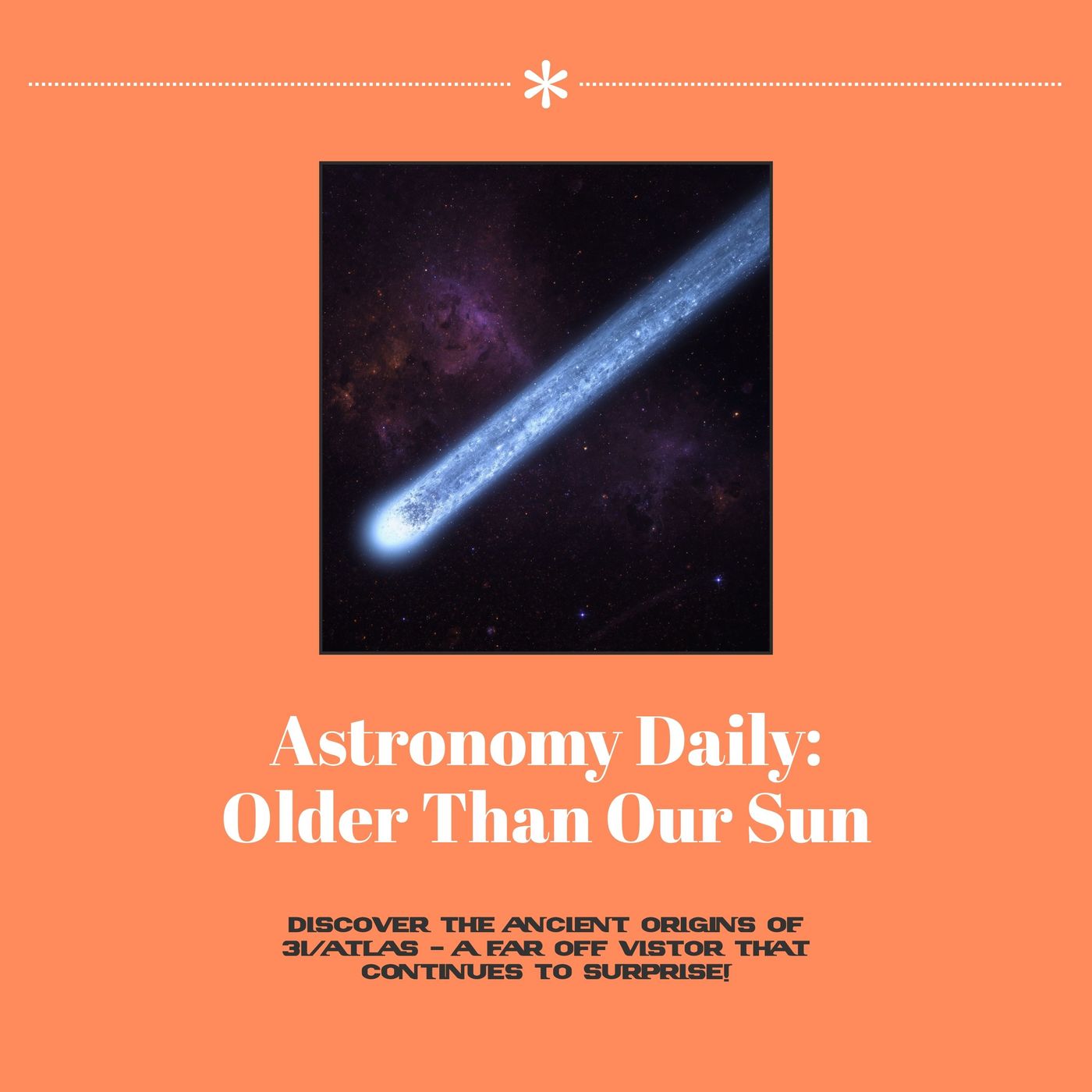
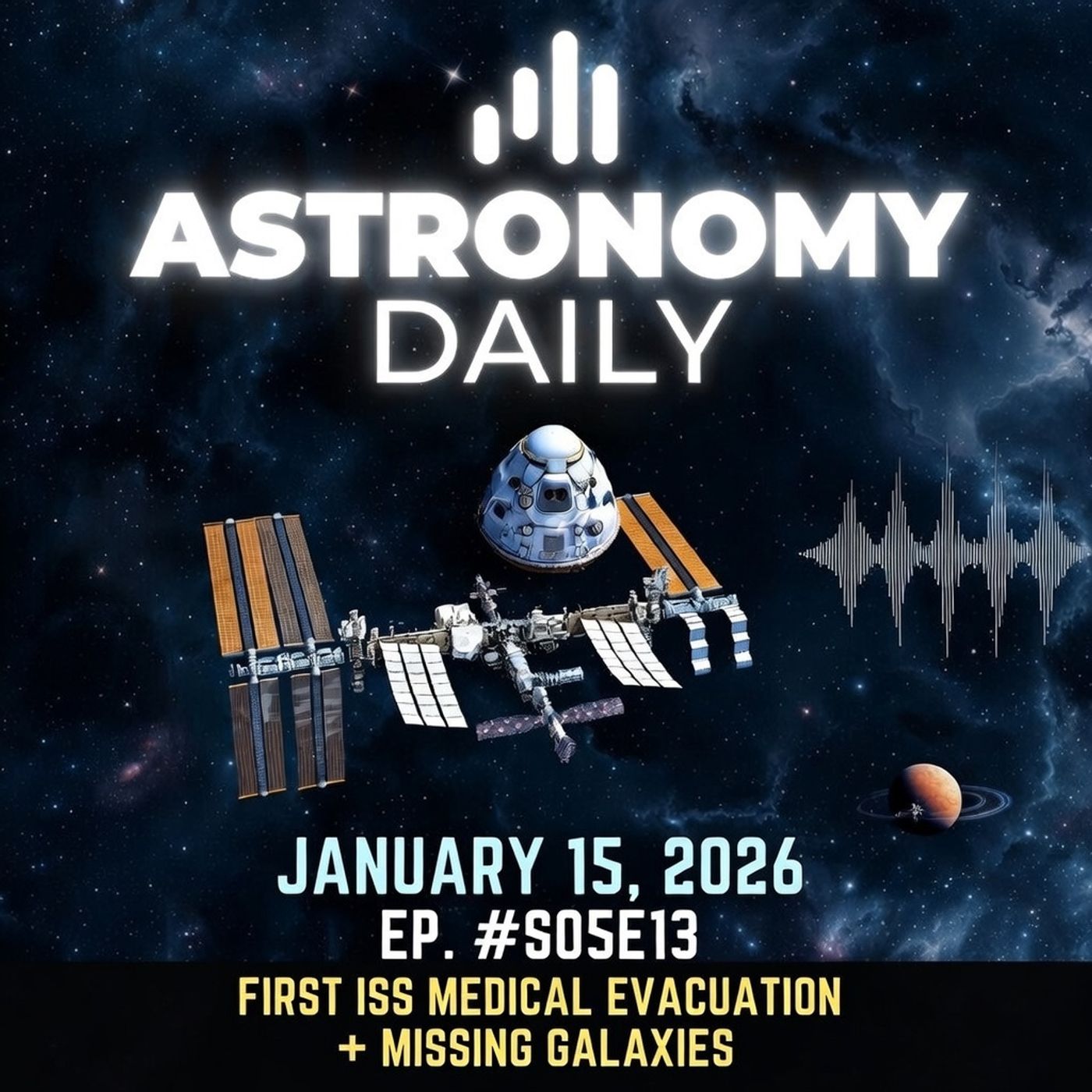
In this episode of Astronomy Daily, Anna and Avery explore six remarkable stories from the frontiers of space science. JWST has determined that interstellar comet 3I/ATLAS likely formed 10–12 billion years ago — before our Sun existed — making it the oldest object ever chemically characterised. NASA's Perseverance rover has delivered its most robust organic detection yet in Mars's Jezero Crater. ESA's Euclid telescope has released the largest and most detailed visible-light image ever taken of the Milky Way's galactic bulge. NASA's plan to deorbit the ISS into the Pacific Ocean faces new legal and environmental scrutiny. Research from the University of Glasgow reveals the Chicxulub impact crater hosted an underground hydrothermal system for eight million years — four times longer than previously estimated. And astronomers have discovered the first-ever pair of sibling supernova remnants, hiding in the glow of the famous Jellyfish Nebula. Story 1 — JWST & 3I/ATLAS Origin • Cordiner et al. (2026). 'Isotopic evidence for a cold and distant origin of 3I/ATLAS.' Nature. DOI: 10.1038/s41586-026-10771-6 • Opitom et al. (2026). 'High nitrogen and carbon isotopic ratios in the interstellar comet 3I/ATLAS.' Nature (in press). arXiv: 2603.07187 • NASA Science: https://science.nasa.gov/missions/webb/nasas-webb-finds-clues-to-ancient-distant-origin-of-comet-3i-atlas/ • Science Magazine: https://www.science.org/content/article/interstellar-comet-unlike-anything-seen-our-solar-system Story 2 — Perseverance Organic Detection • Murphy et al. (2026). 'Spatially distributed complex organic matter detected in an ancient river valley in Jezero crater, Mars.' Science Advances. DOI: 10.1126/sciadv.adx0047 • Space.com: https://www.space.com/astronomy/mars/did-nasa-just-find-evidence-of-ancient-life-on-mars-perseverance-rover-spots-complex-carbon-in-red-planet-rocks • ScienceAlert: https://www.sciencealert.com/perseverance-finds-complex-organic-compounds-in-strange-mars-rocks Story 3 — Euclid Milky Way Image • ESA Euclid Mission Press Release, 24 June 2026 • NASA JPL: https://www.nasa.gov/missions/roman-space-telescope/euclid-view-of-milky-way-heart-previews-core-survey-by-nasas-roman/ • Space.com: https://www.space.com/astronomy/galaxies/this-is-the-largest-and-most-detailed-image-of-our-milky-way-with-over-60-million-stars-and-50-exoplanet-systems • CBS News: https://www.cbsnews.com/news/euclid-telescope-most-detailed-image-milky-way-stars/ Story 4 — ISS Deorbit Environmental Concerns • US Government Accountability Office report on ISS deorbit, June 2026 • Space.com: https://www.space.com/space-exploration/international-space-station/nasa-wants-to-dump-the-iss-in-the-sea-experts-say-the-plan-raises-serious-concerns-for-ocean-health • The Ocean Foundation statement, June 2026 Story 5 — Chicxulub Hydrothermal System • Pickersgill et al. (2026). 'Hydrothermal activity persisted for at least 8 Myr at Chicxulub.' Communications Earth & Environment. DOI: 10.1038/s43247-026-03618-5 • Phys.org: https://phys.org/news/2026-06-dino-asteroid-fueled-underground-life.html • EarthSky: https://earthsky.org/earth/dinosaur-killing-asteroid-underground-hydrothermal-habitat/ Story 6 — Jellyfish Nebula Sibling Remnant • Astrophysicists' paper on IC 443 sibling supernova remnant, Universe Today, June 23 2026 • Universe Today: https://www.universetoday.com/Become a supporter of this podcast: https://www.spreaker.com/podcast/astronomy-daily-latest-space-news--5648921/support.
Sponsor Details:
Ensure your online privacy by using NordVPN. To get our special listener deal and save a lot of money, visit
Anna: From the farthest reaches of the galaxy to the red dust of Mars. You're tuned in to Astronomy Daily, your daily briefing on, um, the universe. I'm Anna. Avery: And I'm Avery. Today on the show, an interstellar comet has just revealed it's older than our sun by billions of years. Perseverance scores its most impressive organic detection yet on Mars. And Europe's dark matter detective turns its gaze to the heart of our own galaxy and delivers the most stunning portrait ever made. Anna: We've also got a controversial plan to dump the world's largest space station into the Pacific Ocean, raising some very pointed questions.
Plus, an asteroid that killed the dinosaurs may have kept underground life burning for 8 million years. And astronomers have just found that a, uh, famous nebula has a long lost twin sibling. Avery: It's Thursday, the 26th of June, 2026, and this is Astronomy Daily. Anna: We start today with one of the most remarkable findings in the short but extraordinary history of interstellar astronomy. The comet known as 3i Atlas, which swept through our solar system last year and captured the imagination of scientists worldwide, has now revealed something almost impossible to wrap your head around.
This comet is older than our Sun. Avery: Much older, potentially. Two new papers published in the journal Nature this week, using data from NASA's James Webb Space Telescope, report that 3i Atlas carries a chemical fingerprint unlike anything found in our own solar system. And that fingerprint points to an origin between 10 and 12 billion years ago. Anna: To put that in perspective, our sun is about 4 1/2 billion years old. So this comet may have been drifting through the galaxy for more than twice the lifetime of our entire Sol solar system before it happened to pass through our neighborhood.
Avery: The key evidence comes from isotopes, specifically the ratio of two forms of carbon and a type of water molecule called semi heavy water, in which some of the hydrogen atoms carry an extra neutron. Astronomers using Webb's near infrared Spectroscope found that 3i Atlas has far less carbon 13 relative to carbon 12 than anything in our solar system. And carbon 13 builds up in the universe over time as successive generations of stars are born, live, and explode. Less carbon 13 means an older origin, one from a time before many stars had even had the chance to die.
Anna: The semi heavy water signature is equally telling. That kind of water tends to form in high radiation environments, cold, massive star forming regions that were far more common in the early universe. And taken together, the Webb team concludes this comet formed during what astronomers call cosmic noon, when star formation across the universe was at its absolute peak. Avery: Lead researcher Martin Cordiner of NASA's Goddard Space Flight center described it as a unique opportunity to study an ancient object from the distant galaxy, probably predating our sun and solar system.
His words. On one hand, we get direct insight into that distant time and place, and on the other, we learned something about how our own solar system may be. Anna: A companion study from the European Southern Observatory's Very Large Telescope found complementary evidence in the comet's carbon and nitrogen isotope ratios, further cementing the picture of an ancient, cold, alien origin. 3i Atlas, it seems, is a genuine relic from another era of the universe Avery: entirely, and it's on its way out.
The comet is now departing our solar system, never to return. But the data it's left behind will be studied for years, perhaps decades. Anna: We stay in the realm of ancient chemistry, but this time a little closer to home, just 40 to 250 million km away, depending on where Mars and Earth happen to be in their orbits. NASA's Perseverance rover has just delivered what scientists are calling the most robust organic detection made in Jezero Crater. A new study published in Science Advances reports that the rover's SHERLOCK instrument, a laser based spectrometer on the end of the robotic arm, has detected complex macromolecular carbon in two mudstone rocks at a site called Bright angel in an ancient river valley called Neretva Vallis.
Avery: The paper's own summary describes it as, and I'm quoting, the most robust organic detection in Jezero Crater. That thus far and the only detection of macromolecular carbon on a natural rock surface on Mars. That's macromolecular, meaning large, complex carbon based molecules, the kind that on Earth are associated with biology. But we need to be careful here. Anna: Absolutely. The researchers are very clear that detecting organic carbon on Mars does not mean life. The SHERLOCK instrument cannot distinguish between carbon produced by biology and carbon produced by geology or delivered by meteorites.
What it can do is show that the chemical ingredients were there, and in this case, they were there in abundance. Hundreds of individual detections across just two rocks. Avery: What makes this particularly compelling is the location these mudstones are at. Bright angel connected to Naret Va Vallis, the ancient river channel that fed Jezero Crater's western delta billions of years ago. This was a water rich environment, exactly the kind of place where on Earth you would expect to find microbial sheltering in sediment.
Anna: One of the two rocks examined is the now famous Chayava Falls, the very rock that caused such excitement last year with its distinctive leopard spot markings. Finding complex macromolecular carbon in it adds yet another Intriguing layer to the mystery. The other rock showed organic carbon associated with carbonate and sulfate minerals, both of which can be connected to biological processes. Avery: The researchers also note this is the first detection of this type of complex carbon in a mudstone on Mars outside of Gale Crater, where the Curiosity rover operates more than three and a half thousand kilometers away.
That suggests the conditions that allowed organics to form and survive may have been widespread across Mars, not just in one localized area. Anna: The samples Perseverance has collected are still sealed in its sample tubes, waiting for a future Mars sample return mission to bring them back to Earth. When they arrive in a laboratory, scientists will be able to run tests orders of magnitude more sophisticated than anything a rover instrument can perform. That's when the real detective work begins.
Avery: Microlensing works by detecting the tiny brightening of a background star when a foreground star and any orbiting planets pass in front of it. Acting as a gravitational lens. It's a powerful technique for finding cold, distant planets that are otherwise invisible. And to do it, you need an incredibly crowded starfield, which, as it turns out, is exactly what the galactic bulge provides. Anna: The Euclid Image already contains 51 known planetary systems. Scientists expect it will also help confirm and measure the masses of around 60 previously detected but poorly characterized exoplanets.
And when Roman comes online and begins repeatedly monitoring the same field, the two data sets together will give us the most complete picture yet. Yet of how many planets exist throughout the galaxy. Avery: For Australian and Southern Hemisphere listeners, you're in an ideal position to see the galactic center in the night sky. Right now, it's high in the winter sky in the constellation Sagittarius. And under dark skies, away from city lights, you can see the glow of the bulge. With your naked eye, you're looking at the very region Euclid just photographed.
Now, a story about endings and the complications that come with them. The International Space Station has been continuously inhabited for more than 24 years. It's hosted astronauts from 22 countries, conducted thousands of experiments, and served as humanity's permanent foothold in low Earth orbit. But its time is running out, and NASA's plan for how to retire it is now under scrutiny from some unexpected quarters. Anna: The plan, in brief, is starting in 2028, the ISS will begin a, uh, gradual orbital lowering.
In mid-2029, NASA will launch a SpaceX built in deorbit vehicle and attach it to the station. That vehicle, fitted with 46 Draco thrusters, will then push the entire structure out of orbit in a controlled re entry, targeting a splashdown in the remote South Pacific, near a location called Point Nemo. Avery: Point Nemo is the most isolated spot on the planet, more than 2,600 km from the nearest land. It's already known as a spacecraft cemetery. Russia's Mir station ended its days there, along with hundreds of other spacecraft.
NASA chose it precisely because it minimizes the risk to any human population. But a leading ocean conservation organization says that calculation misses something important. Anna: The Ocean foundation based in Washington D.C. says the deorbit plan, and I'm quoting, raises serious concerns for ocean health that the space community has not adequately grappled with. The organization's president Mark Spalding, says there is a quote, troubling structural gap in international law that the ISS de orbit throws into sharp relief.
Avery: The legal gap he's referring to is this. The 1972 Space Liability Convention requires that if a country's space debris falls on another nation's territory or damages another nation's property, the launching country must pay compensation. But international waters and the ocean floor beneath them, um, are not a nation's territory. There's no equivalent protection for the deep sea. Anna: And this isn't a small amount of debris. The ISS weighs roughly 450,000 kilograms. While much of the structure will burn up during re entry, denser heat resistant components, including pressurized modules, structural beams and hardware are expected to survive and reach the seafloor.
The exact quantity and composition of what will sink is, according to critics, insufficiently studied. Avery: The concerns have now drawn the attention of the U.S. government Accountability Office, which has issued a report highlighting the issues. The Ocean foundation is calling for NASA to conduct a full environmental impact assessment before proceeding with the re entry, currently planned for around 2030 to 2031. There's still time, but not unlimited time to address these questions. Anna: It's a fascinating tension.
The very success of the ISS program, the sheer scale of the structure humanity built up there is now what makes disposing of it so complicated. And this case, as legal experts have noted, is likely to set precedents for how we handle the growing number of much larger orbital platforms expected in the coming decades. Moving on to our next story. Today, 66 million years ago, a 10 kilometer wide asteroid slammed into what is now the Yucatan Peninsula of Mexico with a force equivalent to billions of nuclear weapons.
The impact triggered Megatsunami, a uh, global firestorm and a years long impact winter that blotted out the sun and wiped out roughly three quarters of all species on Earth, including every non avian dinosaur. It is the most studied extinction event in history. Avery: But new research from the University of Glasgow has uncovered a remarkable footnote to that catastrophe. While the surface of the Earth was plunged into darkness and death underground in the shattered rocks beneath the crater, life may have found a way, and not just briefly.
The new study suggests it found the way for 8 million years. Anna: The Chicxulub crater, the scar left by that asteroid is buried beneath layers of sediment and ocean in the Gulf of Mexico. But it still spans nearly 200 km in diameter. When the asteroid hit, the immense heat it generated fractured the bedrock and superheated water trapped in the rock, creating a vast hydrothermal system beneath the crater. A network of hot water flowing through porous shattered rock. Avery: Hydrothermal systems like this are well known on Earth at, uh, mid ocean ridges and volcanic vents.
They host entire ecosystems of organisms that live completely independently of sunlight. Bacteria, tube worms, crabs, and more, all powered by chemical energy from the Earth's interior. The question for scientists has always been, how long did Chicxulub's version of this system survive? Anna: Previous estimates based on computer models from the early 2000s suggested about 2 million years. The new study, led by Dr. Ann Marie Pickerskill of the Scottish University's Environmental Research center, used advanced argon.
Argon dating of potassium rich feldspar crystals collected during a 2016 drilling expedition to the crater's peak ring. The result? The system remained active for at least 8 million years, four times longer than anyone had previously estimated, and the longest impact generated hydrothermal system ever documented. Avery: To be clear, this doesn't mean complex life was thriving underground while the dinosaurs went extinct. Above, we're talking about microbial life, bacteria and other microorganisms sheltering in the warm, chemically rich porous rock, shielded from the radiation and temperature extremes at the surface.
But even that is extraordinary, and the Anna: implications extend beyond Earth. Mars has endured countless asteroid impacts over its history and may have once had liquid water. If the same dynamics applied there, and there's no reason to think they wouldn't then. Even as Mars became cold and dry on the surface, underground hydrothermal systems could have kept microbial life viable for millions of years. The Chicxulub finding makes that possibility more credible than ever. Avery: We close today with a story that's part astronomy, part cosmic detective work.
And we'll admit it a little bit poetic. Somewhere between 4,000 and 5,000 light years away, in the constellation Gemini, there's a supernova remnant called IC443. Astronomers gave it a more evocative nickname long ago, the Jellyfish Nebula, for its billowing tentacle like filaments of glowing gas. Anna: It's one of the most photographed nebulae in the sky, a favorite of astrophotographers the world over. Its soft, wispy tendrils of light are, uh, the expanding shockwave from a star that died in a spectacular explosion somewhere between 3,000 and 30,000 years ago.
It's beautiful. It's well studied, and astronomers thought they knew it well. Avery: But new research has revealed that the Jellyfish Nebula has been hiding something. Lurking right there in the bright glare of the Jellyfish itself, Barely visible against it, is a second supernova remnant connected to IC443 by a bright filament of gas. Astrophysicists are calling this the first. First confirmed pair of sibling supernova remnants ever identified. Anna: Two massive stars, born from the same cloud of gas and dust, lived out their lives in relative proximity, and then both died in supernovae, leaving behind these two glowing, expanding shells of debris.
The fact that their remnants are still connected by that filament of gas tells us the two explosions happened close enough in space and time to interact with one another. Avery: What makes the discovery particularly striking is not just what was found, but where it was hiding. The second remnant had been there all along, but the Jellyfish Nebula's own brightness had been obscuring it, like trying to see a faint star right next to the Full Moon. It took careful analysis to disentangle the two structures and recognize the second for what it was.
Anna: It's a reminder that even some of the most familiar objects in the sky can still surprise us. That even after decades of observation, the universe has a habit of tucking secrets away in plain sight, waiting for us to look a little more carefully. Avery: And for observers in Australia and New Zealand, the Jellyfish Nebula is in Gemini, which sits low on the northern horizon in winter evenings. While the nebula itself requires a telescope, it's a wonderful target for astrophotographers. And now, when you photograph it, you can tell people you're looking at two nebulae for the price of one.
Anna: And that's our universe for today. An ancient interstellar traveler, older than the Sun. The strongest hint yet that Mars once had the chemistry for life. The most detailed portrait ever made of our galaxy's crowded heart. The ISS's complicated farewell. A crater that kept life burning Underground for 8 million years, and a, uh, nebula that turned out to be twins. Avery: The universe keeps delivering. Make sure you subscribe so you never miss an episode. Anna: And subscribe. Avery: And if today's show sparked something for you, leave us a review.
It genuinely helps the show reach more Anna: listeners, find us at astronomydaily IO Follow us Astrodaily Pod on all your socials, and we'll see you right back here tomorrow. Avery: Until then, keep looking up.
 Apple Podcasts
 Spotify
 Pocket Casts
 Castbox
 Overcast
 Podbean
 iHeartRadio
 Castro
 Goodpods
 Moon FM
 Podcast Addict
 Podcast Republic
 YouTube