In this episode
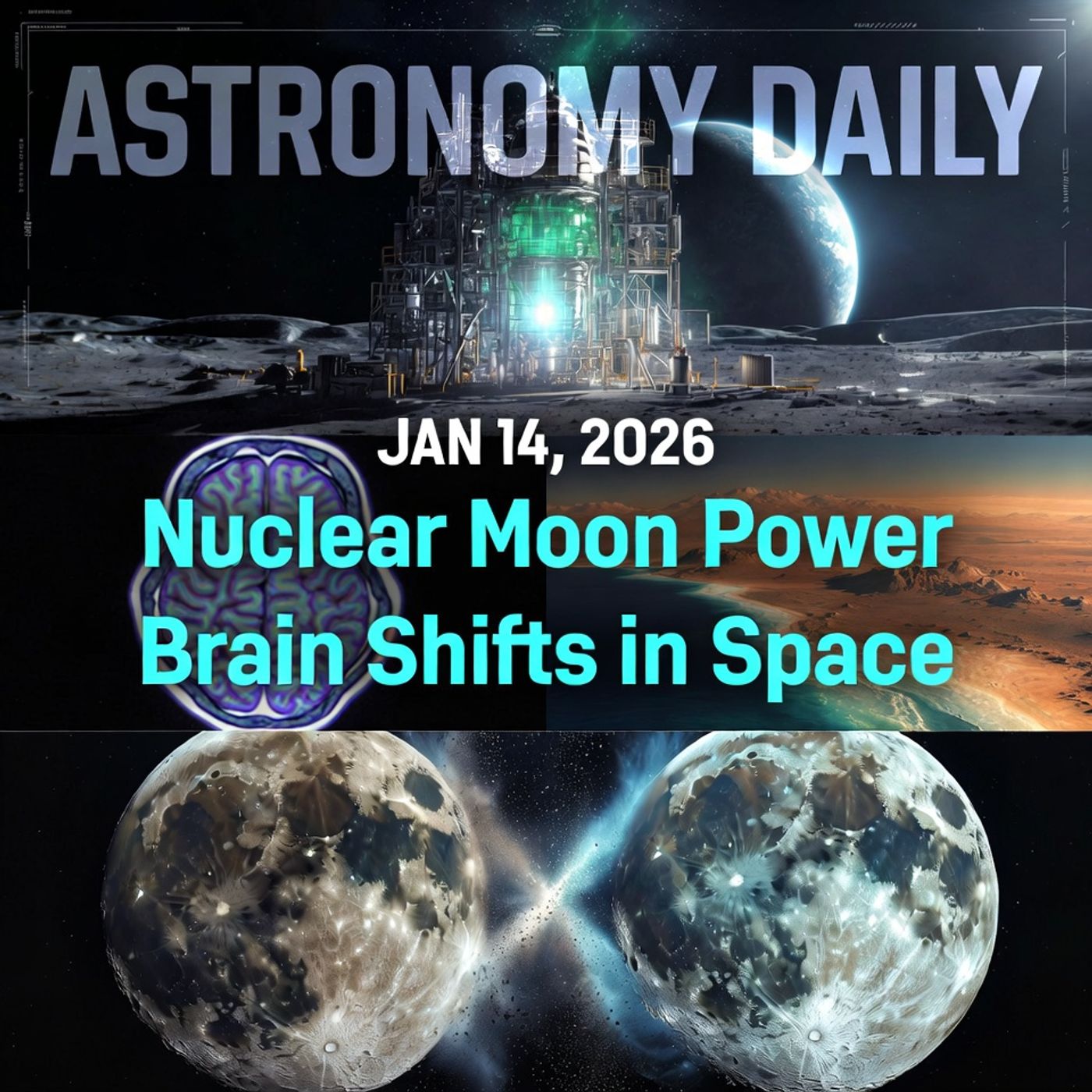
Astronomy Daily - January 14, 2026 Episode Nuclear Moon Power, Mars Ocean Evidence, and Brains in Space Episode Description Join hosts Anna and Avery for an action-packed episode covering six major space stories! We explore NASA's ambitious plan to put a nuclear reactor on the Moon by 2030, get the latest on tomorrow's historic ISS medical evacuation, examine compelling new evidence for an ancient Martian ocean, discover how spaceflight literally shifts astronauts' brains, learn about a revolutionary privately-funded space telescope, and find out how scientists finally solved the mystery of the Moon's two faces. Episode Duration: 17 minutes Episode Highlights ⚛️ NASA Commits to Lunar Nuclear Reactor by 2030- NASA and DOE sign memorandum of understanding
- President Trump's executive order drives ambitious timeline
- Nuclear power essential for permanent lunar bases
- Building on 50+ years of space nuclear collaboration
- First-ever medical evacuation from ISS proceeds on schedule
- Undocking set for 5:05 PM EST Wednesday, January 15
- Splashdown off California coast at 3:41 AM Thursday
- Station will operate with skeleton crew of three
- River delta features identified in Valles Marineris
- Ocean covered half of Mars 3+ billion years ago
- High-resolution orbital imagery reveals ancient coastline
- Major implications for Mars' past habitability
- MIT study reveals brains move "backward, upward and tilted"
- Changes persist up to 6 months after return to Earth
- Brain displacement linked to post-flight balance issues
- Critical for planning longer Moon and Mars missions
- Eric Schmidt funds Lazuli Space Observatory
- "Move fast" philosophy applied to flagship telescope
- Designed to catch transient events like gravitational waves
- Will test technology for future NASA missions
- Chang'e-6 samples reveal impact chemistry differences
- Ancient collision reshaped Moon's internal structure
- Evidence of hemisphere-wide mantle convection
- First hard evidence from lunar far side
Become a supporter of this podcast: https://www.spreaker.com/podcast/astronomy-daily-latest-space-news--5648921/support.
Sponsor Details:
Ensure your online privacy by using NordVPN. To get our special listener deal and save a lot of money, visit www.astronomydaily.io/nordvpn. You'll be glad you did!
Get the best secure and private email on the planet. Stop your Government, google and who knows who else spying on every email you write. Do what we did and use ProtonMail. They beleive in privacy and there are no ads in their business model...yet they still provide a free forever service. Check them out and get out special deal at www.astronomydaily.io/protonmail
Become a supporter of Astronomy Daily by joining our Supporters Club. Commercial free episodes daily are only a click way... Click Here
This episode includes AI-generated content.
Anna: Hello, everyone and welcome to Astronomy Daily. I'm Anna. Avery: And I'm Avery. Thanks for joining us this Tuesday, January 14, 2026. We've got a fantastic lineup of space news for you today. Anna: We really do. We're covering everything from nuclear reactors on the moon to ancient Martian oceans, plus some fascinating discoveries about how spaceflight affects astronaut brains. Avery: And we'll be talking about a major ISS update, a new privately fund space telescope and scientists finally solving a six decade old mystery about the moon's two faces.
Anna: It's going to be an exciting episode, so let's dive right in. Avery: Anna. Uh, let's start with some big news from NASA and the Department of Energy. The United States is getting serious about putting a nuclear reactor on the moon by 2030. Anna: That's right, Avery. This isn't just talk anymore. Last week, NASA Administrator Jared Isaacman and U.S. secretary of Energy Chris Wright signed a memorial memorandum of understanding that reaffirms their commitment to meet that ambitious deadline.
Avery: And this comes on the heels of President Trump's executive order from December calling for construction to begin on a lunar base by 2030 with a nuclear reactor ready to launch by that same year. Anna: Isaacman said something really interesting in the announcement. He said achieving this future requires harnessing nuclear power. This agreement enables closer collaboration between NASA and the Department of Energy to deliver the capabilities necessary to usher in the golden age of space exploration and discovery.
Avery: It makes sense when you think about it. Nuclear power can generate electricity continuously for years without refuelling. And it's not affected by the moon's two week long nights or changing weather conditions like solar panels would be. Anna: And this isn't the first time NASA and the Department of Energy have worked together on space nuclear systems. They've been collaborating for more than half a century. Right? Avery: Many of NASA's deep space robotic explorers have used radioisotope thermoelectric generators, or RTGs, as a power source.
We're talking about missions like the Cassini Saturn orbiter and the Curiosity and Perseverance Mars rovers. Anna: But this lunar reactor would be something different entirely. It would be designed to power one or more bases on the lunar surface. As part of NASA's Artemis programme, Secretary. Avery: Wright made a connection to America's historic achievements. He said history shows that when American science and innovation come together, from the Manhattan Project to the Apollo mission, our nation leads the world to reach new frontiers once thought impossible.
This agreement continues that legacy. Anna: For NASA's Artemis programme, having a reliable long term power source on the Moon is absolutely critical. If we're going to establish a permanent presence there and use it as a stepping stone to Mars. We need infrastructure that can operate reliably. Avery: For years, and the 2030 timeline is really aggressive. We're talking about just over four years from now. That's incredibly fast for a project of this magnitude. Anna: It is. But with the renewed focus on lunar exploration and the competition with other spacefaring nations, particularly China, there's definitely motivation to move quickly.
Avery: Speaking of space developments, we have an important update on the Crew 11 situation at the International Space Station. Mission managers have officially given the go for the crew's return to Earth tomorrow. Anna: That's right. NASA astronauts Zena Cardman and Mike Finke, along with JAXA astronaut Kimia Yu and Roscosmos cosmonaut Oleg Platanov, are scheduled to undock from the harmony module at 5:05pm Eastern Time on Wednesday. Avery: And they're coming home aboard the SpaceX Dragon crew spacecraft, with Cardman commanding and Finke piloting.
The weather forecast is looking excellent for their parachute assisted splashdown off the coast of California, which is scheduled for 3:41am on Thursday. Anna: Yesterday, the crew spent most of their time preparing for departure. They packed cargo, reviewed return to Earth procedures and transferred hardware. Hardman and her crewmates also trained on how to use respirators during unlikely emergency events like an ammonia Lee. Avery: NASA is planning extensive coverage of the event. NASA will begin live coverage at 3pm on Wednesday when the crew enters the Dragon spacecraft and says goodbye to the remaining crew on the station.
Anna: Coverage continues at 4:45pm for the actual undocking, then returns at 2:15am Thursday for the descent, and finally at 5:45am for the post splashdown news conference. You can watch all of this on NASA, Amazon prime or NASA's YouTube channel. Avery: As we discussed yesterday, this is the first medical evacuation in ISS history. The crew was originally scheduled to stay until after Crew 12 arrived in mid February, but an undisclosed medical condition affecting one of the four crew members prompted NASA to bring them home early.
Anna: After Crew 11 leaves, Expedition 74 will be commanded by Roscosmos cosmonaut Sergey Kudzverchkov, leading flight engineers Sergei Mikayev and NASA's Chris Williams. That's a skeleton crew of just three people running the entire station. Avery: Yesterday, Kuts, Verchkov and Mikhayev participated in a study assessing how crews make decisions and work together in space, which is especially relevant given they'll be operating with a reduced crew for a while. Anna: BASA is still evaluating whether they can move up the Crew 12 launch date to replenish the station crew sooner than originally planned.
Avery: Now let's talk about Mars. Anna. There's exciting new evidence that an ancient ocean once covered half the planet. Anna: This is really fascinating research, Avery. A team led by Ignatius argadestia, a, uh, PhD student at the University of Bern, has identified features in Mars Valles Marineris that look remarkably similar to river deltas here on Earth. Avery: Valles Marineris is that massive canyon system on Mars, right? The largest in the solar system. Anna: Exactly. Along with Olympus Mons, it's one of Mars's most defining features.
This research focused specifically on the southeast part of a sub canyon called Copratus Chosma. Avery: The researchers used images from multiple orbital Cameras, CTX and HiRISE on NASA's Mars Reconnaissance Orbiter and CASSIS on the ESA Roscosmos Trace Gas Orbiter. They also worked with digital elevation models to examine what they call scarpa fronted deposits. Anna: These scarp fronted deposits, or SFDs, are fan shaped sediment deposits that form where a river empties into a body of standing water.
The team identified three of these features in Copratus Chasma and they're almost identical to river deltas we see on Earth. Avery: Professor Fritz Schlundjugger put it really clearly. He said, the structures that we were able to identify in the images are clearly the mouth of a river into an ocean. Anna: What's particularly compelling is that all three SFDs are at the same elevation. That suggests they were all deposited at the same water level, essentially marking an ancient coastline. Avery: The researchers believe these deposits were formed sometime between the late Hesperian period and the early Amazonian period.
That's roughly between 3.7 billion and 3 billion years ago. Anna: Reid author R. Ghedestia said something interesting in the press release. He said, when measuring and mapping the Martian images, I was able to recognise mountains and valleys that resemble a, uh, mountainous landscape on Earth. However, I was particularly impressed with the deltas that I discovered at the edge of one of the mountains. Avery: Previous research had suggested Mars had a large ocean, but this study provides much more concrete evidence.
Slunjugger noted that earlier claims were based on less precise data and sometimes indirect arguments. Anna: But their reconstruction of the sea level is based on clear evidence of an actual coastline. Thanks to these high resolution images, the paleo shoreline they identified extends from Valles Marinus all the way to the northern lowlands. Avery: Argadestia summed it up nicely. With our study we were able to provide evidence for the deepest and largest former ocean on Mars to date, an ocean that stretched across the northern hemisphere of the planet.
Anna: This has huge implications for Mars past habitability. As the authors write, their findings will impact research on the evidence for potential life on Mars. Since this represents a period when Mars had the highest water availability, it's amazing. Avery: To think that billions of years ago, Mars might have looked very different from the cold, dry desert we see today. Anna: Speaking of things changing, Avery, let's talk about a fascinating new study on how spaceflight literally changes astronauts brains.
Avery: This is wild. Ana um. A team led by Rachel Seidler at MIT took MRI scans of 26 astronauts and 24 non astronaut participants. And they found that spaceflight causes astronauts brains to shift position inside their skull. Anna: The study was published just yesterday. The researchers found a consistent pattern of the brain shifting backward and upward and rotating upward after time in microgravity. And here's the kicker. Some of these positional changes were still detectable months after astronauts returned to Earth.
Avery: Instead of looking at the brain as one whole unit, they divided it into 130 separate regions and examined each one individually. This regional analysis showed many areas with significant displacement across two spatial axes. Anna: The data set included astronauts with different mission lengths, roughly two weeks, six months and one year. They found significant positional shifts across large portions of the brain, with some displacements measured as high as 2.52 millimetres in subjects with the most time in space.
Avery: To put that in perspective, that's about a uh, tenth of an inch. It might not sound like much, but when we're talking about the brain inside your skull, that's actually quite significant. Anna: The researchers also compared astronauts with people who participated in a long duration head down tilt bed rest experiment which is used to simulate some effects of microgravity on Earth. Avery: And they found some interesting differences. Astronauts showed stronger upward movement, while the bed rest participants showed stronger backward movement.
Only some of the brain shape changes observed after spaceflight appeared in the bedrest group. Anna: This tells us that head down bed rest, while useful, doesn't perfectly replicate what happens to the brain in actual microgravity. There are unique effects that only real spaceflight produces. Avery: One of the most important findings was the connection to balance problems. The study found that displacement affecting sensory related brain regions correlated with larger declines in astronauts balance after spaceflight, Right.
Anna: We know that when astronauts return from space, they often experience balance issues because their inner ear's sense of direction isn't immediately restored. This study helps explain why that happens. Avery: And while astronauts normally find their footing within a week or so, the physical shifts in their brains persisted for up to six months post spaceflight. That's quite remarkable. Anna: The authors note that this underscores the long lasting effects of spaceflight on neuroanatomy. They recommend future studies with larger astronaut crews on a broad range of mission lengths to better understand how quickly these shifts begin and how they evolve.
Avery: This research is crucial as we plan longer missions to the moon and eventually to Mars. Understanding how extended spaceflight affects the brain will help us better prepare astronauts and develop countermeasures. Anna: Avery, let's shift gears and talk about a really exciting development in space telescope technology. There's a new privately funded observatory called Lazuli that could change how we build flagship class telescopes. Avery: This is fascinating, Anna. Uh, the Lazuli Space Observatory is being funded by Eric Schmidt, the former CEO of Google and his wife Wendy, through their philanthropic organisation, Schmidt Sciences.
We're talking about a $500 million investment. Anna: The whole premise is applying the new space philosophy to space telescopes. You know that Silicon Valley mindset of move fast and don't break things. The idea is to prove that you don't need decades and billions of dollars to build a flagship level space observatory, right? Avery: Compare this to the James Webb Space telescope, which cost $10 billion, or the upcoming Nancy Grace Roman Space Telescope, which is on track for $3 billion. These huge costs come from using completely de risked flight proven technology to ensure taxpayer dollars don't literally go up in flames.
Anna: But schmidt has a $36 billion fortune, so even if Lazulli fails, he can afford the loss. And that's kind of the point. This is an experiment to see if the approach even works for expensive flagship level observatories. Avery: To keep costs down, up to 80% of the telescope will use off the shelf components. And operating under Schmidt Sciences alleviates a lot of the bureaucratic and political decision making that inevitably delays government funded programmes. Anna: So where does Lazuli fit in the bigger picture?
Webb is obviously already operational, sending back spectacular images. Roman is next scheduled to launch in May 2027. But both have weaknesses when tracking transient phenomena. Avery: Exactly. Events like kilonovae or gravitational wave producing black hole mergers happen on timescales of hours, not days. They require almost immediate response from observatories to catch them before they end. Anna: And Webb just can't slew. That's the term for rotating to a new target fast enough. It captures extremely high resolution images, but it takes too long to get into position.
Avery: On the other hand, Roman is a survey telescope that looks at white swaths of sky, but doesn't have the resolution to examine individual systems like Lazuli will. Anna: So Lazuli's sweet spot is Target of opportunity tracking. It's designed to slew within an hour and a half to observe short lived events. It'll work in concert with ground based observatories like ligo, the Gravitational Wave Detector. Avery: But it has the advantage of being in space so no cloud cover or daylight to worry about.
Lazuli will also have a wild Field context camera with 23 separate CMOS sensors, kind of like Roman, to detect things like exoplanet transits. Anna: And here's something really cool it should be able to directly image exoplanets using a vector Vortex coronagraph along with deformable mirrors to suppress starlight by up to 10 million times. Avery: This same technology is planned for NASA's Habitable Worlds Observatory which won't launch for decades, so Lazuli will actually serve as a technology demonstration platform well before the taxpayer funded mission.
Anna: Perhaps the most impressive aspect is the timeline. Schmidt Sciences is planning a three to five year development cycle for this massive space observatory that's exponentially faster than any comparable government led system. Avery: Though to be fair, new space leaders do have a tendency to underestimate timelines. Even if it takes twice as long though, we'd still get another flagship level observatory within a decade. Anna: And here's something amusing. If Schmidt just leaves his remaining $36 billion in an S&P 500 index fund, he'd make back around 40 times what the entire project cost over a five year period.
So financially this is barely a blip for him. Avery: Either we get an amazing new space telescope or we get a $500 million lesson in what can go wrong when applying speed to large scale astrophysics projects. Either way, the scientific community learned something. Anna: Valuable for our final storey today. Avery scientists may have finally solved a mystery that's puzzled them for over 60 years. Why does the moon look so different on its near and far sides? Avery: This is based on analysis of dust collected from the lunar far side by China's Chang' e 6 mission, which returned the first ever samples from the moon's hidden hemisphere in 2024.
Anna: The material came from the south pole Aitken Basin, which is believed to be the site of the largest impact in the solar system. This colossal crater spans nearly a quarter of the lunar surface. Avery: A team letter by Heng Si Tan from the Chinese Academy of Sciences conducted isotopic analysis of potassium and iron found in the far side dust and compared it with samples from the moon's near side collected during the Apollo missions and by China's Chang' E5 spacecraft. Anna: The results showed a significant difference near side Samples contained more light isotopes, while the far side material was richer in heavier isotopes, particularly of potassium.
Avery: This type of isotopic separation couldn't be explained by normal volcanic activity. Instead, the researchers suggest the south pole Aitken impactor generated such extreme heat that lighter isotopes were vaporised and lost, leaving behind a heavier chemical fingerprint. Anna: The researchers wrote this feature most likely resulted from potassium evaporation caused by the south pole Aitken basin forming impactor, demonstrating the profound influence of this event on the Moon's deep interior.
Avery: What's particularly interesting is that the study suggests the impact may have punched through the crust and into the mantle, permanently changing the Moon's inner composition. Anna: The sample analysis revealed that potassium isotopes on the far side appear to originate from a mantle source distinct from that of the near side. This implies widespread internal melting and chemical redistribution. Avery: The team even proposes that the impact might have triggered hemisphere wide mantle convection, a process that could reshape a planet's crust and inner layers over time.
Anna: As they noted in their study, this finding also implies that large scale impacts are, uh, key drivers in shaping mantle and crustal compositions. Avery: So planetary impacts leave far more than just visible craters. They can set off long lasting internal transformations that remain detectable billions of years later. Anna: Heng Si Tian summed it up nicely. With our study, we were able to provide evidence for the deepest and largest former ocean on Mars today date. Wait, that's the wrong quote.
Avery: Wrong planet. Anna: Anna, uh, oh my goodness, let me get that right. Pyeon said. With the Chang' e 6 samples, scientists now have their first hard evidence from the Moon's far side, an area once entirely out of reach. Avery: This discovery is particularly timely as multiple nations gear up for lunar exploration missions, including NASA's Artemis programme and China's continuing Chang' E missions. Anna: Understanding the Moon's geological history and internal structure will be crucial as we plan to establish permanent bases there.
Each new sample and discovery helps us piece together the storey of how our nearest celestial neighbour formed and evolved. Avery: Well, that brings us to the end of today's episode of Astronomy Daily. What an incredible day of space news. Anna: From nuclear reactors on the moon and the crew 11 undocking tomorrow to ancient Martian oceans and shifting astronaut brains, plus a uh, privately funded space telescope and solving the Moon's two faced mystery, we've covered a lot of ground today. Avery: If you enjoyed today's episode, please subscribe to Astronomy Daily wherever you get your podcasts.
And don't forget to leave us a review. It really helps other space enthusiasts discover. Anna: The show you can find us on social media and at our website for more space news and updates. Um, on the socials search for Astro Daily Pod and our website can be found at astronomydaily.IO thanks so much for listening everyone. Avery: Until, um, next time, keep looking up Clear skies.
Sam.



 Apple Podcasts
 Spotify
 Pocket Casts
 Castbox
 Overcast
 Podbean
 iHeartRadio
 Castro
 Goodpods
 Moon FM
 Podcast Addict
 Podcast Republic
 YouTube