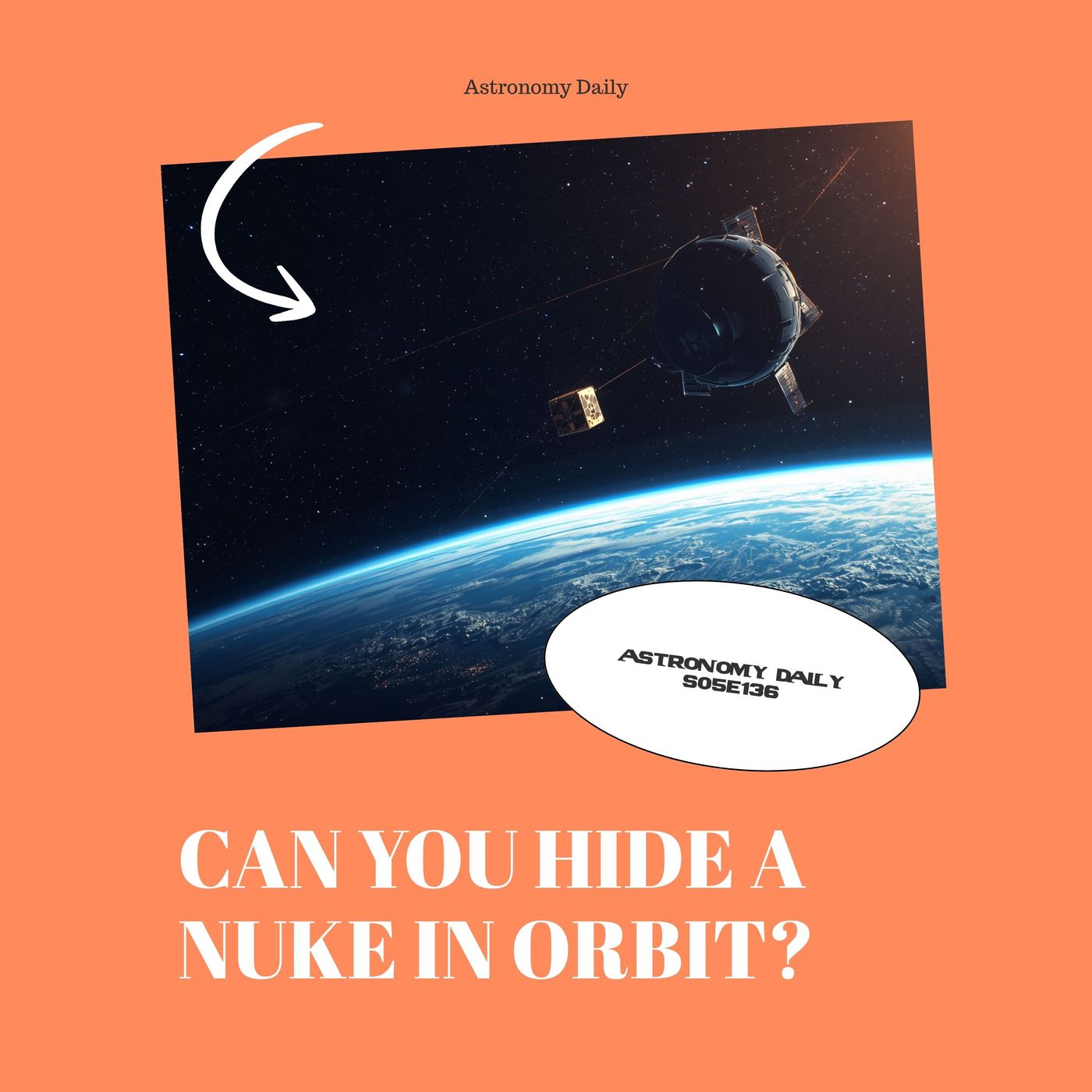
Nuclear Satellite Inspections, New Horizons Awakens, and a Cosmic Catalog of Galaxy Clusters
In this episode
Astronomy Daily S05E136 — Thursday, 9 July 2026 An MIT physicist proposes a shoebox-sized satellite that could catch a hidden nuclear weapon in orbit, NASA's New Horizons wakes up after its longest hibernation ever nearly six billion miles from home, an Antarctic telescope catalogues over seven thousand galaxy clusters, Japan's ispace books cargo space on a SpaceX Starship Moon mission, a Falcon 9 booster breaks its own reuse record for a thirty-sixth flight, and we close with tonight's Venus–Regulus conjunction. In This Episode • A shoebox-sized satellite that could catch a hidden nuclear weapon in orbit • New Horizons wakes up after its longest hibernation, 5.9 billion miles from Earth • An Antarctic telescope catalogues over 7,000 galaxy clusters • Japan's ispace books cargo space on a SpaceX Starship Moon mission • SpaceX's Falcon 9 booster B1067 breaks its own reuse record — 36 flights • Tonight's sky: Venus cosies up to RegulusBecome a supporter of this podcast: https://www.spreaker.com/podcast/astronomy-daily-latest-space-news--5648921/support.
Sponsor Details:
Ensure your online privacy by using NordVPN. To get our special listener deal and save a lot of money, visit www.astronomydaily.io/nordvpn. You'll be glad you did!
Get the best secure and private email on the planet. Stop your Government, google and who knows who else spying on every email you write. Do what we did and use ProtonMail. They beleive in privacy and there are no ads in their business model...yet they still provide a free forever service. Check them out and get out special deal at www.astronomydaily.io/protonmail
Become a supporter of Astronomy Daily by joining our Supporters Club. Commercial free episodes daily are only a click way... Click Here
This episode includes AI-generated content.
Anna: Hello and welcome to Astronomy Daily. I'm Anna. Avery: And I'm avery. It's Thursday, July 9, 2026, and we've got a proper mixed bag for you today. Anna: We've got nuclear physics hibernating spacecraft, a map of thousands of galaxy clusters, a moon delivery deal, a rocket breaking its own record, and we'll finish up looking at the evening sky. Avery: Six stories, 16 minutes. Let's get into it, Avery. Anna: This first one sounds like the plot of a thriller novel, but it's a real peer reviewed paper that came out this week.
Avery: It really does. So here's the setup. The 1967 Outer Space Treaty bans nuclear weapons in orbit. 118 countries have signed it, including the US and Russia. Problem is, there's never been an actual way to check whether a satellite is quietly breaking that rule. Anna: Which matters a lot more than it might have a few years ago, because back in February 2022, Russia launched a satellite called Kosmos 2553 into a very strange, very high radiation orbit. Weeks later, they invaded Ukraine. Avery: Russia says it's just a sensing and surveillance satellite.
U.S. officials have suspected for a while that it might actually be testing components for a nuclear anti satellite weapon. Anna: So how do you check without just taking someone's word for it? Avery: That's exactly the problem MIT physicist Arag denagulian set out to solve, publishing his solution in nature on July 8th. His idea is a shoebox sized inspector satellite, a nine unit cubesat that flies up close to a suspect satellite. Anna: And it's not looking for the bomb directly, is it? It's looking for a signature, right?
Avery: Neutrons. Earth's Van Allen radiation belts are full of high energy protons. And if there's a nuclear device up there, those protons interacting with it produce a very specific neutron signal. Dana Gulian's modeling shows a single CubeSat could confirm a nuclear warhead from about 4km away in roughly a week of watching a constellation of 10 of them would do it much faster. Anna: Why does this even matter? Beyond the treaty paperwork, what actually happens if someone detonates a nuclear weapon in orbit?
Avery: This has actually been tried, believe it or not. Back in 1962, the US ran a test called Starfish Prime, a, ah, 1.4 megaton warhead detonated in orbit. It pumped so many high energy electrons into the Van Allen radiation belts that it knocked out several satellites of that era just, just from the radiation environment it created. Anna: So a modern version of that wouldn't just take out one target, it could wipe out huge swaths of orbit Reconnaissance satellites, communications, gps, starlink, all of it indiscriminately.
Avery: Yes, which is exactly why Denaghulian is up front that this isn't a uh, finished, ready to launch system yet. His quote was quote, this isn't a completely proven system. The purpose of the paper is to show the scientific community that it's scientifically possible to do this. Anna: I really like his line about why physics based verification matters, especially between countries that don't trust each other very much. Avery: You can fake intelligence, but you can't fake physics. And that's really the heart of it.
A shoebox satellite that just measures neutrons, doesn't care about geopolitics, it just tells you what's actually there. Anna: A genuinely elegant idea for a genuinely unsettling problem. Avery: From the very human problem of nuclear weapons to a much older, much quieter kind of drama. NASA's New Horizons spacecraft just woke up. Anna: It's been asleep for a while, hasn't it? Avery: Its longest hyper mission yet. 321 days starting back on August 7th last year. NASA confirmed on July 7th that it's safely woken up in good health.
Anna: And just to put the distance in perspective, where actually is New Horizons right now? Avery: 5.9 billion miles from Earth. 9.5 billion kilometers. That's so far out that a radio signal traveling at the literal speed of light takes 8 hours and 52 minutes just to get here one way. Anna: So mission control says good morning and doesn't hear back until almost lunchtime. Avery: Pretty much. Mission operations manager Alice Bowman said every single weekly status beacon through the entire hibernation came back green.
Everything nominal the whole time. Anna: What's actually asleep during hibernation though? Because it wasn't doing nothing out there, Avery: Most systems powered down to save energy. But the science instruments kept working the entire time. The solar wind around Pluto or swap. The Pluto Energetic Particle Spectrometer and and the Venetia Burney student dust counter. All quietly gathering ADA the whole way through. Anna: So now it's awake. What happens? Avery: First, health and safety data comes down first.
Then the team starts retrieving nearly a year's worth of stored science data. In about three weeks, the onboard Alice ultraviolet spectrograph will start studying hydrogen gas out in the heliosphere while swap Pepsi and the dust counter keep measuring as engineers run instrument checkouts. Anna: This spacecraft's had quite a Life already. Avery: Launched January 26, 2006. Fastest human made object ever launched at the time. Blue pass, Pluto in 2015 gave us our first close look at the Kuiper Belt object arrokoth in 2019.
And now it's pressing on toward the true edge of the solar system's heliosphere. Anna: And it's running on updated Autonomy software now too, to cope with the growing distance. Avery: Exactly accounting for the slow decline in power from its plutonium generator and the ever lengthening delay in talking to Earth, NASA HM expects it to keep returning good data well into the2030s. Anna: Nine hours for a single good morning message. That's the kind of patience this mission runs on. Alright, moving on.
This next one's been making the rounds this week and it's a genuinely enormous data set. A new catalog of more than 7,000 galaxy clusters built from five years of Avery: data from the South Pole telescope, specifically its SPT3G camera out at the Amundsen uh, Scott South Pole Station in Antarctica. An Argonne National Laboratory led team put it together. Anna: How much is the sky are we actually talking about here? Avery: About 4%, 1600 square degrees out. Out of that patch they identified 8892 candidate clusters and confirmed 7190 of them.
Around 1800 of those date back more than 7.8 billion years. Anna: How do you even spot a galaxy cluster? From a telescope in Antarctica pointed at the sky? Rather than say an optical telescope looking at galaxies directly, they used something called Avery: the Sunyaev Zel Dutch effect. Light from the cosmic microwave background. The afterglow of the Big Bang passes through a galaxy cluster on its way to us. And high energy particles in the cluster subtly distort that light. It leaves behind a faint shadow like signature that the telescope can pick up.
Anna: And then they double checked those detections with something else. Avery: Optical confirmation came from the Dark Energy Survey. And here's the bit that surprised even the researchers. The data showed a marked increase in dust related emission from these cluster environments. Further back in time, that's a new window into how star formation activity evolved in and around these massive structures. Anna: Why do galaxy clusters matter so much to cosmologists? Avery: Specifically, they're the largest gravitationally bound structures in the universe.
Hundreds to thousands of galaxies held together with hot gas and huge amounts of dark matter. Because of that scale, they're one of the best tools we have for testing ideas about dark matter and dark energy. Anna: Sebastian Bouquet from the SPT collaboration put it nicely, didn't he? Avery: He did. Quote with the SPT3G cluster sample we will probe the evolution of cosmic structure formation over the past 10 billion years. And this is really just a start. Future work will refine the cluster mass measurements and upcoming surveys from the Vera Rubin Observatory and Europe's Euclid Miss should confirm M even more distant clusters in the same patch of Sky.
Anna: Nearly 9,000 candidate structures, each one holding thousands of galaxies. And that's only 4% of the sky. Avery: From cosmology back down to Earth. Well, down to the moon, really. And the business of getting there. Anna: This is the Ispace and Starship story. Avery: That's the one. Tokyo based lunar transport company ispace announced on July 8 that it's bought 500 kilograms, around 1100 pounds of cargo space aboard a future starship mission targeting a moon landing no earlier than 2030. Anna: What did that actually cost them?
Avery: Um, around US$50 million, which works out to roughly $100,000 per kilogram to the lunar surface. Anna: That's ispace's new business, isn't it? Not just landing their own stuff, but carrying other people's payloads too. Avery: Exactly right. They're calling it their Lunar Access Integrator Service. Think of it as a shared ride bus to the moon. They'll aggregate smaller payloads from governments, research institutions and commercial customers, which is a different business, to their existing dedicated lander service, which they describe as a more of a taxi.
Anna: And once Starship actually lands, how does the cargo get to where it needs to go? Avery: That's where ispace's own mobile cargo system comes in. A rover they're developing that can carry payloads a few kilometers from the landing site to their final destination. Anna: CEO Takeshi Hakamada had a good line about why this matters. Avery: For the bigger picture, Quote, high capacity, relatively low cost lunar transport, such as that provided by Starship, is essential for realizing a sustainable lunar economy that Ispace aims to create.
Anna: Now, I have to ask, ispace's track record on actual landings hasn't been perfect. Avery: No, it hasn't. They flown two lunar lander missions on SpaceX Falcon 9 rockets in 2023 and 2025, and both reached lunar orbit successfully, but crashed during landing. They're now developing a, uh, new lander design called ultra, with three missions planned between 2028 and 2030, including one under NASA's Commercial Lunar Payload Service program. Anna: So rather than betting everything on getting their own landings right, they're also building a second business on somebody else's rocket.
Avery: Precisely. And SpaceX seems keen on it too. Their VP of Commercial Sales, Stephanie Bednarig, said this gives, quote, a VALU pathway for smaller payloads to secure a ride to the moon today. Worth milling. This isn't exclusive either. NASA's using Starship for the crewed Artemis lander and the US company AstroLabe has separately booked starship cargo space as well. Anna: Two failed landings hasn't slowed them down one bit. If anything, they're doubling down on the moon, just letting someone else do the heavy lifting this time.
Right, quick one now, but a satisfying one if you like your rockets to keep proving a point. Avery: SpaceX launched the Falcon 9 out of Cape Canaveral early this morning, July 9, 5:25am M Eastern Time, carrying 29 Starlink satellites. Anna: And the headline isn't really the satellites, Avery: no, it's the booster tail number. B1067 flew for the 36th time today, breaking its own company record, which was 35 flights. Anna: For comparison, where does that sit against the all time record for any reusable orbital vehicle?
Avery: Still behind NASA's space shuttle Discovery, which flew 39 times across its career. But B1067 is closing the gap, and it's doing it on a much faster turnaround cadence than Discovery ever could. Anna: What happened to the booster after separation? Avery: About eight and a half minutes after liftoff, it landed on the drone ship, a shortfall of gravitas out in the Atlantic. The upper stage carried on and deployed those 29 Starlink satellites to low Earth orbit around 63 and a half minutes after launch.
Anna: This is launch number 80 for Falcon 9 this year already, isn't it? Avery: It is, and SpaceX president Gwynne Shotwell has said they're targeting somewhere around 140 to 145 Falcon 9 launches this year. SpaceX now has more than 10,700 active Starlink satellites in orbit. About 80% of this year's flights have gone toward building that constellation out. Anna: 36 trips to space and back for the exact same piece of hardware. Reusable rockets have gone from a wild idea a decade ago to a company quietly breaking its own record on an ordinary Thursday morning.
Avery: And to close things out, something that doesn't need a spacecraft, a, uh, peer reviewed paper or a rocket. Just clear skies and about 10 minutes after sunset. Anna: This is tonight's sky, isn't it, July 9th? Avery: That's right. Venus is putting on a lovely little show, sitting close to Regulus, the brightest star in the constellation Leo, low in the evening sky after sunset. Anna: And Venus is easy to find regardless because it's so bright. Avery: It's the brightest point of light in the sky after the Moon.
So this pairing is genuinely a, uh, naked eye, no equipment needed kind of moment. Look west after sunset and you can't really miss it. Anna: So of course, Venus and Regulus aren't actually anywhere near each other in real terms, not remotely. Avery: Regulus is a proper star about 79 light years away. Venus is right here in our own solar system. It's purely a trick of perspective. From where we're standing, they line up and look like neighbors. Anna: And there's more to come this month, too. Avery: There is.
Venus goes on to meet a slender crescent moon on July 17. So if you enjoy this one, pencil that date in as well. Anna: And for our listeners south of the Avery: equator, Venus and Leo are still catchable low in the western sky after sunset. For Southern Hemisphere viewers, too. Well worth a look if you want an easy win with the family. No telescope required. Anna: Sometimes the best story of the day really is just look up right there. Tonight. Avery: That's today's edition of Astronomy Daily. Nuclear physics A Ah, spacecraft waking up nine hours from home, thousands of galaxy clusters, a moon delivery deal, a record breaking rocket, and a couple of bright dots in tonight's sky.
Anna: If you enjoyed today's episode, please hit subscribe wherever you're listening and leave us a review. It genuinely helps new listeners find the show. Avery: Show and here's today's did you know for you, New Horizons radio signal takes almost nine hours to reach Earth, which means by the time mission control hears all systems green, the spacecraft has already been fine for the better part of a working day. Anna: I'm Anna. Avery: And I'm Avery. We'll see you next time on Astronomy Daily.
Anna: Love.

 Apple Podcasts
 Spotify
 Pocket Casts
 Castbox
 Overcast
 Podbean
 iHeartRadio
 Castro
 Goodpods
 Moon FM
 Podcast Addict
 Podcast Republic
 YouTube