The ISS's Fiery Farewell, Self-Making Water Worlds, and The Black Hole Birth Theory
In this episode
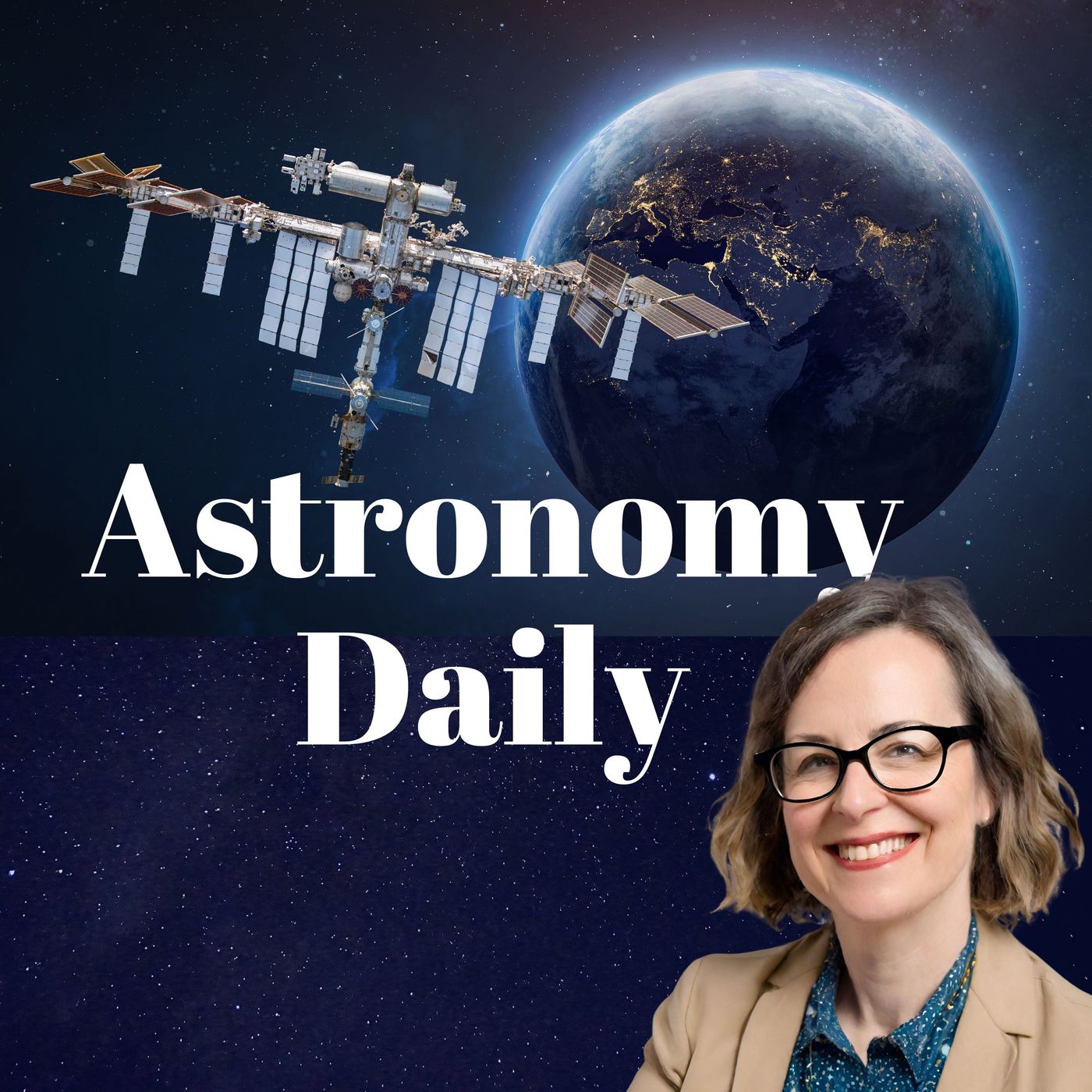
- End of an Era for the International Space Station: NASA has outlined its final plans for the International Space Station, marking a significant transition in space exploration. The ISS, after over 25 years of continuous human presence in low Earth orbit, is set for a controlled deorbit in late 2030, targeting Point Nemo to minimize risks to people and property during its descent.
- Planets as Self-Sufficient Water Factories: New research reveals that certain exoplanets, specifically sub-neptunes, may generate their own water through chemical reactions between hydrogen-rich atmospheres and rocky interiors. This groundbreaking finding could reshape our understanding of habitability and the prevalence of water-rich worlds in the universe.
- Busy Week for Rocket Launches: This week is bustling with rocket launches globally, including China's Shung Zheng 7A rocket, the European Ariane 62, and multiple Falcon 9 launches by SpaceX. The week culminates with Blue Origin's new Glenn rocket carrying NASA's Escapade mission to study Mars' magnetosphere.
- India's Communications Satellite Launch: The Indian Space Research Organization (ISRO) successfully launched its heaviest communications satellite, CMS03, designed to enhance the operational capabilities of the Indian Navy. This launch signifies India's growing ambitions in space exploration, including plans for a crewed lunar mission by 2027.
- Universe Born Inside a Black Hole?: A new cosmological model proposes that our universe may have originated inside a black hole, challenging traditional Big Bang theories. This model suggests a gravitational bounce from maximum compression could lead to the birth of new universes, potentially explaining cosmic inflation and allowing for a multiverse scenario.
- For more cosmic updates, visit our website at astronomydaily.io. Join our community on social media by searching for #AstroDailyPod on Facebook, X, YouTubeMusic, TikTok, and our new Instagram account! Don’t forget to subscribe to the podcast on Apple Podcasts, Spotify, iHeartRadio, or wherever you get your podcasts.
- Thank you for tuning in. This is Anna and Avery signing off. Until next time, keep looking up and exploring the wonders of our universe.
NASA's ISS Deorbit Plan
[NASA](https://www.nasa.gov/)
Sub-Neptunes Water Research
[Nature Astronomy](https://www.nature.com/natastronomy/)
Global Rocket Launch Schedule
[Space Launch Schedule](https://www.spacelaunchschedule.com/)
ISRO's CMS03 Satellite Launch
[ISRO](https://www.isro.gov.in/)
Black Hole Cosmological Model
[Nature Physics](https://www.nature.com/nphys/)
Become a supporter of this podcast: https://www.spreaker.com/podcast/astronomy-daily-space-news-updates--5648921/support.
Sponsor Details:
Ensure your online privacy by using NordVPN. To get our special listener deal and save a lot of money, visit www.bitesz.com/nordvpn. Help support our show and do yourself a big favour!
Sponsor Details:<br...
Avery: Welcome back to Astronomy Daily, the podcast that brings the cosmos down to Earth. Uh, I'm Avery. Anna: And I'm Anna. Uh, we have another busy show for you today. We're discussing the end of an era for the International Space Station, a huge. Avery: Moment in space history. Anna: We'll also explore new research suggesting some planets can create their own water. We'll cover a ridiculously busy week for rocket launches around the globe. And we'll dive into into a mind bending new theory that our universe might have been born inside a black hole.
Avery: That last one sounds incredible. Let's get right into it. Anna: First up, um, a story that marks a monumental transition in space exploration. After more than 25 years of continuous human presence in low Earth orbit. NASA has detailed its final plan for the International Space Station. Avery: It's hard to imagine our presence in space without it. So the deorbit is planned for late 2030. What is the final farewell going to look like for this incredible structure? Anna: Well, it won't be a quiet retirement.
The plan is to perform a controlled DE orbit, guiding the 460 ton station to a fiery re entry over the Pacific Ocean. Right. Avery: And they have a very specific target in mind, don't they? Anna: They do. The target is Point Nemo, also known as the Oceanic Pole of Inaccessibility. It's the point on Earth farthest from any land. Avery: The spacecraft cemetery. I remember reading that it's so isolated, the closest humans are often the astronauts flying overhead on the ISS itself. A fitting final resting place it is.
Anna: That isolation minimizes any risk to people or property from falling debris. To get it there, NASA will use a modified SpaceX Dragon capsule to essentially act as a deorbit vehicle, providing the final push to guide the station's descent. Avery: And this is a big deal. Physically speaking, it's the largest human made object ever to be brought down from orbit, isn't it? Anna: By far. Most of the station is expected to vaporize due to the intense heat of reentry. But some some denser, more resilient components will likely survive the plunge and sink to the ocean floor.
Avery: Mhm. And the goal is to avoid what happened with Skylab in 1979. Anna: Exactly. The uncontrolled re entry of Skylab scattered debris across parts of Western Australia, which was a major wake up call. They learned from that. And Russia's much more precise deorbit of the Mir space station in 2001 provided a better model, which this plan builds upon. Avery: A carefully managed end for a monumental piece of human history. From that story of cosmic endings. Let's turn to one about cosmic creation.
Anna. This next story about planets making their own water is fascinating. Anna: It really is. New research suggests that certain types of exoplanets, specifically a class called sub neptunes, might not need water delivered by comets or asteroids. They might be able to generate it themselves. Avery: So they're self sufficient water factories. How does that work? Anna: The theory centers on their unique structure. These planets have rocky interiors, but they're enveloped in thick hydrogen rich atmospheres.
During their chaotic formation their surfaces would have been vast magma oceans. Avery: Okay, magma and hydrogen. Anna: Exactly. Scientists recreated these conditions in a lab. They found that the immense pressure and heat cause hydrogen from the atmospher to react with iron rich silicates in the magma. This reaction releases oxygen from the rock which then immediately combines with the surrounding hydrogen to form water. Avery: That's incredible. So the planet essentially breathes in hydrogen and um, exhales water into its own geology.
What does this mean for the search for life? Anna: It's a potential game changer. It offers a completely new pathway for how rocky planets can acquire water which we consider a key ingredient for habitability. It could mean that water rich worlds are far more common in the universe than we previously thought. Avery: Amazing. It widens the scope of where we might look for life now from planet formation to modern day exploration. It seems like this week is shaping up to be one of the busiest in recent memory for space launches.
Anna: It's an absolutely packed schedule. It feels like someone is launching something every day, right? Avery: Kicking things off. A Chinese Shung Zheng 7A rocket has already launched the Yaogan 46 Earth observation satellite. Over in Europe an Ariane 62 is set to launch Sentinel 1D to monitor Earth's surface with radar. Anna: MHM and Rocket Lab is in on the action too. Avery: M of course. Their electron rocket will be deploying the sixth QPS SAR satellite for a Japanese Const. And then there's SpaceX which has not one, not two, but three Falcon 9 launches scheduled, carrying dozens more Starlink satellites into orbit.
Anna: It's always a Busy week when SpaceX has a triple header and we're not done. Avery: United Launch alliance is launching an Atlas V with a viasat communications satellite. And the grand finale is Blue Origin's new Glenn rocket scheduled for its second flight carrying a really exciting NASA mission. Anna: That's the escapade mission, isn't it? It's sending twin spacecraft to study Mars magnetis here which is a key to understanding how Mars lost its atmosphere over billions of years. Avery: Exactly.
A uh, truly global and jam packed week for spaceflight. Speaking of national space programs making big moves. Let's talk about India's latest achievement. Anna: Yes. The Indian Space Research Organization, or isro, had a major success. They just launched their heaviest communications satellite to date, called CMS03 from the Srihrakota launch site. Avery: How heavy are we talking about? Anna: 4,410 kg, or nearly £10,000. It was launched aboard the LVM3M M5 vehicle, which is an upgraded version of the very same rocket that successfully sent the Chandrayaan 3 mission to the moon.
Avery: That rocket is proving to be a real workhorse for them. This fits right in with India's growing ambitions in space. I know Prime Minister Modi praised the achievement. Anna: It does. It's part of a broader push that includes the goal of sending an Indian astronaut to the moon by 2040 and a crewed mission that's planned for as early as 2027. They are rapidly becoming a major player in space exploration. Avery: And what's the purpose of this specific satellite, CMS03? Anna: It has a crucial role.
It's designed to provide secure and encrypted communication links specifically for the Indian Navy, enhancing their operational capabilities across the region. Avery: Another impressive milestone for isro. Okay, for our final story, we're moving from the practical to the purely theoretical. And this one is a mind bender. Could our entire universe have been born inside a black hole? Anna: This is one of those ideas that sounds like science fiction, but is grounded in some serious physics. A new cosmological model is proposing just that, Challenging the Big Bang's concept of a singularity.
Avery: The singularity. The idea that everything came from an infinitely dense point. So what does this new model suggest instead? Anna: The theory suggests that as matter collapses inside a black hole in a parent universe, it doesn't form an infinitely dense point. Instead, quantum pressure prevents that from happening. The matter reaches a point of maximum compression and then rebounds in what they call a gravitational bounce. Avery: And that bounce is the birth of a new universe. Our universe.
Anna: That's the idea. It expands to become a new universe. What's compelling about this black hole universe model is that it uses established principles of quantum mechanics and general relativity. It doesn't need to invent hypothetical particles or forces to work. Avery: So it's a more elegant solution in a way. Could it explain some of the big mysteries like cosmic inflation? Anna: Potentially, yes. The dynamics of the bounce could naturally explain the rapid expansion phase of the early universe and why our universe appears to be geometrically flat from the outside.
In the parent universe, it would just look like a normal black hole. But on the Inside, a new cosmos is being born. Avery: Wow. Is a theory like this even testable? Anna: It might be. The theory predicts there should be a very slight detectable curvature to our universe. Upcoming missions, like the European Space Agency's Arrake's telescope, could be sensitive enough to measure it and either support or challenge this incredible new idea. Avery: So if this model holds true, it implies a kind of cosmic recycling.
A multiverse where universes are constantly budding off from one another inside black holes. It's a staggering thought. Does the theory say anything about what the parent universe might be like? Anna: That's where things get even more speculative. The model doesn't require the parent universe to have the same physical laws as our own. The gravitational bounce could effectively reset the fundament mental constants. So the universe next door, so to speak, could be utterly alien to ours. With different physics, different chemistry, perhaps not even allowing for stars and galaxies as we know them.
Avery: It's a humbling perspective. It means our entire existence could just be one outcome of a process that's happening countless times across a much grander reality. And we're completely isolated, unable to ever see or interact with that parent universe. Anna: Precisely from our perspective, the event horizon of the black hole we were born from acts as an ultimate boundary. It's a one way door. Information from the parent universe can't get in and we can't get out. Our universe is self contained.
It also solves the problem of what came before the Big Bang. In this scenario, there was another universe, another timeline, another. Avery: And it also suggests that, uh, black holes in our own universe could potentially be spawning new universes as we speak. So the cycle continues. Anna: That's the logical extension of the theory. Yes. Every supermassive black hole at the center of a galaxy, every stellar mass black hole formed from a collapsing star. Each one could be a seed for a new cosmos.
It's a beautiful, if mind boggling picture of cosmic evolution. Avery: What a way to end the show. From the end of the ISS to the potential beginning of everything, that's all the time we have for today. Anna: Thanks for tuning in to Astronomy Daily. Join us again tomorrow as we continue to explore the wonders of the universe. Until then, keep looking up.
 Apple Podcasts
 Spotify
 Pocket Casts
 Castbox
 Overcast
 Podbean
 iHeartRadio
 Castro
 Goodpods
 Moon FM
 Podcast Addict
 Podcast Republic
 YouTube