In this episode
- Interstellar Comet 3I Atlas Update: An exciting update on the interstellar comet 3I Atlas reveals it is brightening much faster than anticipated as it approaches the Sun. With its distinct blue color, astronomers believe it is venting ancient frozen materials, offering a rare glimpse into the chemical composition of an object from another star system. Amateur astronomers can now spot this cosmic visitor with their telescopes!
- NASA vs. Celebrity Misinformation: A recent claim by Kim Kardashian questioning the authenticity of the 1969 Moon landing prompted NASA to respond publicly. Acting Administrator Sean Duffy reiterated the overwhelming evidence supporting the Moon landings, including lunar rocks and retroreflectors, and extended an invitation to Kardashian to witness the upcoming Artemis mission launch.
- Ancient White Dwarf Star Discovery: Astronomers have discovered a 3 billion-year-old white dwarf star that is still consuming the remains of its own planet, challenging existing models of stellar evolution. This unique observation suggests that planetary systems can remain active long after their stars have died, providing insights into the future of our own solar system.
- Debunking the Full Moon Effect: Investigating the long-held belief that the full Moon influences sleep and behavior, a neurologist found minimal evidence for its effects. While people may sleep about 20 minutes less during a full Moon due to increased brightness, claims linking lunar phases to erratic behavior are largely unfounded, attributed instead to psychological patterns of perception.
- For more cosmic updates, visit our website at astronomydaily.io. Join our community on social media by searching for #AstroDailyPod on Facebook, X, YouTubeMusic, TikTok, and our new Instagram account! Don’t forget to subscribe to the podcast on Apple Podcasts, Spotify, iHeartRadio, or wherever you get your podcasts.
- Thank you for tuning in. This is Anna and Avery signing off. Until next time, keep looking up and exploring the wonders of our universe.
Interstellar Comet 3I Atlas
[NASA](https://www.nasa.gov/)
NASA's Response to Misinformation
[NASA](https://www.nasa.gov/)
Ancient White Dwarf Star Study
[Nature Astronomy](https://www.nature.com/natastronomy/)
Full Moon Effect Research
[Journal of Sleep Research](https://onlinelibrary.wiley.com/journal/13652869)
Become a supporter of this podcast: https://www.spreaker.com/podcast/astronomy-daily-space-news-updates--5648921/support.
Sponsor Details:
Ensure your online privacy by using NordVPN. To get our special listener deal and save a lot of money, visit www.bitesz.com/nordvpn. You'll be glad you did!
Sponsor Details:
Ensure your online privacy by using NordVPN. To get our special listener deal and save a lot of money, visit www.astronomydaily.io/nordvpn. You'll be glad you did!
Get the best secure and private email on the planet. Stop your Government,...
Avery: Welcome to Astronomy Daily. I'm avery. Give us 10 minutes and we'll give you the universe. Anna: And I'm Anna. It's great to be with you. We've got a fascinating lineup today, from an, um, update on our interstellar visitor to a cosmic myth that just won't fade. Avery: That's right. We'll also be touching on a very public debate about our history on the Moon and a discovery that challenges what we thought we knew about the end of a star's life. So let's get started. First up, something for all you stargazers out there.
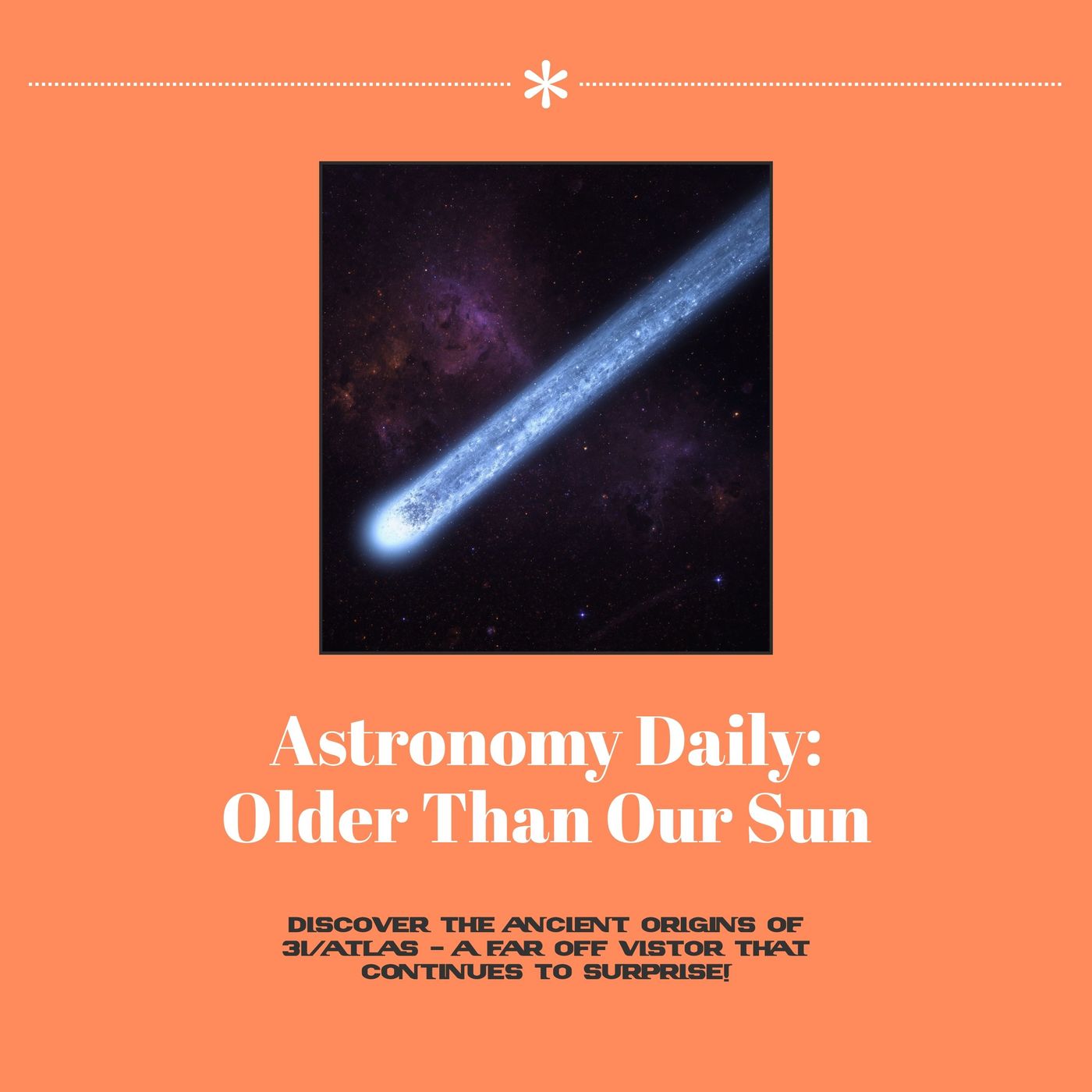
Our lead story is an update about a visitor from beyond our solar system, an interstellar comet named 3i Atlas. Which is putting on quite a show, right? Anna: This isn't just any comet. It's brightening much, much faster than anyone predicted. As it gets closer to the sun, it's becoming a real point of interest for both professional and amateur astronomers. Avery: Exactly. And it's not just its brightness. It has this distinct blue color. What does that tell us, Ann? Anna: That color is a big clue about its composition.
The blue hue strongly suggests significant gas emissions, likely from volatile compounds like cyanogen and ammonia ice sublimating, turning directly from solid to gas as the Sun's heat hits them. It's like the comet is venting its ancient frozen materials into space. Avery: Fascinating. So we're essentially seeing the chemical makeup of an object from another star system. And we have some amazing tools pointed at it, right? Anna: Mm mhm. A whole fleet of solar monitoring satellites are tracking it.
We're talking about stereo, A, SoHo, and even the new GOES 19 weather satellite. They're all being used to get different perspectives and data on how the comet is behaving as it heats up. Avery: And the best part for our listeners who might have a telescope sitting in their garage, is that 3i Atlas is now bright enough to be spotted with amateur equipment. So if you know where to look, you can see an object from another star with your own eyes. Anna: And these different perspectives are crucial, aren't they?
Because this comet is on a hyperbolic trajectory, meaning it's moving too fast to be captured by our Sun's gravity. It's a one time visitor zipping through our neighborhood before heading back out into the vastness of interstellar space. Avery: That's what makes every piece of data so precious. Unlike, uh, comets from our own Oort cloud, which we can study again and again, this is our only chance to analyze the building blocks of another star system up, uh, close. It's like a cosmic probe sent to us from a distant unknown star.
Anna: It's a really exciting opportunity. These interstellar visitors are rare, and one that puts on a show like this is even rarer. A great reason to dust off that telescope. Avery: Speaking of things capturing public attention, our next story shifts from the outer reaches of the solar system to a debate happening right here on Earth, centered on our own moon. Anna: This is a strange one. NASA recently had to publicly respond to a claim made by Kim Kardashian on her show. She stated that she believes the 1969 moon landing was fake.
Avery: It's a conspiracy theory that's been around for decades, but it's always surprising when it gets a platform of that size. What was her reasoning? Anna: She cited some heavily edited videos of astronaut Buzz Aldrin where his words were taken out of context to make it sound like he was admitting it didn't happen. It's a classic case of misinformation, unfortunately. Mhm. Avery: So how did NASA handle it? You don't often see a government science agency getting into a back and forth with a reality TV star.
Anna: They handled it with a lot of grace, I think. The acting administrator, Sean Duffy, issued a very clear statement. He didn't just dismiss the claim, but reiterated the fact that NASA has successfully landed humans on the moon six times. Avery: He also pointed to the mountains of physical evidence. We have hundreds of kilograms of lunar rocks that have been studied by scientists worldwide. Their composition is entirely different from Earth rocks. Plus there are retroreflectors left on the moon's surface by the Apollo missions that observatories still use today to measure the exact distance to the moon.
Anna: And he extended an invitation, right? Avery: He did. He invited Kardashian to the Kennedy Space center to witness the launch of the upcoming Artemis mission, which will be sending astronauts back to the Moon. A sort of come see for yourself gesture. It was a firm but very classy way to counter the misinformation. And turned it into a teachable moment. Anna: Exactly. And let's not forget the independent verification. The Soviet Union, America's chief rival in the space race, was monitoring the Apollo missions.
If the landings were faked, they would have had every incentive to expose it, and they never did. The evidence is simply overwhelming. Avery: Absolutely. A good reminder of how important it is to rely on primary sources and scientific consensus. From celebrities looking at the moon to scientists looking at distant dying stars. Our next story is a real head scratcher. Anna: This one comes from the field of stellar evolution. Astronomers have found something that really shouldn't exist according to our current models.
It's an ancient White dwarf star about 3 billion years old that's still actively consuming the remains of its own planet. Avery: That's incredible. A white dwarf is a dense core left over after a star like our sun dies. The con thinking is that any planetary cleanup process should be over much, much sooner than 3 billion years. Anna: Precisely. The star is called LSPM J M02073331, and it's surrounded by a debris disk made of shredded planetary material. This disk is the oldest and most metal rich ever observed around a star of this type.
It's like finding a dinosaur that's still alive and eating. Avery: So what's the theory? How is this still happening after so long? Anna: The leading hypothesis is that the planetary system must have been disturbed relatively recently. Something must have happened. Perhaps a gravitational nudge from a surviving outer planet that sent a rocky body spiraling inwards towards the white dwarf, where it got torn apart by the star's immense gravity. Avery: So it suggests that planetary systems can remain dynamically active for billions of years after their star has died.
That's a profound thought. Anna: It's a chaotic process, but one that provides a unique window. When this material falls onto the white dwarf, Astronomers can analyze its chemical signature using spectroscopy. This tells them exactly what the shredded planets were made of, whether they were rocky like Earth, or rich in other elements. It's like performing an autopsy on an exoplanet. Avery: So this discovery isn't just about one strange old star. It gives us a glimpse into the very, very distant future of our own solar system.
Billions of years from now, after our sun becomes a white dwarf, the remaining planets might get jostled around, and Earth itself could eventually be torn apart and consumed in a similar fashion. Anna: It really is. It forces us to rethink the timelines for the late stages of stellar evolution. It's a beautiful, chaotic glimpse into the far future of, uh, systems like our own. Avery: That brings us back closer to home. We were just talking about the Moon in a cultural context. But our final story looks at a long standing belief about its direct effect on us, specifically on our sleep and our behavior.
Anna: Right. The idea of the full Moon effect. Many people swear they sleep worse or that people act strangely during a full moon. We spoke with a neurologist to get the scientific take on this. Avery: And what's the verdict? Is there any truth to it? Anna: There's a tiny kernel of truth when it comes to sleep. Studies show that on average, people get about 20 minutes less sleep on the nights surrounding a full moon. But the influence on mental health or behavior has no scientific proof whatsoever.
Avery: Okay, so why the 20 minutes of lost sleep? Is it gravity or something more mysterious? Anna: Nothing so mysterious. The most likely culprit is simply light. A full Moon is significantly brighter than any other phase. And that extra light, especially in pre industrial times, could be enough to delay our body's internal clock and suppress the production of the sleep hormone melatonin. Avery: That makes sense. And the behavioral stuff? The idea that emergency rooms are busier or people are more erratic.
Anna: It's an ancient belief, isn't it? The word lunacy itself comes from luna, the Latin word for Moon. For centuries, people have tried to link human behavior to the lunar cycle without any real evidence. Avery: That's likely a psychological phenomenon called illusory correlation. Our brains are wired to find patterns, and we tend to remember events that confirm our beliefs. So if something odd happens during a full Moon, we link the two while ignoring all the odd things that happen when the Moon isn't full.
Anna: That's right. And another common argument you hear is about the Moon's gravitational pull affecting the water in our bodies, just like it causes ocean tides. But the neurologist we spoke to completely debunked that. The gravitational force of the Moon on a person is miniscule, far less than the force exerted by a large building you're standing next to. It's simply not strong enough to have any biological effect. Avery: Right. And the neurologist also pointed out that the impact of the Moon's light pales in comparison to the artificial light we're bathed in every night from our phones, screens and streetlights.
Anna: Exactly. If you're worried about light disrupting your sleep, the full Moon should be the least of your concerns. It's a fascinating myth, but one that science has largely put to bed. Avery: A perfect summary. And that's all the time we have for today's deep dive into the cosmos, from interstellar comets to ancient stars and lunar myths. Anna: Thanks for joining us, uh, on Astronomy Daily. I'm Anna. Avery: And I'm Avery. Join us next time as we continue to explore the universe. Until then, keep looking up.
 Apple Podcasts
 Spotify
 Pocket Casts
 Castbox
 Overcast
 Podbean
 iHeartRadio
 Castro
 Goodpods
 Moon FM
 Podcast Addict
 Podcast Republic
 YouTube