In this episode
Sponsor Link:When your ready to check out our special money saving NordVPN deal - Click Here
Today on Astronomy Daily: A weather-delayed rocket launch gets a second chance — Dragon is heading to the ISS tonight. The most powerful rocket ever built is fuelled and ready, with Starship V3 Flight 12 targeting as early as May 19. NASA's Psyche spacecraft is days away from a dramatic Mars slingshot. A startup wants to beam electricity to satellites using lasers. Physicists may have cracked one of science's greatest puzzles. And Juno delivers the closest-ever view of a mysterious moon of Jupiter. All this — plus a Southern Hemisphere skywatching guide and space trivia — on Episode 101. Chapter Timestamps 00:00 — Cold Open & Introduction 01:15 — Story 1: SpaceX CRS-34 Dragon cargo launch — weather scrub resolved 05:00 — Story 2: Starship V3 Flight 12 — launch as early as May 19 09:00 — Story 3: NASA Psyche spacecraft Mars flyby — this Friday 13:00 — Story 4: Star Catcher Industries raises $65M for space power grid 17:00 — Story 5: Brown University solves the cosmological constant problem 21:00 — Story 6: Juno's closest-ever image of Jupiter's moon Thebe 25:00 — Southern Hemisphere Skywatching Guide 26:30 — Space Trivia: What is asteroid Psyche made of? 27:30 — Outro & Sign-off Stories Covered Today • SpaceX CRS-34 mission launches tonight from Cape Canaveral after Tuesday weather scrub • Starship V3 completes wet dress rehearsal — Flight 12 targeting May 19 • NASA Psyche spacecraft performs Mars gravity assist flyby on May 15 • Star Catcher Industries raises $65 million for world's first orbital power grid • Brown University proposes topology solution to the cosmological constant problem • NASA Juno captures closest-ever image of Jupiter's inner moon Thebe Find us at astronomydaily.io | Follow @AstroDailyPod | Part of the Bitesz.com Podcast Network
Become a supporter of this podcast: https://www.spreaker.com/podcast/astronomy-daily-latest-space-news--5648921/support.
Sponsor Details:
Ensure your online privacy by using NordVPN. To get our special listener deal and save a lot of money, visit www.astronomydaily.io/nordvpn. You'll be glad you did!
Get the best secure and private email on the planet. Stop your Government, google and who knows who else spying on every email you write. Do what we did and use ProtonMail. They beleive in privacy and there are no ads in their business model...yet they still provide a free forever service. Check them out and get out special deal at www.astronomydaily.io/protonmail
Become a supporter of Astronomy Daily by joining our Supporters Club. Commercial free episodes daily are only a click way... Click Here
This episode includes AI-generated content.
Anna: A rocket that got grounded by the weather. It's back on the pad and ready to fly tonight. Avery: And the most powerful rocket ever built is fueled, stacked and just waiting for a green light. Flight 12 could happen any day now. Anna: Plus a uh, spacecraft is about to use Mars as a slingshot. And someone has figured out how to beam electricity to satellites using lasers. Avery: Big day in space. Let's get into it. This is Astronomy Daily. Anna: Hello and welcome to Astronomy Daily, your daily guide to the universe and everything in it.
I'm Anna. Avery: And I'm um, avery. It's Wednesday the 13th of May 2026 and this is season five episode 101. Anna: Episode 101. We've officially passed the century mark. Thank you as always to everyone listening. From Europe to Australia, across the Southern hemisphere, through the Americas and all of the northern hemisphere and around the world. Avery: Big program today, six stories, some real science, a, uh, sky watching update, and a trivia question to keep your brain ticking. Anna: Let's start with the launch that almost wasn't, but very much is.
Avery: If you were with us yesterday, you might remember we mentioned that the SpaceX Dragon cargo launch was looking a little shaky, weather was a concern and sure enough NASA and SpaceX called off the Tuesday evening attempt. Anna: And here we are, it is back on the CRS 34 mission. Dragon's 34th cargo run to the International Space Station is scheduled to lift off today, Wednesday the 13th of May at 6:50 in the evening Eastern Time. That's 8:50am M Thursday morning for us here in Australia. Avery: The Falcon 9 launches from Space Launch Complex 40 at AH, Cape Canaveral Space Force Station in Florida.
On board, about 6,500 pounds, roughly 2,950 kilograms of supplies, hardware and scientific experiments bound for the ISS. Anna: And there are some genuinely interesting experiments in that cargo hold. There's a project looking at how well Earth based simulators actually replicate microgravity M conditions, which matters enormously for preparing future astronauts. Avery: There's also a bone scaffold, uh, made from wood. Yes, wood that could eventually lead to new treatments for conditions like osteoporosis and equipment to study how red blood cells and the spleen adapt to the space environment.
With an eye on protecting future long duration crews. Anna: What makes this mission particularly special though is the Dragon capsule itself. This is the sixth flight for the specific vehicle, setting a new record for a SpaceX cargo craft. Avery: Six flights for one capsule. That reusability story just keeps getting more impressive. If all goes to plan, Dragon will dock with the Harmony Module's forward port at around 7:35 in the morning EDT on Thursday the 14th. Anna: We'll keep an eye on that one.
RCS 34 the comeback launch While one Avery: rocket is heading to the ISS today, another one is sitting on the pad in South Texas, generating enormous anticipation. SpaceX's Starship V3 Flight 12 could launch as soon as May 19th. Anna: And the milestone from this week that has engineers buzzing. The fully stacked V3 vehicle successfully completed its wet dress rehearsal. That means it was fueled up for the first time ever more than 5,000 metric tons of propellant. That's a number so large it barely sounds real.
Avery: Standing 124 meters tall, that's taller than a 40 story building. The V3 is a complete, complete redesign of the Starship system. It features upgraded Raptor 3 engines, a new lattice structure for hot staging, and massively increased payload capacity. We're talking 100 metric tons to low Earth orbit in a fully reusable configuration. The previous version managed around 35. Anna: Flight 12 will be a suborbital test. SpaceX is deliberately taking a step back in ambition to validate the new V3 architecture before pushing for the booster catch milestones we saw in Flight 11.
Both the booster and the ship are uh, targeting splashdown on this one. Avery: What's at stake? Quite a lot. SpaceX's has a reported IPO on the horizon. NASA's Artemis program needs a functioning starship lunar lander and the company's banking on this vehicle to grow Starlink and eventually launch AI data centers into orbit. Anna: The wet dress rehearsal is done. The static fires are done. All they need now is an FAA launch license. And that apparently is close. Watch this space quite literally, if you Avery: want a front row seat to some incredible orbital Mechanics, this Friday, May 15th is your moment.
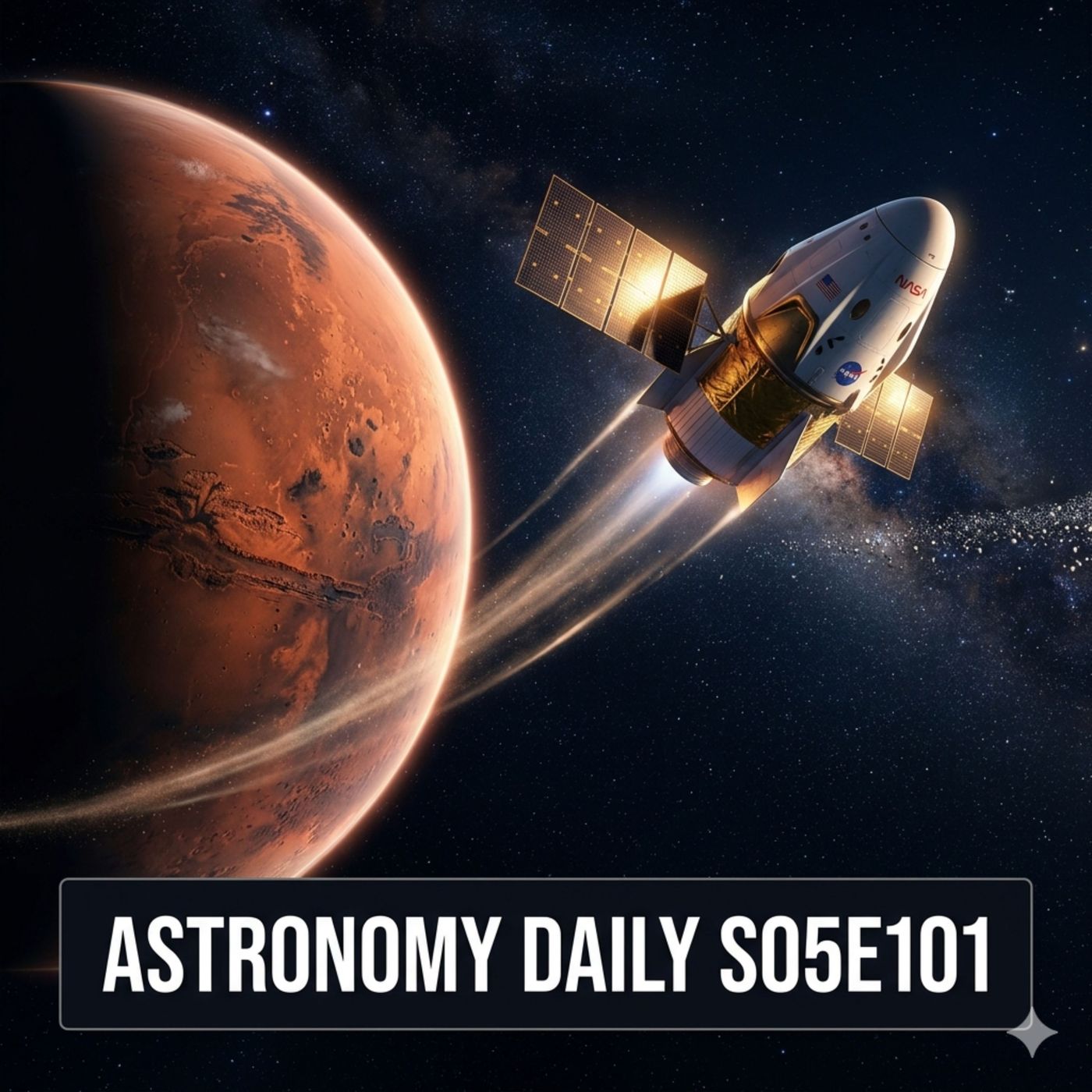
NASA Psyche spacecraft is about to use Mars as a gravitational slingshot. Anna: Psyche launched back in October 2023 and has been on a long fuel efficient journey toward the asteroid belt, where it's heading for a metal rich asteroid, also named psyche, arriving in 2029. But to get there, it needs a speed boost. And Mars is about to provide one. Avery: At about 12,333 miles per hour. That's nearly 20,000 kilometers per hour. The spacecraft will pass just 2,800 miles, or about 4,500 kilometers from the Martian surface.
The planet's gravity will effectively grab Psyche, swing it around, accelerate it and redirect its trajectory towards the asteroid belt. Anna: This is called a, uh, gravity assist and it's one of the most elegant techniques in all of space exploration. Instead of burning precious fuel, you borrow energy from a planet's orbital motion. It's been used on missions dating back to Voyager. Avery: But this by blight isn't just about speed. It's a rare opportunity to calibrate Psyche science instruments.
While there's something large enough to actually observe, the imager will get its first proper workout. The magnetometer may detect Mars's magnetic field. And scientists are intrigued by the possibility that the spacecraft might catch glimpses of a faint dust ring or torus surrounding Mars created by micrometeorites striking the surfaces of its two moons, Phobos and Deimos. Anna: Several existing Mars missions, including the Curiosity and perseverance rovers and NASA's orbiters, will also be watching and contributing data during the encounter.
Avery: Friday the 15th. Mark it in your calendar. Psyche and M Mars an encounter 2.8 billion kilometers in the making Just before Anna: I take us into our next story, a quick reminder to check out the great deal our uh, sponsor NORDVPN has put together for you. Get top grade online security for a fraction of the price. You can check the details out via the link in the show notes. Alright, moving on. Here's a story that sounds almost like science fiction, but it is very much real and very much happening right now.
A Florida based startup called Starcatcher Industries has just raised $65 million to build what it describes as the world's first power grid in space. Avery: The concept is called optical power beaming. Starcatcher plans to launch a constellation of satellites that will focus sunlight in the form of laser light onto other solar panels of other satellites that need more power. No hardware modifications to the receiving satellite required just extra electricity on demand. Anna: The company says its system can deliver up to 10 times more power to client satellites than they could generate on their own, and its CEO, Andrew Rush made an analogy that I think really captures why this matters.
He said, and I'm paraphrasing that every satellite is essentially on camping trip. It carries its own power and at some point it runs low. Avery: Starcatcher wants to change that the same way the terrestrial power grid enabled revolutions in communications computing here on Earth. An orbital power grid could unlock the next generation of capabilities in space, things like persistent Earth observation, real time data processing and advanced communications infrastructure. Anna: The Series A round was oversubscribed, meaning more investors wanted in than there were shares available, and was led by B Capital, with Shield Capital and Cerberus Ventures also co leading.
Notably, General J. Raymond, the first chief of space operations of the US Space Force, is joining the board. Avery: Starcatcher already holds the world record for optical power beaming on the ground and has completed an on orbit subsystem demonstration. Now it's moving from validated technology to scalable infrastructure. An in space demonstration is planned for later this year. Anna: Mhm. Lasers in space, charging your satellites. The future is something else. Avery: Alright, now we're going deep.
This one is for everyone who's ever stared at the night sky and thought, why is any of this here? And why does it work the way it does? Anna: Physicists at Brown University in Rhode island have published a paper in Physical Review Letters proposing a potential solution to one of the most vexing problems in all of the cosmological constant problem. Avery: Let's unpack that. The cosmological constant is the mathematical term that describes the energy driving the accelerating expansion of the universe.
Einstein introduced it, famously, called it his greatest blunder, and then died not knowing he'd actually been right about it. Observations in the 1990s confirmed the universe's expansion is indeed accelerating. Anna: Here's the Quantum field theory, one of the most successful and rigorously tested frameworks in physics, predicts that vacuum energy, the energy inherent in empty space, should make the cosmological constant enormous, practically infinite. But what we actually observe, a tiny, tiny fraction of that prediction, the discrepancy is around 120 orders of magnitude.
That's, uh, a one followed by 120 zeros. Avery: It is, without exaggeration, the worst prediction in the history of physics, and the Brown University team thinks they may have found a way to explain it. Anna: Their insight draws an analogy with something called the quantum hall effect, an exotic phenomenon in condensed matter physics, where electrical conductance in certain materials is held perfectly steady, regardless of imperfections, because of the topology, the mathematical shape of the quantum state.
Avery: The researchers found that the simplest formulation of quantum gravity has a mathematically analogous structure, something called the Chern Simons Kodama state. And in that framework, the cosmological constant becomes essentially locked in place. It's protected by topology. The quantum fluctuations that should be destabilizing it are simply too small or improbable Anna: to shift it, which, if it holds up, would explain why the constant has the value it does, not because of some extraordinary fine tuning, but because the universe's geometry protects it.
Avery: The authors are the first to acknowledge this is a beginning, not an ending. There's a lot of detailed work still to do, but it's a genuinely new idea in one of the oldest unsolved problems in physics, and that deserves a moment. Anna: We end today in the Jovian system And with an image that has had planetary scientists genuinely excited. Avery: On 1 May, NASA's Juno spacecraft completed a close flyby of Thebe, the second largest of Jupiter's inner moons. And when we say close, we mean it.
Juno passed within just 3,100 miles or 5,000 kilometers of thebe's surface. The resulting image captures detail at a resolution of about 1.9 miles per pixel. The sharpest view we have ever had of this world. Anna: Thebe sits at the outer edge of Jupiter's faint ring system. And that position is no coincidence. Scientists believe Thebe plays an active role in shaping one of Jupiter's most delicate structures, the so called gossamer ring. Dust shed from Thebes surface gets swept into the ring, helping maintain it.
Avery: The image was captured using Juno's Stellar Reference Unit, an instrument whose primary job is navigation imaging star fields to keep the spacecraft oriented. But its exceptional sensitivity in low light conditions has made it a surprisingly powerful secondary science instrument. It's previously discovered shallow lightning in Jupiter's atmosphere and revealed the structure of Jupiter's ring system. Anna: And now it's given us Thebe up close. A small irregular world, heavily cratered, ancient, playing a uh, quiet but essential role in the dynamics of the solar system's largest planet.
Avery: Juno continues to surprise us even this deep into its extended mission. What a spacecraft. Anna: Before we go, let's take a look at the sky above you this week. Southern Hemisphere listeners. Avery: This morning, if you were up early enough, you may have caught Saturn and a slender crescent moon sharing the sky in the east just a few degrees apart in Pisces. Saturn's ring system is tilted towards us again after years at southerly declinations, so conditions are improving every month. Anna: Also in the pre dawn sky, Neptune is in the area, though you'll need binoculars or a telescope for that one.
Avery: Tomorrow morning, Thursday the 14th, Mars makes its own crescent moon pairing. A thin sliver of moon sitting about 4 degrees from the red planet, both visible to the naked eye under a reasonably dark sky. Anna: And looking ahead, the flower moon, May's full moon arrives on May 31 and it will be a blue moon. That's the second full moon in a single calendar month. It won't actually look blue, but it's a lovely thing to know. Avery: Clear skies to all of you out there now, trivia time. Anna: Today's trivia question ties into our Psyche mission story.
Avery: The asteroid 16 Psyche is thought to be the exposed metallic core of an ancient protoplanet. Scientists believe it may be composed primarily of two elements. Anna: What are they Oh, I know that one. The answer Nickel and Iron Psyche is thought to be a, uh, remnant planetary core, the building blocks of rocky worlds stripped bare by billions of years of collisions. Studying it from orbit could give us the closest thing we'll ever have to a look inside the Earth itself, which Avery: is remarkable when you think about it.
We can't drill to our own planet's core, but we might be able to Anna: fly around one that is everything for today's episode of Astronomy Daily, episode 101. Thank you for spending part of your day with us. Avery: If you enjoyed the show, please subscribe, leave a review and tell a space curious friend. Every listener matters. Anna: You can find us at astronomydaily, IO and across all major podcast platforms, and you can follow us on social media. Astrodaily Pod we'll be back tomorrow with Avery: the latest from the universe.
Until then, keep looking up from Anna and Avery Clear skies.

 Apple Podcasts
 Spotify
 Pocket Casts
 Castbox
 Overcast
 Podbean
 iHeartRadio
 Castro
 Goodpods
 Moon FM
 Podcast Addict
 Podcast Republic
 YouTube