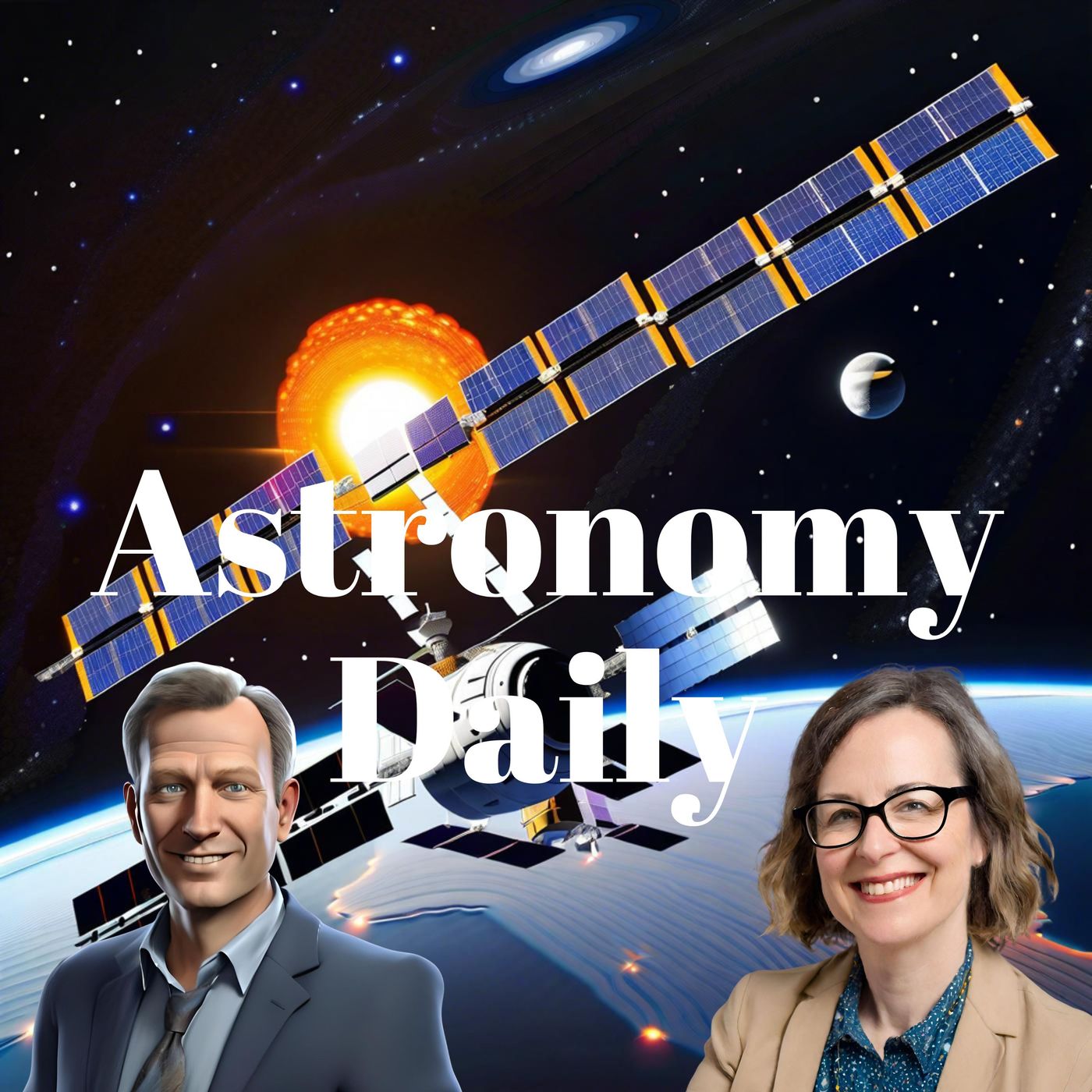
Cosmic Chronicles: JAXA's Cargo Revolution, Solar Secrets Unveiled, and Distant Galaxies' Mysteries
In this episode
- Japan's HTV X Resupply Mission: JAXA is gearing up for the inaugural flight of its new cargo delivery vehicle, the HTV X, set to launch this October. Discover how this advanced spacecraft, designed to carry up to 4 metric tonnes of supplies, will enhance the efficiency of resupply missions to the International Space Station, featuring a larger hatch for last-minute cargo loading.
- - Parker Solar Probe Confirms Magnetic Reconnection: NASA's Parker Solar Probe has validated a 70-year-old theory about the sun's energy release through magnetic reconnection. Learn how this groundbreaking confirmation, achieved during a flyby of a solar explosion, could improve our understanding of space weather and its impacts on Earth.
- - Galaxies Colliding: A Glimpse into Our Future: Astronomers are studying the collision of galaxies NGC 5713 and NGC 5719, offering insights into the eventual merger of the Milky Way and Andromeda galaxies. This observation may also hold the key to solving the dwarf satellite galaxy problem, suggesting that galactic collisions could create the missing satellites we’ve yet to observe.
- - James Webb's Surprising Discovery: The James Webb Space Telescope has revealed unexpected levels of oxygen in the galaxy Jades GS z11O, dating back to just 400 million years after the Big Bang. This finding challenges our understanding of early galaxy formation and hints at the earlier availability of essential building blocks for life in the universe.
- For more cosmic updates, visit our website at astronomydaily.io. Join our community on social media by searching for #AstroDailyPod on Facebook, X, YouTube Music, TikTok, and our new Instagram account! Don’t forget to subscribe to the podcast on Apple Podcasts, Spotify, iHeartRadio, or wherever you get your podcasts.
- Thank you for tuning in. This is Anna and Avery signing off. Until next time, keep looking up and stay curious about the wonders of our universe.
HTV X Resupply Mission Details
[JAXA](https://www.jaxa.jp/)
Parker Solar Probe Findings
[NASA](https://www.nasa.gov/)
Galactic Collision Research
[Hubble Space Telescope](https://hubblesite.org/)
James Webb Discoveries
[James Webb Space Telescope](https://www.jwst.nasa.gov/)
Astronomy Daily
[Astronomy Daily](http://www.astronomydaily.io/)
Become a supporter of this podcast: https://www.spreaker.com/podcast/astronomy-daily-space-news-updates--5648921/support.
Sponsor Details:
Ensure your online privacy by using NordVPN. To get our special listener deal and save a lot of money, visit www.bitesz.com/nordvpn. You'll be glad you did!
Sponsor Details:
Ensure your online privacy by using NordVPN. To get our special listener deal and save a lot of money, visit www.astronomydaily.io/nordvpn. You'll be glad you did!
Get the best secure and private email on the planet. Stop your Government, google and who knows who else...
Avery: Hello, and welcome to Astronomy Daily, the podcast that brings you the biggest news from across the cosmos. I'm your host, Avery. Anna: And I'm Anna. Uh, it's great to have you with us. We have a packed show for you today covering everything from new hardware heading to the International Space Station to a deep dive into the sun's explosive behaviour. We'll also be looking at colliding galaxies that offer a sneak peek into the Milky Way's distant future. And a surprising discovery from the James Webb Space Telescope that could change how we think about the dawn of the universe.
So let's get started. First up, let's talk about the lifeline to our outpost in orbit, the International Space Station. It looks like Japan's space agency JAXA is preparing a major upgrade for its cargo delivery service. Avery: That's right. JAXA has announced that its new resupply vehicle, the HTV X, is scheduled to make its inaugural flight to the ISS this October. This is a big deal. For years they used the reliable Konotori or White Stork vehicles. The HTV X is its successor and it comes with some serious improvements.
What kind of improvements are we talking about? The Konotori was already a very capable craft. Anna: It was, but space logistics are always about efficiency. The HTV X can carry more cargo, about 4 metric tonnes of pressurised supplies. It also features a larger side hatch which is a game changer for loading last minute time sensitive cargo like fresh or critical science experiments just before launch. Avery: That late loading capability is something I know station managers have wanted for a long time.
It adds a lot of flexibility. And I understand this new vehicle will be launched on Japan's new flagship rocket, the H AH3. Anna: Exactly. This first HTVX mission will be the third flight of the H3 rocket. It really showcases Jax's next generation of spaceflight hardware. The mission plan is for the HTVX to spend about 45 days docked at the station delivering supplies and experiments before it's loaded with trash and undocks for a destructive re entry over the Pacific Ocean, a crucial role in keeping the ISS running.
It's a great example of the international collaboration that makes the station possible. Okay, from low Earth orbit, let's travel towards the centre of our solar system. What's the latest news from our star, the sun? This is a fantastic story. NASA's Parker Solar Probe, the fastest object ever built by humans, has just confirmed a 70 year old theory about how the sun unleashes its energy. We are talking about a phenomenon called magnetic reconnection. Avery: Magnetic reconnection for our, uh, listeners.
Can you break down what that means? It sounds complex. Anna: Think of it like stretching a bunch of rubber bands. The sun's surface is a chaotic mess of powerful magnetic field lines. Sometimes these lines which point in opposite directions, get pushed together. They stretch and strain and eventually they snap and reconnect in a new configuration. Avery: And um, just like a snapping rubber band, that process must release a tremendous. Anna: Amount of energy, an unbelievable amount. This process is the engine behind some of the most violent events in the solar system.
Like solar flares and coronal mass ejections, these events create what we call space weather, which can send streams of charged particles hurtling towards Earth. Avery: So how did the Parker Solar Probe confirm this? Scientists have suspected this was happening for decades. Anna: By doing something no other spacecraft could. It flew right through the heart of one of these events. On its eighth flyby of the sun, its instruments detected the telltale signs of reconnection happening in the solar wind.
It measured the magnetic field's flipping direction and clocked particles being accelerated to incredible speeds, providing the first ever direct in place evidence. Avery: So it was basically flying through a solar explosion. That sounds incredibly dangerous. How did the probe even survive that? Well, it's an absolute triumph of engineering, Anna. Uh, the probe is protected by a revolutionary heat shield, officially named the Thermal protection system, or TPS. This shield is about 8ft in diameter, but only 4.5 inches thick.
And it's made of a reinforced carbon carbon composite, A material designed to be both lightweight and incredibly heat resistant. On its sun facing side, it has to withstand temperatures that can reach nearly 2,500 degrees Fahrenheit. Hot enough to melt steel. But the truly incredible part is its efficiency. While the front of the shield is scorching hot, the instruments just a few feet behind it are kept at a comfortable room temperature around a balmy 85 degrees Fahrenheit. Anna: That is truly remarkable.
It's one thing to have a theory, but to actually fly a probe through the event as it's happening is another level of confirmation. And uh, this has practical implications for us here on Earth, doesn't it? Avery: Absolutely. Better understanding the fundamental physics of space weather helps us improve our forecasts. Severe space weather can disrupt our GPS and communications satellites, damage power grids on the ground and pose risk to astronauts in space. Confirming this theory is a huge step toward predicting these events more accurately.
Anna: Amazing work from the Parker Solar Probe team. Alright, from the drama in our own solar system, let's look much, much further afield. We have a story about colliding Galaxies that acts as a sort of crystal ball for our own Milky Way. Avery: This is a glimpse into our very, very distant future. Astronomers have been observing two colliding galaxies known as NGC 5713 and NGC 5719. As these two massive systems merge, their gravitational forces are tearing long streams of stars and gas away from them, creating what are called tidal tails.
Anna: And this is relevant to us because our own Milky Way galaxy is on a collision course with our nearest large neighbourhood, the Andromeda Galaxy. Avery: It is, but don't panic. It's not expected to happen for another four and a half billion years. By studying systems like NGC 5713 and NGC 5719, we get a preview of what that cosmic smash up might look like. But there's another fascinating piece to this puzzle. Anna: Oh, uh, what's that? Avery: It might help solve a major headache in cosmology known as the dwarf satellite galaxy problem.
The standard model of cosmology, our best theory for how the universe works, predicts that large galaxies like the Milky Way should be surrounded by many more small dwarf satellite galaxies than we actually observe. There's a mismatch. Anna: So there are, uh, missing galaxies. Theoretically, how does this observation help? Avery: Well, observations of these colliding galaxies show that the clumps of gas and dust within those tidal tails actually collapse under their own gravity to form new small dwarf galaxies.
These are called tidal dwarf galaxies. The idea is that these collisions could be a factory for creating the missing satellites. Anna: So the dwarf galaxies aren't missing, they just haven't been formed yet. Or maybe they were formed in past collisions and we just haven't been able to identify them as such. Avery: Precisely. It suggests that galactic collisions are a key part of the cosmic ecosystem, recycling material to build new structures. So this one observation gives us a window into our future and a potential solution to a long standing cosmological puzzle.
It's a beautiful piece of science. Anna: It certainly is. And for our final story, we're going from the distant future to the very, very distant past. The James Webb Space Telescope has once again delivered a finding that is making astronomers scratch their heads. This time about the chemical makeup of one of the earliest known galaxies. Avery: Yeah, this is a, uh, mind bender. Using both JWST and the ALMA Radio Telescope Array in Chile, an international team studied a galaxy called Jades GS z11O.
The light from this galaxy has travelled for so long to reach us that we are seeing it as it was, just 400 million years after the Big Bang. That's the cosmic equivalent of a newborn baby. Anna: Incredible. And what was so surprising about this infant galaxy? Avery: It was surprisingly rich in oxygen. Now, in cosmic terms, elements heavier than hydrogen and helium are called metals. Oxygen is one of them. These elements are forged inside stars and scattered into space when those stars die. The early universe was almost exclusively hydrogen and helium.
Anna: So to find a lot of oxygen so early on means that there must have been at least one full generation of massive stars that had already formed, lived their entire lives, and exploded to enrich the galaxy with these heavier elements. And that all had to happen within the first 400 million years. Avery: That's the issue. It pushes the timeline. It suggests that the first stars might have formed even earlier than we thought, or that they were exceptionally massive and burned through their fuel incredibly quickly, ceding the cosmos with heavy elements at a furious pace.
Our current models of early galaxy formation might need some serious revision. Anna: And there's an even bigger implication here, isn't there? When we talk about oxygen, we often think about its role in biology. Avery: That's the most exciting part. For life as we know it, elements like oxygen and carbon are essential building blocks. The prevailing thought was that the universe had to be quite old before enough of these elements were available to make life possible. This discovery suggests that the necessary chemical ingredients for life might have been present much, much earlier in the universe's history than we ever imagined.
Anna: It doesn't mean life existed then, of course, but it slightly opens the door to the possibility that the conditions for it could have emerged sooner. What an incredible discovery. From space station logistics to the origins of the elements needed for life, we've really covered some ground today. Avery: We certainly have. And that's all the time we have for this episode of Astronomy Daily. We hope you've enjoyed this journey through the latest cosmic news. Anna: Thank you for listening. You can find more information on all the stories we discussed on our website, astronomydaily.IO Join us next time as we continue to explore the universe together.
Avery: Until then, keep looking up

 Apple Podcasts
 Spotify
 Pocket Casts
 Castbox
 Overcast
 Podbean
 iHeartRadio
 Castro
 Goodpods
 Moon FM
 Podcast Addict
 Podcast Republic
 YouTube