
Stellar Surprises; The Interstellar Comet 3I ATLAS and Upcoming Comet LEMMON
In this episode
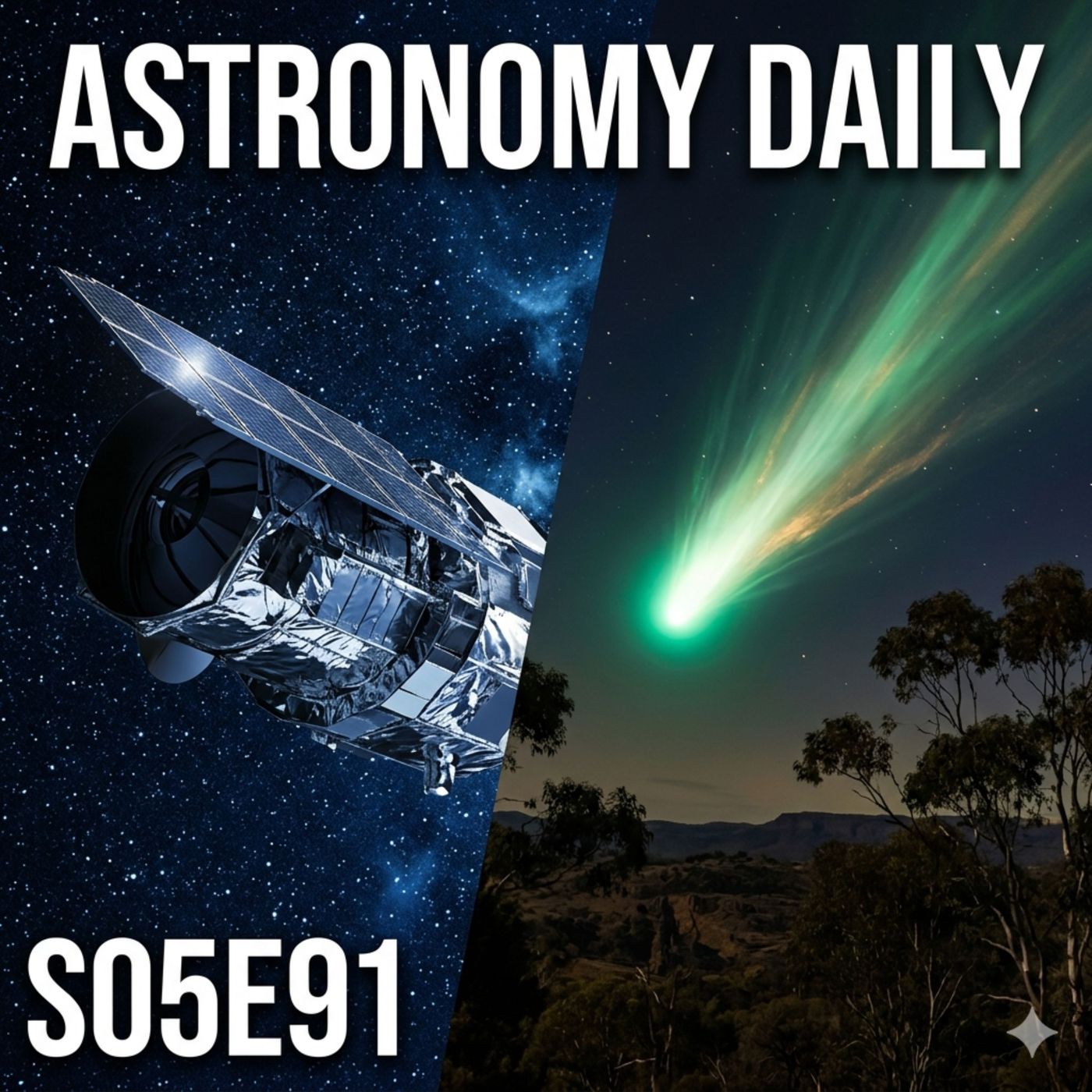
- Interstellar Comet 3I ATLAS Captured by Gemini South Telescope: The Gemini South Telescope has unveiled stunning new images of interstellar comet 3I ATLAS, the third known comet from outside our solar system. Discovered on July 1, 2025, this comet is becoming increasingly active as it approaches the Sun, developing a prominent tail and a glowing coma. Its composition resembles that of comets from our solar system, suggesting consistent formation processes across different star systems. This ancient relic is expected to provide astronomers with unprecedented opportunities to study its interactions with our solar system.
- Comet LEMMON (C 2025 A6) Approaching Earth: Get ready for Comet LEMMON, expected to be visible to the naked eye in October! Discovered by the Mount Lemmon survey, it will make its closest approach on October 20, passing 55.41 million miles from Earth. Predictions for its brightness vary, with some suggesting it could reach magnitude 4 to 5, making it easily visible, while others estimate it could be around magnitude 7.3. The comet is expected to display a greenish hue, adding to its allure for skywatchers.
- James Webb Space Telescope Observations of Trappist1e: The James Webb Space Telescope has been studying Trappist1e, an Earth-sized planet in the habitable zone of a red dwarf star. Recent observations suggest that Trappist1e likely lost its primary atmosphere due to stellar flaring. However, hints of trace amounts of methane may indicate the presence of a secondary atmosphere. This research is crucial for understanding habitability around red dwarfs, which make up a significant portion of stars in our galaxy.
- Upcoming SpaceX CRS NG23 Mission: Tune in for the SpaceX CRS NG23 mission launching on September 14th at 8:11 PM ET. This mission will utilize a Northrop Grumman Cygnus XL spacecraft, capable of carrying significantly more cargo to the International Space Station. Viewers may also witness the booster’s return to launch site landing, making it a double feature of launch and landing excitement.
- For more cosmic updates, visit our website at astronomydaily.io. Join our community on social media by searching for #AstroDailyPod on Facebook, X, YouTubeMusic Music, TikTok, and our new Instagram account! Don’t forget to subscribe to the podcast on Apple Podcasts, Spotify, iHeartRadio, or wherever you get your podcasts.
- Thank you for tuning in. This is Avery and Anna signing off. Until next time, keep looking up and exploring the wonders of our universe.
Interstellar Comet 3I ATLs
[NASA](https://www.nasa.gov/)
Comet Lemon Details
[Astronomy](https://www.astronomy.com/)
James Webb Space Telescope Findings
[NASA](https://www.nasa.gov/)
SpaceX CRS NG23 Mission
[SpaceX](https://www.spacex.com/)
Astronomy Daily
[Astronomy Daily](http://www.astronomydaily.io/)
Become a supporter of this podcast: https://www.spreaker.com/podcast/astronomy-daily-latest-space-news--5648921/support.
Sponsor Details:
Ensure your online privacy by using NordVPN. To get our special listener deal and save a lot of money, visit <a href="https://www.astronomydaily.io/nordvpn" target="_blank"...
Avery: Welcome to Astronomy Daily. I'm Avery, and as always, I'm joined by my co host, Anna. We're here to bring you the latest and most fascinating news from the cosmos. Breaking down complex discoveries into conversations you'd have with your space obsessed friends over coffee. Anna: Hey, everyone, I'm Anna. And wow, do we have an incredible lineup for you today. We're talking about not one, but two amazing comets making headlines right now. Plus some groundbreaking observations from the James Webb Space Telescope that are helping us understand what it's like on pot.
Potentially habitable worlds beyond our solar system. Avery: That's right. And what makes today's, uh, episode especially exciting is that we're covering some truly rare cosmic visitors. Anna, when I first read about our first story today about interstellar comet 3I ATLAS, I had to do a double take. We're talking about only the third known comet from outside our solar system. Anna: I know, right? It's absolutely mind blowing. Let's dive right into this because the Gemini South Telescope just captured some stunning new images of three I ATLAS.
And what they're showing us is fascinating. This interstellar visitor was discovered on July 1, 2025 by the Atlas survey in Chile. And it's becoming increasingly active as it travels through our inner solar system. Avery: So, Anna, help me understand this. When we say it's becoming more active, what exactly are we seeing? Anna: Great question. The latest Observations show that 3i ATLAS is developing a prominent tail and a glowing coma. That's the fuzzy atmosphere around the comet's nucleus. As it gets closer to our sun, the solar radiation is heating up the comet's surface, causing dust and ice to sublimate and create this beautiful glowing display.
What's really remarkable is that the composition appears to be very similar to comets from our own solar system. Avery: That similarity in composition is what really gets me excited because it suggests that comet formation processes might be remarkably consistent across different star systems. I mean, think about it. This object formed around a, uh, completely different star, potentially billions of years ago, yet it's made of the same basic materials as comets we see regularly in our own neighborhood.
Anna: Exactly. And speaking of age, Avery, here's something that blew my mind. Scientists think this could be the oldest comet we've ever observed. We're potentially looking at a relic from the very early universe, a time capsule that's been wandering through interstellar space for eons before finally making its way into our solar system. Avery: That's incredible. And it's not just passing through either. 3i ATLAS is going to make close passes by The Sun, Earth, Mars, and Jupiter. This gives astronomers an unprecedented opportunity to study an interstellar object up close as it interacts with our solar system.
Anna: Those close approaches are going to provide us with so much valuable data. Every time we get a chance to study one of these interstellar visitors, we learn something new about how planetary systems form and evolve throughout the galaxy. Now, speaking of comets making news, we have another fascinating visitor to talk about. And this one might actually be visible to the naked eye. Avery: Oh, yes. Comet C 2025 A6, also known as Comet LEMMON And this is the kind of story that gets amateur astronomers really excited, because there's a chance chance that people might be able to step outside in October and see this comet with their own eyes.
Anna: That's right. This comet was discovered by the Mount Lemmon survey in Arizona, and it's approaching Earth right now. The closest approach will be on October 20th, when it'll pass by at about 55.41 million miles away. Now, that might sound far, but in cosmic terms, that's practically next door. Avery: And here's where it gets interesting for skywatchers. The comet will reach perihelion, its closest point to the sun, on November. But the brightness predictions are all over the place, which honestly makes this even more exciting because we're not quite sure what we're going to get exactly.
Anna: Some predictions suggest it could reach magnitude 4 to + 5, which would make it easily visible to the naked eye, even from moderately light polluted areas. But other estimates put it at magnitude 7.3, which would require binoculars or a small telescope to see clearly. Avery: The uncertainty is part of what makes comet watching so thrilling. Comets are notoriously unpredictable. They can suddenly brighten dramatically, or sometimes they just fizzle out. For Comet Lemmon, the best viewing opportunities look like they'll be in early October.
And starting October 12, it should be visible in the evening sky. Anna: And here's a fun detail for anyone planning to observe it. Comet LEMMON is expected to display a greenish color, which is likely caused by dicarbon molecules in its coma. That green glow is actually a pretty common feature in comets, and it creates this beautiful, otherworldly appearance against the night sky. Avery: What I find fascinating about this comet is its orbital period. It's approximately 1,350 years. But here's the kicker.
That period has actually been shortened due to an encounter with Jupiter. It's yet another example of how the giant planets in our solar system act as gravitational shepherds, influencing the paths of these cosmic wanderers. Anna: Jupiter really is the heavyweight champion of our solar system when it Comes to altering orbits. Now let's shift gears from these relatively nearby visitors to something much distant but equally fascinating. The the James Webb Space Telescope has been studying Trappist1e, an earth sized planet in the habitable zone around a red dwarf star about 40 light years away.
Avery: The Trappist 1 system has been on everyone's radar since its discovery because it has seven Earth sized planets and several of them orbit in the habitable zone where liquid water could potentially exist on the surface. Trappist1e is particularly interesting because it's right in the middle of that Goldilocks zone. Anna: Right. And what JWST has been doing is observing transits, basically watching as the planet passes in front of its host star. From our perspective, based on the first four transit observations, the results are both revealing and somewhat disappointing for those hoping for signs of a thick, potentially life supporting atmosphere.
Avery: So what did they find, Anna? Uh, I, um, know the results suggest the planet likely lost its primary atmosphere, but can you break that down for us? Anna: Sure. The main finding is that Trappist1e has probably lost its primary atmosphere due to stellar flaring from its red dwarf host star. Red dwarfs are notorious for being very active, especially when they're young, producing intense radiation and particle bombardment that can strip away planetary atmospheres. JWST didn't detect the thick hydrogen atmosphere that some models might have predicted was present.
Avery: But here's the thing, and this is why I love science. The results don't completely rule out the possibility of a secondary atmosphere. Right. There could still be an atmosphere that formed after the primary one was stripped away. Anna: Absolutely. And in fact, there are some intriguing hints in the data. The observations suggest there might be trace amounts of methane in what could be a, uh, nitrogen rich atmosphere. Now, methane in an atmosphere is particularly interesting because it can be produced by both geological and biological processes, Though we.
Avery: Have to be careful not to get too excited about the biological implications just yet. The challenge with these observations is that they're complicated by stellar contamination from the red dwarf's flaring activity. When the star flares, it can create signals that, uh, mimic or mask atmospheric features. Anna: Exactly. And that's why the JWST team has developed a really clever technique to deal with this problem. They're planning 15 more observations and they're going to compare Trappist 1e to, with its neighboring planet, Trappist 1b, to filter out those stellar artifacts.
By observing both planets, they can better separate the star's contribution from the actual planetary atmospheric signals. Avery: That's brilliant. It's like having A control group in the Same star system, Trappist 1b, orbits much closer to the star, so it's definitely had its atmosphere stripped away, making it the perfect reference point for understanding what signals are coming from the star versus the planet we're actually interested in. Anna: And this technique could revolutionize how we study exoplanet atmospheres around active stars.
Red dwarfs make up about 75% of all stars in our galaxy, and many potentially habitable exoplanets orbit these stars. So figuring out how to reliably detect atmospheres around them is crucial for understanding habitability throughout the cosmos. Avery: Speaking of keeping our eyes on space activity, Anna, um, we should definitely tell our listeners about this weekend's launch activity. There's a really interesting SpaceX mission coming up that I think will be worth watching. Anna: Oh, yes, the CRS NG23 mission.
This one's launching on Sunday, September 14th at exactly 8 hours, 11 minutes and 49 seconds PM Eastern Time from Cape Canaveral. What makes this launch particularly interesting is that it's using a Northrop Grumman style Cygnus XL spacecraft. That's the stretched version with significantly more cargo capacity. Avery: Right. And that XL designation isn't just marketing. We're talking about a spacecraft that can carry up to 1,300kg more mass than the previous Cygnus versions. That's a substantial increase in capability, which means more supplies, experiments, and equipment heading to the International Space Station crew.
Anna: And there's actually a bit of a story behind this mission. Avery to this Cygnus is stepping in to replace the NG22 spacecraft that was damaged in transit. The space industry really shows its resilience in moments like these. When one spacecraft can't make it, there's always a backup plan. This particular Cygnus will be named after William Willie C. McCool, the naval aviator and astronaut. Avery: What I find fascinating about this mission is the booster story. SpaceX is using B1094 and this will be its fourth flight.
Another example of how routine booster reuse has become. But here's what makes it even more interesting for viewers. This booster is going to perform a return to launch site landing at landing zone 2. Which means if you're watching the launch, you might actually get to see the landing burns and touchdown as well. Anna: I love those double features. Launch and landing. And speaking of international collaboration, it's worth mentioning that this Cygnus was built by Thalis Alenia Space, with facilities in both France and Italy.
It's always amazing to see how these cargo missions represent this incredible global effort to keep the International Space Station supplied and operational. Avery: So if you're free Sunday evening around 8:11pm Eastern, it's definitely worth stepping outside or tuning in to the livestream. There's something special about watching these routine supply missions. They remind us that we literally have people living and working in space right now, and missions like this keep that incredible achievement going.
You know Anna, what strikes me about all of these stories is how they represent different scales of exploration. From interstellar visitors in our own solar system to naked eye comets we can observe from our backyards to detailed atmospheric analysis of worlds dozens of light years away, it's this incredible range of astronomical discovery happening all at once. Anna: That's such a great point. And what I love is how each discovery builds on our understanding of the bigger picture. Whether it's learning that interstellar comets have similar compositions to our local ones, or figuring out how to detect atmospheres around distant worlds, every observation helps us understand our place in the universe a little bit better.
Avery: And for our listeners who might be inspired by today's comet stories, October is shaping up to be a fantastic month for skywatching. Whether Comet LEMMON reaches naked eye, visibility or requires binoculars, it's going to be worth looking for. There's something magical about seeing these ancient wanderers with your own eyes. Anna: Absolutely. And remember, even if you need binoculars to see Comet LEMMON clearly, you'll still be looking at something that last visited our inner solar system over a thousand years ago ago.
That's perspective that never gets old. Avery: Thanks for joining us on today's Journey through the Cosmos, everyone. I'm Avery alongside Anna, and we'll be back soon with more fascinating discoveries from the universe. Until then, keep looking up. And remember, every clear night is an opportunity to connect with the cosmos. Anna: Thanks for listening to Astronomy Daily. Whether you're planning to hunt for Comet Lemmon in October, or just marveling at the fact that we can study the atmospheres of worlds light years away from, remember that we're living in an incredible age of cosmic discovery.
Clear skies everyone, and keep looking up.


 Apple Podcasts
 Spotify
 Pocket Casts
 Castbox
 Overcast
 Podbean
 iHeartRadio
 Castro
 Goodpods
 Moon FM
 Podcast Addict
 Podcast Republic
 YouTube