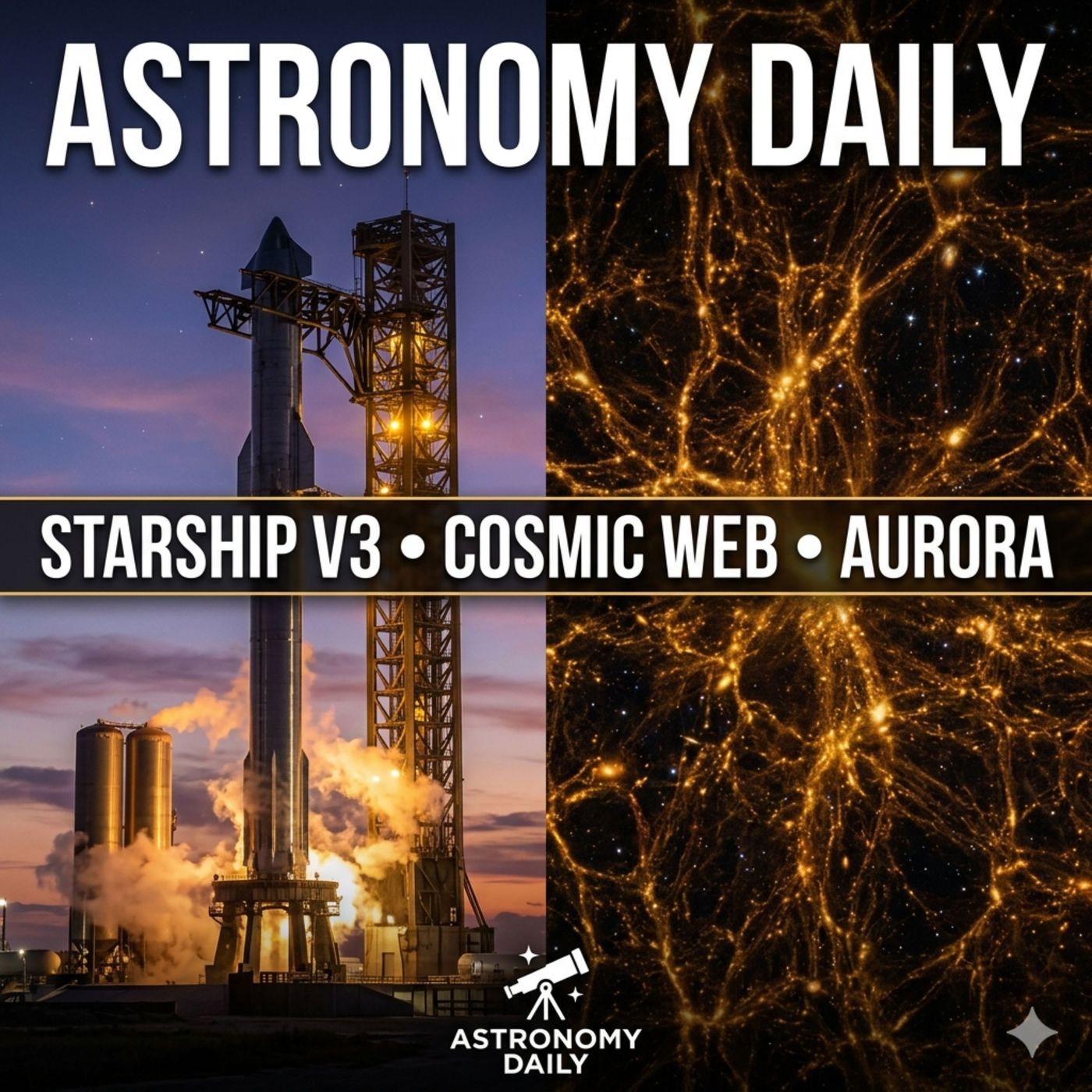
Starship V3 Has a Launch Date + Psyche's Mars Flyby + JWST Cosmic Web
In this episode
Sponsor Link:Our sponsor this week, NordVPN has put together a great money saving deal for you. Get the best protection for less. We use them and recommend them highly. To check out the details - Click Here
Astronomy Daily — S05E102 | Thursday 14 May 2026 In today's episode, Anna and Avery cover six stories spanning the entire space science spectrum — from a record-breaking rocket debut to medieval literary theory. Stories in This Episode 1. Starship V3 Gets a Launch Date — SpaceX confirms May 19 for Flight 12, the debut of the fully redesigned Version 3 Starship and Super Heavy. 2. Psyche Mission: Mars Flyby Tomorrow — NASA's asteroid-bound spacecraft passes just 2,800 miles from Mars on May 15 for a crucial gravity assist. 3. JWST Maps the Cosmic Web — The James Webb Space Telescope charts 164,000 galaxies across 13.7 billion years in the most detailed cosmic web map ever made. 4. Aurora Watch: Coronal Hole Facing Earth — A large solar coronal hole is pointing at Earth; G2 storm conditions expected from May 15 with aurora potential for Southern Hemisphere observers. 5. Dante's Inferno and Impact Physics — New research presented at the European Geosciences Union argues Dante's 14th-century Hell maps the geometry of a planetary impact crater. 6. CRS-34: Dragon Docks at the ISS — After two weather scrubs, SpaceX's Dragon cargo capsule successfully delivers 6,500 lbs of science experiments to the space station. Chapter Timestamps 00:00 — Introduction & Headlines 01:00 — Starship V3: May 19 Launch Date Set 05:00 — NASA Psyche: Mars Gravity Assist Flyby 08:30 — JWST Maps the Cosmic Web 12:00 — Aurora Alert: Coronal Hole & Solar Wind 15:00 — Dante's Inferno as Impact Crater Science 18:30 — CRS-34 Dragon Docks at the ISS 21:30 — Skywatcher's Corner: Aurora Tips & Mars 23:00 — Trivia, Sign-Off & Socials Find us at astronomydaily.io | Follow @AstroDailyPod | Part of the Bitesz.com Podcast Network
Become a supporter of this podcast: https://www.spreaker.com/podcast/astronomy-daily-latest-space-news--5648921/support.
Sponsor Details:
Ensure your online privacy by using NordVPN. To get our special listener deal and save a lot of money, visit www.astronomydaily.io/nordvpn. You'll be glad you did!
Get the best secure and private email on the planet. Stop your Government, google and who knows who else spying on every email you write. Do what we did and use ProtonMail. They beleive in privacy and there are no ads in their business model...yet they still provide a free forever service. Check them out and get out special deal at www.astronomydaily.io/protonmail
Become a supporter of Astronomy Daily by joining our Supporters Club. Commercial free episodes daily are only a click way... Click Here
This episode includes AI-generated content.
Anna: Hello and welcome to Astronomy Daily, your daily guide to the Universe for Thursday the 14th of May, 2026. I'm Anna. Avery: And I'm Avery. Big show today, Anna. Uh, we've got a rocket about to make history, a spacecraft using Mars as a slingshot, and a medieval poet who may have accidentally written the world's first impact physics textbook. Anna: Coming up, SpaceX locks in a launch date for the most powerful version of Starship yet. NASA's Psyche probe is just hours away from its dramatic Mars flyby.
The James Webb Space Telescope has delivered its clearest ever map of the universe's skeleton. Avery: Coming up, a large coronal hole is sending a surge of solar wind our way. Good news for Aurora watchers in the Southern Hemisphere. The Dragon cargo capsule has docked at the International Space Station after a week of weather delays. And we'll tell you why researchers are re reading Dante's Inferno through the eyes of a planetary scientist. Anna: Stay with us. It's all coming up on Astronomy Daily.
Avery: Let's go. Anna: Then let's kick things off with a story that has the space community buzzing. SpaceX has officially announced the launch date for Starship Flight 12, and it is just five days away. Avery: That's right, May 19 is now the target for what may be the most anticipated rocket test of the decade. This isn't just any starship launch. Flight 12 will be the debut of Starship version 3, a thoroughly redesigned vehicle that SpaceX says has been rebuilt almost from the ground up for full and rapid reuse.
Anna: So what's actually changed? Well, the super heavy booster now sports three grid fins instead of the original six. Those are the lattice like structures that help steer it back through the atmosphere. The whole vehicle is taller, heavier and more capable than its predecessors. Avery: The launch window opens at 6:30 in the evening Eastern Time. That's 8:30 the next morning here in Australia. On May 20th, it'll lift off from Starbase in South Texas. And um, importantly, this will be the very first launch from Starbase's second orbital launch pad.
Anna: Now, because this is a brand new vehicle design, SpaceX won't be attempting to catch the super heavy booster back at the launch tower on this flight. Instead, both the booster and the upper stage, known as Ship, are targeting water landings. The booster aims for the Gulf of Mexico and Ship is targeting the Indian Ocean about 65 minutes after liftoff. Avery: As for the payload, ship will carry 22 dummy Starlink satellites on the same suborbital trajectory. And there's a clever experiment. The last two of those dummy satellites will actually scan Starship's heat shield and beam images back to mission controllers.
They want to test whether they can remotely assess heat shield integrity from orbit. Anna: There's also a single Raptor engine relight planned in space, something that'll be essential for future operational missions. And SpaceX has deliberately removed one heat shield tile to measure how adjacent tiles behave under re entry stress when there's a gap. Avery: Full disclosure on the engineering nerves here. The previous version of this booster, called B18, was actually destroyed during ground testing late last year when its liquid oxygen tank imploded during a pressure test.
B19 has had a much smoother road, passing three static fire tests in the last three months, including a, uh, full 33 engine full duration burn. Anna: We will of course, be watching this one very closely. Mark your calendars May 19th. We'll have full coverage in the next episode. Enormous stakes, enormous rocket. Avery: While everyone's eyes are on Starship next week, there's something happening tomorrow that deserves just as much attention, at least for the science crowd. NASA's Psyche spacecraft is about to use Mars as a cosmic slingshot.
Anna: This is one of those elegantly clever things about orbital mechanics. The Psyche mission is ultimately headed for a metal rich asteroid, also called Psyche, out in the main asteroid belt between Mars and Jupiter. It launched back in October 2023, and it's been gradually building speed using its solar electric propulsion system ever since. Avery: But solar electric propulsion is quiet and efficient rather than fast. So to get the extra kick it needs, the team planned this Mars flyby from the very beginning.
On May 15th. That's tomorrow, Psyche will pass just 2,800 miles from the Martian surface. That's closer than the orbit of Mars own moon, Phobos. Anna: And it'll be moving at over 12,300 miles per hour, nearly 20,000 kilometers per hour. Mars's gravity will grab the spacecraft, whip it around and send it on its way faster and on a tilted trajectory that would have been prohibitively expensive to achieve with propellant alone. Avery: The mission team has been preparing for this for months. Back on February 23rd, they fired the spacecraft's thrusters for, uh, a full 12 hours to fine tune the approach.
And since May 7th, Psyche has been sending back early images. First a distant star field, then a crescent shaped Mars, growing larger by the day. Anna: Those images aren't just pretty, they're functional. The imaging team is using this period to calibrate their cameras and practice the techniques they'll need when Psyche eventually arrives at the asteroid in late 20. It's essentially a dress rehearsal. Avery: One unique visual because Psyche is approaching from Mars's night side, the planet currently looks like a crescent, just a thin sliver of sunlight on the edge, very much like our own crescent Moon.
After closest approach, mission controllers expect to see a near full Mars view. As the spacecraft swings around to confirm Anna: the flyby was successful, the team will monitor radio signals through NASA's Deep Space Network. And there's a bonus science objective, too. Psyche will use its instruments to search for any faint dust rings that might surround Mars created by micrometeorites striking Phobos Avery: and Deimos asteroid arrival 2029 but tomorrow is a big milestone. We'll have the results in our next episode.
Anna: Now for something that puts everything, and we mean everything, in perspective. Astronomers using the James Webb Telescope have produced what they're calling the most detailed map ever made of the cosmic web. Avery: The cosmic web is, well, it's the universe's skeleton. Imagine the largest structure that exists, a vast network of dark matter filaments and gas sheets interwoven across billions of light years, connecting galaxies and galaxy clusters together. Between those filaments are enormous, almost entirely empty regions called voids.
That's the cosmic web. Anna: And now, for the first time, we have a truly detailed map of it, one that stretches all the way back to when the universe was only about 1 billion years old. The research was led by a team at the University of California, Riverside, using what's known as the Cosmos Web Survey, the single largest observing program that Webb has ever conducted. Avery: The map charts the positions of over 164,000 galaxies plotted across 13.7 billion years of cosmic history. Think about that A map of 164,000 galaxies spread across nearly the entire age of the universe.
Published in the Astrophysical Journal. Anna: What makes this such a leap forward is precision. Webb's infrared instruments can detect galaxies that were completely invisible to older telescopes and can measure their distances with far greater accuracy. That's what allows you to place each galaxy precisely in its cosmic context, rather than just knowing roughly where it sits. Avery: The lead author, Jose Hatamnia, a graduate student at UC Riverside, put it this for the first time, scientists can study how galaxies evolve within cluster and filamentary structures across of cosmic time, from the universe's infancy right up to the present day.
Anna: And the images from this map are genuinely beautiful. The dense clusters and filaments show up as bright yellow in the visualizations. The voids are dark, great sweeping emptiness between the cosmic threads. It really does look like a web. Avery: The implications reach well beyond aesthetics. Understanding how the cosmic web formed and evolved over time is key to understanding why galaxies look the way they do today, why some are large spirals, others are elliptical, others are irregular, and how dark matter has shaped the universe we live in.
Anna: One of the most stunning results from the cosmos Webb data is that the cosmic web appears to have been in place much earlier than some models predicted, meaning the universe organized itself into this vast structure surprisingly quickly after the Big Bang. Avery: Webb continues to rewrite the textbooks. This one is a landmark result. Anna: Time now for a quick reminder to check out the great deal our UH, sponsor this week NORDVPN has put together for our listeners. Get the best in online security for not a lot of money.
The savings are that good. Check out the details by following the link in the show notes. Only the best is good enough and that's why we use NORDVPN and so should you. Again, link in the show notes. Avery: Alright, let's get back to today's space and astronomy news. Anna: Now for something that Southern Hemisphere listeners may want to keep an eye on this weekend our sun has been busy and the results could mean auroras for sky watchers across Australia, New Zealand and southern South America. Avery: A large coronal hole has rotated into what's called a ah, geoffective position, meaning it's pointing directly at Earth.
Coronal holes are regions in the Sun's outer atmosphere where the magnetic field opens outward into space rather than looping back, allowing a fast stream of solar wind to escape directly into the solar system. Anna: This particular coronal hole is both large and positioned right at the solar equator, which means the high speed solar wind stream it produces is aimed squarely in our direction. That stream is expected to begin reaching Earth on Friday, which is tomorrow. Avery: Our time base weather forecasters have issued a uh, G2 moderate geomagnetic storm watch for Friday the 15th.
G2 conditions are significant enough to push aurora visibility well beyond the polar circles. For Southern Hemisphere observers, that means southern Australia, Tasmania and New Zealand could all be in play. Anna: There's also a separate, slightly earlier event to watch, a coronal mass ejection. A blob of solar plasma was launched on May 10 during an M M5.7 flare from Active Region 4436. That CME may deliver a, uh, glancing blow today or tomorrow, potentially adding some extra activity before the main solar wind stream arrives.
Avery: So what should you do if you want to catch the show? Tonight and Friday night are your best windows? Get away from city lights, find the clear southern horizon and check the Bureau of Meteorology's Space Weather Alert page or apps like space weather live for real time, KP Index updates. If it hits KP5 or above, look south. Anna: Clear skies and fingers crossed. For those of you hoping to see the Southern lights this weekend, now for Avery: something a little different. What if one of the greatest works of medieval literature was also accidentally a, uh, reasonably accurate description of a planetary impact event?
Anna: That is the argument being put forward by Timothy Burberry, a professor at Marshall University in West Virginia, in research presented at the European Geosciences Union General assembly in Vienna earlier this month. And once you hear it, it's genuinely hard to unthink. Avery: So, the basics. Dante Alighetti wrote the Divine Comedy in the early 1300s. That's the 1300s. The inferno is the first part of that work. And it describes Hell as an inverted conical pit beneath Jerusalem. Nine concentric circles descending downward to a frozen core where Satan is trapped.
Anna: Now, for seven centuries, readers have interpreted this as spiritual allegory, pure and simple. Satan fell from heaven and was imprisoned at the Earth's center. Mount Purgatory was created on the opposite side of the globe from the displaced Earth. Vivid imagery, profound theology, end of story. Avery: Or so everyone thought. Burberry's argument is that if you strip away the religious symbolism and look at what Dante is actually describing as a physical event, it maps remarkably well onto the structure of a complex impact crater.
Anna: In his interpretation, Satan acts as a high velocity impactor, an asteroid sized object striking the southern hemisphere at tremendous speed, drilling through the crust to the Earth's core. The nine circles of Hell. They closely resemble the concentric terraced rings that large impacts create as shockwaves propagate outward, the same structures you see in major impact basins on the Moon and Venus. Avery: The specific comparison Burberry makes is to the Chicxulub impact, The asteroid strike 66 million years ago that ended the age of the dinosaurs and left the 150 kilometer crater beneath what is now the Gulf of Mexico.
Chicxulub is one of the best studied complex impact structures on Earth. And its internal geometry, peak rings, terraced walls, central basin, mirrors what Dante described. Anna: Mount Purgatory rising on the opposite side of the globe. That would be the central peak, or in some large impacts, an antipodal feature, a mountain created by the focused seismic energy of the impact converging on the far side of the planet. Avery: It's a real phenomenon now, and, um, this is important. Burberry is not claiming that Dante had secret knowledge of impact physics.
He's proposing something more interesting than that, that Dante intuitively applied the best physics available to him in the 14th century to think through what a catastrophic fall from heaven would look like as a real physical event. And in doing so, he stumbled into something that looks a lot like what we now know about impact craters. Anna: The research was presented under the flag of what Burberry calls literary geomythology, the idea that ancient texts and myths sometimes preserve intuitions about natural phenomena long before science has the tools to formally describe them.
The nine Circles of Hell as Multi Ring Impact Basin Satan as Oblong Asteroid it's quite a thought. Avery: The Divine Comedy simultaneously one of history's greatest literary achievements, and apparently a geophysical thought experiment. Anna: Who knew Wrapping up our main stories today with an update to a mission we've been following this week. After not one but two weather scrubs, the SpaceX Dragon cargo capsule for NASA's CRS 34 mission has successfully docked with the International Space Station.
Avery: The launch finally got off the ground from Cape Canaveral on Wednesday evening. After scrubs on both Tuesday and Wednesday due to weather, Dragon arrived at the ISS today, May 14, docking autonomously to the forward port of the Harmony Module. Anna: On board about 6,500 pounds, roughly 2,950 kilograms of science experiments, supplies and hardware for the expedition's 74 crew. BASA astronaut Jack Hathaway and ESA astronaut Sophie Adenow were on duty to monitor Dragon's approach and docking.
Avery: Now, some of that cargo is genuinely fascinating. One investigation, called Green Bone, involves a scaffold made from wood that researchers believe could be used to help grow bone cells in microgravity. The goal is to develop new treatments for bone fragility conditions, particularly osteoporosis Wood derived growing bone in space. Anna: There's also the ODESSI study, which is testing how accurately Earth based simulators can replicate actual microgravity conditions. Scientists will compare bacteria behavior in true space conditions against results from ground based labs, and if the data differs, it could mean some of our ground based conclusions about microgravity biology need to be revised.
Avery: And a third investigation is looking at how red blood cells and the spleen change in the space environment, crucial data for protecting the health of astronauts on long duration missions to the moon and eventually Mars. Anna: This Dragon capsule known as C209 is actually making its sixth flight to the ISS. That's a record for a SpaceX cargo craft and a sign of just how reliably reusable these vehicles have become. It's expected to stay at the station for about a month before returning to Earth with completed experiments splashing down off the coast of California in mid June.
Avery: Despite the weather delays, CRS 34 is on its way. Science is being done. Good news all round. Anna: Time now for your Sky Watcher's Corner, our weekly guide to what's worth looking for in the night sky. And this week, Avery, we've got a very timely one. Avery: We do. As we mentioned in story four, there is a real chance of aurora activity this weekend for the Southern Hemisphere observers with a, uh, G2 geomagnetic storm watch in effect from Friday the 15th. The Southern Lights, the Aurora Australis could be visible from southern Australia, Tasmania and New Zealand.
Anna: The best viewing is away from city light pollution with a clear, unobstructed southern Horizon. Check the KP index. If it reaches 5 or higher, you're in business. Apps like Space Weather Live and my Aurora Forecast give real time updates. Bundle up, be patient and look south. Avery: And while you're out there Friday evening, remember that just hours earlier, NASA's Psyche spacecraft will have completed its Mars flyby, slingshotting around the red planet on its way to a metal asteroid. Mars itself is in the pre dawn sky this week near Saturn.
Early risers can catch both as the sky lightens before sunrise. Anna: A weekend of space events right on our doorstep. Don't miss it. Avery: That's everything from us for this Thursday edition of Astronomy Daily. What a show. Starship V3 on the launch pad. Psyche swinging past Mars. The universe's skeleton mapped in unprecedented detail. Aurora alerts for the Southern Hemisphere. Dante moonlighting as an impact physicist and Dragon safely at the station. Anna: Before we go, a quick trivia. The Chicxulub impact crater, the one that helped end the dinosaurs 66 million years ago, is buried beneath the Gulf of Mexico and the Yucatan peninsula.
At roughly 150km across, it's one of the largest confirmed impact structures on Earth. And now possibly in medieval Italian poetry. Avery: Links to everything we've covered today are in the show Notes. Find us at astronomydaily IO and follow us on social media astrodaily pod. And if you enjoy the show, please leave us a rating and a review. It genuinely helps new listeners find us. Anna: From all of us here at Astronomy Daily, keep looking up clear skies and we'll see you tomorrow. Avery: I saw every day the stories be told.
Stories.

 Apple Podcasts
 Spotify
 Pocket Casts
 Castbox
 Overcast
 Podbean
 iHeartRadio
 Castro
 Goodpods
 Moon FM
 Podcast Addict
 Podcast Republic
 YouTube