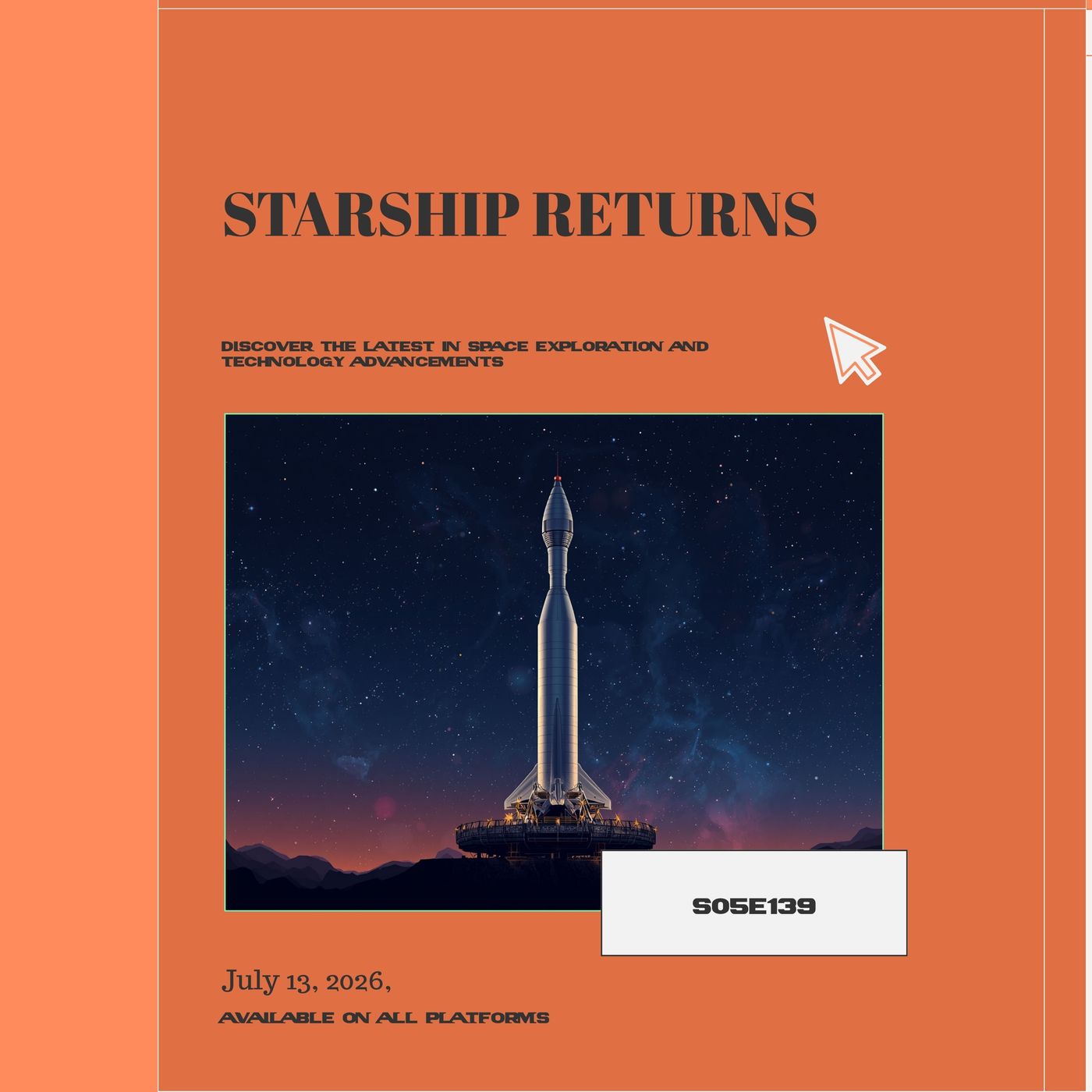
Starship Set for Flight 13, Japan's Reusable Rocket Breakthrough, and SpaceX's 100,000 Satellite Ambition
In this episode
Astronomy Daily S05E139 — Monday, 13 July 2026 Starship could fly again as soon as Wednesday — carrying its first-ever real payload. Japan quietly joins the reusable rocket club just a day after China. SpaceX asks regulators for a jaw-dropping 100,000 satellites. Physicists may have heard the accumulated whispers of every star that ever exploded. Isar Aerospace signs a $150 million deal to launch from Canada. And a ravenous black hole just 1.8 billion light-years away is giving astronomers — including teams from CSIRO and the University of Sydney — a window into the dawn of time. In this episode • Starship Flight 13: Booster 20's 33-engine static fire complete; launch NET Wednesday (AEST); first deployment of 20 Starlink V3 satellites; in-space Raptor relight and Indian Ocean splashdown planned. • JAXA's RV-X reusable rocket completes its first hop at Noshiro — about 40 seconds, 10–11 metres up, landing upright — one day after China's Long March 10B sea recovery. • SpaceX files with the FCC for a 100,000-satellite Gen3 constellation in very low Earth orbit, pitched at multi-gigabit AI-era connectivity — and entirely dependent on Starship. • Super-Kamiokande reports the first indication of the Diffuse Supernova Neutrino Background from nearly 5,000 days of data — the accumulated neutrinos of every core-collapse supernova in cosmic history. • Isar Aerospace signs a 10-year deal with Maritime Launch Services for a dedicated complex at Spaceport Nova Scotia — first orbital launches targeted for 2028, up to 40 per year by 2029. • Galaxy SDSS J110546.07+145202.4: a lightweight, ferociously fast-growing black hole behaving like the early universe's titans, shining 20-fold brighter in radio for eight-plus years — with CSIRO's ATCA among the follow-up telescopes. • Skywatching: New Moon Tuesday evening (7:44pm AEST / 9:44pm NZST); prime Milky Way core viewing; Venus brilliant in the west; Mars near Aldebaran pre-dawn; Comet 10P/Tempel 2 favours southern observers. Sources & further reading • Space.com — Starship Flight 13 static fire & launch outlook; Starlink Gen3 filing; Isar/MLS deal; ravenous black hole; supernova neutrino whispers • AP / Japan Times / RTÉ — JAXA RV-X first test flight • Max Planck Institute for Radio Astronomy press release; Komossa et al., The Astrophysical Journal (2026) • Tohoku University / phys.org — Super-Kamiokande DSNB indication (Neutrino 2026 conference) • CBC / The Globe and Mail / SpaceQ — Isar Aerospace & Maritime Launch Services agreement details • NASA JPL What's Up July 2026; EarthSky; Space.com night sky guide — skywatchingBecome a supporter of this podcast: https://www.spreaker.com/podcast/astronomy-daily-latest-space-news--5648921/support.
Sponsor Details:
Ensure your online privacy by using NordVPN. To get our special listener deal and save a lot of money, visit www.astronomydaily.io/nordvpn. You'll be glad you did!
Get the best secure and private email on the planet. Stop your Government, google and who knows who else spying on every email you write. Do what we did and use ProtonMail. They beleive in privacy and there are no ads in their business model...yet they still provide a free forever service. Check them out and get out special deal at www.astronomydaily.io/protonmail
Become a supporter of Astronomy Daily by joining our Supporters Club. Commercial free episodes daily are only a click way... <a...
Anna: Hello and welcome to Astronomy daily for Monday 13th July, 2026. I'm Anna. Avery: And I'm, uh, Avery. And what a way to start the week, because the week ahead is shaping up to be a genuinely big one. Anna: It really is. Coming up today, SpaceX's Starship could fly again as soon as Wednesday. And this time, it's carrying real working satellites for the first time, not the dummies of earlier flights. Avery: Japan quietly joins the reusable rocket club, just one day after China did something similar in spectacular fashion.
Anna: Plus, SpaceX asks permission to launch 100,000 satellites. Yes, you heard that number right. Avery: Physicists may have heard the faint whispers of every star that's ever exploded. A rocket company we've been following all year signs a deal to launch from a second continent. Anna: And we close with a black hole in our cosmic backyard that's behaving like it belongs at the dawn of time, with some Aussie science right at the heart of the discovery. Avery: All that, plus what's in your skies this week.
Let's get into it. Anna: Let's start at Starbase Texas, where SpaceX is in the final stretch before Starship's 13th test flight. And if all goes to plan, we could see it fly as soon as Wednesday, our time. Avery: The pace over the past few days has been something to behold. On Thursday, Booster 20, the newest super heavy off the production line, rolled out to the pad and was hoisted onto its launch mount by those famous Mechazilla chopstick arms. Anna: And then on Friday, SpaceX lit up all 33 of its upgraded Raptor 3 engines in a static fire test.
And by all accounts, it was a monster. One observation team, measuring from about 10 km away, recorded dramatically higher acoustic pressure than previous tests, one of the strongest events they've ever captured at Starbase. Avery: With that test in the books, the FAA's advisories point to a large window opening as early as Wednesday morning, Australian Eastern time. As always with Starship, dates can slip, but the hardware is stacked and ready now. Anna: This is the second flight of the Version 3 vehicle, the tallest, most powerful iteration yet.
Standing around 124 meters. Flight 12 back in May was V3's debut, and it was a mixed bag. The ship suffered an engine out during ascent and the booster fumbled its boost back burn and ended up in the Gulf instead of coming home. Avery: So Flight 13 is essentially the do over. Same suborbital profile, with the booster aiming to nail that boost back and landing burn at an offshore point and the ship performing an in space raptor relight. Before a controlled splashdown in the Indian Ocean, which as we like to remind you, is our neck of woods.
Anna: But here's the genuinely new for the first time, Starship is carrying real functional satellites rather than the mass simulators of earlier flights. 20 Starlink V3s due to be deployed on that suborbital arc where they'll unfold their solar arrays and antennas and attempt to talk to the ground before re entering. Avery: And six of those satellites have been fitted with camera suites specifically to scan Starship's heat shield during the mission and beam the IM home, helping SpaceX work out when it's safe to bring a ship all the way back to the launch site.
Anna: Keep that Starlink detail in your back pocket because it connects directly to our third story today. For now, eyes on Texas. Come Wednesday morning, we'll have full coverage of however it plays out. Avery: From the biggest rocket in the world to one of the smallest test vehicles making headlines. And honestly, this might be my favorite story of the day. On Saturday, Japan flew and landed a reusable rocket for the first time. Anna: This is JAXA's RV X, the Reusable Vehicle Experiment, and it took its first hop at the Noshiro testing Center in Akita Prefecture in Japan's north.
Avery: Now let's be clear about the scale here. This wasn't an orbital flight. The whole thing lasted about 40 seconds. The rocket lifted off, climbed to roughly 11 or 12 meters, translated about 16 meters sideways, keeping itself perfectly upright the whole time, and set itself back down on its four landing legs. Anna: 40 seconds and 11 meters might not sound like much, but everyone in this game starts with a hop. SpaceX's grasshopper did exactly these baby steps more than a decade ago. And look where that led.
Avery: The vehicle itself is about 7.3 meters tall and 1.8 meters across, Co developed by JAXA and Mitsubishi Heavy Industries. And the engine is a hearty little thing. It's survived 165 combustion tests on the ground. Anna: The project lead Takashi Ito told reporters he felt, quote, a great sense of relief, which after that many years of development is probably an understatement. Next up, JAXA wants to push rvx to around 100 meters altitude and the agency is also collaborating with France and Germany on reusable rocket technology more broadly.
Avery: And here's the thing that makes this a story about a weekend rather than a single flight. This came just one day after China netted a long March 10B booster out at sea on its first ever orbital class landing, which was our lead story Anna: On Saturday's show two Asian space powers cracking two different pieces of the reusability puzzle within 24 hours of each other. The era of the throwaway rocket really is drawing to a close, and the club SpaceX had all to itself for nearly a decade is suddenly getting crowded.
Alright, remember those 20 Starlink V3 satellites hitching a ride on Flight 13? Here's why they matter so much. SpaceX has just filed an application with the US Federal Communications Commission to operate a, uh, next generation constellation of up to 100,000 satellites. Avery: 100,000 for context, SpaceX currently has roughly 10,000 Starlinks in orbit already by far the largest constellation in history. With approval for 15,000. This filing asks for nearly 10 times that. Anna: The paperwork went in early last week, and the wider world caught on when astronomer and satellite tracker Jonathan McDowell spotted the filing.
Facex calls it the Gen3 system. And interestingly, the application doesn't even use the word starlink. Avery: The satellites themselves would be big units, around 2 tons each, so heavier than most of what's flying today, parked in very low Earth orbit, shells roughly between 320 and 480km up at inclinations covering essentially the whole planet. Anna: The pitch is multi gigabit symmetrical broadband, meaning uploads as fast as downloads, with expansion into entirely new slices of radio spectrum.
And the framing throughout the filing is all about artificial intelligence. SpaceX argues the world's AI devices will need massive uplink capacity and that this constellation would carry their words the majority of the world's Internet traffic. Avery: Worth being clear on what this is not. It's separate from that even wilder proposal we covered back in February, the one seeking up to a million satellites acting as orbital data centers. This is the communications network that was the computing network.
Anna: And crucially, the whole thing is contingent on Starship. You Simply cannot loft 100,000 two ton satellites on Falcon 9. By one analysis that would take well over 3,000 launches. It only pencils out if Starship starts flying regularly with big satellite batches. Hence Wednesday's flight carrying those first V3 test units. Avery: Uh, now we'd be remiss not to mention the other side of this ledger. Astronomers are already wrestling with satellite streaks in their data. Atmospheric scientists are studying what thousands of re entering satellites do to the upper atmosphere and orbital debris trackers are watching low Earth orbit get busier by the month.
100,000 satellites is a different category of question altogether. Anna: The FCC will take public comment before anything is decided, and history suggests these mega requests get trimmed substantially. But even the ask tells you where SpaceX believes the future is heading and how central starship is to all of it. Avery: Okay, deep breath, because this next one is the kind of story that reminds you why we love this field. Physicists in Japan may have detected for the first time the accumulated whisper of every star that has ever died in a supernova.
Anna: This comes from Super Kamiokande, a gigantic neutrino detector sitting a full kilometer underground in Gifu Prefecture, Japan. Picture a cathedral sized tank of 50,000 tons of ultra pure water lined with thousands of golden light sensors buried under a mountain. Avery: Neutrinos are often called ghost particles. They have almost no mass, no electric charge, and they stream through planets, through you, through everything, barely ever interacting. Trillions have passed through you since we started this story.
Anna: Now, somewhere in the universe, a, uh, massive star collapses and explodes as a supernova several times every second. Each of those blasts releases an absolutely staggering flood of neutrinos. And since the universe began, all those neutrinos from all those explosions have been quietly accumulating, spreading out, filling space. Avery: That accumulated flux has a name, the diffuse supernova neutrino background theorists have predicted it for decades. Nobody had ever seen a hint of it. The signal is impossibly faint, like straining to hear a whisper from the far side of a stadium during a rock concert.
Anna: Until now. After analyzing nearly 5,000 days of data, that's more than 13 years of watching the Super Kamiokande collaboration, some 250 researchers across 60 institutions has reported the first observational indication of that background. Background. The results were presented at the big International Neutrino Physics conference in California. Avery: A key breakthrough was chemistry of all things. The team dissolved gadolinium into the water a few years back, which makes the tank far better at flagging the specific signature of electron antineutrinos exactly the flavor the supernova background should deliver.
Anna: Now the honest caveat. This is an indication not yet a gold plated discovery. The excess they see needs more data to reach that threshold. That's where Hyper Kamiokande comes in, the even bigger successor detector under construction, which together with Super K, should settle the question. Avery: And if it holds up, then we've gained something extraordinary. A, uh, way to read the entire history of star death in the universe. How many stars exploded when and what they forged, written in particles that have traveled untouched, cross borders billions of years.
Anna: The whispers of every star that ever died finally reaching our ears. That's just gorgeous science. Now for an update in a saga long time listeners will know well. Isar Aerospace, the German company behind the spectrum rocket we've been following since way back in March, has signed a deal to launch from a second continent. Avery: Isar has inked a 10 year agreement with Canada's Maritime Launch Services for a dedicated launch complex at Spaceport Nova Scotia, near the town of Canso on Canada's Atlantic coast.
Headline value around US$150 million, made up of quarterly facility fees over the decade plus additional per launch charges, with options to extend a, uh, further 10 years. Anna: And Isar isn't just renting a patch of concrete. The company plans to pour roughly $100 million of its own into building out the pad. And it stood up a Canadian subsidiary to anchor the operation. Construction is slated to begin later this year. First orbital launches are targeted for 2028, and the ambition is up to 40 launches a year from the site by 2029.
Avery: The deal was actually signed at a NATO defense industry summit in Turkey. And that's not incidental. Canada has flagged sovereign launch capability as a strategic priority. The federal government took its own 10 year lease at the same spaceport earlier this year. And Isar's pitch is bringing end to end launch capability to allied nations. Anna: Geography helps, too. Nova Scotia's Atlantic coast lets rockets head over open water into polar and sun synchronous orbits, the workhorse trajectories for Earth observation without overflying anyone.
Avery: Now the deliciously cheeky footnote. Spectrum has not actually reached orbit yet. Its debut from Norway ended in a fireball seconds after liftoff, and a second attempt was scrubbed in June over fluid system issues. But investors clearly believe the company raised 270 million euros that same month. Anna: When we first covered Spectrum's troubles back in March, this was a company fighting for its next launch window. Sixteen months on, it's planning operations on two continents. Whatever else you say about the new space race, the ambition curve only points one way.
Avery: And for our final story today, a, uh, galaxy that's been misbehaving in the most scientifically wonderful way with Australian researchers and Australian telescopes right in the middle of it. Anna: The galaxy goes by the extremely catchy name SDSSJ 1105-460714-52024. Let's just call it J1105. It's a spiral galaxy in the constellation Leo, about 1.8 billion light years away, which sounds far, but in cosmological terms, it's practically our backyard. Avery: For more than eight years now, J1105 has been blazing in radio waves.
Its radio emission jumped more than 20 fold and simply hasn't dimmed at radio wavelengths, it's shining around 10, quadrillion times as intensely as our Sun. Most radio flare ups near black holes last days or weeks. This has lasted the better part of a decade, the first source of its kind ever seen. Anna: An international team led by Stefani Camosa at the Max Planck Institute for Radio Astronomy pulled together new observations and years of archival data from radio right through to X rays and published the results in the Astrophysical Journal.
Avery: And um, here's the the black hole at AH J1105's center is comparatively lightweight, but it's growing at a ferocious rate, gorging on infalling matter and firing off a newly launched jet of particles at nearly the speed of light. That combination, a small black hole growing incredibly fast, is something astronomers have only ever seen in the early universe in the first billion years or so after the Big Bang. Anna: Which is what makes this so valuable. The early universe is agonizingly hard to study.
Those baby galaxies are impossibly faint and distant. But J1105 is close enough that you can literally see its two spiral arms in survey images. It's like finding a living fossil, a creature from the dawn of time, alive and well down the street, available for study in exquisite detail. Avery: And the Aussie connection runs deep. Follow up observations use CSIRO's Australia Telescope Compact Array at Narabi alongside the 100 meter Effelsberg Dish in Germany. CSIRO's Phil Edwards is a co author and he describes J1105 as the prototype of a new class of galaxies that uh, undergo rapid changes in radio emission.
Anna: Hovey Rose from the University of Sydney is on the team too and made the point that these high energy events let us study physics in some of the most extreme environments in the universe. Avery: And this is just the opening act when the Square Kilometer Array comes fully online with its core sites right here in Australia and in South Africa. Surveys should start turning up more of these long duration radio transformers. Anna: A window into the dawn of time hiding in plain sight in leo. Not bad for a Monday.
Avery: Alright, let's send you outside because this is one of the best sky watching weeks of the month. Anna: Tomorrow evening brings the New Moon. For us, That's Tuesday evening, the 14th at uh, 7:44pm Eastern Australian time, 9:44pm for our new Zealand listeners. And New Moon means the darkest skies of the month. Avery: And July's dark skies are made for one thing above all the Milky Way. The galactic core is riding high for Southern Hemisphere observers right now. That glorious dense band through Sagittarius and Scorpius nearly overhead in the evening.
Get away from city lights this week. Give your eyes 20 minutes to adjust. Leave the phone in your pocket and Anna: just look up in the evening west. Brilliant Venus is impossible to miss after sunset, stepping eastward through Leo and for the early risers. Reddish Mars is hanging near Aldebaran in the pre dawn east, with Saturn well Avery: placed higher up and one for the telescope owners. Comet 10P Tempel 2 is brightening in the evening sky, currently around magnitude 7 to 8 as it heads toward its early August closest approach to the Sun.
And here's the kicker. Southern Hemisphere observers get the better view with the comet sitting higher in our Anna: sky, dark skies, the galactic core overhead, and a comet that favors the south. Sometimes the universe just hands us the good seats. Avery: And that's Astronomy Daily for Monday 13 July, Starship on the pad for Wednesday, Japan's first reusable hop 100,000 satellite ambition, the whispers of dying stars, Yessar's transatlantic leap, and the Black Hole is showing us the dawn of time.
Anna: If you enjoyed today's episode, please hit subscribe wherever you're listening and leave us, uh, a review. It genuinely helps new listeners find the show. You'll find all our episodes and [email protected] I'm Avery. And I'm Anna. We'll see you tomorrow on Astronomy Daily.



 Apple Podcasts
 Spotify
 Pocket Casts
 Castbox
 Overcast
 Podbean
 iHeartRadio
 Castro
 Goodpods
 Moon FM
 Podcast Addict
 Podcast Republic
 YouTube