
Starship V3 Flight 12: A Giant Leap for SpaceX | Neptune's Moon Mystery Unveiled
In this episode
Sponsor Link:To secure your online life and save money into the bargain, check out our NordVPN offer - Click Here
Starship V3 is on the pad and tonight's the night — Flight 12 launches the most powerful rocket ever built. Plus: Webb solves a decades-old Neptune mystery, why space debris is quietly corrupting climate science, new doubts cast on DESI's dark energy results, a smarter route to the Moon, and why the galaxy may be full of hellish Venus-twins rather than Earths. All that on Astronomy Daily for Thursday, May 21, 2026.
Become a supporter of this podcast: https://www.spreaker.com/podcast/astronomy-daily-latest-space-news--5648921/support.
Sponsor Details:
Ensure your online privacy by using NordVPN. To get our special listener deal and save a lot of money, visit www.astronomydaily.io/nordvpn. You'll be glad you did!
Get the best secure and private email on the planet. Stop your Government, google and who knows who else spying on every email you write. Do what we did and use ProtonMail. They beleive in privacy and there are no ads in their business model...yet they still provide a free forever service. Check them out and get out special deal at www.astronomydaily.io/protonmail
Become a supporter of Astronomy Daily by joining our Supporters Club. Commercial free episodes daily are only a click way... Click Here
This episode includes AI-generated content.
Anna: The world's biggest rocket is sitting on a launch pad in South Texas right now. And tonight, for the first time ever, Avery: it's going to Fly Starship version 3 flight 12. And it is absolutely the biggest story in spaceflight today. Anna: We've also got a deep solar system mystery wrapped up by the James Webb Space Telescope and some genuinely unsettling news about what the galaxy may be full of. Avery: Not very many Earths. Anna: I'm Anna. Avery: And I'm, uh, Avery. This is Astronomy Daily.
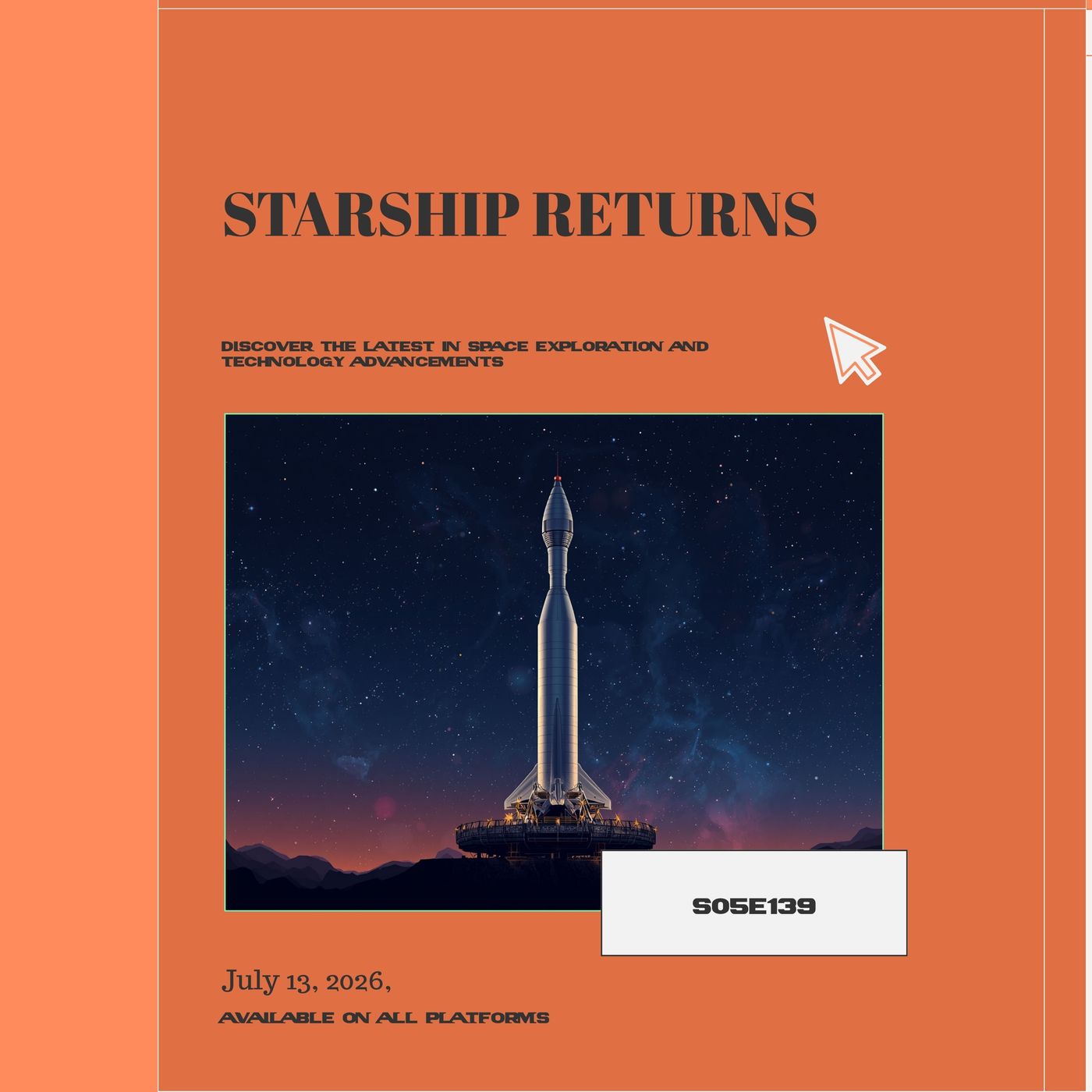
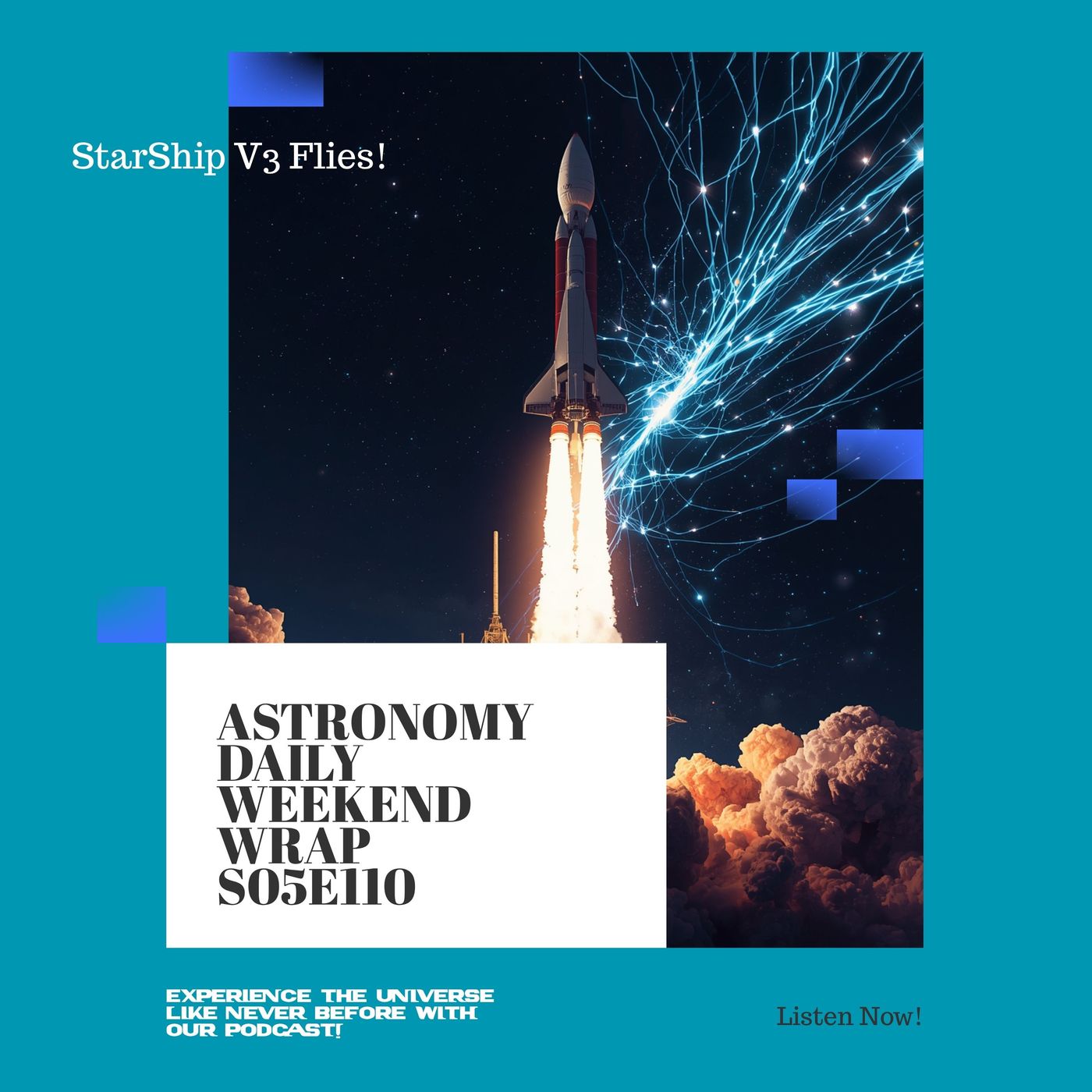
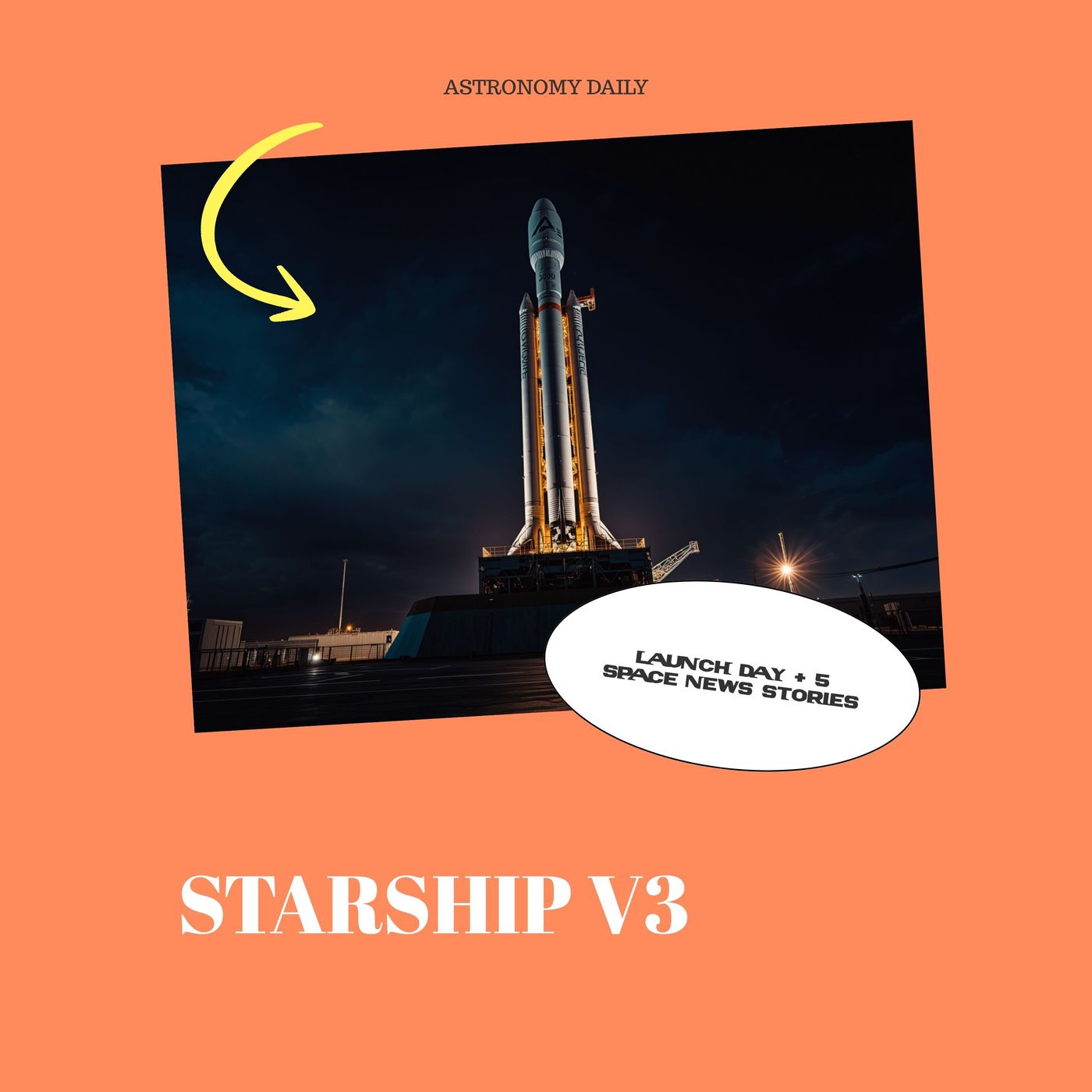
Today's space news from the universe to you. Anna: We've been tracking the Starship V3 story for a couple of days now. The delays, the wet dress rehearsal, the OSHA investigation. And today is finally the day. The launch window opens at 5:30 this afternoon, Texas time, and SpaceX is going for it. Avery: This is Flight 12 in the Starship program overall, but it's the first flight of the V3 design, which is by some measures an almost entirely new rocket. Anna: Elon Musk himself said that nearly every part has been redesigned.
Compared to V2, the rocket now stands 124.4 meters tall. That's just over 400ft, making it officially the tallest rocket humanity has ever built. Avery: And it's not just bigger for the sake of it. The big structural change on this version is that Starship V3 is designed for in orbit refueling for the first time. That's the capability that unlocks deep space missions to the moon and eventually Mars. Anna: ASA is counting on exactly that. Starship has been selected as the human landing system for the Artemis program.
The current plan is for a docking test in low Earth orbit as early as 2027, with a moon surface landing targeted for the Artemis 4 mission in 2028. Avery: But there's a mountain to climb before any of that. SpaceX still hasn't sent Starship into full orbit. The program has seen explosions, delays, and last week a contractor working at Starbase in Texas died in a fall. The US Occupational Safety and Health Administration has opened an investigation. Anna: Today's flight profile is suborbital, similar to recent missions.
The plan is to deploy 20 Starlink simulator satellites, attempt a single Raptor engine relight in space, and test the heat shield by deliberately removing one tile to measure aerodynamic load on neighboring tiles during re entry. Avery: That tile experiment is actually quite clever. You need to understand the failure modes before you can fix them. Anna: Weather is sitting around 55% favorable right now. Not ideal, but workable. And there is a lot riding on this. Beyond engineering pride. SpaceX's planned IPO, which could value the company at, uh, up to $1.75 trillion, would be the largest public offering in history.
Today's test flight is very much in the shop window. Avery: No pressure, then. Anna: None whatsoever. We'll have the result in tomorrow's episode. Whatever happens tonight, it's a pivotal moment for the program and for the future of human spaceflight. Avery: Next up, today. Billions of years ago, Neptune had a tidy family of moons. Then a rogue intruder arrived and tore everything apart. New research published in the journal Science Advances suggests that one moon survived the chaos, and we've known about it since 1949.
Anna: That moon is Nereid, Neptune's third largest satellite and one of the strangest orbits in the solar system. It swings as close as 1.4 million kilometers to Neptune and as, uh, far away as 9.6. For comparison, our moon is a pretty consistent 384,000 kilometers from Earth. Avery: For decades, astronomers have known that Nereid's extreme elliptical orbit was unusual, but they couldn't agree on why. The leading theory was that it was a captured object, something that drifted in from the outer solar system and got gravitationally trapped.
But this new study, led by Matthew Belyakoff at the California Institute of Technology, strongly rules that out. Anna: The team used NASA's James Webb Space Telescope to study Nereid in detail, and what they found changes the story significantly. Their observations are consistent with Nereid being an original moon of Neptune, one that formed right alongside the planet, but was thrown into its wild orbit when Neptune captured its largest moon, Triton. Avery: And Triton's story is quite the tale itself.
Triton is thought to have originated in the Kuiper Belt, the frigid region beyond Neptune where objects like Pluto live. At some point, Triton was captured by Neptune's gravity, and the gravitational chaos of that event scattered Neptune's original moons onto collision courses with each other. Most were destroyed. Anna: Neptune's innermost moons are thought to be the shattered remnants of those originals, rubble that coalesced after Triton's arrival. Nereid, according to this new research, escaped that fate by being thrown into its current extreme orbit.
Far enough out to survive, but close enough to still be bound to Neptune. Avery: As Belyakov puts it, it takes a long time to do science. This mystery began with Nereid's discovery in 1949, and we may finally have some answers in 2026. Thanks to Webb. The researchers note that this work would simply not be possible with any previous telescope. It really is a testament to what Webb continues to deliver. Anna: A survivor of 4 billion years of Cosmic chaos. Not a bad story for a Thursday. Avery: Here's a number that should give you pause.
In 2005, the European Space Agency was tracking around 16,000 pieces of debris in orbit. By 2026, that number has grown to more than 44,000, an increase of roughly 180%. And that's only what we can track. Anna: The vast majority of debris is too small to track at all. ESA estimates there are millions of fragments out there paint flecks, bolt fragments, shards from old rocket stages moving at orbital velocities. Even something tiny can cause catastrophic damage. Avery: But new research is drawing attention to a consequence that gets less coverage than the collision risk.
The scientific cost. A study looking at NASA's Earth observing satellites, specifically Aqua, Terra and Aura, found that since 2005, this fleet has had to execute avoidance maneuvers at least 32 times to dodge debris. Anna: And those maneuvers aren't free, not in terms of fuel and possibly not in terms of data. According to records from the Land Data Products Evaluations Assessment, some of those avoidance burns may have corrupted climate data. During the collection window. You move the satellite, the instruments point somewhere different, and the record has a gap or an artifact.
Avery: These satellites were not designed with this level of debris in mind. Aqua, for instance, has lasted 18 years longer than its original design life. It's been incredibly productive, but it only has so much fuel left. Every avoidance maneuver burns some of that reserve. Anna: And as one insurance analyst put it to space.com even without collisions, space debris has an economic cost. Each time a satellite has to maneuver to avoid a potential collision, it uses fuel, which is a finite and precious resource.
The headline quote from researchers is blunt Things will get worse before they get better. Avery: The good news is that two companies have announced plans to begin active debris removal from orbit in 2027. The technology exists. The will and the regulation need to catch up quickly. Anna: Next on today's agenda. Over the past year or so, results from the dark energy spectroscopic instrument DESI have been causing excitement and consternation in equal measure. The data appeared to hint that dark energy, the mysterious force driving the accelerating expansion of the universe, might be evolving over time, changing in strength as the cosmos ages.
Avery: Which, if true, would be a genuinely enormous deal. The standard cosmological model treats dark energy as a fixed cosmological constant. If it's changing, the model needs to be rebuilt from the ground up. Anna: Exactly. But new research published in Physical Review D is urging caution. Scientists at the Tata Institute of Fundamental Research in Mumbai have found something a small but simple significant mismatch between two Key data sets used to measure dark energy's supernova brightness data and baryon acoustic oscillations, which are essentially ripples in the distribution of galaxies across the universe.
Avery: And the mismatch matters because the DESI results that pointed to evolving dark energy relied on combining those two datasets. If they aren't mutually consistent, if there's a small but real discrepancy in what they're measuring, then the apparent signal of evolving dark energy could be a systematic artifact rather than a genuine physical phenomenon. Anna: The researchers traced the mismatch back to a potential violation of what's called the cosmic distance duality relation, a fundamental geometric relationship that underpins how we calculate distances in the universe.
If that relation is being violated, or if there are subtle calibration errors in the datasets, then the apparent evolution of dark energy may simply disappear. Avery: What does this mean in practical terms? Anna: It means we don't know yet. This paper doesn't prove dark energy is constant. It just raises a serious methodological flag. Science is working exactly as it should. Extraordinary claims get extraordinary scrutiny. More data from DECE's third release and from ESA's Euclid mission should help clarify things later this year.
Avery: The universe remains stubbornly mysterious, which is Anna: honestly what keeps us in a job. Avery: Now, here's a question that sounds simple but turns out to be extraordinarily complex. What's the most efficient way to get from Earth to the Moon? Anna: I mean, you point the rocket at Avery: it, you'd think, right? But no, because in spaceflight, the most direct path is almost never the most efficient one. And the new study, published in the journal Astrodynamics, has found the trajectory to the Moon that is better than any route previously described in the scientific literature.
Anna: How much better? Avery: The new route uses 58.8 meters per second less fuel, what engineers call Delta V compared to the previous, best known path. That might sound tiny. But consider the total fuel budget for an Earth to Moon transfer is around 3,343 meters per second. Shave nearly 60 off that, and you've made a real difference. Every meter per second saved is, as the researchers put it, a massive amount of fuel consumption. Anna: So how did they find it? Avery: The team from the universities of Colimbra, Porto and Evora in Portugal and the University of so Paulo in Brazil used a mathematical approach called the theory of functional connections.
It dramatically reduces the computing power needed to simulate trajectories, which let them test around 30 million different routes. Previous studies had managed around 280,000. Anna: That's an enormous leap in the search Avery: space, and it paid off. The most efficient route they found is counterintuitive. Instead of heading more or less directly toward the Moon, the spacecraft first swings toward a point called the L1 Lagrange point, the gravitational balance point between Earth and the moon.
About 85% of the way there, it enters a stable orbital pathway around L1, then departs on an unstable pathway that transitions it, uh, into lunar orbit. Anna: Essentially using the Moon's own gravity as part of the propulsion system. Avery: Exactly. The team also notes that the L1 point maintains constant line of sight with Earth, which means communication is uninterrupted throughout the journey. And crucially, this method can be adapted. You could use it for any planet, moon system, or any orbital transfer problem.
As the researchers say, the systematic analysis they developed could be adopted much more widely going forward. Anna: Small savings Scaled across dozens of future Artemis missions, that adds up to a Avery: lot of rocket fuel and a lot of money. Anna: Speaking of money, here's a way you can save heaps and secure your online life. Simply do what we did and get NORDVPN to take advantage of our, uh, very special offer. Just look for the link in the show notes. Avery: Stay safe online and away from prying eyes.
Get NordVPN. Anna: All right, on to our next story. And this one will surprise many. If you've ever looked up at the night sky and felt reassured that the galaxy must be full of Earth's worlds with oceans, atmospheres and the potential for life, new research from the European Geosciences Union conference in Vienna may give you pause. Avery: That's not the most comforting preamble. Anna: Preliminary results presented by Shawn Jordan, a postdoctoral researcher at ETH Zurich, suggest that our galaxy may be filled with a far greater number of Venus like worlds than true Earth analogs, and that this might simply be how rocky planet formation works.
Avery: Walk us through the science. Anna: When a rocky planet forms, it goes through what's called a magma ocean phase. Essentially the entire surface is molten. As it cools, the atmosphere it develops heavily depends on its chemistry and its distance from its star. Dourdan and colleagues argue that it's actually quite straightforward to end up with a carbon dioxide dominated atmosphere, thick, hot, crushing Venus style. After that cooling phase, getting to an Earth like nitrogen oxygen atmosphere is harder, Avery: meaning a, uh, Venus outcome might be the path of least resistance.
Anna: That's the implication. And there's a philosophical reframe buried in here too. Jordan suggests that Venus may not have gone wrong. It may simply have been born that way. A planet that came out of its magma ocean phase looking exactly like Venus does today without ever having oceans or a temperate climate. Avery: How many exovenus candidates are we actually talking about? Anna: At least a few dozen rocky exoplanets are considered potential Venus analogues, though none have been confirmed as such.
We don't yet have the atmospheric characterization tools to be certain. The challenge is that a Venus like atmosphere, although sulfuric acid clouds, looks very similar to a, uh, featureless atmosphere in our current observations. Avery: There's a telling phrase in the coverage of this research that our own Venus has been described as criminally underexplored. Only one mission has sent a lander since the Soviet program in the 80s. Anna: That's the awkward irony. We're looking for Venus twins across the galaxy while barely understanding the one we have next door.
ESA's Envision mission and NASA's DaVinci program are, uh, both in development, and they can't come soon enough. Our nearest twin, the cautionary tale, deserves a much closer look from a habitable Avery: paradise candidate to the galaxy's most common world. Quite the motion. Anna: Science rarely flatters our assumptions before we Avery: head out, A quick look at the sky for our Southern Hemisphere listeners, particularly in Australia and New Zealand, this week Anna: is a beautiful time to watch the evening sky.
Jupiter is blazing brightly in the west after sunset, and the waxing moon is sliding past it over the next couple of nights. Tonight they're particularly close together, making for a stunning naked eye pairing. Avery: No equipment needed, just step outside about 30 to 45 minutes after sunset, look west and you'll see the moon and the brightest star near it. That's Jupiter. It's one of those simple, wonderful reminders that the solar system is right there every clear night. Anna: Cloud free skies to all of you.
Avery: That is Astronomy Daily for Thursday, May 21, 2026. Six stories from the launch pad in Texas to the farthest reaches of Neptune's Anna: battered moon and the starship. Result. Whatever it is, we'll have it for you tomorrow. Avery: If you enjoyed the show, please take a moment to subscribe and leave a rating. Wherever you get your podcasts, it genuinely makes a difference. Anna: You can find us at astronomydaily IO and on socials astrodaily pod. We're part of the bytes.com podcast network.
Avery: Until tomorrow, keep looking up Clear Skies Astronomy Day Anna: stories.
 Apple Podcasts
 Spotify
 Pocket Casts
 Castbox
 Overcast
 Podbean
 iHeartRadio
 Castro
 Goodpods
 Moon FM
 Podcast Addict
 Podcast Republic
 YouTube