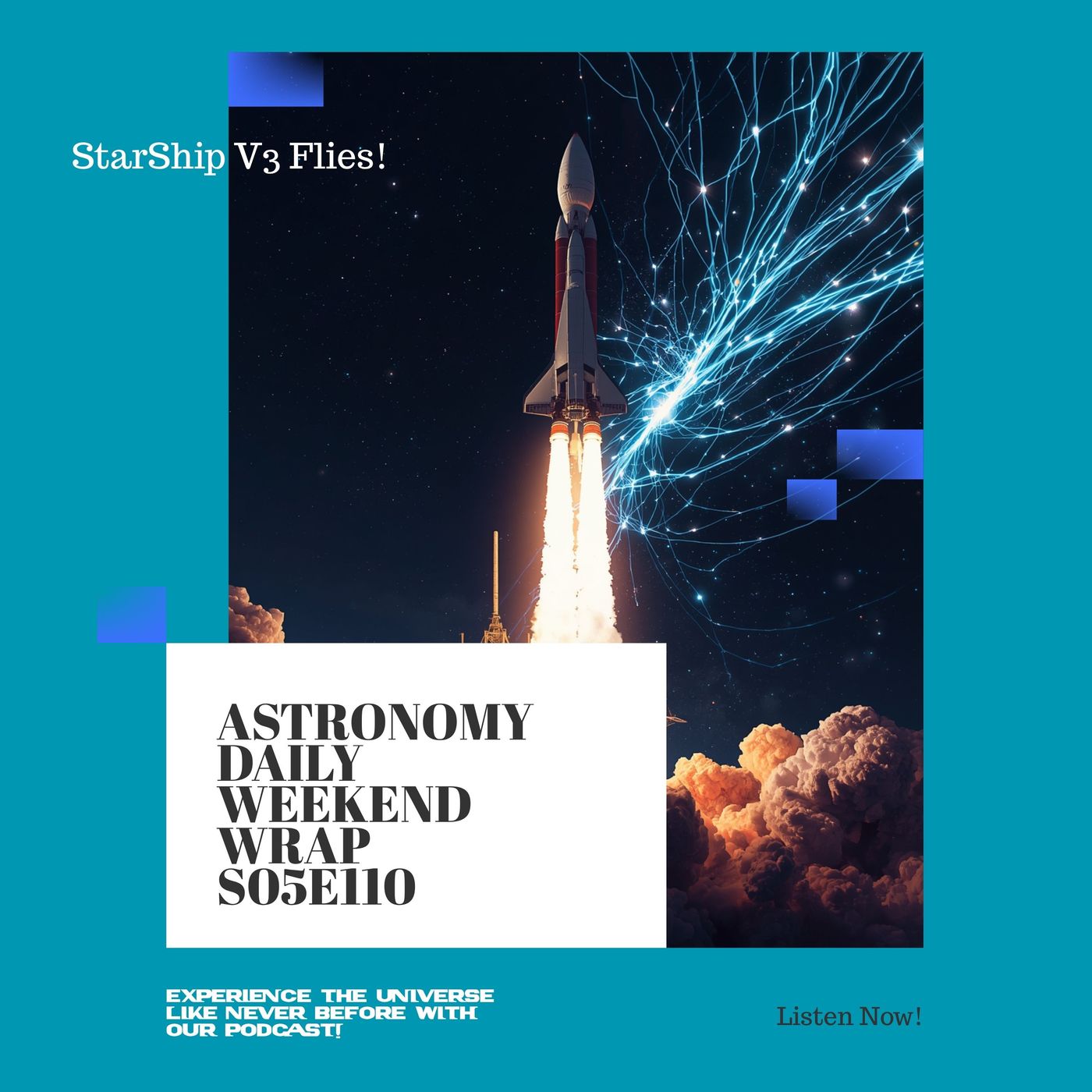
Starship V3 Maiden Flight, New Glenn Cleared, Cosmic Web Photographed | Weekend Wrap
In this episode
Sponsor Link:You've heard us talking about them now it's time to check out the special money saving deal from our sponsor NordVPN. CLICK HERE
Your weekly roundup of the biggest stories from across the cosmos — two fresh stories plus the best of the past seven days from Astronomy Daily. In This Episode • Starship V3 Flight 12: SpaceX launches its redesigned megarocket for the first time — an historic milestone with some drama along the way • New Glenn Cleared to Fly: Blue Origin completes its NG-3 failure investigation — the FAA approves the report and the rocket is back in action • First Direct Image of the Cosmic Web: A 3-million-light-year filament photographed in unprecedented detail by ESO's Very Large Telescope • Dark Matter Fingerprint? MIT researchers find a gravitational wave signal that may carry the first direct imprint of dark matter • Roman Space Telescope: NASA's next great observatory is targeting September 2026 launch — eight months ahead of schedule • AI Space Chip: NASA tests a radiation-hardened chip that could give future spacecraft genuine autonomous decision-making Story Sources & Further Reading Starship V3 / Flight 12: Space.com, Universe Today, Spaceflight Now, Next Spaceflight New Glenn / Blue Origin: SpaceNews (May 22, 2026), Space.com, TechCrunch Cosmic Web Image: Nature Astronomy — Tornotti et al.; ESO/VLT press release; Mirage News (May 16, 2026) Dark Matter / Gravitational Waves: Physical Review Letters — Aurrekoetxea et al.; ScienceDaily, Universe Today (May 19, 2026) Roman Space Telescope: NASA.gov, Scientific American, ScienceDaily (May 18, 2026) NASA AI Space Chip: ScienceDaily, NASA (May 15, 2026) About Astronomy Daily Astronomy Daily delivers the latest space and astronomy news every weekday, plus a Weekend Wrap on Saturdays. Hosted by Anna and Avery, and produced by the Bitesz.com Podcast Network. Website: astronomydaily.io | Social: @AstroDailyPod
Become a supporter of this podcast: https://www.spreaker.com/podcast/astronomy-daily-latest-space-news--5648921/support.
Sponsor Details:
Ensure your online privacy by using NordVPN. To get our special listener deal and save a lot of money, visit www.astronomydaily.io/nordvpn. You'll be glad you did!
Get the best secure and private email on the planet. Stop your Government, google and who knows who else spying on every email you write. Do what we did and use ProtonMail. They beleive in privacy and there are no ads in their business model...yet they still provide a free forever service. Check them out and get out special deal at www.astronomydaily.io/protonmail
Become a supporter of Astronomy Daily by joining our Supporters Club. Commercial free episodes daily are only a click way... Click Here
This episode includes AI-generated content.
Anna: Hello and welcome to Astronomy Daily. Your weekend wrap for Saturday, May 23, 2026. I'm Anna. Avery: And I'm, um, Avery. If you've been following the news from Boca Chica, Texas, you already know it's been quite a week for spaceflight. Anna: Quite a week is an understatement. Starship version 3 finally left the pad last night. And while it wasn't a clean sheet, it was absolutely a milestone. We'll have the full story and all the drama coming up shortly. Avery: And in our second fresh story, we're heading to a rival launch pad.
Blue Origin has just cleared the way for New Glenn to fly again. After its spring mishap, the heavy lift rocket race is firmly back on. Anna: Then we'll take a look back at the best of the week. The universe's hidden highways finally photographed. Possible fingerprints of dark matter in gravitational waves, uh, a revolutionary new space telescope nearly ready to fly, and a chip that could teach spacecraft to think for themselves. Avery: It's, uh, a full slate. Let's get into it. Anna: So last night was the night.
After a scrubbed attempt, on Thursday, SpaceX finally got Starship version 3 off the ground for the very first time. Avery: Flight 12 lifted off at 6:30pm Eastern from Pad 2, a brand new launch pad at Starbase in Boca Chica, Texas. That's actually two first in one made in flight of the V3 vehicle and debut of the new pad. Anna: And let's give credit where it's due. Elon Musk himself called it epic. And for good reason. The V3 Starship is a significant redesign from previous versions. Both the super heavy booster and the ship are powered by the next evolution of SpaceX's Raptor engine.
They've simplified the aft sections, increased propellant capacity, and built in new hardware for future orbital refueling. Avery: But, and it's a fairly significant but not everything went to plan. The booster performed well on ascent and nailed stage separation. But the boostback burn went non nominal, several engines dropped out, the booster started to spin out of control, and ultimately it came down hard rather than completing its planned water landing in the Gulf. Anna: Meanwhile, up in the ship, one of the vacuum Raptor engines shut down unexpectedly.
But the ship compensated using its sea level Raptors and continued on its intended trajectory, eventually splashing down as planned in the Indian Ocean. Avery: So the scorecard ship success booster lost. But this was always billed as a test flight, not a demonstration. And given it was the maiden flight of a significantly redesigned vehicle, getting the ship home safely and gathering a mountain of data on the booster anomaly is a genuinely Useful outcome. Anna: The stakes couldn't be higher for SpaceX right now.
NASA has picked Starship as the lunar lander for the Artemis 4 crewed moon mission in 2028. That means SpaceX needs V3 to demonstrate full orbital capability in orbit, refueling, docking, and eventually a crewed lunar surface landing. None of which have happened yet. Avery: And there's a financial dimension too. SpaceX recently filed for an IPO and the investment community is watching very closely. A partial success like this historic milestone, some anomalies, is probably the best honest summary of where the program stands.
Anna: Flight 13 is already penciled in for June, which tells you how quickly SpaceX wants to turn this around. Last night was the beginning of V3's story, not the end. Avery: One more thing worth noting. There was a fascinating site announcement just before launch. Cryptocurrency billionaire chun Wong, the Fram 2 mission commander who circled the poles in Dragon earlier this year, announced he'll lead the first starship flyby of Mars. A crewed Mars flyby, not a landing. Anna: But still, the ambition levels in this industry right now are genuinely something else.
We'll be tracking all of it as Flight 12's data gets analyzed and preparations for Flight 13 begin. Avery: And speaking of heavy lift rockets, Blue Origin had some significant news of its own yesterday. The company has officially completed its investigation into the new Glenn NG3 mission failure from April and the FAA has signed off on the report. Anna: So New Glenn is cleared to fly again. Let's quickly recap what happened back on April 19, M NG3 lifted off from Cape Canaveral carry an AST Space Mobile's Bluebird 7 satellite.
The good news? The booster nailed its landing on the drone ship. Actually the first ever reuse of a new Glenn booster, which was a genuine milestone. Avery: The bad news? The second stage ran into some trouble during its second burn. Blue Origin traced it to an off normal thermal condition that prevented one of the BE3U engines from reaching full thrust. The result was Bluebird 7 ending up in an orbit too low for its onboard propulsion to recover from. The satellite was deorbited. A, uh, costly and embarrassing outcome.
Anna: The FAA grounded New Glenn while the investigation ran. And now, five weeks later, Blue Origin has its clearance back. The corrective actions have been accepted and the path to the next launch is open. Avery: The timing is actually quite pointed, isn't it? This news, landing on the Same day Starship V3 makes its debut. Two of the world's most powerful rockets, both dealing with growing pains, both, uh, pushing toward their next flights. Anna: And for Blue Origin, the Pressure is real. New Glenn is supposed to launch the first ever Blue Moon crewed lunar lander test flight later this year.
That's one of NASA's two contracted Artemis Landers alongside Starship. Avery: Any further delays to New Glenn's schedule ripple directly into the Artemis timeline. AST Space Mobile, who lost a Bluebird 7 satellite, said in their May earnings call that they're looking forward to the next New Glenn launch, which will carry four Bluebird satellites to make up for it. No firm date yet, but the investigation being closed is step one, Two rockets, Anna: two milestones, one Wild Friday and spaceflight.
Not bad for a weekend rap lead in. Avery: Alright, time to roll back through the week, four stories that caught our eye. From the very fabric of the universe to the future of space exploration. Anna: Let's start with one that genuinely stopped me in my tracks. Avery: The cosmic web. For decades we've known it exists. This vast invisible skeleton of matter that connects galaxies across the entire univers universe. We've modeled it in supercomputer simulations. We've inferred its existence from the way galaxies cluster.
But actually photographing it, actually seeing a filament of the web that had always been beyond reach until now. Anna: An international team of astronomers this week published the sharpest direct image ever captured of a cosmic web filament. The image shows a strand of intergalactic hydrogen gas stretching 3 million light years, connecting two galaxies that were actively forming when the universe was only about about 2 billion years old. Avery: 3 million light years. The Milky Way itself is only about a hundred thousand light years.
Across this filament is 30 Milky Ways laid end to end. Anna: To pull this off, the team used muse, the Multi Unit Spectroscopic Explorer mounted on the European Southern Observatory's Very Large Telescope in Chile. And it wasn't quick. They spent hundreds of hours gathering observations to detect a structure this faint. The result was published in Nature Astronomy and represents one of the most ambitious observing campaigns ever conducted in a single region of the sky. Avery: What makes this particularly exciting scientifically is that the image matches cosmological simulations so closely.
The structure of the cosmic web. The way gas flows along these filaments to feed galaxy formation. The real universe looks exactly like what our models predicted. That's a powerful validation of our understanding of large scale cosmic structure. Anna: The team's lead researcher described capturing the light from this filament, light that traveled for nearly 12 billion years to reach us, as a way to precisely characterize its shape. And importantly, this opens a new observational window. Now that we've done it once we can start building up a picture of the web one filament at a time.
Avery: If you haven't seen the image, look it up. The simulations next to the real data are extraordinary. Anna: Now this one comes with appropriate scientific caution, but if it holds up, it could be one of the most significant detections in the history of physics. Avery: We're talking about dark matter, the invisible substance that makes up roughly 85% of all matter in the universe, and that we have never directly detected. We know it's there from the way galaxies rotate from gravitational lensing, from the large scale structure of the cosmos, but directly never caught it until maybe now.
Anna: A team at MIT has developed a new model that predicts how dark matter could leave a subtle imprint on gravitational waves. The ripples in spacetime we detect when black holes merge. The idea is if two black holes happen to spiral through a dense cloud of dark matter on their way to merging, that dark matter slightly alters their orbital dynamics and those tiny changes get encoded in the shape of the gravitational waves. Avery: It's using one incredible detection, gravitational waves, to search for another invisible phenomenon.
Layers of detection on detection. Anna: And when the team tested their model against real data from ligo, the Laser Interferometer Gravitational Wave Observatory, one signal stood out. One black hole merger event occurred to carry exactly the kind of distortion their model predicted for a dark matter environment. Avery: Now, important caveat, this is one signal, one candidate. It needs to be replicated, scrutinized and tested against alternative explanations before anyone declares victory. But the methodology is sound, the physics is elegant, and the possibility that we are holding in our hands the first direct fingerprint of dark matter is genuinely extraordinary.
Anna: The paper appeared in Physical Review Letters this week. A, uh, prestigious venue that doesn't publish lightly. We'll be watching this story very closely, alright? Avery: From the very small and invisible to the very large and imminent. NASA's Nancy Grace Roman space telescope has been in development for years. And this week we got the news that it's not just on track, it's ahead of schedule. Anna: NASA announced that Roman is now targeting launch as early as September 2026, a full eight months ahead of its original May 27 deadline.
And crucially, it's under budget. In a space program landscape where overruns are practically expected, that's a genuine achievement. Avery: So what is Roman and, um, why should we be excited? In short, it's the widest field infrared telescope ever launched, where James Webb is designed to stare deeply at individual targets with extraordinary precision. Roman is designed to survey enormous swaths of the sky. Think of Webb as a powerful telephoto lens and Roman as an astonishing wide angle camera for the entire cosmos.
Anna: And the numbers are staggering. Over its five year primary mission, Roman is expected to discover tens of thousands of new exoplanets, catalog battle billions of galaxies and observe tens of billions of individual stars. NASA administrator Jared Isaacman put it simply. What would take the Hubble Space Telescope 2000 years to survey Roman can do in a single year. Avery: Its primary scientific goals are dark energy and dark matter, probing the accelerating expansion of the universe and mapping the invisible mass that shapes cosmic structure.
But given the sheer scale of what it will observe, astronomers expect Roman to deliver surprises that nobody has even thought to predict yet. Anna: Roman will launch aboard a SpaceX Falcon Heavy rocket to the Sun, Earth L2 Lagrange Point, about a million and a half kilometers from Earth, in the same cosmic neighborhood as James Webb. September can't come soon enough. Avery: And our final highlight this week takes us to a quieter but potentially very consequential development. A new computer chip that could fundamentally change how deep space missions operate.
Anna: NASA has been testing a uh, next generation radiation hardened space computer chip designed to give spacecraft the ability to make intelligent decisions independently without waiting for instructions from Earth. Avery: And that matters more than it might sound right now. Deep space probes are fundamentally reactive. They carry out pre programmed instructions and when something unexpected happens, they wait for guidance from ground control at the distance of Saturn. That's a one and a half hour round trip for a radio signal at the outer planets.
It can be three to five hours for a mission to the nearest star. We're talking years. Anna: A spacecraft with genuine onboard intelligence could detect an anomaly, assess it, and respond, all without waiting for a human to weigh in from millions of kilometers away. Or it could autonomously identify scientifically interesting targets and choose to observe them in real time, rather than waiting for a pre planned observation sequence. Avery: The chip being tested is described as showing performance that opens up real possibilities for autonomous operations.
Radiation hardening is the critical piece here. Deep space is a, uh, punishing environment for electronics and chips that work perfectly in a lab can fail catastrophically when hit by cosmic rays. Getting that balance right is genuinely hard engineering. Anna: We're still in the testing phase, but this is the kind of foundational technology that a, uh, decade from now we'll look back on as the point where the next generation of truly independent robotic explorers became possible. Avery: And that is your weekend wrap for Saturday, May 23rd.
What a week to be following space news. Anna: Starship V3 in the air. New Glenn cleared to fly again. Cosmic web photographed for the first time, hints of dark matter and gravitational waves, Roman almost on the pad, and AI chips that could give our spacecraft minds of their own. Avery: The universe keeps delivering, and so do we. Astronomy Daily is available wherever you get your podcasts, and you can find us online at astronomydaily IO. Anna: Follow us on social media at. Ah, astrodaily Pod for daily updates, breaking space news, and the occasional stunning image that will make you feel very small in the best way possible.
And please check out our sponsor's special deal that will give you the best online protection for less money. Win win, I would say. Link is in the show Notes. Avery: We'll be back on Monday with the latest from the Cosmos. Until then, keep looking up. Anna: Clear skies, everyone.
Avery: The stories the tongue.

 Apple Podcasts
 Spotify
 Pocket Casts
 Castbox
 Overcast
 Podbean
 iHeartRadio
 Castro
 Goodpods
 Moon FM
 Podcast Addict
 Podcast Republic
 YouTube