In this episode
Happy Valentine's Day from Astronomy Daily! The cosmos has pulled out all the stops today — from astronauts docking at the space station to a dying star sending the universe a literal heart-shaped Valentine. Plus, the ring of fire eclipse countdown, why eclipses always arrive in pairs, a comet that flipped its spin, a six-planet parade to look forward to, and a chance of aurora tonight.In this episode:
🚀 SpaceX Crew-12 launched yesterday and docks at the ISS today — a Valentine's Day arrival to end a month of skeleton-crew operations
🌑 Just 3 days until the "ring of fire" annular solar eclipse over Antarctica on February 17th
🌒 Why eclipses come in pairs: eclipse seasons explained — and 2026 has four eclipses across two spectacular seasons
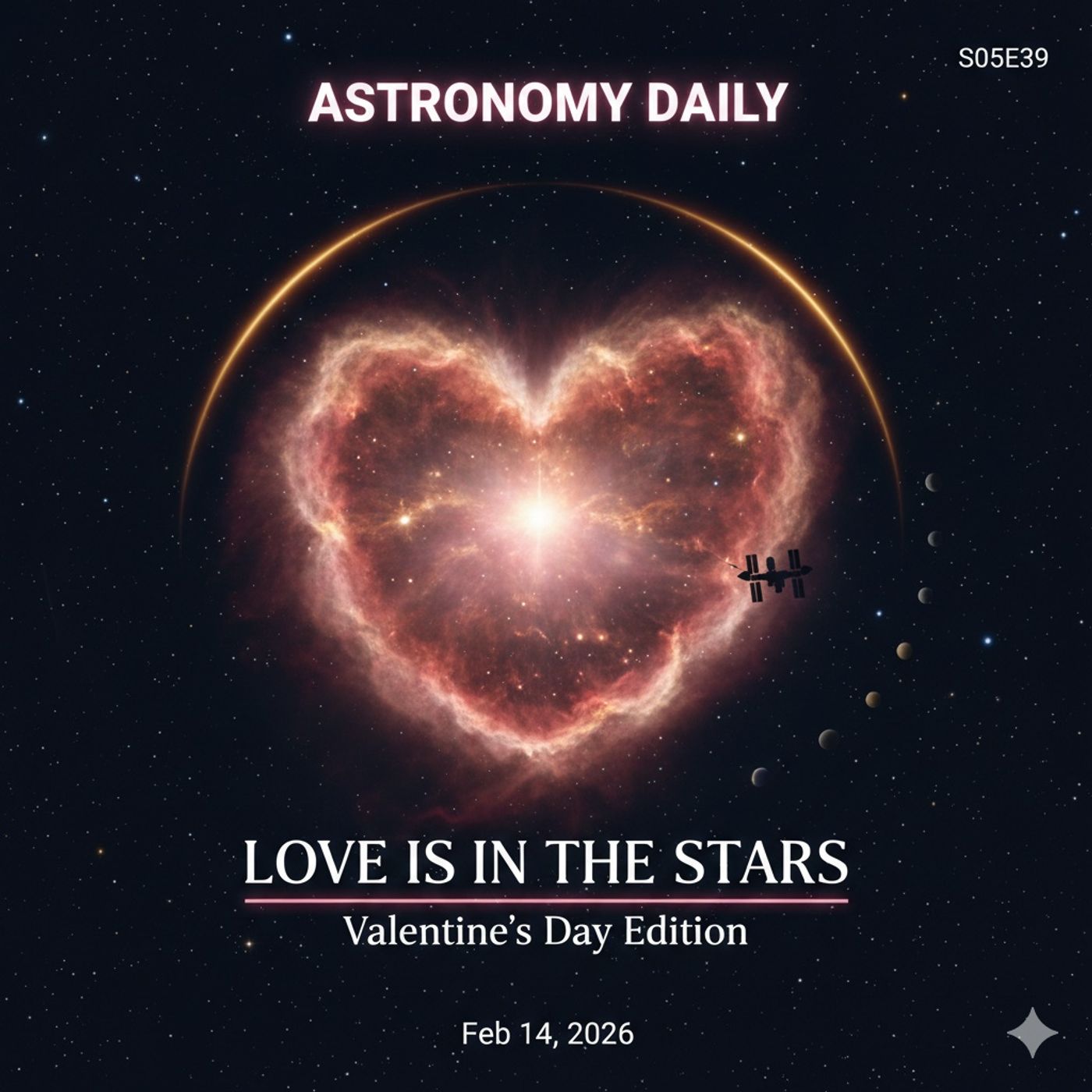
💖 A dying star's cosmic Valentine: Mira A ejects a heart-shaped cloud of gas and dust 300 light-years from Earth
☄️ Comet 41P stuns scientists by flipping its rotation direction — what's behind this mysterious spin reversal?
🪐 Six-planet parade coming February 28 — Mercury, Venus, Mars, Jupiter, Uranus and Neptune line up at a civilised hour
🌌 Bonus: Possible Valentine's Day aurora from geomagnetic activity tonight
Website: https://astronomydaily.io
Social: @AstroDailyPod on all platforms
Part of the Bitesz.com podcast network
Become a supporter of this podcast: https://www.spreaker.com/podcast/astronomy-daily-latest-space-news--5648921/support.
Sponsor Details:
Ensure your online privacy by using NordVPN. To get our special listener deal and save a lot of money, visit www.astronomydaily.io/nordvpn. You'll be glad you did!
Get the best secure and private email on the planet. Stop your Government, google and who knows who else spying on every email you write. Do what we did and use ProtonMail. They beleive in privacy and there are no ads in their business model...yet they still provide a free forever service. Check them out and get out special deal at www.astronomydaily.io/protonmail
Become a supporter of Astronomy Daily by joining our Supporters Club. Commercial free episodes daily are only a click way... Click Here
This episode includes AI-generated content.
Speaker 1: Happy Valentine's Day, everyone. Welcome to Astronomy Daily, the podcast that brings you the latest space and astronomy news every single day.
Speaker 2: I'm Anna and I'm Avery, and what a day to be talking about the Cosmo Xana. The universe has really pulled out all the stops for Valentine's Day.
Speaker 1: This year, it really has. We've got astronauts arriving at the space station today, a dying star sending the universe a literal Valentine, possible Aurora dancing across the skies tonight, and a whole lot more. So let's get into.
Speaker 2: It ready when you are.
Speaker 1: Our top story today is a Valentine's Day rendezvous, not between sweethearts, but between a Dragon spacecraft and the International Space Station facex's Crew twelve mission launched yesterday morning at Cape Canaveral at five point fifteen Eastern time, and as we speak, four astronauts are on their way to dock with the ISS later this afternoon.
Speaker 2: And what a crew it is. Commanding the mission is NASA astronaut Jessicamir with Jack Hathaway as pilot. They're joined by ISSA astronaut Sophie Adenat, whose mission has been named Epsilon and Ross Cosmos cosmonaut Andre Fetiyev. It's a truly international crew.
Speaker 1: This mission has been particularly urgent avery the ISS has been operating with just three crew members, a skeleton crew since mid January, when Crew eleven had to make an unexpected early return to Earth due to a medical issue with one of its members.
Speaker 2: That left NASA astronaut Chris Williams and two Russian cosmonauts Sergei kutz Verskov and Sergei Mikhayev, holding down the four under own. NASA has been clear that seven crew members is really what you need to maximize a science output on a station that costs around three billion dollars a year to operate.
Speaker 1: So there was real pressure to get this launch done quickly. SpaceX actually had the rocket and spacecraft ready ahead of schedule, but crew training and weather kept pushing the date. They lost two launch windows earlier in the week to bad weather along a flight path before finally getting off the ground yesterday.
Speaker 2: And in a lovely touch for Valentine's Day, the crew revealed their zero gravity indicator, a handmade crocheted model of Earth with four little satellites representing each crew member. Plus a tiny moon for Commander Mer. It was made by Mer's childhood best friend and Hathaway's daughter. That's pretty adorable, it really is.
Speaker 1: Docking is expected at around three point fifteen pm Eastern Time today, so by the time many of you are listening to this, the ISS should be back to its full complement of seven. NASA Administrator Jared Isaacman praised the teams, saying they brought Crew eleven home early, pulled Crew twelve forward, and did it all while preparing for the Artemis two moon mission. A busy few weeks at NASA, to say the least.
Speaker 2: And speaking of the Artemis to rocket, there was a fantastic photo from Kennedy Space Center this week showing the massive SLS Moon rocket photo bombing the Crew twelve Falcon nine on the neighboring launch pad, two very different rockets side by side, representing the present and future of human spaceflight.
Speaker 1: Now we've been keeping you updated on this one, but with just three days to go, it's time for a final reminder. On Tuesday, February seventeenth, the first solar eclipse of twenty twenty six will take place. An annular solar eclipse or also known as a ring of fire eclipse.
Speaker 2: And here's the thing. This one is going to be witnessed by more penguins than people. The path of annularity, where you'd actually see that stunning ring of sunlight around the Moon, cuts across a remote stretch of Antarctica and the Southern Ocean.
Speaker 1: At maximum eclipse, the Moon will cover about ninety six percent of the Sun's disc, leaving that slim glowing ring visible for up to two minutes and twenty seconds. But you'd need to be at one of the scientific research stations down in Antarctica, like the French Italian Concordia Station or Russia's Myrni station.
Speaker 2: For the rest of the world, partial phases will be visible from the very southern tips of Chile and Argentina and the cross parts of Southern Africa, including South Africa, Mozambique and Madagascar. But if you're in Europe, North America or most of Asia, no dice on this one. I'm afraid Bill.
Speaker 1: It's a reminder that eclipse season is upon us, and that brings us neatly to our next story.
Speaker 2: Have you ever noticed that solar eclipses and lunar eclipses seem to arrive in pairs. It's not a coincidence. Every eclipse is part of a predictable pattern during a short window known as an eclipse season.
Speaker 1: That's right. An eclipse season lasts about thirty one to thirty seven days, and there are typically two each year, roughly six months apart. They occur when the Sun passes near one of the lunar nodes, the points where the Moon's tilted orbit crosses the plane of Earth's orbit around the Sun. During this window, the geometry lines up for eclipses to.
Speaker 2: Happen, and because the window is long enough to contain both a new moon and a full moon, which are always about two weeks apart, you almost always get a pair, a solar eclipse at new moon and the lunar eclipse at full moon, or vice versa.
Speaker 1: So the annular solar eclipse on February seventeenth is the opening act. Exactly fourteen days later, on March third, the same eclipse season delivers a total lunar eclipse, a blood moon, with the Moon spending nearly an hour fully inside Earth's dark umbrel.
Speaker 2: Shadow, and that one is much more accessible observers in East Asia Australia. The Pacific and western North America will have excellent views of the Moon turning that gorgeous coppery color during flatality.
Speaker 1: But wait, there's more. The second eclipse season of twenty twenty six arrives in August, and this one is the blockbuster. On August twelfth, a total solar eclipse will sweep across Greenland, Iceland, and northern Spain. That's the first total solar eclipse since April twenty twenty four, and much of Western Europe and North America will see at least a deep partial eclipse.
Speaker 2: Then two weeks after that, on August twenty eighth, a partial lunar eclipse rounds out the season. So twenty twenty six really is shaping up to be a remarkable year for eclipse chasers, for eclipses, two seasons, and some genuinely spectacular events. If you've been meeting to plan an eclipse trip, now's the time.
Speaker 1: We'll have much more on the March and August eclipses as they get closer, so stay tuned.
Speaker 2: And now for what has to be the most perfectly timed astronomy story of the year. Just in time for Valentine's Day, Space has sent us a heart shaped greeting.
Speaker 1: The star Mira A, about three hundred light years from Earth, has ejected a cloud of gas and dust that forms a striking heart shape around it. And this isn't just a pretty picture, it's a genuinely surprising science discovery.
Speaker 2: Mira A is a red giant star, one of the most famous variable stars in the sky. It was first documented all the way back in fifteen ninety six as a star. In the last stages of its life, it's been shedding material into space, but the amount and speed of this particular rejection caught astronomers off guard.
Speaker 1: The study, led by Theo Corey at Sweden's Chalmers University of Technology, found that Mira A ejected roughly seven earth masses of material in this burst. Using observations from both the Very Large Telescope and the Alma radio array in Chile, the team discovered that gas fills the heart shaped structure, while dust concentrates along the outer edges, creating a beautiful glowing outline.
Speaker 2: What's particularly fascinating is that the star appears to be acting like a lighthouse, illuminating its surroundings unevenly. Corey said that they were very surprised to see the structure, and that the star's illumination of the surrounding us varies in unexpected ways.
Speaker 1: And there's a companion star in this love story too. Mira B, a white dwarf star that orbits Mira A, is already beginning to gather some of the ejected material. The researchers say they'll keep monitoring the expanding cloud because it could eventually affect Mira B. Though we've got a cosmic couple exchanging material on Valentine's Day, You couldn't make it up.
Speaker 2: The study has been accepted for publication in the journal Astronomy and Astrophysics, and the preprint is already available on archive. A truly heartfelt discovery.
Speaker 1: Literally from hearts to headspinners. Scientists have been lift puzzled by a comment that has done something truly extraordinary. It's flipped its rotation direction.
Speaker 2: Palmet forty one p Tutal Jacobini Cresak try saying that three times fast was observed by NASAs Swift spacecrafts back in twenty seventeen, slowing its rotation dramatically. It went from once every twenty hours to once every fifty three hours in just sixty days.
Speaker 1: To put that in context, the previous record for a commentary spin down was held by Comet Hartly II, which slowed from seventeen to nineteen hours over ninety days. So Comet forty one p changed its spin rate ten times more dramatically in two thirds the time. It's unprecedented.
Speaker 2: But that's not even the stranger part. New analysis of Hubble space telescope images by astronomer David Jewett at UCLA has revealed that after slowing down, the comet's rotation appeared to actually reverse it started spinning the other way.
Speaker 1: The culprit appears to be the comet's own outgassing. As comets approach the Sun, the heat up and release jets of gas. When that gas escapes unevenly from the surface, what scientists call anisotropic outgasing, it creates a torque on the nucleus, gradually changing and eventually reversing its spin.
Speaker 2: Jewett estimates that the nucleus is less than zero point seven kilometers in radius, making it particularly susceptible to these forces. And here's the sobering implication. The lifetime of the nucleus to rotational instability is just a few decades, which is incredibly short compared to the thousands of years it's been in its current orbit.
Speaker 1: So while the comet's orbit might be stable for millennia, its physical integrity is much more fragile. It raises the question of whether comets might not last as long as we previously thought, with their own internal forces eventually tearing them apart. The paper is available as a pre print on archive for anyone who wants to dig into the details.
Speaker 2: And finally, here's something for everyone to look forward to. Later this month, a rare six planet parade is building in the evening sky, and the best part, it's happening at a perfectly civilized hour.
Speaker 1: Throughout February, six planets are lining up across the sky in what astronomers call a planetary alignment. The parade features Mercury, Venus, Mars, Jupiter, Uranus, and Neptune, and the show peaks on February twenty eighth.
Speaker 2: Now, four of those Mercury, Venus, Mars, and Jupiter will be visible to the naked eye, Urinus and Neptune will require binoculars or a telescope. The best time to look is about thirty minutes after your local sunset low in the western sky. You'll want a clear, unobstructed horizon.
Speaker 1: Mercury might be the trickiest to spot because of its low position near the horizon, but Venus and Jupiter should be unmistakable. They're the brightest objects in the evening sky after the moon.
Speaker 2: Now, this isn't quite as rare as the seven planet alignment we saw in February last year, which included all the classical planets plus Uranus and Neptune. That one won't happen again until twenty forty. But groupings of six planets are still pretty special.
Speaker 1: As astronomer Greg Brown from the Royal Observatory Greenwich has pointed out. While groups of three or four planets appearing together are relatively common, the more planets involved, the more orbital geometry has to cooperate. So a six planet parade is definitely worth stepping outside for.
Speaker 2: Mark your calendars for February twenty eighth, and maybe start scoping out a good western facing spot with a low horizon. We'll remind you as a day gets.
Speaker 1: Closer before we go, one more little Valentine's Day treat. If you're in the Northern United States or southern Canada tonight, you might want to step outside after dark and look north. NOAA forecasters are predicting possible G one minor geomagnetic storming this weekend, driven by the combined effects of a coronal whole high speed solar windstream and a coronal mass ejection from earlier this week.
Speaker 2: So there's a chance, no guarantees, but a chance to see the Northern lights tonight and into Sunday. Dates like Michigan and Maine, and of course our friends in Canada and northern US Europe have the best odds. What could be more romantic than watching the Aurora dance across the sky on Valentine's Day?
Speaker 1: Imagine telling your date, I arranged the Northern Lights just for you.
Speaker 2: Smooth move, very smooth. Well that's off for today's show. Whether you're spending Valentine's Day stargazing, watching a spacecraft doc with the Space Station, or just enjoying the cosmic love story of Mira A and its heart shaped nebula, we hope the universe gives you something to smile about today.
Speaker 1: Don't forget to subscribe to Astronomy Daily wherever you get your podcasts, and you can find us online at Astronomy Daily dot io and on social media at astro Daily Pod. If you enjoyed today's episode, please leave us a rating and review. It really helps others find the show.
Speaker 2: Until next time, keep looking up and Happy Valentine's Day from all of us at Astronomy Daily, Queer Skies, Everyone, Sunday Starts Store is the Soul Store? Is the troll
Speaker 2: mhm
 Apple Podcasts
 Spotify
 Pocket Casts
 Castbox
 Overcast
 Podbean
 iHeartRadio
 Castro
 Goodpods
 Moon FM
 Podcast Addict
 Podcast Republic
 YouTube