ISS Back to Full Strength, Artemis 2 Battles Hydrogen Leaks, and Enceladus Goes Electromagnetic
In this episode
• Crew-12 Docks at ISS — The SpaceX Crew-12 mission docked at the International Space Station on Valentine’s Day, restoring the station to full strength after over a month with a skeleton crew. Astronauts Jessica Meir, Jack Hathaway, Sophie Adenot, and Andrey Fedyaev join Expedition 74 for an eight-month mission. • Artemis 2 Hydrogen Leak Update — NASA’s “confidence test” on the SLS rocket’s repaired hydrogen fueling seals showed mixed but cautiously encouraging results. March remains the earliest potential launch window for humanity’s first crewed mission to the Moon in over 50 years. • Enceladus: Electromagnetic Powerhouse — A major new study of 13 years of Cassini data reveals Saturn’s tiny moon Enceladus generates Alfvén waves extending over 504,000 km, transforming our understanding of how small moons influence giant planetary magnetospheres. • Catching 3I/ATLAS — Researchers from the Initiative for Interstellar Studies propose a Solar Oberth Manoeuvre mission launching in 2035 that could intercept the interstellar comet, currently heading toward Jupiter for its closest pass on March 16. • Geomagnetic Storm Watch — G1 minor storming is likely today as a coronal mass ejection arrives alongside fast solar wind from a returning transequatorial coronal hole. Aurora possible at higher latitudes tonight. • SpaceX Starlink 6-103 — 29 Starlink V2 Mini satellites launched to orbit in the early hours of today, the 10th orbital flight from Cape Canaveral in 2026. LINKS & RESOURCES: • NASA Crew-12 Docking: https://www.nasa.gov/blogs/spacestation/2026/02/14/spacex-crew-12-docks-to-station-beginning-long-duration-mission/ • Artemis 2 Confidence Test Update: https://www.nasa.gov/blogs/missions/2026/02/13/following-confidence-test-nasa-continues-artemis-ii-data-review/ • Enceladus Alfvén Wings Study: https://phys.org/news/2026-02-tiny-enceladus-giant-electromagnetic-saturn.html • 3I/ATLAS Solar Oberth Paper: https://www.universetoday.com/articles/a-new-concept-for-catching-up-with-3iatlas • Space Weather Updates: https://earthsky.org/sun/sun-news-activity-solar-flare-cme-aurora-updates/ • Spaceflight Now Launch Schedule: https://spaceflightnow.com/launch-schedule/ Astronomy Daily is part of the Bitesz.com Podcast Network Website: https://astronomydaily.io Social: @AstroDailyPodBecome a supporter of this podcast: https://www.spreaker.com/podcast/astronomy-daily-latest-space-news--5648921/support.
Sponsor Details:
Ensure your online privacy by using NordVPN. To get our special listener deal and save a lot of money, visit www.astronomydaily.io/nordvpn. You'll be glad you did!
Get the best secure and private email on the planet. Stop your Government, google and who knows who else spying on every email you write. Do what we did and use ProtonMail. They beleive in privacy and there are no ads in their business model...yet they still provide a free forever service. Check them out and get out special deal at www.astronomydaily.io/protonmail
Become a supporter of Astronomy Daily by joining our Supporters Club. Commercial free episodes daily are only a click way... Click Here
This episode includes AI-generated content.
Speaker 1: Good Monday, everyone, and welcome to Astronomy Daily, your go to source for space and astronomy news.
Speaker 2: I'm Anna and I'm Avery. It's February sixteenth, twenty twenty six, and what a weekend it's been in space. We've got six stories for you today, starting with some very welcome news from Low Worth Orbit.
Speaker 1: That's right, after more than a month of operating with a skeleton crew, the International Space Station is finally back to full strength. SpaceX's Crew twelve mission docked at the ISS on Saturday afternoon, Valentine's Day, no less, bringing four fresh crew members to the orbiting laboratory.
Speaker 2: And what a crew it is. We've got NASA astronauts Jessica Mayer and Jack Hathaway, ESA astronaut Sophie Adnaut from France, and Ross Cosmos cosmonaut Andre Fadeev. They launched the board of Falcon nine rocket early on Friday the thirteenth, the first time NASA has ever launched a crude mission on a Friday the thirteenth, by.
Speaker 1: The way, lucky day after all. The Dragon capsule Freedom docked at the space facing port of the Harmony module at three point fifteen pm Eastern time on Saturday. Commander Jessica Mayer radioed up as they approached, and Chris Williams, who'd been holding the fort with just two cosmonauts since mid January, was clearly delighted to see them arrive.
Speaker 2: You can understand why the station had been down to just three crew members since January fifteenth, when Crew eleven departed a month ahead of schedule due to a medical issue with one of its astronauts. NASA hasn't identified which astronaut or given details, but it left the ISS short staffed for a lot longer than anyone wanted.
Speaker 1: Now here's the interesting subplot to this mission. The original Crew twelve lineup was different. Russian cosmonaut Oleg Artemyev was originally assigned to the flight, but was abruptly removed back in December. Ross Cosmos officially said he was transitioning to other work, but reports from investigative journalists tell a rather different story.
Speaker 2: Right As we reported last week, according to The Insider, Artimiev was expelled from the United States after being accused of violating International Traffic in Arms Regulations ITAR. As it's known. He was allegedly caught photographing SpaceX engines, documents and other sensitive technologies with his phone. That's his serious allegation in the world of space cooperation.
Speaker 1: Very serious. Indeed, it's a reminder that even in an era of international collaboration aboard the ISS, geopolitical tensions are never far from the surface. That Yajev stepped in as the replacement and the mission went ahead.
Speaker 2: The crew twelve team is expected to stay aboard through October, making this a slightly longer stint than the usual six months. Sophie Ateno has a particularly packed schedule. She's expected to take part in nearly two hundred experiments, including testing a development version of the new EVA suit called Eurosuit, which was developed by French companies Spartan Space and Decathalon, along with the Institute of Space Medicine.
Speaker 1: Testing spacesuits designed partly by the people who make hiking gear. I love that. All right, Let's move to our second story, and it's the saga that just won't quit Artemis two and its ongoing battle with hydrogen leaks.
Speaker 2: Oh, this is becoming quite the drama. So here's where things stand. NASA conducted what they called a confidence test on February twelve, partially filling the SLS core stage's liquid hydrogen tank to check whether newly replaced seals in the fueling interface were doing their job, and the result mixed. They encountered a problem with ground support equipment that reduced the flow of hydrogen into the rocket. The good news is that engineers were able to gather data at the critical interfaces, the exact points where the leak had occurred during the earlier wet dress rehearsal on February second, and from what NASA Administrator Jared Isaacman said during the Crew twelve coverage, the early signs are cautiously encouraging.
Speaker 1: He said they didn't see the same leaks at comparable periods during this test that they'd seen during the full wet dress rehearsal. That's progress, even if it's not a definitive green light yet.
Speaker 2: For those catching up, here's the backstory. The first wet dress rehearsal ran from January thirty first through February third. They managed to fully load both SLS stages with cryogenic propellant and even got the countdown to the T minus five minute mark, but then the ground launch sequencer automatically stopped everything because of a spike in the hydrogen leak rate.
Speaker 1: And these pesky hydrogen leaks are nothing new for the SLS program. They plagued Artemis one back in twenty twenty two, causing months of delays. The Mission Management Team chair John Honeycutt admitted this latest round caught them off guard. Hydrogen is such a tiny molecule it can escape through the smallest imperfection in the propellant system.
Speaker 2: The February launch window has already been abandoned and NASA is now targeting March for the earliest possible launch. Engineers worked through the weekend to perch lines, inspect equipment, and replace a filter suspected of causing the reduced flow. A second full wet dress rehearsal is expected before any launch attempt.
Speaker 1: We'll keep following this one closely. Artemis two, when it does fly, will send four astronauts, Reed Wiseman, Victor Glover, Christina Cock and Canadian astronaut Jeremy Hansen on a ten day trip around the Moon, the first crude lunar flyby since the Apollo era.
Speaker 2: Now from the challenges of getting off our planet to the wonders of the outer Solar System, our third story is a real Beautyana.
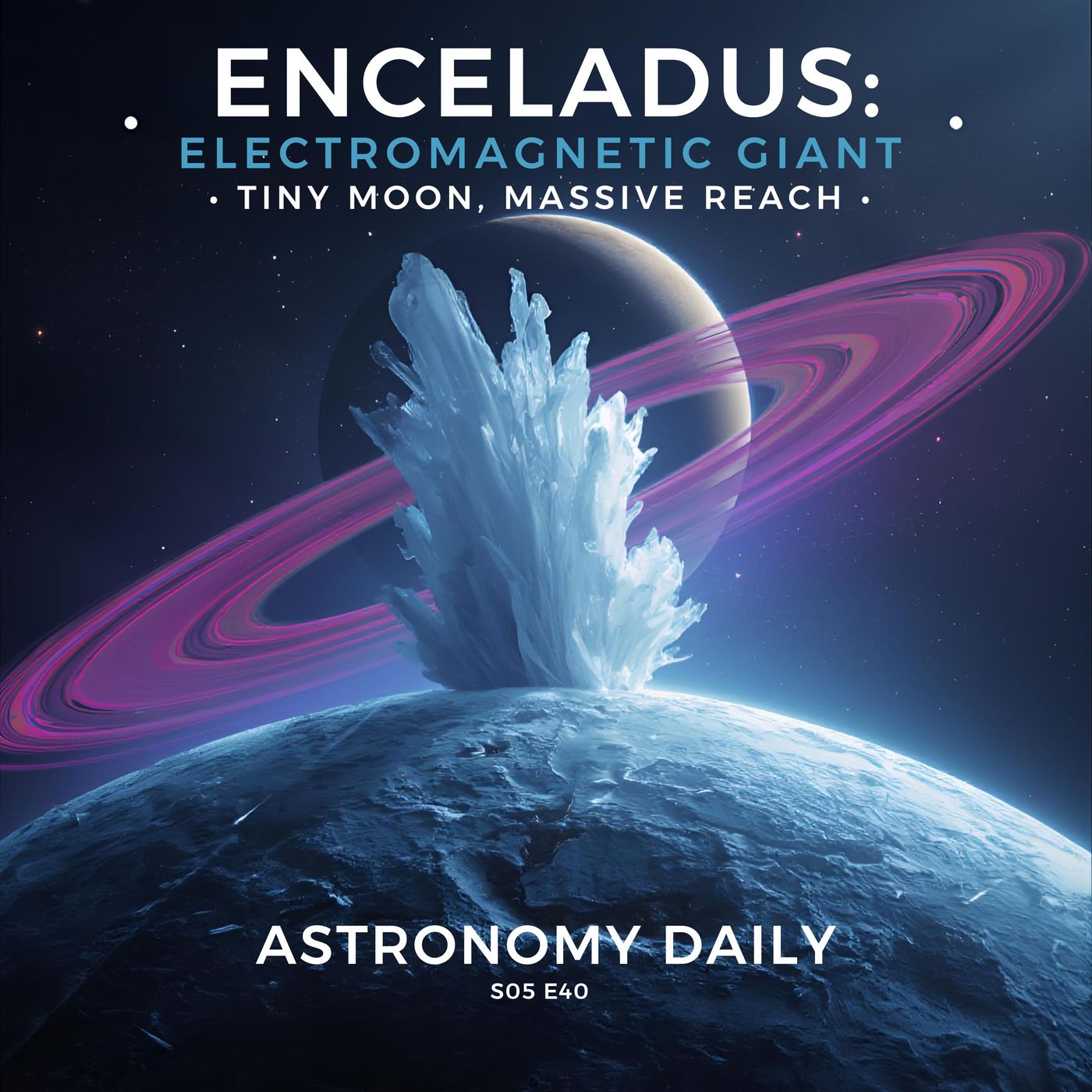
Speaker 1: Oh, I love this one. Saturn's tiny moon, Enceladus, just five hundred kilometers across, has been revealed as a giant electromagnetic powerhouse whose influence stretches over half a million kilometers through saturn space environment.
Speaker 2: Half a million kilometers that's more than two thousand times the Moon's own radius. An international team led by Lena Hadid from the Labretois the Plasmas in France analyzed thirteen years of data from the Cassini spacecraft, and what they found is stunning.
Speaker 1: So we all know Enceladus for its water geysers, those spectacular plumes erupting from the south pole. But it turns out those geysers do a lot more than just spray water into space. The water, vapor, and dust become ionized, creating an electrically charged plasma that interacts with Saturn's magnetic seld as it sweeps past.
Speaker 2: And that interaction generates these structures called alfin wings. Think of them like electromagnetic vibrations traveling along a string, except the string is Saturn's magnetic field lines, and they're connecting this tiny moon to the giant planet's poles.
Speaker 1: The researchers found that the primary alphin wing isn't just a simple structure. It's threaded by fine scale filaments produced by turbulence in the plasma. These filaments help the waves bounce back and forth between Saturn's ionosphere and the plasma Taurus that encircles Enceladus's orbit. The result is this incredible lattice like pattern of crisscrossing electromagnetic waves.
Speaker 2: Across four different Cassini instruments. The team identified thirty six separate crossings that showed these wave signatures. And here's the remarkable part. Thirteen of those crossings occurred far from any close flyby of Enceladus. The moon's electromagnetic reach is simply enormous.
Speaker 1: Co author Thomas Chust described Enceladus as a planetary scale alphin wave generator moon, just five hundred kilometers wide, capable of influencing the magnetospheric environment on the scale of Saturn itself. The team says this has major implications for understanding how small bodies regulate energy flow in giant planetary magnetospheres.
Speaker 2: And there's the forward looking element too. The researchers say their findings highlight the importance of future missions to Enceladus, like the planned ISSA orbiter and lander in the twenty forties, carrying instruments specifically designed to study these electromagnetic interactions.
Speaker 1: From Enceladus to interstellar space. Now, our fourth story takes us to the ongoing saga of three Iatls, the third interstellar object ever detected in our Solar system.
Speaker 2: And today researchers from the Initiative for Interstellar Studies i FORIS have published a fascinating new paper proposing how we might actually catch up with this cosmic visitor. The comment is heading away from Us, now approaching Jupiter for its closest pass on March the sixteenth, before it leaves our Solar system forever.
Speaker 1: The challenge is obvious. By the time three IATLS was discovered in July twenty twenty five, it was already moving too fast for any direct intercept mission from Earth. Even the issa's planned comet interceptor, sitting ready at the Sun Earth L two point wouldn't have been able to reach it.
Speaker 2: So Adam Hibberd and colleagues at I FOURIS took a different approach. They're proposing what's called a solar obirth maneuver. The idea is to launch a spacecraft in twenty thirty five that would first swing past Jupiter for a gravity assist, then plunge close to the Sun, firing its engines at the closest approach to maximize the slingshot effect. This would hurl the probe out of the Solar System fast enough to catch three iatls.
Speaker 1: The downside a fifty year flight time, but the researchers argue it's worth it. Every interstellar object that passes through is a message in a bottle from another star system. The science return from a close up study would be extraordinary, and.
Speaker 2: There have been earlier proposals too, including one that suggested NASA's junoprobe could be redirected from Jupiter orbit to intercept three iatls, but with JUNO low on fuel and having engine issues, that always seemed like a long shot.
Speaker 1: Three iatls remains one of the most fascinating objects to visit our Solar System. Bigger and more active than either Omuamua or Borisov, It's given us an unprecedented look at material from beyond our stellar neighborhood, Even if we can't catch it this time. Studies like this are laying the groundwork for when the next interstellar visitor comes calling.
Speaker 2: Now, let's turn our gaze back to our own star for story number five. If you're an Aurora chaser, today might be worth keeping an eye on.
Speaker 1: That's right, there's currently a G one minor geomagnetic storm watch in effect for today, February sixteenth, and it's being driven by a combination of factors.
Speaker 2: First, there's a huge trans equatorial corona hole directly facing Earth right now, and it looks like an old friend. Observers believe it's the same corona hole we saw back in mid January, having survived its transit across the far side of the Sun and come back around for another pass. These corona holes act like solar wind lighthouses, sweeping Earth with fast solar wind roughly every twenty seven days as the Sun rotates.
Speaker 1: On top of that, an M one point zero solar flare erupted from active region forty three seventy three on February thirteenth, launching a coronal mass ejection that's expected to arrive at Earth right about now. If the CME interacts strongly with the coronal hole's high speed stream, we could see conditions bump up to G two moderate levels.
Speaker 2: For our listeners at higher latitudes thank Northern Europe, Canada and the Northern Tier US States, it's worth checking those Aurora apps tonight. Even at G one levels, Aurora displays can be visible in Scotland, Scandinavia and across the Northern Tier US States.
Speaker 1: And with the sun now in the declining phase of solar cycle twenty five, space weather experts say that while big explosive events may become less frequent, coronal holes can actually provide a steadier rhythm of minor to moderate storms. Aurora chasers shouldn't pack away their cameras just yet.
Speaker 2: And finally, our sixth story is a quick one, but it shows just how relentless the pace of spaceflight has become.
Speaker 1: SpaceX launched yet another Starlink mission in the early hours of this morning. The Starlink six Dash one Ozho three mission lifting off from Cape Canaveral's Space Launch Complex forty. It carried twenty nine to Link V two mini satellites to low Earth orbit.
Speaker 2: This was the tenth orbital flight from Cape Canaveral so far in twenty twenty six, and we're not even through February. The first stage booster flying for its tenth time successfully landed on the drone ship a shortfall of gravitas in the Atlantic.
Speaker 1: N slights for that booster. SpaceX continues to demonstrate the reliability and reusability of Falcon nine at a pace that would have seemed extraordinary just a few years ago. Combined with the Crew twelve launch on Friday, SpaceX's six hundredth Falcon nine flight, It's been quite the week for Hawthorn.
Speaker 2: The six hundredth Falcon nine. That's genuinely remarkable when you think about.
Speaker 1: It, it really is. And that brings us to the end of today's episode of Astronomy Daily fixed stories covering human spaceflight, lunar ambitions, Saturnian science, interstellar visitors, space weather, and the unstoppable launch cadence of SpaceX.
Speaker 3: If you've enjoyed today's show, please do leave us a review on your favorite podcast platform. It really helps new listeners find us and follow us on social media at astro Daily Pod for updates throughout the day.
Speaker 1: You can also check out our full show notes and blog post at Astronomydaily dot io, where we've got links to all the sources and studies we've discussed today.
Speaker 2: Until tomorrow. Keep looking up clear size.
Speaker 1: Everyone.
Speaker 2: Sunday, Start, Start,


 Apple Podcasts
 Spotify
 Pocket Casts
 Castbox
 Overcast
 Podbean
 iHeartRadio
 Castro
 Goodpods
 Moon FM
 Podcast Addict
 Podcast Republic
 YouTube