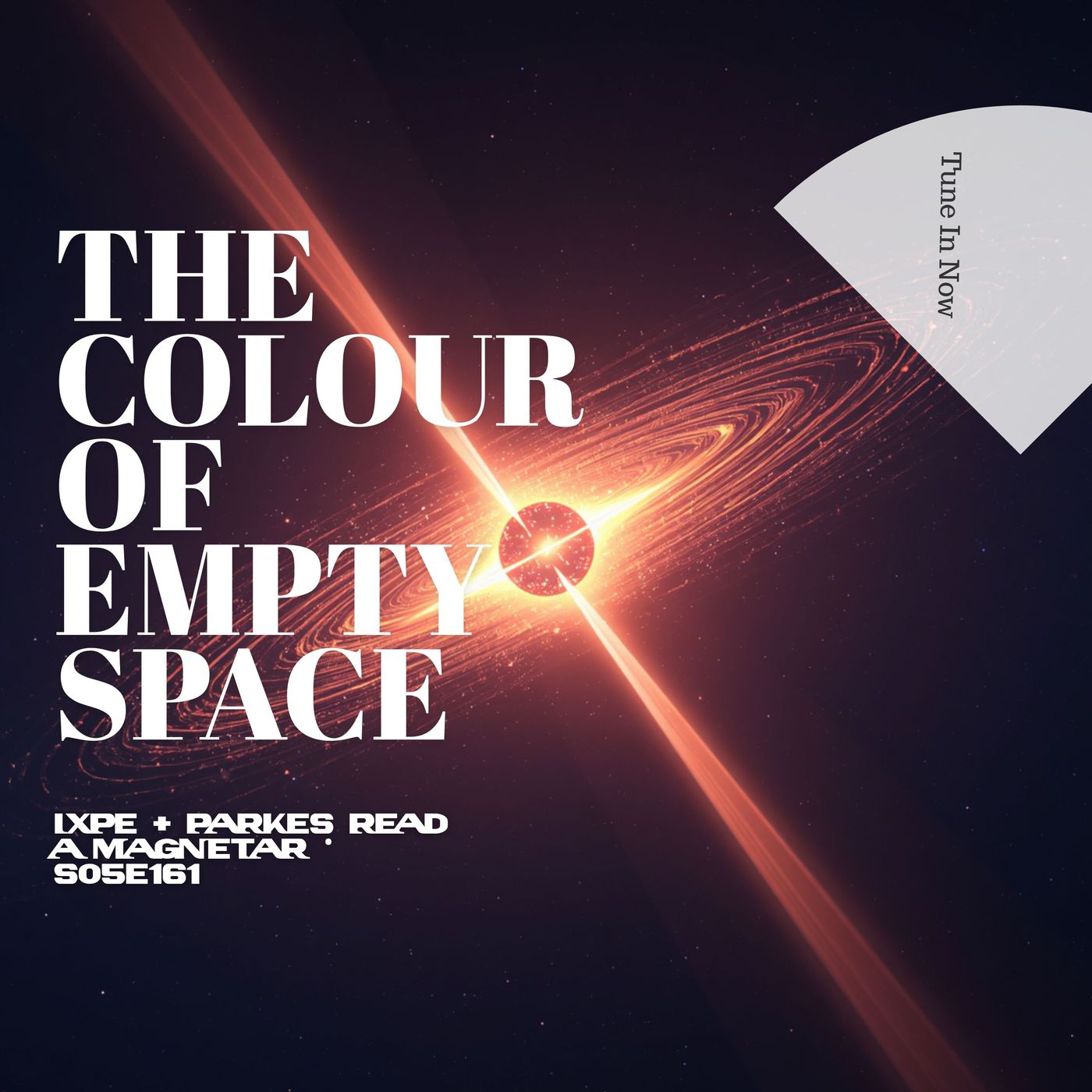
In this episode
Astronomy Daily · S05E161 · “The Colour of Empty Space” · Friday 7 August 2026. Hosts: Anna & Avery. astronomydaily.io · @AstroDailyPod ① Vacuum birefringence: reading a magnetar ● NASA’s IXPE, with NICER and the Parkes/Murriyang radio telescope (NSW), measured the polarised X-rays of magnetar 1E 1547.0−5408. ● Result: soft X-ray polarisation ~65% at 2 keV, rising to nearly 80% at some rotation phases — the strongest signal yet of vacuum birefringence, a QED effect predicted by Heisenberg in 1936. ● The team calls it the “most definitive signal to date,” not a confirmed detection; an April 2026 analysis disputes it under different geometry. Co-leads: Rachael Stewart; Hoa Dinh Thi (Rice); with Marcus Lower (Swinburne). ● Source: Stewart et al., Nature, 5 Aug 2026 (DOI 10.1038/s41586-026-10859-z); NASA IXPE release. ② Gateway HALO hardware → Lunar Infrastructure Demos ● NASA and Northrop Grumman are repurposing the HALO module’s power, data and avionics into three surface missions — LID-1, LID-2, LID-3. ● Goal: “survive-the-night” power and thermal tech for the lunar South Pole, where night lasts ~14 Earth days and temperatures plunge below −200 °C. ● Part of a wider Moon-base update in which four commercial landers reached final qualification testing at once. ● Source: NASA & Northrop Grumman releases, 4 Aug 2026; Spaceflight Now. ③ New Glenn: the cause is a valve ● Blue Origin traced the 28 May New Glenn booster explosion (during a pad hot-fire at Cape Canaveral) to the main oxygen valve on one of the seven BE-4 engines. ● Fix: small, retrofittable valve modifications; return to flight still targeted by year’s end. The BE-4 also powers ULA’s Vulcan. ● Source: Blue Origin CEO Dave Limp, 5 Aug 2026; SpaceNews. ④ LINK’s de-spin: the fight to save Swift ● Katalyst Space’s LINK robot — tasked with boosting NASA’s ageing Swift observatory before re-entry — hit a multi-axis tumble when two of three reaction wheels failed. ● Using gimballed electric-propulsion thrusters, the team cut the spin from ~9°/s to ~1.47°/s on under 100 g of propellant. A flight-software update is next; rendezvous slips to ~end of August. ● Source: NASA Swift blog, 6 Aug 2026; Katalyst mission updates. ⑤ Skywatch: eclipse + Perseids ● 12 Aug total solar eclipse — totality across Greenland, Iceland, northern Spain; afternoon partial for eastern Canada and the NE United States (>10% only NE of the NYC–Rochester line; ~50% in Atlantic Canada). NASA live from 1:15 pm EDT. ● Perseid peak the night of 12–13 Aug under a New Moon — up to ~100/hr from dark rural sites. ● Southern Hemisphere: eclipse not visible; Perseids barely clear the horizon. Sydney: pre-dawn planet line-up + Venus + winter Milky Way. ● EYE SAFETY: use only ISO 12312-2 eclipse glasses for every partial phase; never combine them with a camera, telescope or binoculars.Become a supporter of this podcast: https://www.spreaker.com/podcast/astronomy-daily-latest-space-news--5648921/support.
Sponsor Details:
Ensure your online privacy by using NordVPN. To get our special listener deal and save a lot of money, visit www.astronomydaily.io/nordvpn. You'll be glad you did!
Get the best secure and private email on the planet. Stop your Government, google and who knows who else spying on every email you write. Do what we did and use ProtonMail. They beleive in privacy and there are no ads in their business model...yet they still provide a free forever service. Check them out and get out...
Anna: Picture the emptiest m place you can imagine. No stars, no dust, not a single atom. Now switch off the light and empty space still isn't empty. It seethes with particles that flicker into being and vanish again faster than any clock can catch them. For 90 years, that's been a prediction on a chalkboard. This week, a dead star with an absurd magnetic field may have let us see it by bending starlight through the vacuum itself. G' day and welcome to Astronomy Daily. I'm Anna. Avery: And I'm avery.
It's Friday 7th August 2026, and there is a lot of very good sky ahead of us. Anna: There is coming up, NASA rummages through the parts bin of a canceled space station to help build a moon base. Avery: Blue Origin finally says what blew up its big rocket back in May. And a plucky little robot fights the stop spinning long enough to rescue a beloved NASA telescope. Anna: And we finish where the whole world is looking next week, the total solar eclipse on the 12th paired with the best Perseids in years, both hemispheres and the eye safety rules that are absolutely non negotiable.
But, uh, we start with the physics of nothing at all. Avery, want to set the scene? Avery: Gladly. This is a genuine fundamental physics lead and it's about a lovely Australian thread running through it. Anna: So on Wednesday, the journal Nature published a result that's been decades in the making. A team led by Rachel Stewart used NASA's IXPE X ray telescope, that's the Imaging X Ray Polarimetry Explorer, to stare at a magnetar with the catchy name 1E 1547.0 to 5408. And they think they've caught empty space, behaving exactly as quantum theory says it should.
Avery: Lets define the star first because magnetars are ridiculous objects. Anna: They really are. A magnetar is a neutron star, the collapsed core of a massive dead star. A whole sun's worth of mass crammed into a ball the size of a city. But this particular flavor has the strongest magnetic field known anywhere in the universe. We're talking a field around a thousand trillion times stronger than Earth's. Roughly a, uh, trillion times stronger than the beefiest permanent magnet ever built in a lab.
Avery: And that monstrous field is the whole point because of a prediction from 1936. Anna: Right. This goes back to Werner Heisenberg and his colleagues, one of the founders of quantum mechanics. Quantum theory says the vacuum isn't truly empty. It's a boiling sea of virtual particles, electrons and their antimatter twins, positrons popping in and out of existence and vanishing before you can ever measure them directly. Avery: Which sounds like philosophy until you add a magnetic field. Anna: Exactly.
Turn on a strong enough field and those flickering virtual particles line up. And when they line up, the empty vacuum starts to behave like a piece of glass, or better, like a crystal. It gains a grain. Light traveling one way through it moves slightly differently than light traveling another way. Physicists call it vacuum birefringence. Avery: Birefringence being the same trick a crystal of calcite plays. Split a light ray in two. Anna: The very same. The vacuum becomes a prism made of nothing.
The catch has always been that you need a field so absurdly strong to make the effect visible that no laboratory on Earth can get anywhere near it. Only a magnetar will do. So we've had to wait for the universe to build the experiment for us. Avery: Enter ixpe. And, um, here's where it turns into a proper international relay, with Australia holding one of the batons. Anna: This is my favorite part. IXPE measures the polarization of X rays. The direction the light waves are wiggling. That's the fingerprint you need to catch birefringence.
But the team didn't stop at one telescope. They ran IXPE together with NASA's NICER instrument on the space station and crucially, the Parkes radio telescope in central New South Wales. Avery: Merjang the dish, our dish, doing frontier quantum physics from a paddock outside of Parkes. Anna: And there's more homegrown talent in the byline. Dr. Marcus Lower from Swinburne University in Melbourne is on the team alongside co lead Hoa Dinh T at University in Houston. So this is genuinely a NASA and Australia result.
Avery: What did the numbers actually show? Anna: Extraordinary polarization in the soft X ray band, where you're seeing the star's glowing surface. The light was polarized at around 65%. And at some points in the magnetar's rotation, it climbed to nearly 80. That's enormous. And the pattern shifts smoothly as the star turns. According to the team, you can't reproduce that combination, the X rays and the radio behavior together without the vacuum itself bending the light. In their words, the signal requires vacuum birefringence to be present now, and I Avery: think this is important for our listeners.
This is not case closed, is it? Anna: No, and I'm glad you flagged it. The team is careful. They call it the most definitive signal to date. Not a confirmed detection. And there's a genuine scientific argument happening in real time. Back in April, an independent group looked at the same IXPE data with a different model of the star's geometry and concluded it wasn't compelling evidence yet. So there are two honest readings on Avery: the table, which is science working exactly as it should. Anna: It is to nail it down, you'd want a stronger dip at the specific energy where the effect should bite.
Or the same signature from a whole family of magnetars, which or the dream, a lab experiment on Earth that corroborates it. None of those is in hand yet. But think about what's being claimed that we watched the empty vacuum of space act on light using a dead star as the apparatus and a radio dish in the central west as one of the ears. Avery: The emptiest thing there is finally showing its grain. Anna: That's a lead from the very big physics let's come back down to the moon where Avery someone's been raiding the parts bin.
Avery: They have. Longtime listeners will remember that back in the autumn NASA paused the Lunar Gateway, the small space station that was meant to orbit the moon, and pivoted to putting infrastructure straight onto the surface instead. This week we learned what happens to the hardware that was already built. Anna: It doesn't go in a museum. Avery: It goes to the moon by another route. NASA and Northrop Grumman announced on Tuesday that the guts of Halo, that's the habitation and logistics outpost, the crew module that was going to be the heart of Gateway, will be repurposed into three robotic missions called Lunar Infrastructure Demos Lid 1, Lid 2 and Lid 3.
Anna: So the power systems, the avionics, the data plumbing, all the expensive already flight Avery: ready bits get reused on the surface instead of in orbit. And the job they're being pointed at is the single hardest problem of living at the lunar South Pole. Surviving the night. Anna: The two week night, a uh, night Avery: that lasts about 14 Earth days, where the temperature at the pole can swing wildly and plunge to well below minus 200 degrees Celsius and where your solar panels do precisely nothing for a fortnight.
If you want astronauts to stay for more than one lunar day, you have to keep the lights and the heaters on through that. These demos are meant to prove the power, thermal and avionics kit that makes a persistent base even thinkable. Anna: And the reasoning behind reusing Halo is basically don't reinvent the wheel. Avery: Northrop Grumman's framing is that the hardware is ready to fly, so it lets NASA move faster and start gathering real performance data on the surface sooner. It was part of a broader moon base update too.
Four different commercial landers all reaching final qualification testing at once, which is its own milestone. Anna: It's a very North American story. Basa, Northrop Grumman, the whole Artemis push. But it lands for everyone because the South Pole and its water ice is where the whole world's lunar plans are converging. Avery: Waste not, want not in space. Anna Speaking of things that ah, didn't go to plan. Anna: Yes, some closure on a big bang from earlier this year. Cast your mind back to 28 May.
Blue Origin was running a routine engine test of a new Glenn booster on the pad at Cape Canaveral and it exploded spectacularly. It destroyed the rocket and did serious damage to the launch complex and until Avery: this week we didn't officially know why. Anna: Now we do. On Tuesday, Blue Origin's chief executive Dave Limp gave the first real update on the investigation. The culprit? The main oxygen valve on one of the rocket's seven BE4 engines. They traced it there, then confirmed it by recovering and inspecting the hardware.
Avery: One valve on one of seven engines, One valve. Anna: That's the thing about rockets, they're thousands of parts that all have to behave and any one of them can ruin your day. The valve controls the flow of liquid oxygen into the engine and something about it initiated the anomaly. Limp said they've run extensive component level and engine hot fire tests to understand the failure mode and the fix is Avery: a redesign everything situation or a tweak. Anna: Encouragingly, a tweak. They're making small modifications to the valve that can be retrofitted to engines that already exist rather than starting from scratch.
Blimp's line was simply the path forward is clear with updated hardware coming in the near term and a return to flight still targeted before the end of the year. Avery: There's a wider ripple here too. The BE4 doesn't only fly on New Glenn. Anna: Good point. The same engine powers United Launch Alliance's Vulcan rocket. So the industry will be watching how this valve story plays out beyond Blue Origin. But the headline for today is a good one. They found it, they understand it and they think it's fixable.
That's how you turn a very bad day into a flying rocket again. Avery: From M, a rocket that needs to fly again to a robot that just needs to stop spinning. This one's a nail biter. Anna: Nothing unusual in that though. Avery: In space it genuinely is. We've been following this since the launch scrubs back at the start of July. So let me bring everyone up to speed. NASA's Neil Gerald Swift Observatory, a much loved telescope that's been catching gamma ray bursts since 2004 is slowly sinking. Its orbit is decaying and without a boost it will re enter and burn up later this year.
Anna: And the cavalry is a robot. Avery: The cavalry is a robot called Link, built by a company called Catalyst Space out of Flagstaff, Arizona. They're billing it as America's first commercial space robot. Designed, built and launched in under a year. And its job is to fly up, grab Swift and gently boost it to a higher, safer orbit. It launched on 3 July on an air launched Pegasus rocket. Anna: So what went wrong? Avery: During commissioning, Link got into trouble. It ended up in a multi axis tumble, spinning at about 9 degrees per second, which caused it to drop in and out of communication.
And the cause was nasty. Two of its three reaction wheels, the spinning disks a spacecraft uses to point itself while, were knocked out by a fault in the power system upstream of them. Anna: Losing your steering while you're tumbling, that's the stuff of nightmares. Avery: It is. But here's the clever bit. With the reaction wheels down, the team improvised. They used Lynx electric propulsion thrusters, the gentle ion drive meant for the long cruise to Swift, mounted on a gimbal and fired them to cancel the spin.
And it's working. They've brought the Tumble down from 9 degrees per second to 4, and now to about 1 and a half. All of it using less than a hundred grams of propellant. So they're not eating into the fuel they need for the rescue itself. Anna: A hundred grams, That's a small chocolate bar's worth of fuel to tame a tumbling spacecraft. Avery: Beautifully economical. And the next step is a big flight software upload in the coming days. New control code written specifically for the wounded spacecraft, which should hand full pointing control back to the team.
After that, Link can start. The slow orbital dance to line up with Swift Rendezvous has slipped to around the end of August. Anna: There's a lovely echo here with our lead. Actually, our top story was about reading a magnetar with X ray telescopes. And Swift is itself an X ray and gamma ray observatory. A robot fighting to save one of the very instruments we use to do this kind of science. Avery: Fingers crossed for that software upload. We'll keep watching the dashboard. Anna, take us to the sky.
Anna: With pleasure, because next Wednesday 12th August, as we've mentioned before, is one of the biggest sky days of the year. Two headline events in 24 hours, a total solar eclipse and the peak of the Perseid meteor shower under a beautifully dark moonless sky. Avery: Let's do the eclipse first and let's do it by hemisphere. The path of Totality, where the moon completely covers the sun, sweeps across northern Russia, Greenland, Iceland and northern Spain, clipping a tiny corner of Portugal for mainland Europe.
It's the first total solar eclipse since 1999. If you're lucky enough to be in Spain, totality comes late in the day, Anna: low and golden for our North American listeners, our largest audience. You don't get totality this time, but the Northeast does get a partial. It's an afternoon event. The rule of thumb. You'll see more than a 10% bite only if you're northeast of a line running roughly from New York City up through Rock Rochester, or east of about mid Ontario in Canada. Avery: And the further into Atlantic Canada you go, the better it gets.
Around half the sun covered at maximum. New England and the northeastern states get a smaller nibble. NASDAQ will stream the whole thing live from 1:15 in the afternoon Eastern time. If your local sky won't play along. Anna: Now, the non negotiable bit. And we say this every single time for a reason. Avery: In every partial phase, you must protect your eyes. Use only eclipse glasses or handheld solar viewers certified to the ISO 123122 safety standard. Ordinary sunglasses are not safe, no matter how dark they look.
And never point a camera, telescope or binoculars at the sun while wearing eclipse glasses. The optics will concentrate the light and burn straight through the filter and into your eye. Anna: If you saved your glasses from a previous eclipse, check them for scratches and pinholes. Before you trust them in doubt, throw them out. Avery: And for the southern hemisphere, Anna. Uh, the honest word. Anna: The honest word is that here in Australia, we miss this one entirely. The eclipse isn't visible from our part of the world, and the Perseids are stubbornly a northern hemisphere shower.
Their radiant point barely clears our northern horizon, so at best you might catch a stray one or two very low in the couple of hours before dawn on the 13th. Avery: But we're not left out. What Sydney can do next week is beautiful in its own right. Anna: It is. Get up before dawn and look for the lineup of planets stretched across the eastern sky. And keep an eye on Venus, which is climbing back into view. Add the winter Milky Way arching overhead from a dark site and you've got a genuinely lovely pre dawn show.
No eclipse glasses required. Avery: And for our, uh, northern friends, chasing meteors, the Perseids peak the night of the 12th into the pre dawn of the 13th with a new moon. Conditions are about as good as they get. From a dark rural site, you could see up to a hundred an hour, many of them bright fast and trailing. Get away from city lights. Give your eyes 20 minutes to adjust. Look up and be patient. Anna: That's the show. The vacuum of space showing its colors. A moon base built from spare parts.
Earth. A rocket mystery solved. And a little robot fighting to save a telescope. Avery: All the links and sources are in your show notes and over at astronomydaily IO, where you can also grab the newsletter and drop us a line. Anna: For Avery, I'm Anna. Look after those eyes. Avery: Next Wednesday and until next time. Anna: Clear skies.
The stories.
Avery: Were told.
 Apple Podcasts
 Spotify
 Pocket Casts
 Castbox
 Overcast
 Podbean
 iHeartRadio
 Castro
 Goodpods
 Moon FM
 Podcast Addict
 Podcast Republic
 YouTube