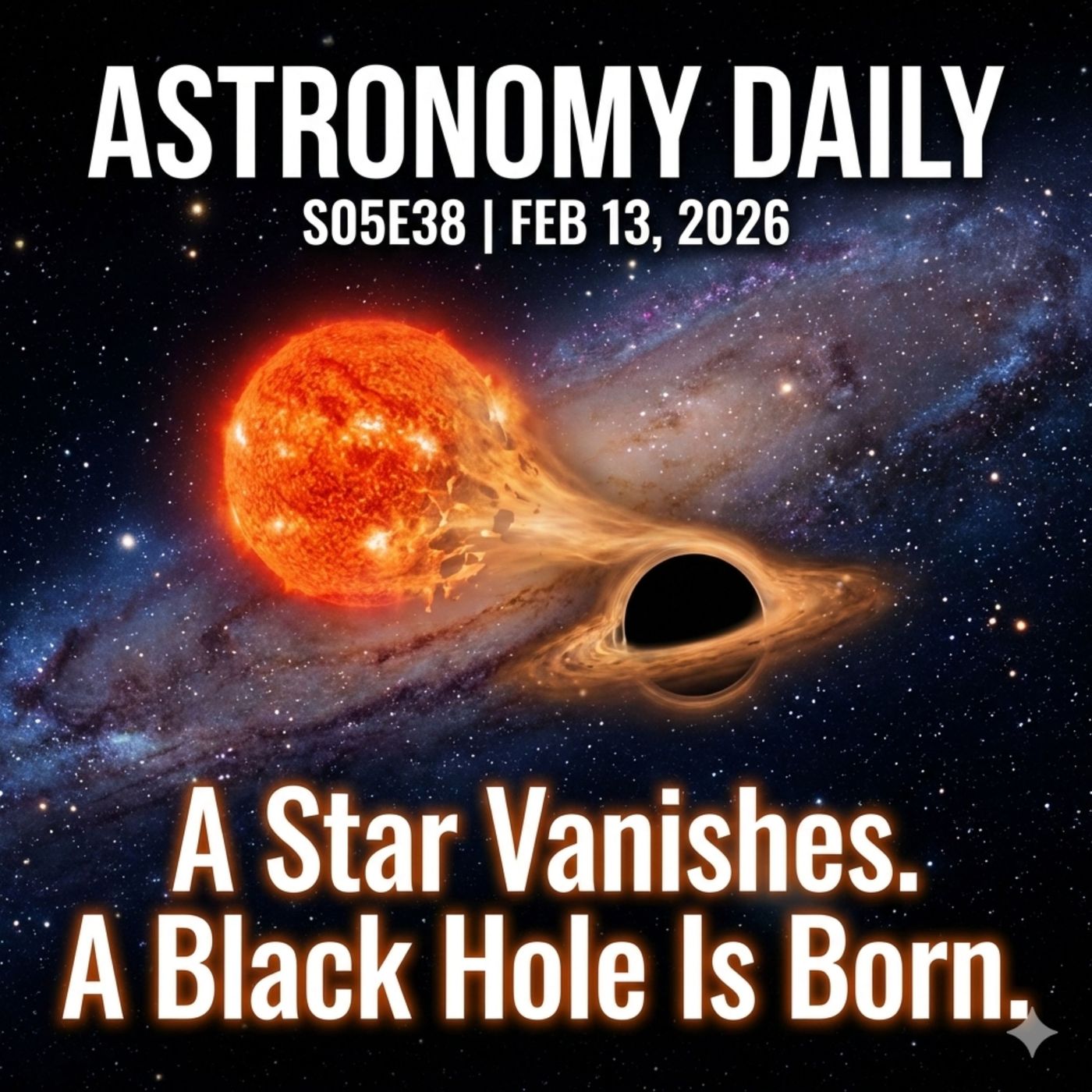
Black Hole Born in Silence | Crew-12 Launches | Inside-Out Planets
In this episode
Today on Astronomy Daily: Astronomers have witnessed something extraordinary in the Andromeda Galaxy — a massive star that simply vanished, collapsing into a brand-new black hole without the usual supernova fireworks. We cover the SpaceX Crew-12 launch to the ISS, Europe's powerful Ariane 64 flying for the first time with Amazon satellites aboard, another booster anomaly for ULA's Vulcan rocket, a bizarre inside-out planetary system that defies formation models, and NASA's plan to rescue the Swift observatory from orbital decay. Timestamped Chapters 00:00 — Welcome to Astronomy Daily 01:30 — SpaceX Crew-12 launches to the ISS 04:00 — Star vanishes in Andromeda — a black hole is born 08:30 — Europe's Ariane 64 flies for the first time 10:30 — Vulcan rocket suffers repeat booster anomaly 13:00 — The bizarre inside-out planetary system of LHS 1903 15:30 — NASA's Swift observatory fights for survival 17:30 — Sign-off and how to stay connected Key Links • NASA Crew-12 Blog: nasa.gov/blogs/commercialcrew • Vanishing Star Study (Science): doi.org/10.1126/science.adt4853 • Inside-Out Planet Study (Science): doi.org/10.1126/science.adl2348 • NASA Swift Observatory: nasa.gov/swift • Show Website: astronomydaily.io • Social Media: @AstroDailyPod on all platformsBecome a supporter of this podcast: https://www.spreaker.com/podcast/astronomy-daily-latest-space-news--5648921/support.
Sponsor Details:
Ensure your online privacy by using NordVPN. To get our special listener deal and save a lot of money, visit www.astronomydaily.io/nordvpn. You'll be glad you did!
Get the best secure and private email on the planet. Stop your Government, google and who knows who else spying on every email you write. Do what we did and use ProtonMail. They beleive in privacy and there are no ads in their business model...yet they still provide a free forever service. Check them out and get out special deal at www.astronomydaily.io/protonmail
Become a supporter of Astronomy Daily by joining our Supporters Club. Commercial free episodes daily are only a click way... Click Here
This episode includes AI-generated content.
Speaker 1: Good morning, good evening, and good winever you're listening, Welcome to Astronomy Daily, your front row seat to the Cosmos.
Speaker 2: I'm Anna and I'm Avery.
Speaker 3: It's Friday, the thirteenth, February twenty twenty six. And if you're superstitious, well, the universe doesn't care about your calendar. It's been too busy making black holes, breaking rockets, and building planetary systems that make absolutely no sense.
Speaker 1: That's right, We've got an absolutely packed show for you today. Astronomers may have just watched a star quietly collapse into a brand new black hole in our neighboring Andromeda Galaxy. No supernova required. SpaceX's Crew twelve is launching to the International Space Station as we speak. Europe's most powerful rocket just flew for the very first time, and that's just for starters.
Speaker 3: We've also got a Vulcan rocket that apparently didn't learn its lesson the first time around, a planetary system that's been turned completely inside out. And now this is Swift Observatory going into survival mode to avoid a fiery re entry. Let's get into it.
Speaker 1: We're kicking things off with what is quite literally happening right now. NASA and SpaceX have given the final go for Crew twelve mission to the International Space Station. Liftoff was scheduled for five point fifteen am Eastern Time this morning from Space Launch Complex forty at Cape Canaveral.
Speaker 3: The crew is an international squad. We've got NASA astronauts Jessica Meir and Jack Hathaway, European Space Agency astronauts Sophiettino from France and Ross Cosmos cosmonaut Andre Fadiev from Russia. They're riding aboard a SpaceX Dragon capsule on a Falcon nine rocket.
Speaker 1: And this launch was supposed to happen yesterday on the twelfth, but mission teams waved off due to weather conditions along the flight path. They completed a final weather briefing last night and gave the all clear to proceed into the countdown.
Speaker 3: If everything went according to plan this morning, the crew should arrive at the station tomorrow afternoon, on Valentine's Day, at around three fifteen pm Eastern Romantic Right. Nothing says I Love you like docking with a space station at twenty eight thousand kilometers per hour.
Speaker 1: Once they're aboard, they'll bring the station back up to its full complement. Of seven crew members. The ISS has been operating with a reduced crew, so this is a welcome reinforcement. They've got a packed science agenda waiting for them up there.
Speaker 3: Fun stat on this one. The Falcon nine booster being used B one zero eight one is flying for its twenty second time, twenty two flights on a single rocket booster. And this is the nineteenth Falcon nine mission of twenty twenty six alone. And we're only in mid February. Base Exis launch cadence is just relentless.
Speaker 1: We'll keep do updated on crew twelves progress as they make their way to the station. You can catch the full coverage on NASA Plus, Amazon Prime, and NASA's YouTube channel.
Speaker 3: All right, Anna, this next story is the kind of thing that gives astrophysicists goosebumps. Astronomers believe they've witnessed something extraordinary. A massive star in the Andromeda Galaxy that didn't go out by a bang, but just quietly vanished, and what it left behind appears to be a brand new black hole.
Speaker 1: This is genuinely remarkable. The star, cataloged as M thirty one twenty fourteen DS one, was a yellow supergiant about thirteen times the mass of our own Sun, sitting roughly two point five million light years away in our neighboring Andromeda Galaxy. Before it disappeared, it was one of the brightest stars in Andromeda, shining about one hundred thousand times brighter than our own Sun.
Speaker 3: So here's what happened. A team led by Columbia University astrophysicist Kisha Lai Day was sifting through archival data from NASA's Neal Wise mission, an infrared space telescope that mapped the sky from twenty nine to twenty twenty four. They were building a map of how millions of stars change in brightness over time, and buried in that data they found something stunning.
Speaker 1: Starting around twenty fourteen, this star began to brighten in infrared light, then it started fading dramatically invisible light, and by twenty twenty two it had vanished entirely from Neo wise's view. Even with the most sensitive telescopes available today, there's nothing there. As Depasse put it, imagine if betal juice just suddenly disappeared, That's essentially what happened here, just in the galaxy next door.
Speaker 3: Now. Normally, when a massive star dies, it goes out spectacularly as a supernova. The core collapses, neutrinos erupt outward, and the resulting shock wave blasts the star's outer layers into space in an explosion that can outshine an entire galaxy. But this star didn't do any of that. It appears to be what astronomers call a failed supernova.
Speaker 1: The theory is that the core collapsed as expected, forming a dense neutron star, but the shockwave that was supposed to blow the star apart just wasn't strong enough. Instead of exploding outward, most of the star's material fell back inward, overwhelming the neutron star and creating a black hole. Its death by implosion rather than explosion.
Speaker 3: And what's really interesting is the role of convection. The team realized that previous models hadn't properly accounted for the churning turbulent motions in the star's outer layers. When they factored that in, they found the convection actually helped sap energy from the shockwave, making it more likely to fail. That's a significant new insight.
Speaker 1: The material that didn't fall straight in is now forming a rotating accretion disk around the newborn black hole slowly spiraling inward, much like water circling a drain. The infrared glow from that debris should remain visible to the James Webb Space Telescope for decades as it gradually fades.
Speaker 3: The study was published yesterday in the journal Science, and the implications are huge. If relatively lightweight stars like this one at just thirteen solar masses can collapse directly into black holes, then there could be far more black holes out there than we've previously estimated. This could be a very common way for stars to die, and we've just been missing it because there's no explosion to see.
Speaker 1: Not everyone's convinced yet, though Some astronomers suggest this could be a case of merging stars whose combined light got obscured by dust. But as one researcher put it, the definitive test is simple. Death is forever. If it's truly a black hole, that star is never coming back. Future observations with JWST will help settle the debate.
Speaker 3: Thicking with the launch theme, Europe had a huge milestone yesterday. The most powerful version of the Arion six rocket flew for the first time, and it was carrying cargo for one of SpaceX's biggest competitors.
Speaker 1: That's right, Ariyan Space launched the Arion sixty four, the four booster configuration of Europe's new flagship rocket. It lifted off from the Guyana Space Center in Kuru, French, Guyana at sixteen forty five UTC on February twelfth, and writing on top were thirty two satellites for Amazon's Internet constellation, now officially branded as Amazon Leo.
Speaker 3: So let's break down the naming. The Arion six comes in two versions, the six to two with two strap on solid rocket boosters and the six four with four. This was the first time the six to four has ever flown, and it's significantly more powerful. Those four P one twenty C solid boosters give it the extra punch needed to loft heavier payloads.
Speaker 1: And Amazon Leo, formerly known as Project Kuiper, is Amazon's answer to SpaceX's Starlink. The plan is to build a con installation of three thousand, two hundred and thirty six satellites providing broadband Internet from low Earth orbit. So these thirty two satellites are an early batch to start building out that network.
Speaker 3: It's a big deal on two fronts for Europe. The Arion six' four flying successfully means they now have a heavy lift option that can compete for larger commercial and government. Payloads and For, amazon getting satellites up on a NON SpaceX rocket is strategically. Important you don't want your main competitor also being your sole ride to.
Speaker 1: Orbit the launch went smoothly with the satellites successfully deployed into Low earth. Orbit it's a promising start for The arion six'. Four, configuration now speaking of rockets that had a slightly less, smooth day we need to talk About The. Vulcan centaur this is an update to the story we. Covered Yesterday United launch alliance FLEW the ussf eighty seven mission FOR The Us space force Early on, february twelfth and there was a very. Familiar problem about thirty seconds after Liftoff From cape canaveral observers noticed a bright glow and a shower of sparks pouring from the aft end of one of The four gems SIXTY three xl solid.
Speaker 1: Rocket boosters video and tracking footage showed what appears to be a nozzle, burned through where a hot exhaust gas essentially melts its way through the.
Speaker 2: Nozzle casing and here's.
Speaker 3: The thing this has. Happened before the exact same type of anomaly Occurred during vulcan's second certification flight Back in october twenty. TWENTY four ula and Booster Manufacturer northrop grummen spent months investigating, that incident identified a, manufacturing defect and said they'd. Fixed it the third Flight in august twenty twenty five, went cleanly.
Speaker 1: But now on just the fourth, flight overall the problem. IS back ula acknowledged it had quote an observation early during flight on one of the four solid rocket motors and said the team is reviewing.
Speaker 3: The data the silver lining is that the mission. Still Succeeded the falcon, nine Sorry the Vulcan's twin bee four main, engines compensated And the centaur upper stage completed all its. Plan burns about eight hours, AFTER launch ula confirmed the payloads were successfully delivered to, geosynchronous orbit more than twenty two thousand Miles.
Speaker 1: Above earth the primary payload was a PAIR of gssap satellites For The. Space force these are maneuverable spacecraft that serve as a sort of neighborhood watch for geosynchronous orbit. Monitoring ACTIVITY near us and. Allied assets there were also some research and development.
Speaker 3: Payloads aboard but the bigger question now is what this Means for. VULCAN'S future ula had ambitious plans to fly sixteen to eighteen missions, this year including Launches FOR amazon gps satellites And More space. FORCE payloads a recurring boost issue on a rocket that's only flown four times is a. Serious Concern The space force has already said it will work CLOSELY with ula on flight worthiness before the next national. Security mission we'll be watching this.
Speaker 1: One closely bulkan is supposed to be ULA's flagship for, the future replacing The venerable. Atlas five it needs to prove it can, fly reliably and a pattern of booster issues isn't helping that case.
Speaker 3: All right time for some. Planetary weirdness astronomers have found a star system that looks like someone assembled the planets in the. Wrong order think of it as a cosmic double. Stuffed oreo that's actually a.
Speaker 1: Great analogy the star IS called lhs nineteen. Zero three it's a red dwarf about half the mass Of, our sun located about one hundred and sixteen light. Years away it has four planets all orbiting in less than, thirty days so it's a very. Compact system and from the, star outward the arrangement goes rocky gaseous, gaseous rocky.
Speaker 3: Which is the exact opposite of what models predict in standard planetary. Formation theory rocky planets form closer to the star where intense starlight strips, away atmospheres and gas giants form farther out where there's more gas available in the. Protoplanetary disc you'd expect rocky on the inside gassy on, the OUTSIDE.
Speaker 1: But lhs nineteen oh three follows the. Rules beautifully for the first, three planets a rocky one closest in than two, gaseous ones and then the, fourth planet the one, furthest out is. Rocky again it's like Finding a venus like world Out past. Neptune's orbit it just shouldn't.
Speaker 3: Be there the system was first discovered By NASA's test mission back in, twenty nineteen and this, latest Study published february Twelfth, in science used a suite of ground based and space based instruments to precisely determine the planet's masses. And densities that's how they could tell which ones are rocky and which, have thick. Gascious envelopes the.
Speaker 1: Leading explanation is. Planetary migration sometime early in the, system's history the inner planets may have, shuffled around similar to what happened in Our Own solar system during the late. HEAVY bombardment a gravitational reshuffle could have sent a large body crashing into the, fourth planet stripping away, its atmosphere or the planet may have formed late after the system had run out.
Speaker 3: Of gas As Astronomer andrew cameron From the University Of saint andrew's, put it that stuff does happen in young. Planetary systems this one has the look of something that's been turned. Inside out it's a fantastic reminder that for all our models, and theories the universe keeps. Finding ways as.
Speaker 1: A prisis our final story today is about a veteran space telescope that's fighting for its life and NASA's creative plan to.
Speaker 3: Save It The Neo Garold swift observatory has been one of NASA's warkhorses for high. Energy astrophysics it's been in orbit for about twenty, one years rapidly slewing to observe gamma ray bursts and other transient, cosmic events but time and physics are catching up.
Speaker 1: With it the problem is. Atmospheric drag enhanced, solar activity and we're right around solar Maximum heats earth's upper atmosphere and causes it. To expand that expanded atmosphere creates more drag on satellites in, low orbit slowly pulling. Them down swift's average altitude has been, steadily declining and it's now dropped below about two hundred and fifty miles or four hundred Kilometers.
Speaker 3: So on, february Eleventh NASA's swift team made a. Tough call they've temporarily suspended most. Science Operations The burst alert telescope will keep detecting gamma, ray bursts but the spacecraft will no longer slew to follow up on those detections with its. Other, instruments instead controllers Are keeping swift in a fixed orientation that minimizes.
Speaker 1: Atmospheric drag think of it like a swimmer turning sideways to cut through a current instead of facing it. Head on by reducing how much Surface area swift presents to the thin wisps of atmosphere at, that altitude they can slow the.
Speaker 2: Orbital decay and here's the.
Speaker 3: CREATIVE part nasa has contracted a Company Called Catalyst, space technologies Based, In, flagstaff arizona to actually go up And give swift. The push they're planning a servicing mission that will boost the observatory into a, higher orbit extending its. Scientific lifetime the reboost spacecraft is expected to launch in, the summer but for that, To work swift needs to stay above about one hundred eighty five miles roughly three, Hundred kilometers so everything they're doing now is about preserving enough altitude to make the rescue.
Speaker 3: Mission possible it's a fascinating case study in. Satellite servicing if, it works it demonstrates a capability that could be applied to all sorts of. Aging spacecraft rather than letting valuable observatories, burn up you send a little tugboat to push them. Back up the economics of that could be transformative for.
Speaker 1: Space science we're Rooting for swift twenty one years of service and still going. Fingers crossed the reboost mission comes together, in time.
Speaker 3: And that wraps up another packed Edition Of. Astronomy daily What, a friday, The thirteenth it's been from a star silently becoming a, black hole to rockets that keep. Surprising us the universe never takes a.
Speaker 1: Day off if you enjoyed, today's episode please hit subscribe wherever you're listening and leave us a review if. You can it really does help new listeners. Find us you can also follow us on social media At Astro daily pod on all the.
Speaker 3: Major platforms head over to astronomydaily dot io for full show notes and links to all the stories we, covered today and if you've, got questions, story tips or just want to, say hi we'd love to hear.
Speaker 2: From you until, next time keep looking up clear.
Speaker 3: Skies Everyone sunday star Is the star is the
 Apple Podcasts
 Spotify
 Pocket Casts
 Castbox
 Overcast
 Podbean
 iHeartRadio
 Castro
 Goodpods
 Moon FM
 Podcast Addict
 Podcast Republic
 YouTube