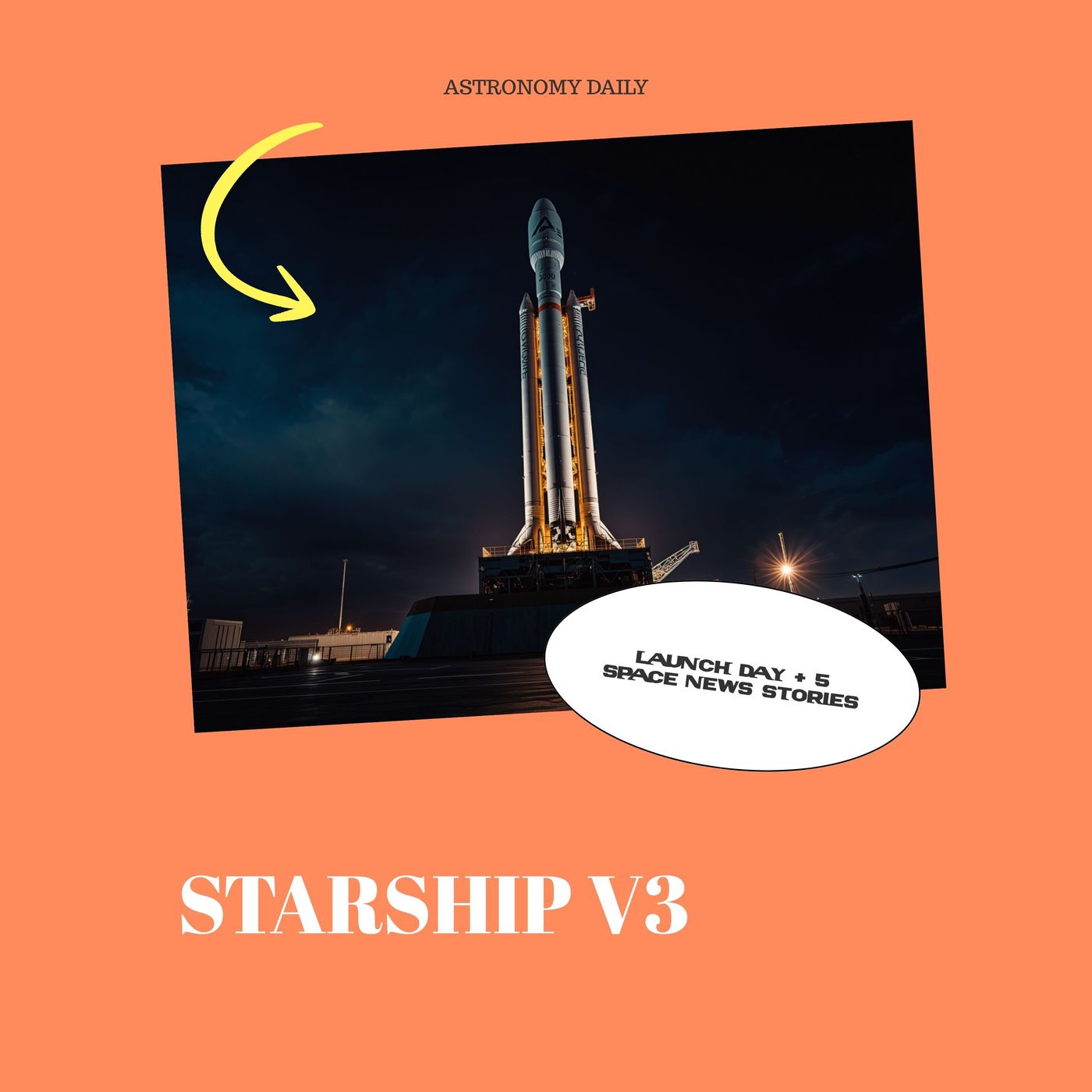
Launch Eve: Starship V3 Ready for Liftoff | Lunar Laser Navigation Breakthrough | VAST Ventures into Satellites
In this episode
Sponsor Link:To check out our great NordVPN money saving deal - Click Here
Astronomy Daily • S05E107 • Wednesday 21 May 2026 Starship V3 is on the pad and counting down for Thursday's debut launch — we bring you the full update including technical objectives, the Artemis stakes, and a sober note about a worker fatality at Starbase. Plus: a NIST proposal to build GPS for the Moon using lasers inside permanently frozen polar craters; space station startup Vast enters the satellite market; JWST finally has an explanation for the universe's impossibly large early black holes; the Roman Space Telescope locks in a September 2026 launch; and interstellar comet 3I/ATLAS gives up two remarkable new secrets — alien water thirty times richer in heavy hydrogen than anything in our solar system, and pre-discovery images that show it was spotted before anyone knew it was there. Stories This Episode • STORY 1 — Starship V3 Flight 12: Launch window opens Thursday 21 May at 6:30 PM EDT (8:30 AM AEST Friday 22 May). Splashdown of upper stage in Indian Ocean off Western Australia ~65 min after liftoff. First flight of Starship V3, first use of Starbase Pad 2. Key objectives: Raptor 3 engines, heat shield imaging by modified Starlink sats, 22 dummy Starlink deployments, Raptor relight in space. Worker fatality at Starbase 15 May under OSHA investigation. • STORY 2 — Lunar GPS via NIST: Proposal to place ultrastable silicon optical cavity lasers in permanently shadowed craters near lunar south pole (~16K, near-perfect vacuum). Could enable lunar GPS network, atomic timekeeping on Moon, precise satellite ranging, gravitational wave detection. • STORY 3 — Vast Corporation: Space station builder announces new line of high-power satellites, expanding beyond Haven-1 into commercial satellite manufacturing. Announced 19 May 2026. • STORY 4 — JWST Black Holes: New arXiv paper proposes 'episodic super-Eddington accretion' in gas-rich dark matter-dominated early galaxies explains overmassive black holes found by JWST. Identifies them as 'missing link' between heavy seeds and luminous quasars. • STORY 5 — Roman Space Telescope: Launch now confirmed as early as September 2026 — 8 months ahead of schedule, under budget. 100x Hubble's field of view, 1,000x survey speed. Targets dark energy, dark matter, exoplanets. Coronagraph for direct exoplanet imaging. • STORY 6 — 3I/ATLAS: Pre-discovery images found in Rubin Observatory data from 21 June–2 July 2025, over a week before official ATLAS discovery. Water deuterium ratio at least 30x higher than any solar system comet (ALMA/U of Michigan/Nature Astronomy). Comet estimated ~12 billion years old. Key Links • SpaceX Starship Flight 12 livestream: spacex.com • Flight 12 timeline (Space.com): space.com/space-exploration/launches-spacecraft/what-time-is-spacex-starship-v3-launch-starship-flight-12-timeline • Starbase worker death (Space.com): space.com/space-exploration/launches-spacecraft/worker-dies-at-spacexs-starbase-in-leadup-to-starship-v3-megarocket-launch • Lunar laser GPS (NIST): nist.gov/news-events/news/2026/05/shooting-moon-ultrastable-lasers-dark-craters-could-enable-lunar-navigation • Vast satellite announcement: space.com (19 May 2026) • Roman Space Telescope launch update: nasa.gov • 3I/ATLAS pre-discovery images: space.com/astronomy/comets • 3I/ATLAS water chemistry (ALMA): almaobservatory.org
Become a supporter of this podcast: https://www.spreaker.com/podcast/astronomy-daily-latest-space-news--5648921/support.
Sponsor Details:
Ensure your online privacy by using NordVPN. To...
Anna: The world's most powerful rocket is on the launch pad and it's launching tomorrow. We have the full Update on Starship V3 and the bittersweet shadow hanging over the launch site. Avery: In the cold darkness of the Moon's south pole, scientists want to build the most precise navigation system ever created. Lasers and craters permanently frozen in shadow. Anna: A, uh, space startup you might know best for its space station ambitions just revealed a surprise new business. Astronomy Daily Season 5 Episode 107 let's go.
Avery: Ready when you are. Anna: It's launch eve for the most anticipated rocket test of 2026. SpaceX's Starship V3, the biggest, most powerful rocket ever built, is on the pad at Starbase in South Texas. Confirmed go for launch Thursday, May 21st. Avery: We've been following this one for a few days now, Anna, and this is genuinely the launch where the stakes couldn't be higher for NASA, for SpaceX, for the whole future of deep space travel. Anna: Let's run through what's happening and why it matters.
The launch window opens at 6:30pm Eastern Time on Thursday. That's 8:30 Friday morning for listeners in Australia and New Zealand. 90 minutes to get off the pad. Avery: This is Flight 12, the 12th Test of the fully stacked Starship vehicle. And um, the very first for the completely redesigned version 3 architecture. It's been seven months since Starship last flew back in October 2025, so the pressure has been building. Anna: And it's the first flight From Starbase Pad 2, a brand new launch complex.
So there are a lot of firsts stacked up in this one mission. Avery: What are the main test objectives for Flight 12? Anna: The Booster Super Heavy will attempt a, uh, controlled splashdown in the Gulf of Mexico about seven minutes after launching. No Mechazilla catch attempt this time. This is a new vehicle and SpaceX wants clean data before pushing for that. Meanwhile, the upper stage ship 39 heads on a suborbital trajectory partway around the world. Avery: And it ends in the Indian Ocean, which puts the re entry path right over Western Australia.
For our Southern Hemisphere audience, there is a real chance of a visible streak across the Predawn sky around 65 minutes after launching. Anna: The upper stage has some fascinating objectives. It'll deploy 22 dummy Starlink satellites. Two of those are specially modified. They'll scan Starship's heat shield from outside and beam images back to mission controllers. That's a completely new capability testing how the team might assess heat shield readiness for future return to Starbase missions. Avery: And there's a deliberately removed heat shield tile to measure what happens aerodynamically when one is missing.
Plus a Raptor engine relay in space and a structural stress maneuver on the rear flaps. SpaceX is loading this flight with data collection. Anna: Now, before we go further with the excitement and we are genuinely excited, we do need to acknowledge something. On 15 May, a worker died at the Starbase site in South Texas. According to reports, the person was a contractor who died after a fall in the early hours of that Friday morning OSHA is investigating. Avery: SpaceX has not publicly commented. Our thoughts are with the person's family and colleagues.
It's a reminder that behind every spectacular launch is a workforce of thousands of people doing difficult, sometimes dangerous work that deserves acknowledgment. Anna: And there is a broader context here. A, uh, 2025 analysis using OSHA data found that Starbase has a significantly higher worker injury rate than comparable aerospace facilities. That's something the industry and regulators need to keep in focus as the pace of operations accelerates. Avery: With that noted, the launch itself. Why does NASA need Starship V3 to work so badly?
Anna: Because Starship is the designated lunar lander for Artemis 4. That's the mission that will actually put boots back on the moon, targeted for 2028. NASA needs SpaceX to prove Starship can get to orbit, refuel there, dock with an Orion capsule and descend to the surface. None of that has happened yet. This test is the foundation. Avery: B3 is also supposed to be the baseline vehicle for crewed missions eventually. And SpaceX's plans for orbital data centers, Mars missions, everything a lot is riding on a clean test tomorrow.
Anna: The launch window opens at 6:30 Eastern Thursday evening. 8:30 Friday morning, Australian Eastern Time. SpaceX will livestream from about 45 minutes before liftoff. We'll link everything in the show Notes next up. Avery: Today, here's, um, an idea that sounds like science fiction, but is grounded in some very serious physics. What if the coldest, darkest, most inhospitable places on the Moon turned out to be the ideal location for one of the most precise instruments ever conceived? Anna: You're talking about the permanently shadowed craters near the lunar south pole.
Avery: Exactly. Researchers at the National Institute of Standards and Technology in the US have published a proposal this week that's genuinely elegant. These polar craters never, ever receive direct sunlight. Because of the Moon's very low axial tilt, they've been in permanent darkness for billions of years. Temperatures inside reach around 16 Kelvin. That's minus 257 degrees Celsius, almost absolute zero. Anna: And that makes them special for lasers. Avery: Incredibly special. The most stable lasers in existence rely on silicon optical cavities, essentially a pair of ultra precise mirrors in a rigid housing.
The problem is that even the tiniest temperature fluctuation or vibration will cause the laser frequency to drift. On Earth, you need enormously complex cryogenic cooling systems and vibration isolation just to keep them stable. In one of these lunar craters, nature provides all of that for free. Anna: The near absolute zero temperature eliminates thermal noise. The near perfect vacuum eliminates atmospheric interference. And the bedrock of a lunar crater is extraordinarily stable compared to any location on Earth.
Avery: Jun Ye, the lead researcher at nist, put it beautifully. He said as soon as he understood what these permanently shadowed regions could offer, he he felt it would be the most ideal environment ever for a super stable laser. Anna: So what would such a laser actually be used for? This isn't just a cool physics experiment. Avery: Not at all. The applications are immediately practical for everything humanity is planning to do on the moon. First, navigation. As we build up Artemis infrastructure at the lunar south pole, spacecraft and landers currently have to rely heavily on Earth based tracking systems.
That's slow, imprecise and increasingly impractical as lunar activity ramps up. A laser locked to this kind of ultra stable cavity could provide a GPS like timing backbone. A master reference signal that spacecraft, landers and astronauts could navigate by an independent Anna: lunar positioning system that's genuinely transformative for long term operations. Avery: There's more. The same laser could enable ultra precise distance measurements between satellites in lunar orbit, critical for mapping and coordination.
It could serve as the first atomic clock on an extraterrestrial body, establishing a lunar timescale. And this one caught my eye. It could potentially support gravitational wave detection from the lunar surface. Anna: The Moon has been discussed as a future gravitational wave observatory site. Because it lacks the seismic noise that limits detectors on Earth, a laser like this would be a key component. Avery: This is still a proposal, but it's the kind of forward thinking infrastructure planning that needs to happen now before the crewed missions arrive.
Because you really don't want to be figuring out lunar GPS after the astronauts are already there. Anna: Before moving on to our next story, a quick reminder about our sponsor NORDVPN and the special money saving deal they have in place for you. When you're ready to upgrade your online security, make sure it's to NORDVPN and save a bunch of money in the process. Avery: When when you can find a link to our special offer in the show notes, do what we did and get NordVPN. Anna: Now you might know vast as the California startup building haven one the commercial space station that launched last year as humanity's first privately owned orbital outpost.
But this week, VAST made an announcement that raised a few eyebrows. They're getting into the satellite business. A pivot, an expansion really. On 19 May, Vast announced a new line of high power satellites distinct from their space station work. They're positioning this as a separate business line, entering a market currently dominated by established players like Boeing and Airbus in the geostationary orbit segment, as well as the emerging high throughput LEO operators. Avery: High power satellites.
What does that mean specifically? Higher power than standard communication satellites? Anna: Exactly. High power satellites can generate significantly more electrical power from their solar arrays, which translates directly into more powerful transmitters and more bandwidth capacity. They're attractive for government customers, defense applications and premium commercial communications sectors where performance outweighs launch cost as a priority. Avery: And VAST has the manufacturing expertise from Haven One to draw on.
Anna: That's presumably part of the logic. Building a space station requires solving very hard problems around long duration power systems, thermal management, structural integrity in orbitall, things that translate well into satellite manufacturing. Bast seems to be betting they can leverage that expertise into a new revenue stream. Avery: It's, um, an interesting strategic move. Space stations are enormously capital intensive with a very long return horizon. Satellites are a more established market with clearer near term revenue.
It diversifies their business in a meaningful way. Anna: Haven One remains their flagship product. This isn't an abandonment of that vision, but it signals that VAST is thinking about itself as a broader space infrastructure company, not just a station operator. One to watch. Avery: Time now for a black hole story. When the James Webb Space Telescope started returning data from the early universe, it created a beautiful problem. It found black holes that were too big. Impossibly big by our models.
Supermassive black holes in galaxies just 800 million years after the Big Bang. Far more massive relative to their host galaxies than anything we see in the modern universe. Anna: And that shouldn't be possible under our standard understanding of how black holes and galaxies co evolve. Avery: Right. The conventional model says black holes and galaxies grow together in a kind of feedback loop. Star formation, gas accretion, they regulate each other. The ratio of black hole mass to galaxy mass is fairly consistent in the local universe, around a, uh, tenth to half a percent.
But JWST kept finding early galaxies where the black hole was grotesquely oversized relative Anna: to its host galaxy, the overmassive black holes. So what's the new explanation? Avery: New research published this week on Arxiv, led by Muhammad Latif at UAE University, proposes a, uh, compelling mechanism in the earliest Cosmic environments. Certain galaxies were extraordinarily gas rich and embedded in particularly dense dark matter halos. That combination created conditions where gas could fall into the central black hole far faster than the surrounding galaxy could form stars.
Anna: Though the black hole got a head start, it never lost exactly. Avery: The researchers call this rapid early phase episodic super Eddington accretion. The black hole was consuming gas at rates that exceed the theoretical limit that normally governs how fast accretion can proceed in these extreme early environments. That limit may have been routinely broken. Anna: This paper also identifies these over massive black holes as potentially the missing link between what are called heavy seeds, the primordial black holes that formed from the collapse of the very first massive stars, and the luminous quasars we observe later in cosmic history.
Avery: There is also a separate but related finding this week on JWST's data from two specific early galaxies, named in the research as Kola 1 and Nepla 4, seen just 800 million years after the Big Bang, where the black holes appear to have grown far faster than their host galaxies. The JWST spectroscopy detected broad hydrogen emission lines, a, uh, telltale signature of gas swirling rapidly around the supermassive black hole. Anna: That we're getting closer to a, uh, coherent story of how the universe's largest structures assembled themselves in those first billion years.
JWST keeps delivering. Avery: If you thought the James Webb Space Telescope changed everything, and it did, you should be paying close attention to what's coming next. NASA's Nancy Grace Roman Space Telescope is now confirmed for launch as early as September 2026. That's eight months ahead of its mandated deadline, and it's under budget, which almost Anna: never happens with flagship space telescopes. Avery: Almost never. NASA administrator Jared Isaacman announced the updated timeline at a news conference at Goddard Space Flight center in April.
And since then, the telescope has completed construction and is being prepared for shipment to Kennedy Space center in Florida. It'll ride to orbit on a SpaceX Falcon Heavy. Anna: Walk us through what Roman actually does, because I think a lot of people haven't heard as much about it as they will once it launches. Avery: Roman is built around the primary mirror that's similar in size to Hubble, about 2.4 meters across. But where Hubble sees a relatively narrow field of view. Roman's Wide Field Instrument captures a patch of sky at least a hundred times larger in a single exposure.
And it surveys the sky at, uh, more than a thousand times Hubble's speed. Anna: That's an almost incomprehensible upgrade in survey capability. Avery: By the end of its planned five year primary mission, Roman is expected to accumulate around 20,000 terabytes of data. Scientists will use that to investigate around 100,000 exoplanets, hundreds of millions of galaxies, billions of stars. And the mission team fully expects to find phenomena that have never been observed. Anna: The primary scientific targets are dark energy and dark matter, the invisible scaffolding of the universe that we know must exist but can't directly see.
Roman should be able to map how much dark matter is distributed across cosmic time in a way that's never been possible before. Avery: It also carries a coronagraph instrument, the most advanced starlight suppression technology ever flown in space, which will enable direct imaging of planets around nearby stars. That's a key stepping stone in the Anna: search for earth like worlds September 2026 mark the calendar. Astronomy is about to get very, very busy. Avery: Our final story today involves a visitor from beyond our solar system and two new revelations about it that are genuinely extraordinary.
Anna: The interstellar comet 3 I HE L A S. We've spoken about this before on Astronomy Daily. It was officially discovered on 1 July 2025 by the ATLAS telescope network in Chile, the third interstellar object ever detected passing through our solar system. Avery: And there are two new developments this week. The first, researchers have found that 3i a atlas was actually being imaged by the Vera C Rubin Observatory in Chile for more than a week before its official discovery. The Comet nearly became 3i Rubin.
Images from between 21 June and 2 July 2025 show it clearly in Rubin data. But the observatory was still in its science validation phase at the time, not yet in full operation. Nobody was looking at those frames in real time. Anna: That's a fascinating footnote about the state of our sky survey infrastructure. Had Rubin been fully operational, we would have had over a week of additional early tracking data. Avery: And that matters enormously for characterizing these objects. The earlier you catch them, the better you understand their trajectory, their composition, their size.
Anna: The second development is even more striking. Research led by the University of Michigan and published in Nature Astronomy reveals that the water inside 2i Atlas is unlike anything we've ever found in our own solar system. Specifically, its ratio of heavy water water molecules, where one hydrogen atom is replaced by deuterium, is at least 30 times higher than anything found in comets from our own solar system. Avery: Thirty times? That's not a small difference. Anna: It's a profound one. Deuterium is a heavier isotope of hydrogen, and the ratio of deuterium to regular hydrogen in water is a chemical fossil.
It records the temperature conditions where the water formed. High deuterium means the water formed in an extremely cold environment, far colder than the outer reaches of our own solar system. Avery: So 3 IA atlas forms somewhere colder and stranger than anything in our neighborhood. A different kind of planetary system, possibly much further from its parent star. Anna: The researchers at ALMA Observatory described it beautifully. They said each interstellar comet brings a little bit of its history, its fossils from elsewhere in the galaxy.
We don't know exactly where 3 IA Atlas came from, but with instruments like ALMA and Rubin and jwst, we're beginning to read the chemical biography of another star system. Avery: And the comet itself is estimated to be nearly 12 billion years old. Its parent star system may no longer exist. We're reading the message from a stellar civilization of ice and rock that formed before our sun was born. Anna: Space travel in slow motion across 12 billion years before we go a, uh, Avery: quick heads up for your skies tonight.
Look west after sunset and you'll find a lovely pairing. Jupiter glows brightly beside the waxing crescent moon. The crescent acts as a natural pointer. Jupiter will be the brightest star like object nearby. No telescope needed, though. Binoculars will show Jupiter's four Galilean moons as tiny dots in a line. Southern Hemisphere viewers look northwest after dark. Enjoy it. Anna: That's Astronomy daily for Wednesday, May 21, 2026. Season 5 Episode 107 Big Day Tomorrow with Starship. We'll be watching.
Avery: If you're enjoying the show, please subscribe, leave a review and tell a fellow space enthusiast. Find us at astronomydaily IO and across all platforms as astrodaily. Pod. This is Anna and Avery. Keep looking up.

 Apple Podcasts
 Spotify
 Pocket Casts
 Castbox
 Overcast
 Podbean
 iHeartRadio
 Castro
 Goodpods
 Moon FM
 Podcast Addict
 Podcast Republic
 YouTube