
Space News Update: SMILE Satellite's Historic Launch | Starship V3 Delayed | Snappy's Quest to Detect Solar Neutrinos
In this episode
Sponsor Link:To get our special money saving deal from NordVPN - Click Here
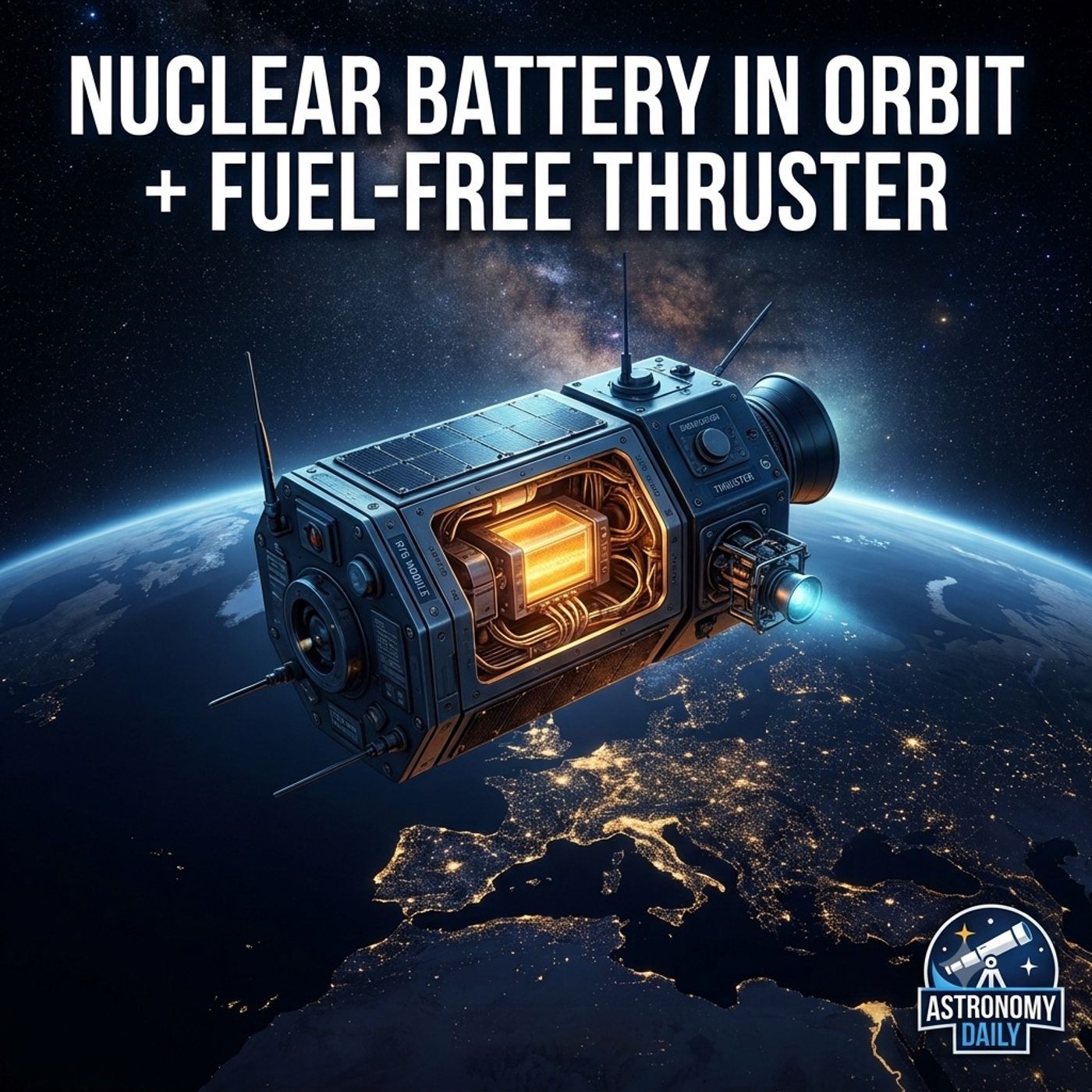
A launch day episode packed with big science and bigger rockets. Today we cover the real-time launch of the ESA/China SMILE space weather satellite, SpaceX's Starship V3 sitting on its brand-new pad (and why it's now heading for Thursday), a UCL study warning that megaconstellation launches may be accidentally conducting an 'unregulated geoengineering experiment' in our upper atmosphere, the world's first space-based neutrino detector operating in orbit, extraordinary evidence in Antarctic ice that Earth is collecting material from a dead star, and a clever new cosmic mapper called TIME that studies the ancient universe using a single spectral line.
Become a supporter of this podcast: https://www.spreaker.com/podcast/astronomy-daily-latest-space-news--5648921/support.
Sponsor Details:
Ensure your online privacy by using NordVPN. To get our special listener deal and save a lot of money, visit www.astronomydaily.io/nordvpn. You'll be glad you did!
Get the best secure and private email on the planet. Stop your Government, google and who knows who else spying on every email you write. Do what we did and use ProtonMail. They beleive in privacy and there are no ads in their business model...yet they still provide a free forever service. Check them out and get out special deal at www.astronomydaily.io/protonmail
Become a supporter of Astronomy Daily by joining our Supporters Club. Commercial free episodes daily are only a click way... Click Here
This episode includes AI-generated content.
Anna: How cool is this? Right now, as you're listening to this, a rocket is in space. A brand new satellite is on its way to a very unusual orbit, one that will take it a, uh, third of the way to the moon. And it's going to do something no spacecraft has ever done before. Take X ray pictures of Earth's own magnetic field. Avery: And that's just story one. Anna: Hello and welcome to Astronomy Daily, the podcast that brings you the universe fresh every single day. I'm Anna. Avery: And I'm Avery. This is season five, episode 106.
And today, Tuesday, May 19, 2026, we have a genuinely packed show. Anna: We've got a historic launch that happened just hours ago. We've got the world's most powerful rocket sitting on a brand new pad ready to fly. Well, almost ready. There's a slight schedule adjustment. We'll explain. And we've got a warning from scientists that the rocket boom itself might be quietly changing our atmosphere. Avery: Plus a, uh, shoebox sized detector that could let us see the core of the sun. Some extraordinary news from Antarctic ice, and a clever new telescope that listens to the ancient universe in a completely new way.
Anna: Six stories. Let's get into it. Avery: Our first story is happening right now, or more precisely, it happened in the early hours of this morning. If you're listening from Australia or New Anna: Zealand, at 5:52 in the morning, Central European time, a, uh, European Vega C rocket lifted off from the M. Guillot Guiana Space center in Kourou, French Guiana. And aboard it was a spacecraft called Smile. Avery: Smile, which stands for Deep Breath Solar Wind, Magnetosphere Ionosphere Link Explorer, a name Anna: that is almost impressively unwieldy for something this elegant.
Avery: But what it's going to do is genuinely beautiful. Smile is a joint mission between the European Space Agency and the Chinese Academy of Sciences. Its entire purpose is to study how Earth responds to the sun. Not the sun itself, but the interaction, that invisible battle between solar wind and our planet's magnetic shield. Anna: And it's going to do two things that have never been done before. First, it will take X ray images of Earth's magnetic field, specifically the boundary where the solar wind rams into the magnetosphere.
That boundary is called the magnetopause, and no spacecraft has ever imaged it in X rays. Avery: Second, Smile will watch the aurora, the northern lights, continuously for up to 45 hours at a time in ultraviolet. Most aurora observations are snapshots. Smile will give us a full movie. Anna: To do all this, it needs a very unusual orbit. After claunch, it'll fire its engine 11 times over 25 days to maneuver into a highly elliptical path, swinging out to 121,000 km above the north Pole, then diving back down to just 5,000 km above the south Pole.
Avery: That's almost a third of the way to the Moon. At its furthest point. Anna: It's carrying four science instruments, a soft X ray imager, an ultraviolet aurora imager, a light ion analyzer and a magnetometer. And it has a planned mission lifetime of three years. Avery: Worth mooting too. This is the seventh flight of a Vega C rocket and the first time Italian manufacturer Avio operated the vehicle directly, replacing Ariana Space which ran the previous six flights. So multiple milestones today, space weather is Anna: something that affects all of us.
It disrupts satellites, threatens power grids and poses real risks to astronauts. Smile won't just do pure science. It'll help us predict dangerous storms earlier and protect the technology we rely on and the people we're sending into space. Avery: There's also a geopolitical subplot here. Worth a moment of your time. ESA and China built this mission together from scratch. Jointly designed, jointly built, jointly operated. Meanwhile, uh, NASA has been legally barred from bilateral cooperation with Chinese space entities since 2011 under the so called Wolf amendment.
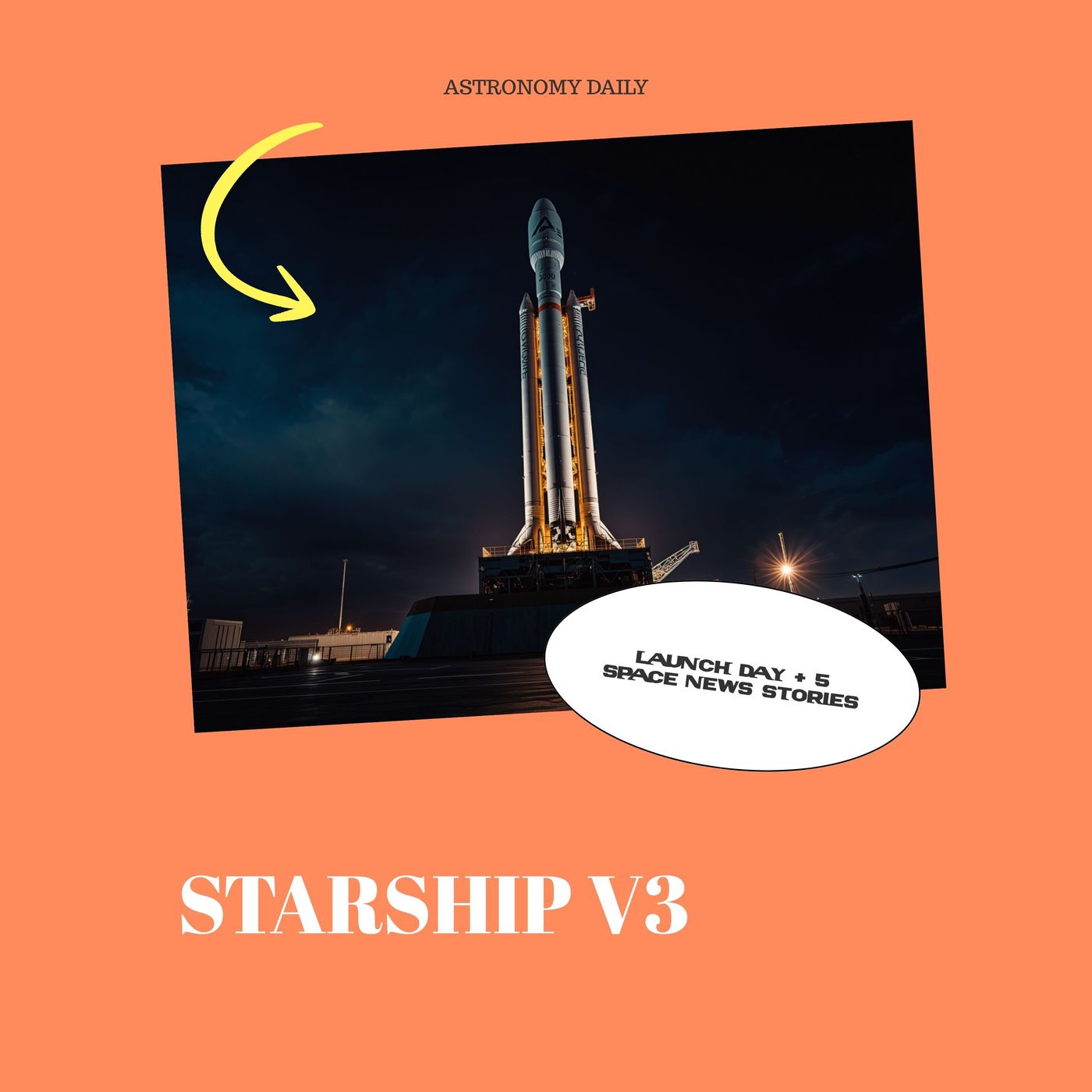
So Smile is quietly saying something about how different parts of the western space community see that question. Anna: And it's now in space. Smile is go now. If you woke up today expecting to watch a Starship launch, SpaceX has a small apology for you. Avery: The debut flight of Starship V3 was originally targeting today. Tuesday it slipped to Wednesday and now it has slipped again to Thursday, May 21 with a launch window opening at 6:30pm Eastern Time, which is 8:30am Friday morning in Sydney.
Anna: SpaceX hasn't explained why publicly. Likely some final closeout and pre fight check work. Road closures around the Starbase site in Texas remain in place through the end of Thursday, which at least tells us Thursday is still a live target. Avery: But let's talk about what is sitting on that pad. Because Starship V3 is genuinely a step change from what came before. When stacked Starship V3 stands over 400ft tall, about 123 meters, making it the largest and most powerful rocket ever built. It pairs booster 19 with ship 39 and both are running the new Raptor 3 engines.
Anna: The Raptor 3 is a meaningful upgrade. Sea level variants now produce 250 tons of thrust each, up from 230 previously. Vacuum engines push to 275 tons. The engines are lighter down to about 1525 kilograms each and have an integrated design that eliminates individual engine shrouds. There are also savings across the whole vehicle, running to roughly a ton per engine. Avery: The payload capacity is eye watering. Starship V3 can carry more than 100 metric tons to low Earth orbit in full reuse configuration, roughly triple what the previous version could manage.
Anna: And this is also the first launch from orbital launch pad 2 at Starbase, meaning SpaceX can now have two rockets being prepared simultaneously rather than one. That's a huge step toward the launch cadence Elon Musk needs for his Mars ambitions. Avery: For Flight 12 itself. Both the booster and the ship will target controlled splashdowns rather than a tower catch a deliberate step back in ambition to validate the new architecture first before chasing the spectacular. The booster will come down in the Gulf of Mexico or the Gulf of America.
About seven minutes after launch, ship 39 will splash down in the Indian Ocean off Western Australia, about an hour into the mission. Anna: During that flight, the ship will also deploy 20 dummy Starlink satellites, relight a single Raptor engine in space, and deliberately fly with one heat shield tile removed to measure what happen happens aerodynamically when a tile is missing. Avery: The stakes here are enormous. NASA needs Starship to serve as the human landing system for Artemis 4, a crewed lunar landing now targeted for 2028.
SpaceX still needs to demonstrate in orbit refueling at scale, a process requiring more than 10 tanker flights to fuel a single moon mission. Starship V3 is the vehicle designed to make that economically possible. Anna: Watch this space. Quite literally, here's a story that connects directly to everything we just talked about. All those rocket launches, all those Starlink satellites might be doing something to our atmosphere that nobody planned and nobody is regulating. Avery: A major new study published in the journal Earth's Future, led by researchers at AH University College London, has done the most comprehensive analysis yet of air pollution from satellite mega constellations.
The Starlinks, Amazon's Kuiper satellites, the Chinese Guang and Tian Fan systems. Anna: And what they found is genuinely alarming. When a rocket launches, it burns kerosene fuel and produces black carbon soot that gets injected directly into the upper layers of the atmosphere. And unlike soot from cars or power plants at ground level, this high altitude soot, uh, lingers for two and a half to three years because of how Avery: long it stays up there. The climate effect of rocket launched black carbon is about 540 times greater per unit than such from ground level sources.
Not a typo. 540 times by 2029. Anna: The UCL team projects that mega constellations will account for 42% of the total climate impact of the entire space sector, up from 35% in 2020. And they note that their estimate is probably conservative because the actual number of launches since they gathered their data has already exceeded their projections. Avery: What makes this particularly thorny is what the accumulation starts to resemble. Scientists have for years discussed a controversial climate intervention called stratospheric aerosol injection.
The idea of deliberately spraying reflective particles into the upper atmosphere to block a fraction of sunl and cool the planet. The space industry is essentially beginning to do accidentally a version of this. Anna: Professor Eloise Meriz, who led the study, used a striking phrase. She called it a small scale, unregulated geoengineering experiment that could have many unintended and serious environmental consequences. Avery: The effect right now is small. We're talking about 100th of the concentration needed for a meaningful geoengineering intervention.
And there's even a slight net cooling effect from the soot, which sounds positive, but comes with the same caveats as all unpredictable impacts on rainfall, weather patterns and the ozone layer. Anna: The ozone layer, by the way, is also affected. Launches and re entries produce chemicals and particles that speed up ozone depleting reactions. The team found that by 2029 the global ozone impact is still small, about 0.02% deplet. But the trajectory is heading in the wrong direction. Avery: SpaceX has recently applied for permission to launch 1 million Starlink satellites on top of the roughly 12,000 already in orbit.
1 million. If even a fraction of those are launched, the picture changes significantly. Anna: The researchers are calling for proper regulation of launch related pollution, something that currently barely exists, and significantly more research funding to even keep pace with the industry's growth. Avery: It's one of those stories where the technology and the environmental impact are running at completely different speeds. Anna: Before we move on to our next piece of news, a quick reminder to check out the great deal our uh, sponsor NORDVPN has in place for you at the moment.
So the best protection you can get online for less money. Sounds like a win win to me. For full details, just click on the link in the show. Notes. Avery: You forgot to mention, NORDVPN is the one we trust to look after us online. We love them. Anna: Alright, back to today's space and astronomy news and let's go small for a moment. Very small, like shoebox small. Avery: On May 3, a SpaceX rideshare mission carried a tiny satellite into low Earth orbit. A uh, 3U cubesat, meaning it's about 30cm long and 10cm wide.
It goes by the name Snappy, which stands for Solar Neutrino Astroparticle physics. Anna: And Snappy is quietly a, uh, historic first. It is the world's first neutrino detector to ever operate in space. Avery: Neutrinos are extraordinary particles. They're produced in enormous quantities by nuclear reactions, including the fusion happening in the core of the sun right now. Every second, hundreds of billions of solar neutrinos pass through your thumbnail. They barely interact with anything. They go straight through the Earth as though it isn't there.
Anna: Which makes detecting them extraordinarily difficult. All our existing neutrino detectors are massive underground facilities, hanks containing thousands of tons of water or ice, buried deep in mountains or frozen in Antarctic glaciers. You need enormous amounts of material to have any chance of catching a neutrino. Avery: Snappy is the opposite of that. It's a tiny detector made of crystals of gallium and tungsten sitting in a satellite orbiting at 500 km altitude. The whole thing was designed by physicist Nicholas Salome at uh, Wichita State University with electronics from NASA Marshall.
Anna: It won't detect many neutrinos. The detector mass is far too small for that. This is explicitly a proof of concept. The goal is to answer one question. Can space based neutrino detection work at all? Because if it can, the next step is extraordinary. Avery: Salome has described the end goal as, and I love this phrase, putting a microscope into the core of the Sun. A larger detector on a future mission could fly close enough to the sun to directly image the fusion shells around the solar core.
We would be able to see in real time what is happening inside the most powerful nuclear furnace in our solar system. Anna: Snappy is currently undergoing on orbit testing. Its two year mission is just beginning. And if it works, it opens a completely new chapter in both solar science and neutrino astronomy. Avery: Big things, shoebox sized packages next. Anna: This is the story that if you stop and think about it properly, will make you feel things M Our solar Avery: system is not sitting still in empty space.
It's moving constantly through the Milky Way. And right now we are passing through a region known as the local interstellar cloud. A vast thin region of gas and dust between the stars. Anna: As we move through it. Earth is sweeping up material from this cloud, including something called iron 60. Iron 60 is a radioactive isotope of iron that isn't produced naturally on Earth. It can only be made in one place inside a dying star in the moments of a supernova explosion. Avery: A new study led by researchers at Germany's Helmholtz Centrum Dresden.
Rostorf has confirmed something remarkable. They analyzed Antarctic ice cores, ice that has been accumulating for tens of thousands of years, layer by layer, trapping whatever drifted down from the atmosphere at the time. And in that ancient ice, they found Iron 60 steadily arriving, varying over time, but persistently there. Anna: The pattern of how the iron 60 arrives and the way it varies tells the researchers that this material has been stored inside the local interstellar cloud since a stellar explosion that happened long, long ago.
And as Earth moves through the cloud, it picks some up. Avery: Think about what that means. The ice in Antarctica is preserving a record of our solar system's journey through the galaxy. The atoms that blew off a dying star are now sitting in the ice at the South Pole, and scientists can read that record. Anna: The study also helps scientists understand the structure and boundaries of the local interstellar cloud, a region whose edges and properties are still being mapped. Our solar system has been inside it for tens of thousands of years and will eventually exit it, moving into whatever lies beyond.
Avery: We are quite literally moving through space, and the universe is leaving fingerprints on our planet as we go. I find that extraordinary. Anna: Our final story today is about a problem that has frustrated astronomers for decades, and a clever new instrument that might solve it. Avery: The early universe is full of ancient galaxies, galaxies that formed when the universe was young, when star formation was happening at an extraordinary rate. But they're so far away and so faint that even our most powerful telescopes struggle to study them.
Anna: Individually, though, astronomers have done something ingenious. Instead of trying to resolve individual galaxies, they've built an instrument that looks at a whole crowd of them at once and tracks one spectral line across the entire population. Watching how that line changes over time and across cosmic distances gives you a statistical picture of what all those galaxies are doing collectively. Avery: The instrument is called time, the Tomographic Ionized Carbon Mapping Instrument. And, um, the spectral line it focuses on comes from ionized carbon, a tracer for star formation.
Carbon emission tells you where gas is being turned into stars. Anna: Time essentially makes a three dimensional map of carbon emission across huge stretches of cosmic history. You're not seeing individual galaxies, you're. You're seeing the aggregate glow of star formation across the ancient universe, shifted and stretched by cosmic expansion. Avery: The tomographic part of the name is key. Tomography means imaging by slices, like a CT scan. But for the cosmos, time slices through cosmic time by measuring how the carbon line appears at different frequencies, each corresponding to a different distance and era.
Anna: It's a bit like trying to study a conversation in a crowded room. You can't hear every individual voice, but you can measure the overall hum, how it changes over time, when it gets louder, when it fades. And from that you learn an enormous amount about the crowd. Avery: Time represents a new class of cosmological instruments, one designed not for precision individual observation, but for the statistics of the universe at scale. And the first results are already showing promise. Anna: It's a reminder that sometimes the most powerful approach isn't to look harder at one thing, it's to look differently at everything.
Avery: Before we wrap up, a quick look at the sky for our Southern Hemisphere and Australian listeners. Anna: And there's something genuinely lovely happening right now in the western sky after sunset. Avery: Venus is blazing in the evening sky. It's one of the brightest things you can see after the sun goes down. And over the next few nights, the crescent moon will be moving past it, creating a beautiful close pairing in the west. Look low on the western horizon about 45 minutes to an hour after sunset.
You won't need binoculars. Anna: And looking ahead to the end of the month, mark May 31st in your calendar, we get a full moon and it's a blue moon, the second full moon in a single calendar month. It won't actually look blue, but it is a rarer event and it'll be a beautiful full moon to observe clear skies, everyone. That is Astronomy daily for Tuesday, May 19th. Six stories, one launch day, one rocket sitting on a brand new pad and a, uh, shoebox changing the future of physics. Avery: If you enjoyed today's episode, please subscribe wherever you get your podcasts and leave us a review.
It really does help new listeners find the show. You can find us at astronomydaily IO and we're @astrodaily pod on all the major platforms. Anna: Astronomy Daily is part of the bites.com podcast network. We'll be back tomorrow with more of the universe freshly delivered. Avery: See you then.


 Apple Podcasts
 Spotify
 Pocket Casts
 Castbox
 Overcast
 Podbean
 iHeartRadio
 Castro
 Goodpods
 Moon FM
 Podcast Addict
 Podcast Republic
 YouTube