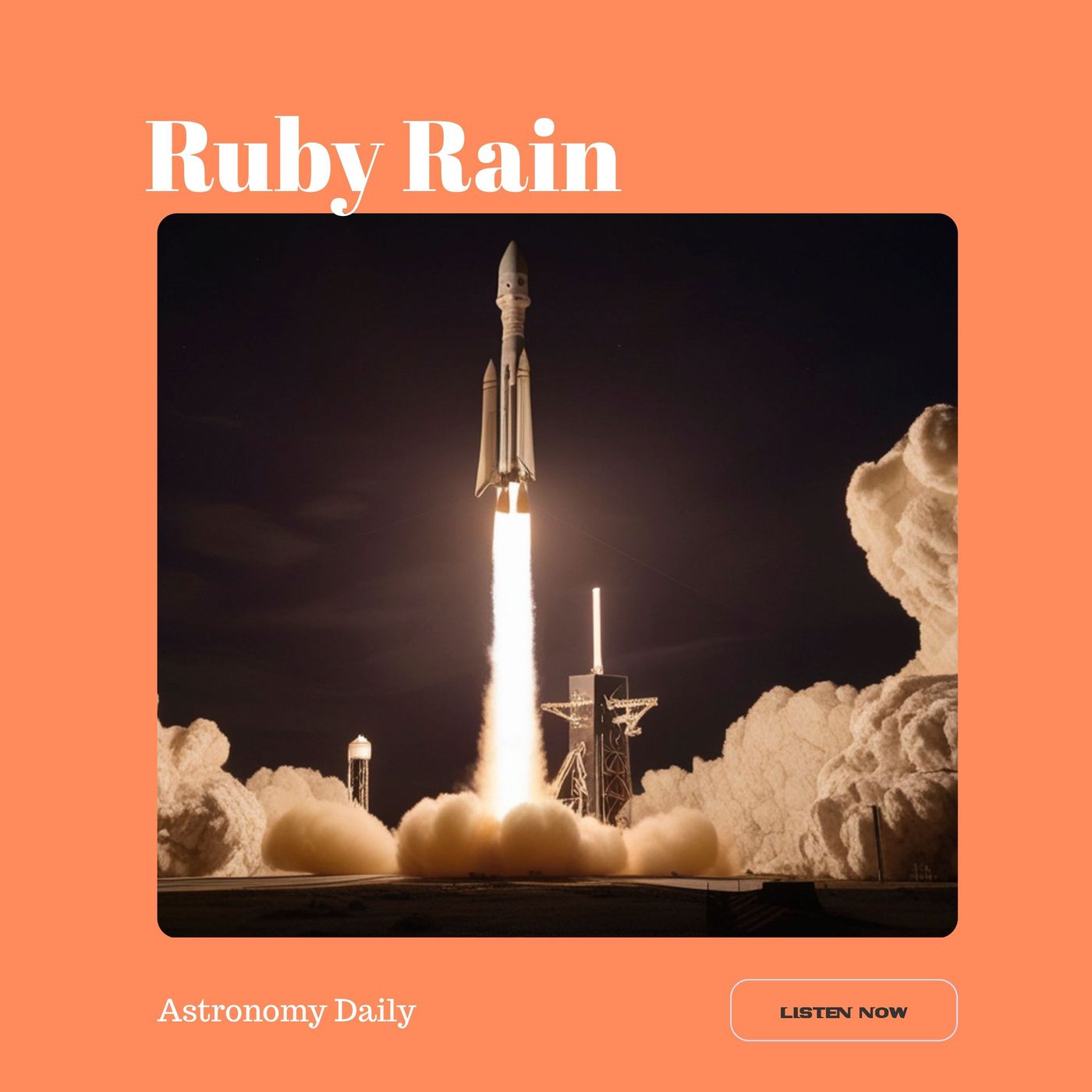
Rockets Across Continents, A Black Hole's Jet Unveiled, and Rain of Rubies on Distant World
In this episode
A launch-packed Wednesday kicks off with two rocket milestones — SpaceX's BlueBird 8-10 direct-to-cell satellite launch and Ariane 6's record-breaking Amazon Leo flight — followed by a splashdown update for the science-laden Dragon CRS-34. Then a Chandra double-header delivers the most detailed X-ray view ever of M87's famous black hole jet, plus the discovery of possible supernova wreckage at the very heart of the Milky Way. We close with JWST's extraordinary weather portrait of WASP-121b — a planet where the rain is made of rubies and sapphires. Story Summaries & Key Facts Story 1 — SpaceX BlueBird 8-10 Launch • Launched: 2:39 a.m. EDT, 17 June 2026, from Cape Canaveral Space Force Station (SLC-40) • Vehicle: SpaceX Falcon 9 (booster B1077, 29th flight) • Booster recovery: drone ship 'A Shortfall of Gravitas', Atlantic Ocean • Payload: AST SpaceMobile BlueBird 8, 9 & 10 (Block 2 next-generation satellites) • Antenna array: ~2,400 sq ft each — largest commercial phased arrays in LEO • Peak data speed: 120 Mbps per coverage cell (nearly double Block 1) • Processing bandwidth: 10 GHz per satellite • Goal: space-based cellular broadband direct to standard smartphones • AST network partners: 50+ MNOs including AT&T, Verizon, Vodafone (~3 billion subscribers) Story 2 — Ariane 6 Record Payload • Mission: VA269 / LE-03 (Amazon Leo 3rd Ariane 6 flight; 8th Ariane 6 overall; 3rd of 2026) • Launch site: Guiana Space Centre, Kourou, French Guiana • Payload: 36 Amazon Leo broadband satellites — heaviest Ariane payload ever (~20,820 kg) • First flight of upgraded P160C solid rocket boosters (debut; replaces P120C) • P160C improvement: +1 metre longer, carries 156 tonnes propellant each (+10% performance) • Ariane 64 LEO capacity with P160C: ~22 tonnes • Previous flights each carried 32 satellites; today's adds 4 more • Arianespace milestone: 100 Amazon Leo satellites launched in under 5 months • Next Ariane 6 launch: 28 August (2-booster configuration; likely Meteosat-14) Story 3 — Dragon CRS-34 Splashdown (Update) • UPDATE on yesterday's S05E116 story (undocking reported 16 June 2026) • Dragon CRS-34 splashed down off Southern California coast, 17 June 2026 (~5:08 a.m. PDT) • Capsule: Cargo Dragon 2 (C209, 6th flight); undocked ~12:25 p.m. EDT 16 June • Science returned: bioprinted organ/cartilage tissue; DNA-inspired cancer treatment materials • Also returned: blood-forming stem cells; cryogenic propellant storage experiment data • Dragon is the ONLY ISS cargo vehicle capable of returning cargo to Earth intact • Time-sensitive samples flown by helicopter from recovery ship to Kennedy Space Center • CRS-34 launched 15 May 2026; delivered ~6,500 lbs cargo to Expedition 74 crew Story 4 — Chandra / M87 Jet (Double-Header Part 1) • Published: 15 June 2026; presented at 248th AAS Meeting, Pasadena, CA • Lead researcher: Camille Poitras (PhD student, Laval University, Canada) • M87* mass: 6.5 billion solar masses; distance: ~55 million light-years • M87* was the first black hole ever directly imaged (Event Horizon Telescope, 2019) • Data span: Chandra observations 2012–2025, processed with advanced deconvolution • Key finding 1: Two distinct components revealed in feature HST-1 (previously blended) • Key finding 2: Global X-ray emission decrease of up to 84% — consistent with synchrotron cooling • Key finding 3: Jet features show both quasi-stationary and superluminal apparent motion • Multi-wavelength: Chandra + JWST + Hubble + VLA + ALMA combined • Significance: most detailed evolving picture of any black hole jet ever produced Story 5 — Chandra / Galactic Centre Supernova (Double-Header Part 2) • Published: Astrophysical Journal, released 14–15 June 2026...Anna: Rockets on two continents, the most detailed look ever at a jet screaming out of the first black hole humanity ever photographed, and a planet where the rain is made of rubies and sapphires. It is Wednesday 17th June 2026 and this is Astronomy M Daily. Avery: I'm Avery. Anna: And I'm Anna. We have got a packed show for you today, including a Chandra double header that we are very excited about. Avery: Plus a quick but important update on a Dragon capsule that splashed down this morning carrying some genuinely remarkable science from the International Space Station.
Anna: Let's get into it. Avery: Our first story comes from Cape Canaveral, where SpaceX kicked off today very early this morning by launching three of the biggest commercial communications satellites ever put into low Earth orbit. Anna: These are AST Space Mobile's Bluebird 8, 9 and 10, the latest additions to what the company is calling the first and only space based cellular broadband network that connects directly to ordinary smartphones. No special hardware, no satellite phone, just the device already in your pocket.
Avery: The Falcon 9 lifted off from Space Launch Complex 40 at uh, Cape Canaveral Space Force Station at 2:39 in the morning Eastern Time. The BO B1007 on its 29th flight came back down on the drone ship, a shortfall of gravitas in the Atlantic about eight and a half minutes later. Business as usual for SpaceX. Anna: But the satellites themselves are anything but routine. These block 2 bluebirds are a major leap over the first generation. Each one carries a phased array spanning nearly 2,400 square feet, making them the largest commercial phased arrays ever deployed in low earth orb.
For comparison, the first generation bluebirds had a raise of around 693 square feet. So we're talking about a uh, three and a half times increase in size Avery: and that size translates directly to capability. Each satellite supports 10 gigahertz of processing bandwidth and peak speeds of 120 megabits per second per coverage cell. AST Space Mobile says that's nearly double what the Block 1 satellites could deliver. Anna: The company has been racing to build out this constellation after a setback earlier this year when a Blue Origin New Glenn rocket carrying another Bluebird satellite exploded during a static fire test.
Today's successful launch puts them firmly back on track. Avery: AST Space Mobile already has agreements with over 50 mobile network operators globally, including AT&T, Verizon and Vodafone, covering nearly 3 billion subscribers. The vision is global broadband coverage, especially for the billions of people in areas where terrestrial mobile networks simply don't reach. Anna: A big morning for space based connectivity and a reminder of just how fast this sector is moving. Story two, and we are staying with launches because if one rocket spectacular wasn't enough for a Wednesday morning, Europe decided to join the party.
Avery: Orion Space launched its Ariane 6 rocket from the Guiana Space center in Kourou, French guiana today, carrying 36Amazon Leo broadband satellites to low Earth orbit. That is the heaviest payload ever launched by any Ariane rocket in the entire history of the program. Anna: To give that some Context, the previous two Ariane 6Amazon LEO flights each carried 32 satellites. Today's mission, designated VA269, carried four more. And payload mass is estimated to be around 45,900 pounds, roughly 21 metric tons.
Avery: But here's what makes this launch particularly noteworthy beyond just a record payload. Today was the debut flight of the upgraded P160C solid rocket boosters. Orion 6 flew today with four of these new strap on boosters and they are a significant improvement over the P120C boosters that have powered all previous Orion 6 flights. Anna: The P160C boosters are 1 meter longer inside and can carry up to 156 tons of propellant each, a, uh, 10% increase in performance over the P120C. That upgrade pushes Ariane 64's total payload capacity to approximately 22 tons in low Earth orbit.
Avery: Ariane says this is all part of Ariane 6 ramping up rapidly. Less than two years after its inaugural flight, the rocket is already undergoing its first major performance upgrade. And with 18 Ariane six launches contracted for the Amazon LEO Constellation alone, the European launch business looks very healthy indeed. Anna: This was the eighth Ariane 6 launch overall, and the third of 2026. And with the successful deployment of these 36 satellites, Arianespace has now placed 100Amazon LEO satellites into orbit in just five months.
That is quite apace. Avery: A uh, quick but important update now following on from the story we brought you yesterday about SpaceX's Dragon CRS 34 cargo capsule undocking from the International Space Station. Anna: As we told you, the Dragon undocked from the Harmony Module's forward port at around 12:25 Eastern Time yesterday afternoon while the station was flying about 418 km above the northern Pacific Ocean. And this morning, right on schedule, it splashed down off the coast of California, completing a roughly 17 hour return journey.
Avery: And um, this is the part that makes this more than just a logistics story. Dragon CRS 34 is bringing back some of the most medically significant science payloads the station has assembled for return in some time. Anna: The cargo includes bioprinted organ and cartilage tissue work that could eventually transform how we approach joint repair and transplant medicine. There are also materials developed for DNA inspired cancer treatments, but blood forming stem cells and data from experiments on improving cryogenic fuel storage for future deep space missions.
Avery: It's worth remembering that Dragon is the only cargo vehicle currently serving the ISS that can return to Earth intact. Russia's Progress capsules and Northrop Grumman's Cygnus spacecraft both burn up on re entry, taking whatever they carry with them. Dragon's ability to bring science home is genuinely irreplaceable right now. Anna: Time sensitive samples like living cell cultures are flown by helicopter from the recovery ship to Kennedy Space center, where research teams are standing by a, uh, reminder that space science doesn't pause at splashdown.
Avery: Story four and the start of our Chandra double header and what a place to begin with the most famous black hole in the universe. Anna: If the name Messier87 rings a bell, that's because in 2019 it became the first black HOL that humanity ever directly imaged. The Event Horizon Telescope captured that now iconic picture of a glowing ring of superheated gas surrounding a dark central shadow. That shadow is M M87 star, a supermassive black hole weighing 6.5 billion times the mass of our sun, located about 55 million light years away.
Avery: And shooting out from that black hole is one of nature's most extraordinary phenomena, a jet of particles being blasted into space at nearly the speed of light, stretching thousands of light years. We've known about this jet for a century, but we've never seen it in quite this level of detail before. Anna: An international team led by Camille Poitras, a PhD student at UH Laval University in Canada, has produced the most detailed X ray view ever obtained of that jet by combining Chandra Observations taken between 2012 and 2025 with advanced image processing techniques.
The results were presented this week at the 248th meeting of the American Astronomical Society in Pasadena, California. Avery: What the team found is genuinely striking. The deconvolved images reveal structures within the jet that were previously too blended together to distinguish, including two separate components in a feature called HST1 and complex morphology in downstream knots. They also measured a global decrease in the jet's X ray emission of up to 84% over the observation period, which is consistent with a process called synchrotron cooling.
Anna: In plain English, the particles in the jet are losing energy as they travel, and we can now watch that cooling happen in real time across more than a decade of observations. Some features of the jet appear to be essentially stationary, while others are moving at what looks like faster than the speed of light, an effect called superluminal motion that's caused by the geometry of how we're viewing the jet. Not a violation of physics. Avery: The team combined Chandra data with observations from jwst, the Hubble Space Telescope, the Very Large Array and alma, giving a truly multi wavelength picture of this extraordinary object.
As one team member put it, these results demonstrate how uniquely powerful Chandra remains for tracking the evolution of extreme phenomena over long timescales. Anna: 26 years after launch, Chandra is still delivering first of its kind science. And we have another example of exactly that coming up next. Avery: The second half of our Chandra double header takes us from 55 million light years away to much closer to home, to the very center of our own Milky way galaxy, about 26,000 light years from Earth.
Anna: Astronomers using data from NASA's Chandra X Ray Observatory, working alongside ESA's XM Newton mission, have detected what appeared appears to be the remnant of a supernova. A, uh, dead star's explosion in a remarkable location right near Sagittarius A, the supermassive black hole at the heart of the Milky Way Galaxy. Avery: If confirmed, this would be the closest supernova remnant ever discovered to Sagittarius A. And the neighborhood it was found in is extraordinary. The galactic center is an incredibly dense, turbulent region packed with massive stars, long threads of magnetic fields and enormous clouds of gas orbiting the central black hole at high speed.
Anna: The evidence comes from X ray data from both Chandra and XM Newton, which showed a mysterious bright spot in a region called the Sagittarius C complex. The brightness of this object is about 10 times greater than other nearby star clusters, which makes it very unlikely to simply be a cluster of stars. The research team believes they're looking at diffuse gas that has been heated to millions of degrees by the shockwave of a stellar explosion. Avery: The team estimates the star that created this wreckage exploded around 1700 years ago.
So sometime in the 3rd or 4th century CE, the exploding star would have ejected material at around 2 million miles per hour. And the expanding shock wave is what Chandra is detecting now as a diffused glow of X rays. Anna: This finding was published in the Astrophysical Journal, and it adds another piece to our picture of the galactic center, one of the most extreme and least understood environments in our own galaxy. The researchers note that supernova remnants like this one are, uh, critical suppliers of heavy elements, iron, oxygen, silicone that are essential for the formation of new planets and ultimately for life.
Avery: Two remarkable stories from one remarkable observatory, Chandra has had quite a week. Anna: We're closing today's episode with our most visually spectacular story, a world so extreme it sounds like science fiction. But everything we're about to tell you is real. And it's backed by data from the James Webb Oscilloscope. Avery: Meet WASP121B. This is what astronomers call an ultra hot Jupiter. A gas giant roughly twice the size of Jupiter, located about 855 light years from Earth. It orbits its host star at such an impossibly close distance that a single year on this planet lasts just 30 hours.
And because it's so close, it's tidally locked, meaning one side permanently faces the star and the other side permanently faces cold, dark space. Anna: The dayside temperature reaches around 3,000 degrees Celsius. That is hot enough to vaporize metals. On that scorching dayside, materials like iron, magnesium, titanium and aluminum exist as gases. But as powerful winds blowing at around 18,000 km per hour carry those vaporized metals around to the cooler night side, something extraordinary happens.
Avery: They condense. And when aluminum condenses with oxygen, it forms a compound called corundum. And corundum, depending on which trace impurities are present, is the mineral that on Earth, we call either a sapphire or a ruby. Anna: So on the night side of WASP121B, it rains rubies and sapphires. Not gemstone quality crystals, but microscopic droplets of what are essentially liquid gemstones falling through the clouds before being swept back to the dayside by those ferocious winds, where they vaporize again and the cycle continues.
Avery: New WJST observations have now given astronomers the most detailed weather picture ever assembled for this world, tracking atmospheric dynamics across both hemispheres in three dimensions. And researchers describe the planet's atmosphere as a 3D system, not just a series of snapshots. And say WJST gives them the most detailed glimpses into distant planets ever obtained. Anna: To put that in perspective, we are not just detecting whether a planet has an atmosphere anymore. We're doing something approaching weather forecasting for a world nearly 900 light years away.
Avery: And the forecast for tonight on Wasp 121B, winds at 18,000 kilometers per hour, with a chance of sapphire showers on the night side. I would leave the umbrella at home. It almost certainly won't help. Anna: That is Astronomy daily for Wednesday, 17 June 2026. Thank you so much for spending part of your day with us. Avery: If you enjoyed today's episode, please subscribe, leave us a review and share the show with someone who loves space. Every new listener helps us keep doing what we do. Anna: Find us at astronomydaily IO for show notes, episode archives, and more.
And you'll find us on social media. Astrodaily Pod. Avery: We'll be back tomorrow with more of the universe's best stories. Until then, keep looking up. Anna: Clear skies, everyone.
The.
Story.
 Apple Podcasts
 Spotify
 Pocket Casts
 Castbox
 Overcast
 Podbean
 iHeartRadio
 Castro
 Goodpods
 Moon FM
 Podcast Addict
 Podcast Republic
 YouTube