In this episode
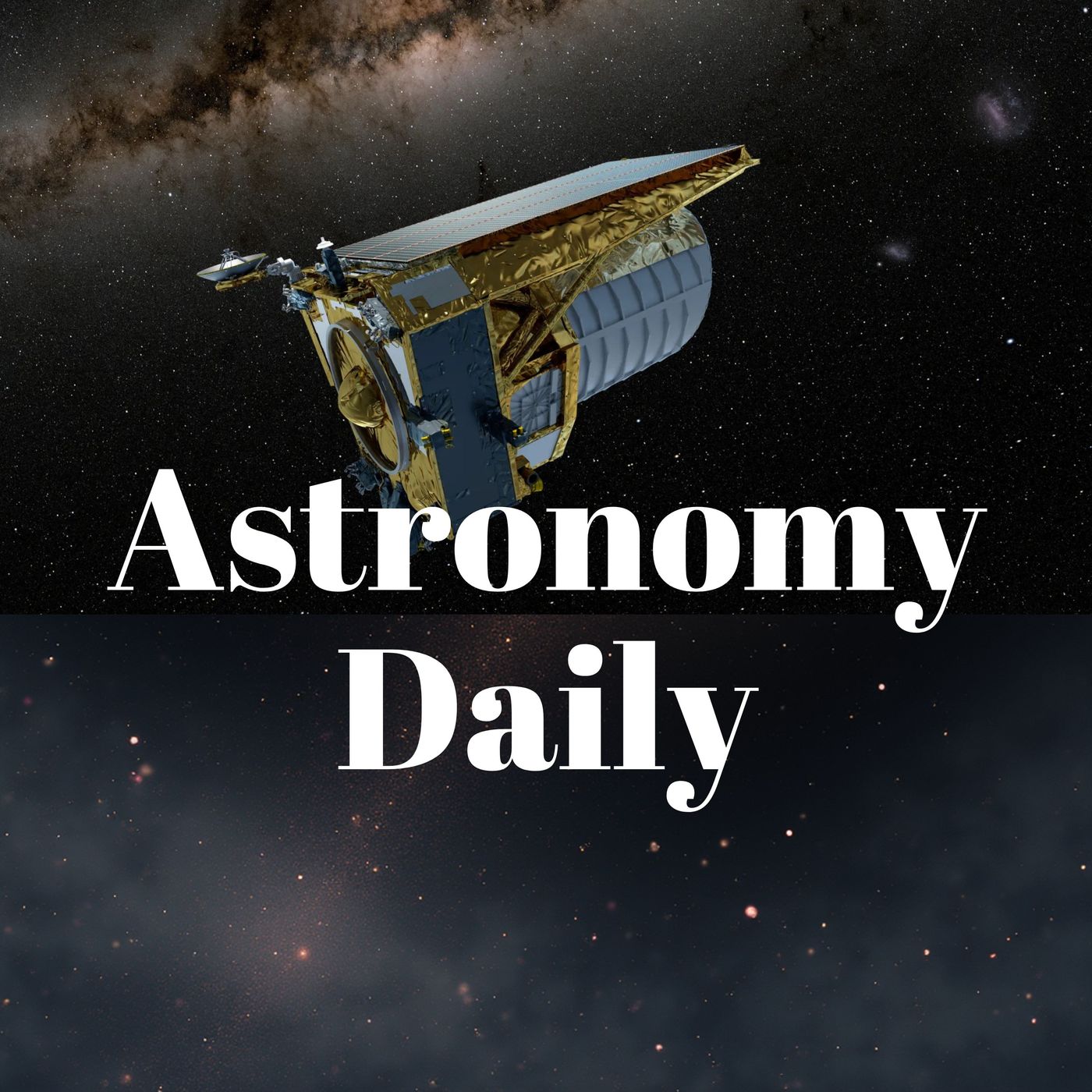
- Euclid Space Telescope's Groundbreaking Findings: The European Space Agency's Euclid mission is revolutionizing our understanding of galaxy evolution just a year into its operations. With the capability to observe over 1.2 million galaxies, Euclid is addressing fundamental questions about galaxy shapes and their formation history, paving the way for a modern galactic tuning fork diagram.
- The Spectacular Geminid Meteor Shower: The Geminid meteor shower is set to peak on December 13th and 14th, promising a dazzling display of bright and colorful meteors. With a waning crescent moon providing optimal viewing conditions, it's the perfect opportunity to witness this annual celestial event.
- Near Earth Asteroids Close Approaches: This week, several near-Earth asteroids will make close passes to our planet, including 2025 VP1, a bus-sized asteroid, and the larger 3361 Orpheus, which is about 1,400 feet wide. While classified as potentially hazardous, their trajectories are closely monitored, ensuring no immediate threat to Earth.
- Runaway Stars and the Large Magellanic Cloud: New research utilizing hypervelocity stars sheds light on the history of the Large Magellanic Cloud. By tracing the paths of stars ejected by a supermassive black hole, scientists gather evidence that could confirm its existence and provide insights into the galaxy's past.
- Andromeda's Satellite Galaxies: A study from Durham University reveals how Andromeda's satellite galaxies are quenched, revealing that many lose their star-forming capabilities long before they even approach Andromeda. This highlights the complex interactions within our cosmic neighborhood.
- For more cosmic updates, visit our website at astronomydaily.io. Join our community on social media by searching for #AstroDailyPod on Facebook, X, YouTubeMusic, TikTok, and our new Instagram account! Don’t forget to subscribe to the podcast on Apple Podcasts, Spotify, iHeartRadio, or wherever you get your podcasts.
- Thank you for tuning in. This is Anna and Avery signing off. Until next time, keep looking up and exploring the wonders of our universe.
Euclid Mission Insights
[European Space Agency](https://www.esa.int/)
Geminid Meteor Shower Details
[NASA](https://www.nasa.gov/)
Near Earth Asteroids Overview
[NASA](https://www.nasa.gov/near-earth-objects)
Runaway Stars Research
[Harvard Center for Astrophysics](https://www.cfa.harvard.edu/)
Andromeda Satellite Galaxies Study
[Durham University](https://www.dur.ac.uk/)
Become a supporter of this podcast: https://www.spreaker.com/podcast/astronomy-daily-space-news-updates--5648921/support.
Sponsor Details:
Ensure your online privacy by using NordVPN. To get our special listener deal and save a lot of money, visit www.bitesz.com/nordvpn. You'll be glad you did!
Sponsor Details:
Ensure your online privacy by using NordVPN. To get our special listener deal and save a lot of money, visit <a...
Anna: Welcome to Astronomy Daily, the podcast that brings you the universe one story at a time. I'm Anna. Avery: And I'm Avery. It's great to have you with us. We've got a packed episode today, from a revolutionary space telescope rewriting galaxy evolution to a spectacular meteor shower you won't want to miss. Anna: Plus, we'll track some near Earth asteroids, chase runaway stars from a neighboring galaxy, and dive into the dramatic lives and deaths of Andromeda's small, smallest companion. Avery: A lot to cover, so let's get started.
First up, the Euclid Space Telescope. This is genuinely exciting stuff. The European Space Agency's Euclid mission is only a year into its operations, but it's already delivering incredible insights. Anna: Right. It's tackling one of the biggest questions in why do galaxies have different shapes? And how do those shapes evolve? Avery: And the scale is just staggering. Euclid has already observed 1.2 million galaxies with the first data dropping in March of 2025. By the end of its six year mission, they're expecting to study tens of millions.
Anna: That's mind boggling. It gives them a huge statistical sample to work with. I saw a great quote from Maximilian Fabricius at the Max Planck Institute. He said Euclid offers an unprecedented combination of sharpness and sky. Avery: Exactly. For the first time, they can systematically study how a, uh, galaxy's shape relates to its formation history on a truly cosmic scale. Anna: And they're already using this data to build a modern galactic tuning fork diagram. It beautifully illustrates the life cycle of galaxies.
Avery: Can you walk us through that? Anna: Of course. On one side, you have these vibrant blue star forming galaxies, like spirals. As they age, they exhaust their gas, they merge with other galaxies, and they slowly drift across the diagram, eventually becoming massive, featureless elliptical galaxies. Avery: So it's a visual timeline of galactic life. Anna: Precisely. And one of the key drivers of that change is mergers. Euclid's data is helping scientists spot galaxies with secondary nuclei. Avery: Right.
So two galactic cores in the process of merging. Anna: Exactly. Each of those nuclei has its own supermassive black hole, millions or even billions of times the mass of our Sun. When the galaxies merge, those black holes are brought together. Avery: They form a binary system. Right. Spiraling around each other. Anna: Mhm. And as they do, they shed energy by creating gravitational waves, ripples in spacetime itself. This causes them to spiral closer and closer until they collide and merge into an even more massive black hole.
Avery: So the growth of these giant elliptical galaxies and the growth of their central black holes are directly linked. Anna: They're inseparable It's a fundamental part of the process. But what's also fascinating is what Euclid is seeing at the other end of the scale. Avery: The dwarf galaxies. Anna: Yes, it turns out the most common galaxies in the universe aren't giant giants like our Milky Way, but these small, faint dwarf galaxies that were too dim to see clearly before. Euclid has already found over 2,000 of them.
Avery: And those are important because they're considered the building blocks for larger galaxies. Anna: It's like we're finally seeing the cosmic bricks that build the great galactic cities. It's a total game changer for understanding. Avery: Galaxy evolution from the cosmic scale to something you can see in your own backyard. Let's talk about the Geminid meteor shower. It's one of the best shows of the year, and it's happening right now. Anna: And this year is set to be particularly good. The shower peaks on the night of December 13th into the morning of the 14th, and the moon will be a waning crescent, so its light won't wash out the meteors.
Avery: That's perfect timing. So when's the best time to head out? Anna: NASA recommends watching after midnight, wherever you are. That's when the radiant point, the spot in the constellation Gemini where the meteors appear to originate, is highest in the sky. Avery: And the usual advice applies. Get away from city lights, find a dark spot, and just give your eyes time to adjust. Anna: Right. What I love about the Geminids is their unusual origin. Most meteor showers come from the icy debris left by comets.
Avery: But the Geminites are different. They come from an asteroid named 3200 Phaeton. Anna: It's a very strange object. It has an orbit that takes it incredibly close to the sun, which causes it to shed rocky dust and particles, almost like a comet. When Earth passes through that debris stream, we get the meteor shower. Avery: And because the particles are rocky bits of an asteroid rather than fluffy eyes from a comet, the meteors are different, aren't they? Anna: They are. Geminid meteors are often brighter, faster, and can leave these beautiful, long lasting, colorful streaks across the sky.
It's a truly spectacular sight. Avery: Well, speaking of rocks flying through space, it's a busy week for near Earth asteroids. And while none of them pose a threat, their close approaches are always worth noting. Anna: Right. First up is an asteroid designated 2025 VP1. It's about the size of a bus, roughly 37ft in diameter, and it's passing. Avery: Within 361,000 miles from Earth. That's closer than the Moon. Anna: It is. But to be clear, that's still a Very safe distance. There's no danger of impact at all.
It's more of a great opportunity for scientists to study these smaller Near Earth objects. Avery: And it's not alone. There's another one of a similar size, 2025 VC4, passing a bit further out at about 1.24 million miles. Anna: Mhm. But the big one this week is 3361 Orpheus. Avery: Big is an understatement. This one is about 1400ft wide. That's approximately 426 meters, which is roughly the size of the Empire State Building. Anna: That is a significant object. It's traveling at 20,000 miles per hour, but again passing at a safe distance.
However, its size is what gets it special attention. Avery: Right. It's classified as a potentially hazardous asteroid or pha. Anna: And that term can sound alarming, but it's really just a classification. It doesn't mean it's an immediate threat. Avery: So what does it mean? Anna: A uh, Pha is any asteroid larger than about 460ft that comes within 4.6 million miles of Earth's orbit. Orpheus fits that definition. So its trajectory is very closely monitored by NASA just to be safe. It's cosmic due diligence from objects passing.
Avery: By our planet to objects being violently thrown out of their own galaxies. There's a fascinating new paper that uses runaway stars to solve a long standing mystery about one of our nearest neighbors. Anna: You're talking about the Large Magellanic Cloud, the lmc. For decades astronomers have debated the exact path it's taken through space over the last few billion years. Avery: Exactly. And researchers at the Harvard center for Astrophysics have come up with a brilliant way to trace its history by using hypervelocity stars.
Anna: These are stars moving at incredibly speeds. Right. Avery: Incredible is the word. We're talking over 1,000 kilometers per second, which is over 2 million miles per hour. Fast enough to eventually escape their home galaxy entirely. Anna: And we think they get that speed boost from a ah, gravitational slingshot. Avery: That's the theory. It happens when a binary star system, two stars orbiting each other, gets too close to a supermassive black hole. The black hole's immense gravity rips the binary apart.
Anna: Mhm. One star gets captured into a tight orbit around the black hole and the. Avery: Other is ejected with tremendous force flung out into intergalactic space. A runaway star. Anna: So the researchers went looking for these in data from the Gaia Space Telescope. Avery: They did. They combed through the data and found three stars that they are confident were ejected from the Large Magellanic Cloud. Anna: And that's a huge clue. If you can trace the paths of those stars backward, they should all point.
Avery: To their origin, the supermassive black hole that kicked them out. This is a big deal because there's still debate about whether the LMC even has a supermassive black hole at its center. Anna: Right? So this provides strong indirect evidence that it does. And more importantly, it tells astronomers exactly where to point their telescopes to look for direct proof. It's brilliant detective work. Avery: This idea of galactic interactions is a perfect lead in to our final story, which looks at our other famous neighbor, the Andromeda galaxy.
We know galaxies grow by emerging and consuming smaller ones. Anna: We can see it happening in real time. Our own Milky Way is currently stripping gas from the Large and Small Magellanic Clouds, right? Avery: Creating that enormous 600,000 light year long feature called the Magellanic Stream. Anna: It's a gravitational tug of war. And the much more massive Milky Way is winning. Andromeda is doing the same thing with its own suite of satellite dwarf galaxies. Avery: And new research from Durham University has been looking at how that process unfolds.
Specifically, they're studying how these satellite galaxies are quenched. Anna: Quenching is when a galaxy stops forming new stars, it essentially runs out of the cold gas it needs to do so. And its star birthing days are over. Avery: And the results from Andromeda are quite stark. The research shows that only the most massive satellite galaxies are able to keep forming stars for more than 3 billion years after their closest approach to Andromeda. Anna: That close approach is called the Paracenter, and it's a brutal experience for a small galaxy.
The immense gravity of Andromeda tidally strips away its gas. And a process called ram pressure stripping acts like a cosmic window blowing the gas out. Avery: So the little guys just can't hold on to their star forming fuel. Anna: Exactly. But what's really interesting is that many of the least massive satellites appear to have been quenched long before they even got close to Andromeda, some as much as 10 billion years prior. Avery: How does that happen? Anna: The researchers call it pre processing.
The idea is that before a dwarf galaxy fell into Andromeda's orbit, it might have been a satellite of a different, slightly larger galaxy. The that earlier encounter was enough to remove its gas and quench it. Avery: So it was already a galactic ghost by the time it met Andromeda. Anna: In a sense, yes. And when the researchers compared Andromeda's satellites to the Milky Ways, they found a difference. Our satellites seem to have been captured earlier and quenched more quickly. It suggests our galaxy might have been a more aggressive consumer in its past than Andromeda was.
Avery: It really paints a picture of a dynamic and sometimes violent cosmic ecosystem. A fascinating look at the lives and deaths of galaxies. Anna: And that's all the time we have for today on Astronomy Daily. From the grand architecture of the universe revealed by Euclid to the fleeting beauty of a meteor shower, the cosmos never fails to inspire. Avery: Absolutely. It's a great reminder to look up if you get a chance this week, try and catch the Geminids. A clear, dark sky is all you need. Anna: Thanks for joining us.
I'm Anna. Avery: And I'm Avery. Clear skies.

 Apple Podcasts
 Spotify
 Pocket Casts
 Castbox
 Overcast
 Podbean
 iHeartRadio
 Castro
 Goodpods
 Moon FM
 Podcast Addict
 Podcast Republic
 YouTube