
Stunning Sculptor Galaxy Images, Black Hole Breakthroughs, and Moths Navigating by Stars
In this episode
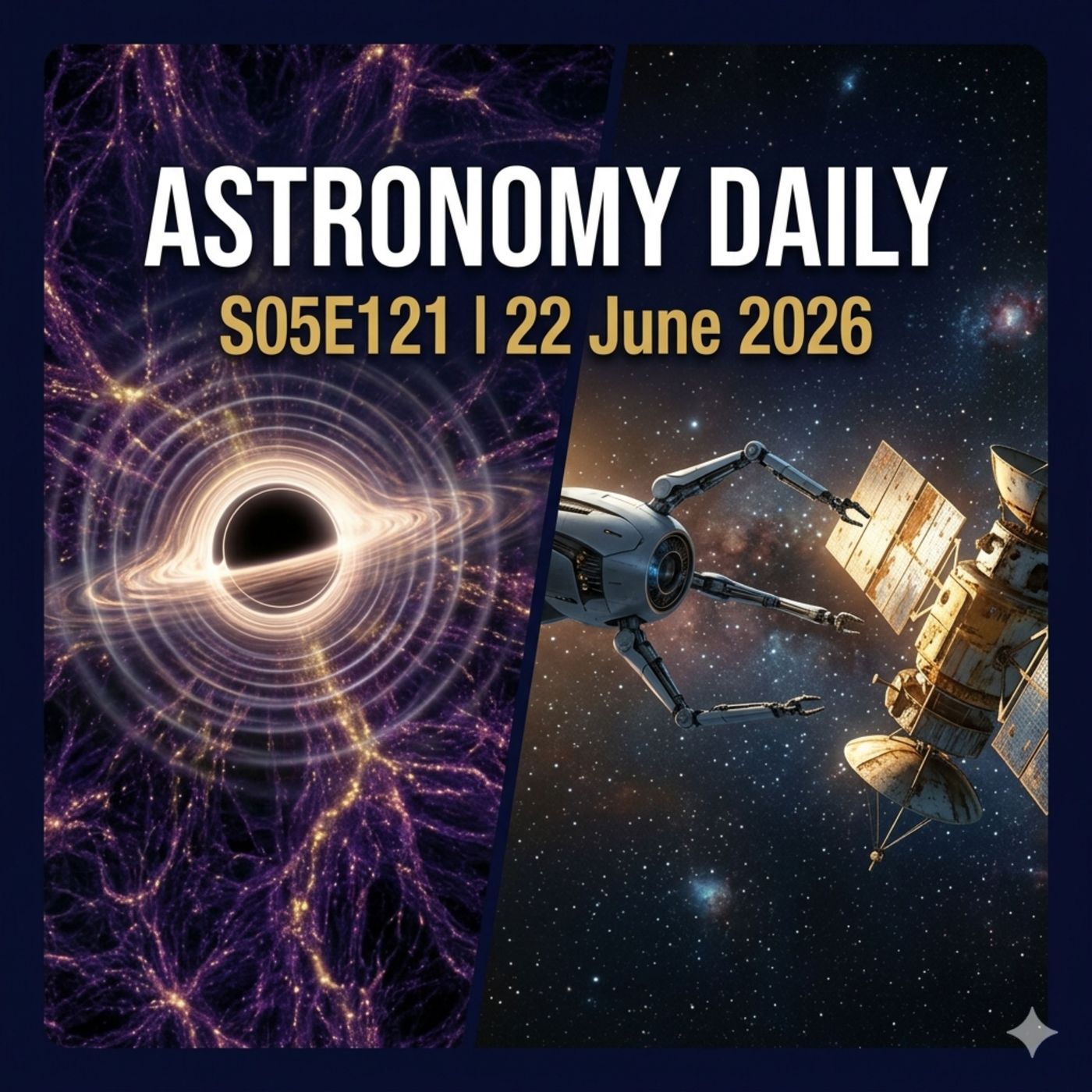
Highlights:- Stunning Sculptor Galaxy Images: In this episode, we unveil breathtaking new images of the Sculptor Galaxy, captured using the Multi Unit Spectroscopic Explorer (MUSE) at the Very Large Telescope in Chile. These intricate visuals reveal the galaxy's complex systems and have already led to the discovery of 500 new planetary nebulae, shedding light on the processes that govern star formation and galactic structure.
- Insights into Sagittarius A: We discuss groundbreaking findings regarding the supermassive black hole at the centre of our Milky Way, Sagittarius A. New analyses from the Event Horizon Telescope indicate that it is spinning almost at maximum speed, with its rotational axis pointed directly at Earth, challenging existing theories about black hole behaviour.
- Vera C. Rubin Observatory Launch: Anticipation builds for the Vera C. Rubin Observatory, set to conduct the most comprehensive survey of the night sky ever attempted. With its remarkable technology, this observatory aims to catalogue billions of stars and galaxies, marking a significant milestone in astronomical research.
- Firefly Aerospace's Ocula: Firefly Aerospace is preparing for its next lunar mission, introducing Ocula, a new high-resolution lunar imaging service. This innovative technology aims to provide unprecedented imagery of the lunar surface, paving the way for future exploration and research.
- Bogong Moths' Stellar Navigation: Fascinating research reveals that the Bogong moth may be the first insect known to use stars for long-distance navigation. This discovery highlights the intricate connections between life on Earth and the cosmos, especially in the face of challenges like light pollution.
- SpaceX Starship Incident: We conclude with breaking news about SpaceX's latest Starship vehicle, which exploded during a test at the Starbase site in Texas. Thankfully, all personnel are safe, and the company is working to secure the test area.
For more cosmic updates, visit our website at astronomydaily.io. Join our community on social media by searching for #AstroDailyPod on Facebook, X, YouTube Music, TikTok, and our new Instagram account! Don’t forget to subscribe to the podcast on Apple Podcasts, Spotify, iHeartRadio, or wherever you get your podcasts.
Thank you for tuning in. This is Anna signing off. Until next time, keep looking up and stay curious about the wonders of our universe.
Chapters:
00:00 - Welcome to Astronomy Daily
01:10 - Stunning Sculptor Galaxy images
10:00 - Insights into Sagittarius A
20:00 - Vera C. Rubin Observatory launch
25:00 - Firefly Aerospace's Ocula
30:00 - Bogong moths' stellar navigation
35:00 - SpaceX Starship incident
✍️ Episode References
Sculptor Galaxy Images
[Astronomy Journal](https://www.astronomy.com/)
Sagittarius A Research
[Event Horizon Telescope](https://eventhorizontelescope.org/)
Vera C. Rubin Observatory
[Rubin Observatory](https://www.rubinobservatory.org/)
Firefly Aerospace Ocula
[Firefly Aerospace](https://www.fireflyspace.com/)
Bogong Moths Navigation
[Nature](https://www.nature.com/)
Astronomy Daily
[Astronomy Daily](http://www.astronomydaily.io/)
Become a supporter of this podcast: <a...
Anna: Hey there, space enthusiasts. Welcome to Astronomy Daily, your go to podcast for all the latest happenings in the cosmos and right here on Earth too. I'm your host, Anna, and I've got a really exciting episode lined up for you today. We're going to dive into some truly stunning new images of distant galaxies, talk about some groundbreaking new space missions that are just around the corner, and even get this, learn about a surprising animal adaptation right here on our own planet that involves, you know, stars.
So buckle up because we're about to explore the universe one fascinating story at a time. Let's get started. Alright, let's kick things off with some absolutely breathtaking news from the cosmos. Astronomers have managed to capture what is truly an unprecedented and intricate image of the Sculptor Galaxy. This isn't just any picture, it's painted in thousands of colours, revealing all these amazing complex details of galactic systems. This incredible shot of the galaxy, which is also known as NGC 253 and is about 11 million light years away.
That's a pretty good distance, right? Was actually collected with the Multi Unit Spectroscopic Explorer, or MUSE instrument, located at the Very Large Telescope, the VLT in Chile. What's really cool is that beyond just giving us this galaxy wide view, the image shows these super intricate details of NGC 253. It's hoped that this kind of detail can really help reveal the finer points of the poorly understood and often complex systems that galaxies actually are. As team leader Enrico Conju from the Universidad de Chile put it, the Sculptor Galaxy is in a sweet spot.
He explained that it's close enough that we can resolve its internal structure and study its building blocks with incredible detail, but at the same time big enough that we can still see it as a whole system. To get this kind of detail, covering 65,000 light years of the 90,000 light year wide galaxy required a lot of work. We're talking 100 exposures collected over 50 hours of Muse observing time. But honestly, that effort was totally justified by the unprecedented detail we're seeing. Team member Katherine Krekel from Heidelberg University in Germany noted that they can zoom in to study individual regions where stars form at nearly the scale of individual stars.
But we, we can also zoom out to study the galaxy as a whole. And speaking of discoveries, an initial look at this image has already yielded some amazing results. The team has been able to find 500 new planetary nebulae within the image. These are shells of gas and dust ejected from stars like our sun after they die and go into that puffed out red giant phase. This is pretty extraordinary because finding detections like this beyond the Milky Way and its immediate neighbours is really rare. Fabian Scheuerman, another Heidelberg University researcher, pointed out that beyond our galactic neighbourhood, we usually deal with fewer than 100 detections per galaxy.
Now, despite the name, these planetary nebulae have absolutely nothing to do with planets, just to be clear. But they could be really fruitful in the future because astronomers can actually use them to make distance measurements. Adam Leroy, a researcher from Ohio State University and a team member, explained, finding the planetary nebulae allows us to verify the distance to the galaxy, a critical piece of information on which the rest of the studies of the galaxy depend. The team isn't done with this image of the Sculptor Galaxy just yet, by the way.
The next step for these astronomers is to explore how hot gas flows through NGC 253, changing its composition and helping to create new stars. Enrico Konju wrapped up by saying how such small processes can have such a big impact on a galaxy whose entire size is thousands of times bigger is still a mystery. Their fascinating research was published just recently in the journal Astronomy and Astrophysics. Moving on to our own galactic backyard, we have some absolutely wild news about the supermassive black hole at the heart of our Milky Way.
Sagittarius A, or CESKAR A for short. New analysis of data collected by the Event Horizon Telescope, or eht, reveals that this monster black hole is actually spinning almost as fast as physics allows. And get this, its rotational axis is pointed right in Earth's direction. These findings are pretty groundbreaking and honestly, they kind of challenge some existing theories about how black holes behave. It gives us these incredible new insights and into the centres of galaxies. So how did they figure this out?
Well, astrophysicists developed and applied a brand new method to really tease out the secrets hidden in those supermassive black hole observations from the eht. You might remember the EHT collaboration from when they gave us the very first direct images of black hole shadows. First M, um, 87 star in a galaxy 55 million light years away. And then of course, our own Sagittarius A. These images are truly incredible, but they are also super difficult to interpret. So to understand what they're looking at, scientists use simulations.
They basically build a bunch of virtual characteristics and then figure out which ones look most like the actual observational data. This technique has been used a lot with EHT images, but now it's been taken up a notch. A team led by astronomer Michael Janssen used high throughput computing to develop millions of simulated black holes. Then they used all that data to train a neural network, which helped them extract as much information as possible from the EHT data and really identify the properties of these black holes.
Their results show, among other things, that Sagittarius A isn't just spinning at close to its maximum speed, but also that the glow around it is generated by hot electrons. Perhaps the most intriguing part is that the magnetic field in the material swirling around Sagittarius A doesn't seem to be behaving in a way that's predicted by current theory. They also looked at M M87 and found that it's also rotating rapidly, though not quite as fast as Sagittarius A. But here's the Twist. With M M87, it's rotating in the opposite direction to the material swirling in a disc around it.
Scientists think this could be because of a past merger with another supermassive black hole. As Janssen put it. That we are defying the prevailing theory is of course, exciting. He also added that he sees their AI and machine learning approach as just a first step, with more improvements and data expected, especially once the Africa millimetre telescope joins in. This incredible research was detailed in three papers published in Astronomy and Astrophysics. Speaking of groundbreaking research and pushing the boundaries of what we understand, let's look forward to a truly monumental event in astronomy.
The astronomical community is eagerly awaiting another historic moment with the Vera C. Rubin Observatory. This incredible new generation telescope, named after the trailblazing astronomer Vera Rubin, who, if you remember from earlier, was instrumental in uncovering the existence of dark matter through her observations of galactic rotation and is poised to continue her revolutionary work. It's been under construction in Chile's Atacama Desert, and honestly, it's a technological marvel. The Rubin Observatory is set to conduct the most comprehensive survey of the night sky ever attempted.
Imagine this. It's going to photograph the entire visible southern sky every few nights for a full 10 years. At its heart is the world's largest digital camera, packing an astounding 3.2 billion pixels. To give you a sense of scale, it features an 8.4 metre primary mirror with a three mirror design, providing an exceptionally wide 3.5 degree field of view. That's like seven times the area of the full moon. Its LSST camera, the Legacy Survey of Space and Time camera, is made up of 189 individual CCD sensors, weighs in at 3200 kilogrammes and operates at a chilling minus 100 degrees Celsius to minimise electronic noise.
Located high up at over 2,600 metres elevation on Chile's Caro Pachon. This observatory isn't just going to search for the subtle effects of dark matter. It's going to catalogue billions of stars and galaxies, track dangerous asteroids, and monitor the universe's constant changes in real time. When it finally begins operations, the Rubin Observatory is expected to generate more astronomical data in its first month than all previous telescopes combined have collected throughout history. That's a lot of data.
It can even slew between targets in just five seconds and will operate using six optical filters, completing a full sky survey every three nights. With just 15 second exposures. Over its 10 year mission, it's estimated it will catalogue 20 billion galaxies and 17 billion stars. It really is incredible to think about how far we've come in just over 400 years since Galileo first peered at the universe through his telescope. And now we're on the cusp of another incredible milestone. So mark your calendars for June 23, 2025 at 15:00-clock UTC.
That's when the Rubin Observatory will unveil its first spectacular images in what they're calling the first look event. This event will be live streamed via YouTube, allowing people worldwide to witness this exciting moment together. It represents more than just another technological achievement. It symbolises our relentless pursuit to understand the universe, carrying forward Vera Rubin's legacy of discovery into an age where the observatory that carries her name will give us a whole new view of the cosmos.
Definitely check that out. When it drops. Okay. From massive new observatories, we're going to pivot a bit to something else that's really exciting in space exploration. Firefly Aerospace is getting ready for its next mission to the moon. And they're hoping to once again make history. But this time, even before they reach the lunar surface, the company recently unveiled something super cool called Ocula, which is a new lunar imaging service. They're aiming to become the very first company to offer this type of high resolution imaging capability in lunar orbit from a commercial provider.
How awesome is that? Jason Kim, the CEO of Firefly Aerospace, said that this idea, you know, getting more imagery of the lunar surface, looking for minerals, understanding activity, or even doing space domain awareness has always been something they were exploring. He thinks Ocula will be super beneficial for NASA as well as for science, commercial and national security missions out there. And here's a fun fact for you. Like a lot of Firefly Aerospace's hardware and software, this new imaging service also pays homage to the movie Serenity, which is a sequel to the sci fi series Firefly Ocula is actually the name of one of the spaceships in the film, Kim said.
It's just a great name for a game changing mission like this, and it's fitting for what they're doing. It's the first of its kind, the first commercial mission to do this imaging and mapping around the moon. Now, unlike their previous Blue Ghost Mission 1, which landed on the earth facing side of the moon, Blue Ghost Mission 2 is going to try a landing on the far side. But before it even attempts that landing, it will deploy the Elytra spacecraft with Ocula on board. Ocula's telescope is designed to capture incredible 0.2 metre resolution images of the moon's surface from an altitude of 50 kilometres.
The goal is to eventually develop a whole constellation of these in lunar orbit, which would offer a high revisit rate to a bunch of different parties. Firefly is already seeing a lot of demand and interest in the data Ocula will gather. They're developing this Ocula technology in partnership with Lawrence Livermore National Laboratory in California, which is pretty cool. Beyond Blue Ghost Mission 2, which is targeting a launch in 2026, Firefly also plans to fly Ocula on the Elytra 3 vehicle, supporting a Department of Defence project no earlier than 2027.
And get this, Kim even mentioned the possibility of deploying the Ocula technology for future Mars exploration missions too. That's like a huge leap, right? It just shows you how versatile and exciting this new capability could be. Okay, so speaking of exciting missions, we have another update with some good news regarding Axiom Space's AXE 4 private astronaut mission to the International Space Station. After a couple of unexpected delays, it looks like it's back on schedule for a launch this coming Sunday, June 22nd.
This mission, AXE 4, is Axiom's fourth crewed flight to the ISS. It was actually supposed to launch back on June 11th, but then they found a liquid oxygen leak in the Falcon 9 booster, which pushed things back a day. And then, believe it or not, they found another leak, but this time it was at the ISS itself in the Zvezda Russian service module. Zvezda has been a bit leaky for a while, apparently, but this new pressure signature prompted an indefinite delay for Axe 4, just out of an abundance of caution, you know.
But good news, it seems like the appropriate repairs have been made. NASA said that after the most recent fix, pressure in the transfer tunnel has been stable, which could mean those small leaks have been sealed. They're still evaluating it to be super sure, but it's looking positive and the fixes to the Falcon 9 booster are definitely complete. SpaceX even did a new fueling test, a wet dress rehearsal and the rocket is ready to go. Alright, from super cool space missions to something a little closer to home, but no less amazing.
Let's talk about the incredible journey of the Bogong moth. Scientists have actually discovered that this Australian moth might be the first insect ever known to use stars for long distance navigation. Yeah, you heard that right, stars. Every spring, billions of these brown Bogong moths migrate around a thousand kilometres or, or about 620 miles north to the Australian Alps. They hide in cool caves there to avoid the heat. And then in the fall or autumn, as they say in Australia, they head back to their breeding grounds.
The big question for a long time was how do they travel to a place they've never visited before? Well, researchers now believe the answer is stellar navigation. We already knew they could use Earth's magnetic field to navigate, but it seemed like they needed visual landmarks too. And what's a more obvious visual landmark at night than the Milky Way? To test this, the scientists captured some moths, put them in a planetarium like flight simulator, which sounds like something out of a sci fi movie, doesn't it?
And blocked Earth's magnetic field, forcing the moths to rely on their eyesight. And guess what? The moths flew in the correct migratory direction based on the stars. Their brains were even most active when they were flying the right way in the simulation. It's truly wild. This is a pretty big deal because while some insects use stars for short distance movements, the Bogong moth is the first known to use them for these epic long distance journeys. Understanding how these little guys navigate is also super important for their conservation.
Especially with light pollution becoming a bigger issue. Urban lights can really disorient them. There was even a time when a whole cloud of moths grew briefly took over the Australian Parliament. It just shows you how intricately life on Earth connects with the celestial sphere. And before I wrap up this episode, some late breaking news. SpaceX's newest Starship vehicle just went up in smoke. The company was testing a starship upper stage at its Starbase site in South Texas on Wednesday night to prepare for the mega rocket's upcoming 10th flight test.
But something went very wrong. Dreadfully wrong. The vehicle exploded, sending a massive fireball high into the dark Texas skies. Video from sources such as NASASpaceflight.com showed the vehicle, designated Ship 36, exploded just after midnight Eastern while on a test stand at a site known as Massey's, several kilometres west from the company's launch pads at Starbase Texas, SpaceX said in a statement about 90 minutes after the incident. A safety clear area around the site was maintained throughout the operation and all personnel are safe and accounted for.
The company added it was working to secure the test site in cooperation with local officials and that there were no hazards for people in the area. And with that news, we come to the end of another episode of Astronomy Daily. I mean, it's just amazing how much is happening out there, isn't it? From galaxies painted in a thousand colours to moths navigating by the stars, there's always something new and incredible to discover. Thank you so much for tuning in. I've been your host. Anna before you go, remember to visit our website at astronomydaily IO.
That's astronomydaily IO. There you can sign up for our free daily newsletter to stay up to date on all the latest space news, and you can also listen to all our back episodes. Don't forget to subscribe to Astronomy Daily on Apple Podcasts, Spotify, YouTube, or, you know, wherever you get your podcasts. You never miss an episode. We'll be back tomorrow with more cosmic wonders. Until then, keep looking up.



 Apple Podcasts
 Spotify
 Pocket Casts
 Castbox
 Overcast
 Podbean
 iHeartRadio
 Castro
 Goodpods
 Moon FM
 Podcast Addict
 Podcast Republic
 YouTube