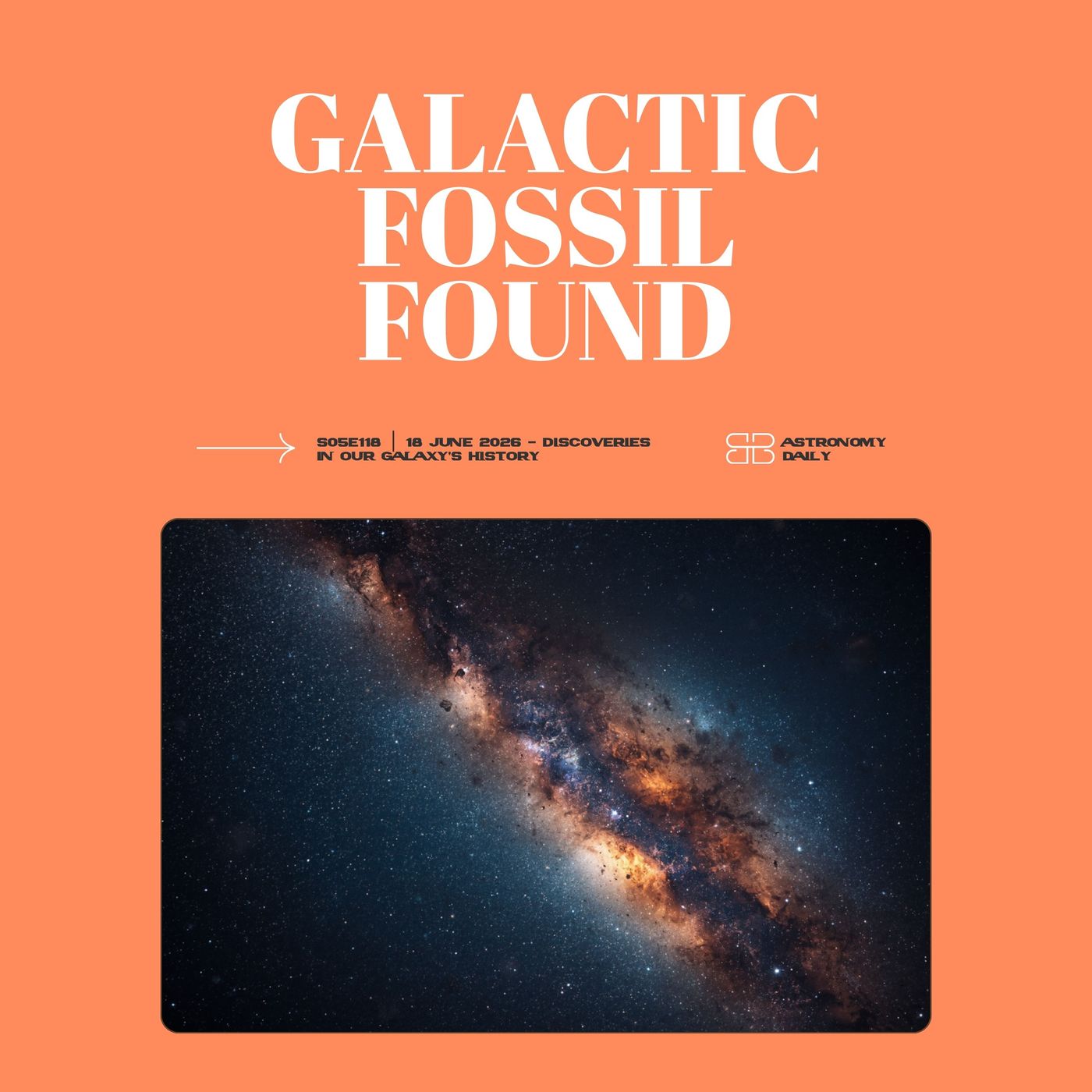
A Milky Way Fossil Unearthed, Extreme Weather on a Roasted Planet, and a Space Telescope's Last Chance
In this episode
A landmark episode packed with discoveries at the cutting edge of space and astronomy. Webb and Hubble redefine a category of stellar object, JWST delivers unprecedented chemistry data from an extreme exoplanet, a 21-year-old NASA observatory faces a daring robotic rescue, a multi-telescope image reveals an ancient galactic supernova, China's Tianwen-2 zeroes in on a possible fragment of our own Moon, and astronomers detect the chemical fingerprint of a planet swallowed by its star. Story 1: Webb & Hubble Rewrite History: Terzan 5 Is a 'Bulge Fossil Fragment' Using the James Webb Space Telescope and archival data from Hubble spanning 12 years, researchers have definitively reclassified Terzan 5 — a stellar system 22,000 light-years away in Sagittarius — from a globular cluster to an entirely new class of object: a 'bulge fossil fragment.' Four distinct generations of stars have been identified within Terzan 5, formed 12.5 billion, 4.7 billion, 3.8 billion, and 2.5 billion years ago. Unlike a typical globular cluster with a single ancient stellar population, Terzan 5 repeatedly formed new stars by retaining the gas and heavy elements expelled by its own supernovae. Astronomers believe Terzan 5 is a surviving relic of the primordial clumps that merged to form the Milky Way's central bulge billions of years ago — a living fossil of galaxy formation. Results were presented at the 248th American Astronomical Society meeting and published in Astronomy & Astrophysics. Source: NASA / ESA / STScI press release, 16–17 June 2026 Story 2: JWST Catches the 'Roasted Exoplanet' HD 80606 b in the Act Astronomers using the James Webb Space Telescope's MIRI instrument have observed the extreme exoplanet HD 80606 b experiencing a temperature increase of 1,100°F (600°C) during its close approach to its host star. HD 80606 b is a gas giant four times the mass of Jupiter on a highly elliptical 111-day orbit. The JWST study — led by Tiffany Kataria of NASA's Jet Propulsion Laboratory — also detected specific atmospheric chemical signatures including methane and carbon dioxide, enabling detailed study of how the planet's chemistry shifts under extreme heating. This is the most detailed look yet at an atmospheric response to a rapid, intense heating event. Results were presented at the 248th AAS meeting in Pasadena, California. Source: NASA / JPL press release, 16–17 June 2026 Story 3: Swift's Rescue Mission Cleared for Launch: LINK on the Pad NASA's Neil Gehrels Swift Observatory, which has studied gamma-ray bursts and other high-energy cosmic events since 2004, is facing re-entry as its orbit decays under increased solar activity. NASA contracted Katalyst Space Technologies in September 2025 to build and launch a robotic servicing spacecraft — called LINK — to boost Swift to a higher orbit. LINK is now encapsulated inside a Northrop Grumman Pegasus XL rocket, which has been attached to the Stargazer L-1011 carrier aircraft and is en route to Kwajalein Atoll in the Marshall Islands for launch later in June 2026. This will be the final flight of the Pegasus XL — the world's first privately developed orbital launch vehicle, which first flew in 1990. Its air-launch capability is uniquely suited to reaching Swift's unusual low-inclination orbit. Source: NASA press release and media teleconference, 17 June 2026 Story 4: Possible Supernova Remnant at the Galactic Centre A striking multi-telescope composite image released as NASA's Astronomy Picture of the Day on 18 June 2026 reveals a possible supernova remnant near the galactic centre — a blue X-ray-emitting structure whose light is estimated to have reached Earth approximately 1,700 years ago, in the third century CE. The image combines X-ray data from NASA's Chandra X-ray Observatory and ESA's XMM-Newton (the blue structure), radio data from the MeerKAT telescope in South Africa (the large red cloud), and optical background star data from the PanSTARRS...Anna: Hello and welcome to Astronomy Daily. I'm Anna. Avery: And I'm, um, avery. It's Thursday the 18th of June, and we have a stellar show lined up for you today. Anna: Stellar quite literally. Webb and Hubble have just reclassified an entire category of object in our own galaxy. And it turns out the Milky Way has been hiding a fossil from its own formation right under our noses for 12 and a half billion years. Avery: We've also got a planet getting absolutely roasted by its star. A, uh, nail biting space rescue about to launch.
A ghostly supernova from Roman times caught in a stunning new image. China sneaking up on Earth's mysterious quasi moon and a star that apparently ate one of its own planets. Anna: Big day. Let's get into it. Avery: Our first story is one of those moments in astronomy where the textbooks need to be rewritten. And it's happening right now. Anna: For decades, a stellar system called Terzon5, sitting about 22,000 light years away in the constellation Sagittarius, has been listed in the catalogs as a globular cluster.
Just another one of those ancient, densely packed balls of stars orbiting our galaxy. Avery: Well, not anymore. Researchers using both the James Webb Space Telescope and the Hubble Space Telescope have now definitively proven that Tirzon 5 is something else entirely. Something much older, much rarer, and far more scientifically exciting. Anna: They're calling it a bulge fossil fragment, and the name says it all. This object isn't a globular cluster. It's a surviving relic, a clump of matter left over from the formation of the Milky Way itself billions of years ago.
Avery: A typical globular cluster has one ancient population of stars. They all formed at roughly the same time from the same material. Simple, uniform, predictable. What Webb and Hubble found in Turzon 5 is the opposite of that. Anna: Four generations of stars. Four separate bursts of star formation spanning billions of years. The oldest population formed 12 and a half billion years ago when the Milky Way itself was still being assembled. Then a, uh, second generation at 4.7 billion years, a third at 3.8 billion and a four fourth most recently, just two and a half billion years.
Avery: Four generations in what we thought was just a run of the mill old star cluster. That's extraordinary. Anna: Webb was the key to cracking this. Terzon5 sits in the densely packed dust choked central bulge of the Milky Way, a region so crowded and obscured that Hubble alone couldn't fully resolve what was in there. Webb's infrared vision cut straight through the dust and cataloged far, far more stars and far fainter stars than any previous observation. Avery: The research team, led by PhD student Georgia Zullo from the University of Bologna, cross referenced the new Webb data with 12 years of Hubble archival observations and the picture that emerged was unambiguous.
This isn't a globular cluster. It never was. Anna: The reason Terzon5 was able to keep forming stars over billions of years is its sheer mass. When supernovae exploded inside it, generating heavier ELE and blasting out gas and dust, lighter systems would have lost all that material to space. Terzon 5 was massive enough to hold onto it, to recycle it into new generations of stars. Avery: It's a self enriching system. Each generation of stars left behind the building blocks for the next. The researchers describe it as a cosmic fossil record, preserving the progressive enrichment of heavier elements across billions of years of star formation.
Anna: What's particularly remarkable is the implication for how the Milky Way formed billions of years ago. Objects like Terazon 5 would have been far more common. Primordial clumps that eventually spread out and merged to form the galaxy's central bulge. Most of them lost their identity in that process. Terzon 5 survived intact to the present Avery: day like a lump in an otherwise well mixed cake batter, which is actually how the researchers themselves described it. Anna: There is one other known object like Tirzon 5, a system called Liller 1 that was similarly reclassified a few years ago.
But the team is now going to examine between 40 and 50 other globular clusters in the galactic bulge to see if any of them are also bulge fossil fragments hiding in plain sight. Avery: A whole new category of object. Confirmed results were presented at the 248th American Astronomical Meeting this week and published in the journal astronomy and Astrophysics. Anna: 12 and a half billion years old and still surprising us. Not bad. Avery: Terzon5 from the same AAS meeting, another web result, and this one involves a planet enduring quite possibly the most extreme weather in the known universe.
Anna: We're talking about HD 80606B, a gas giant four times the mass of Jupiter and one that NASA has literally given its own poster in their exoplanet series with the tagline the Roasted Exoplanet. Avery: It earned that title. HD 80606B follows an extraordinarily elongated orbit around its sun like star, one of the most eccentric orbits of any known exoplanet. For most of its 111 day year. It's cruising along at a reasonable distance, but then it swings in close, very close, in a brief violent approach.
Anna: During that close approach, Webb's MRII M instrument the mid infrared instrument observed the planet's temperature skyrocket by 1100 degrees Fahrenheit. That's 600 degrees Celsius of warming in the space of just a few hours. The kind of temperature swing that makes Venus look temperate. Avery: Team leader Tiffany Kattaria from NASA's Jet Propulsion Laboratory puts it hot Jupiters are already considered some of the most extreme exoplanets we know of. But even among that population, HD 80606B is in a class of its own.
The eccentric orbit creates a completely different beast. Anna: What makes this study particularly significant is the chemistry. Webb isn't just measuring temperature, it's detecting specific molecules in the planet's atmosphere. The team identified signatures of methane and carbon dioxide, tracking how those chemicals appear and disappear as the planet is heated and then cools again. Avery: NASA's now retired Spitzer Space Telescope had previously made infrared observations of HD 80606 b and lay the groundwork.
But what Webb is delivering is orders of magnitude more detailed. Spitzer could tell you it was hot. Webb can tell you exactly what's burning. Anna: This has implications well beyond one bizarre planet. HD 80606 b serves as a kind of extreme test case, a, uh, natural laboratory for understanding how atmospheres of gas giants respond to rapid intense heating. Understanding the chemistry under those conditions helps scientists model a huge range of planetary atmospheres, from hot Jupiters to potentially more Earth like worlds.
Avery: The research team says they're really just getting started deciphering what Webb has to tell them from this single dataset. A, uh, planet getting roasted every 111 days. And Webb has the front row seat Anna: now to a story we've been watching closely and one that is now coming down to the wire. The rescue mission for NASA's Neil Jarrell Swift Observatory is imminent. Avery: Swift has had a remarkable 21 year career studying gamma ray bursts, the most powerful explosions in the universe, and acting as a kind of co responder, flagging transient events and alerting other telescopes to follow up.
Anna: But Swift is in trouble. Its original orbit was around 600 km altitude. After 20 years, it is decayed down to roughly 400 km. And the decay is now accelerating because of increased solar activity, which expands Earth's upper atmosphere and creates more drag. Without intervention speed, Swift will re enter Earth's atmosphere sometime in autumn of this year. Avery: NASA's answer to that was to hire a startup. Last September, the agency awarded a $30 million contract to Catalyst Space Technologies in Flagstaff, Arizona, giving them less than a year to build, test, launch and fly a robotic spacecraft to boost Swift into a higher orbit.
Anna: That spacecraft is called Link, and as of this week it is ready. Engineers attached Link to a Northrop Grumman Pegasus XL rocket last week at NASA's Wallops Flight Facility in Virginia. The rocket is now physically attached to the underside of Northrop Grumman's Stargazer aircraft, a modified L1011 airliner, and the whole assembly is en route to Kwajalein Atoll in the Marshall Islands. The launch site. Avery: The Pegasus XL is an air launched rocket. Instead of lifting off from a pad, it drops from the aircraft at around 39,000ft and then fires its solid rocket motors to reach orbit.
Launch is expected later this month. There's a reason this particular rocket was chosen. Swift flies at an unusual orbital inclination of about 21 degrees, specifically to avoid the South Atlantic anomaly, a region of weaker magnetic shielding. That orbit is very hard to reach from conventional launch sites. Pegasus, dropped from an aircraft over the equatorial Pacific, can get there. Anna: And here's a footnote that makes this mission even more historically significant. This will be the final flight of the Pegasus XL.
The vehicle has been flying since 1990, the world's first privately developed orbital launch vehicle. The 45 missions over 35 years. When Lynx separates from the Pegasus XL over Kwajalein, that will be the last time an air launched rocket carries a spacecraft to orbit anywhere on Earth. Avery: NASA held a media teleconference yesterday to preview the mission. Once Link reaches orbit, it'll spend two to three weeks closing in on Swift approaching, carefully imaging the observatory from standoff distances to assess its current state and then docking to boost it to a higher altitude.
Altitude. If all goes to plan, Swift gets a new lease on life and the US demonstrates a critical orbital servicing capability that will matter enormously for future missions. Anna: A rescue mission, a final chapter for an iconic rocket, and a preview of the future of spacecraft servicing all in one launch. We will absolutely be tracking this one. Avery: Our fourth story takes us to the very heart of the Milky Way and to a cosmic explosion whose light reached Earth 1700 years ago in the third century CE.
Anna: A stunning new multi telescope image released today as NASA's Astronomy Picture of the day has revealed what astronomers believe is the remnant of that ancient supernova, a blue glowing blob lurking near the galactic center just waiting to be properly identified. Avery: The image is a technical marvel. It combines data from four different X ray observations from both NASA's Chandra X Ray Telescope and ESA's XMM M M Newton Space Telescope showing that blue structure radio waves from the MeerKAT telescope in South Africa, revealing a large cloud of material and optical background star data from the Pan Starrs telescopes in Hawaii.
Anna: Each telescope is sensitive to a different type of radiation, and together they build a much richer picture than any single observatory could. The blue emission in X rays is particularly telling. It's the signature of extremely hot gas, the kind you get when a massive star explodes and its shock waves slam M into the surrounding interstellar medium. Avery: The galactic center is an extraordinarily challenging region to study. It's packed with stars, threaded with gas and dust clouds, and home to Sagittarius, a star, the supermassive black hole at the heart of our galaxy.
Disentangling individual structures in that environment is a serious scientific challenge, which is why multi wavelength approaches like this are so Anna: valuable if confirmed as a supernova remnant. This object joins a rich catalog of such structures scattered across the galaxy. The expanding shells and shocked gas left behind by stellar explosions. Each one is a window into the life and death of massive M stars and into the cycle of material that ultimately seeded the formation of new stars, planets, and, yes, the atoms in our own bodies.
Avery: A star died spectacularly 17 centuries ago. We're only now beginning to fully see what it left behind. Anna: Story 5 and we're heading to a corner of the solar system very close to home. Though you've probably never heard of it, China's Tianwen 2 spacecraft is now in the vicinity of an asteroid called Kamoalewa, and its upcoming sample collection mission could resolve one of the most intriguing, intriguing mysteries in planetary science. Avery: Kamoalewa, spelled K A M M O O A L E W A, is a Hawaiian name, and with good reason.
It was discovered in 2016 by the Pan Starrs Telescope on Haleakala in Hawaii, and the name was given by Hawaiian language students working with the University of Hawaii's Institute for Astronomy. It means, roughly, an oscillating celestial fragment, Anna: and oscillating is apartment Kamoalewa is what's called a quasi satellite of Earth. It orbits the sun, not Earth, but does so in an orbit so similar to ours that it perpetually loops around us in a kind of slow, gravitationally choreographed dance.
It's been Earth's companion for more than a century and will remain so for several more. Avery: The asteroid itself is tiny, estimated between 40 and 100 meters across. It rotates once every 28 minutes, which is very fast, and it may be a solid chunk of rock rather than a loosely bound rubble pile. You'd expect the rubble pile to fly apart at that Spin rate. Anna: Now, here's the really fascinating part. When astronomers examined Kamoalewa's reflectance spectrum, the specific pattern of light it reflects, they found it matched weathered lunar rock.
That sparked a theory this asteroid might actually be a fragment of the Moon, blasted into space by an ancient impact and subsequently captured into this unusual Earth accompanying orbit. Avery: Which is exactly why China chose it as the target for Tianwen 2, their asteroid sample return mission that launched in May 2025. The spacecraft performed its main orbit insertion burn on June 7, and since then has been performing a uh, series of smaller fine adjustment burns to zero in on the asteroid. Amateur radio astronomers in Germany and the Netherlands have independently been tracking these maneuvers by receiving Tianwen 2's X band signal.
Since China's space agency has released no Anna: official updates, sample collection is scheduled to begin on July 4, a date that carries its own kind of poetry. With Tianwen 2 departing Kamoalewa in April 2027 and sample capsule returning to Earth's surface in late November 2027. If those samples match lunar composition at the isotopic level, the Moon fragment theory will be confirmed, and we'll have a whole new category of object in the solar system's menagerie. Avery: There's a wrinkle, though.
A paper just published in Nature Communications has challenged the lunar origin story, suggesting instead that Kamu Elewa might be an ordinary rocky asteroid from the inner asteroid belt, one that just happens to have been heavily space weathered in a way that mimics lunar material. So the debate is very much alive, and Tianwen two samples will settle it. Anna: And this mission has a second act. After delivering its samples, Tianwen 2 won't be done. It'll use an Earth gravity assist to slingshot toward the main asteroid belt, eventually rendezvousing with an object called 311P PAN STARS, an active asteroid.
More of a comet, really. In January 2035, one spacecraft, two completely different destinations, a, uh, decade apart. Avery: Quite the itinerary. We'll keep you posted as sampling operations approach. Now for a final story for today is a cautionary tale from about 1300 light years away, and the reminder that not every planet gets to live out its natural lifespan. Anna: Meet TOI 5882, a, uh, binary star system. Two stars orbiting each other, looking, by most measures, like a perfectly ordinary stellar pair.
Except that astronomers have now detected a striking chemical difference between the two stars, a difference that points to one of them having consumed at least one of its planets. Avery: The study was led by Brooke Cotton of the University of Michigan, and it builds on a technique that's been growing in power over recent years. When a star ingests a planet, it swallows the planet's rocky material iron, silicon, magnesium and other elements that are rare in a star's outer layers but abundant in a rocky world.
That leaves a detectable chemical fingerprint. Anna: In the case of TOI 5882, that imbalance is there. One star in the pair carries the chemical signature of having swallowed rocky planetary material. The other doesn't. The researchers estimate the consumed material could amount to the equivalent of several Earth masses, meaning this wasn't just a small pebble. At least one substantial planet met its end inside that star. Avery: The mechanics of how planets end up falling into their host stars are still being actively studied.
And gravitational interactions with other planets in the system, gradual orbital decay, close encounters early in the system's formation all of these can perturb a planet's orbit inward until it crosses the point of no return. What's fascinating is that the surviving star carries the record of what happened to its twin's planetary family written in its own chemistry. Anna: As our ability to analyze stellar compositions becomes ever more precise, we're finding more and more binary systems with this kind of chemical imbal, which raises a sobering question about how common planetary ingestion really is, and whether our own solar system, with Jupiter acting as a kind of gravitational shepherd for the inner planets, has been unusually well behaved.
Avery: Stars they can be a bit greedy sometimes, apparently. Anna: But on that cosmic note, it's time to wrap up today's show. Avery: What an episode today. A fossil from the dawn of the Milky Way, a planet being roasted alive, a 21 year old space telescope getting a second chance at life, an ancient supernova captured across four wavelengths, a quasi moon about to give up its secrets, and a star that ate its own planet. Not a slow news day in space. Anna: Never is. If you enjoyed today's show, please do subscribe.
Leave us a review and share Astronomy Daily with someone who should be looking up a little more. You'll find us ah@astronomydaily IO and on social media astrodaily pod. We'll be back tomorrow with your Friday edition. Until then, keep your eyes in the Avery: sky and your mind in the stars. Good night everyone.
Anna: Stories.


 Apple Podcasts
 Spotify
 Pocket Casts
 Castbox
 Overcast
 Podbean
 iHeartRadio
 Castro
 Goodpods
 Moon FM
 Podcast Addict
 Podcast Republic
 YouTube