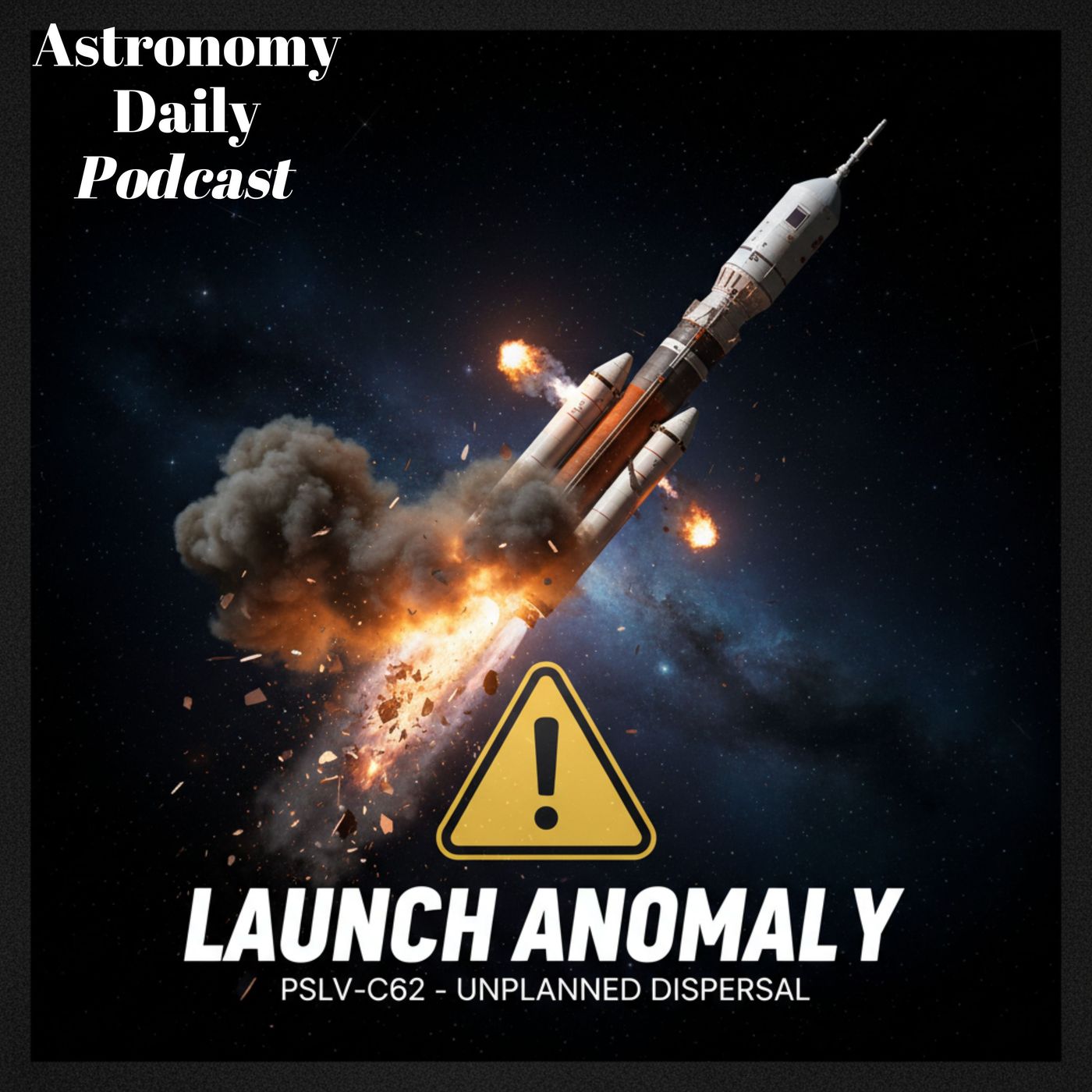
Anomalies in India's Launch| SpaceX's Starlink Expansion| Cosmic Dawn Signals: Your Daily Space Update
In this episode
In today’s episode of Astronomy Daily, Anna and Avery take you from rocket pads on Earth to the farthest corners of the cosmos. We cover India’s latest PSLV launch and its unexpected anomaly, the FCC’s green light for thousands more Starlink Gen2 satellites, NASA’s Pandora mission to decode exoplanet atmospheres, a fleeting signal from a supernova that exploded 13 billion years ago, a breakthrough in understanding the Sun’s most violent flares, and the surprising discovery of a barred spiral galaxy in the early Universe.It’s an episode where orbital mechanics meet cosmic archaeology — with a dash of solar storm science.
---
## 📰 Stories Covered
1. India’s EOS‑N1 Launch on PSLV-C62
- First PSLV liftoff since a May 2025 anomaly.
- Carried a military Earth‑observation satellite plus 15 payloads.
- Third‑stage deviation under investigation.
2. FCC Approves 7,500 Additional Starlink Gen2 Satellites
- Expansion to boost coverage and speed.
- Partial approval pending further review of SpaceX’s larger request.
- Implications for connectivity, orbital traffic, and astronomy.
3. NASA’s Pandora – Exoplanet Atmosphere Investigator
- Small, dedicated telescope to study exoplanet atmospheres.
- Focused on separating signals from planets and their stars.
- Could refine the hunt for biosignatures.
4. A Ten‑Second Signal from the Early Universe
- Likely a supernova about 13 billion light‑years away.
- Offers a rare probe into early stellar death.
- Discovered via coordinated, multi‑wavelength observations.
5. Unmasking the Sun’s Most Violent Flares
- Discovery of ultra‑energetic particles in the upper solar atmosphere.
- Provides a clearer picture of gamma‑ray production.
- Could improve space weather forecasts.
6. Earliest Known Barred Spiral Galaxy
- Dated to 11.5 billion years ago.
- Challenges models of how fast galaxy structures form.
- May force revisions in early-Universe galaxy evolution theories.
---
## 🔍 Key Themes & Takeaways
- Space Operations: Even reliable rockets can have anomalies — data analysis is crucial.
- Policy & Infrastructure: Starlink expansion reshapes the orbital environment.
- Scientific Frontiers: Compact, focused missions can massively advance our understanding.
- Cosmic Forensics: The early Universe was more structured than we thought.
- Solar Hazards: Better flare science means better protection for tech and people.
---
## 📚 Further Reading & References
- [India launches EOS‑N1 military satellite with PSLV-C62](https://www.space.com/space-exploration/launches-spacecraft/india-eos-n1-military-satellite-15-payloads-pslv-launch)
- [FCC approves 7,500 more Starlink Gen2 satellites](https://spacenews.com/fcc-approves-7500-additional-starlink-satellites/)
- [NASA’s Pandora mission launch coverage](https://www.space.com/space-exploration/launches-spacecraft/watch-spacex-launch-nasas-pandora-exoplanet-studying-satellite-on-jan-11)
- [Supernova signal from 13 billion years ago](https://dailygalaxy.com/2026/01/earth-receives-10-second-signal-from-supernova-13-billion-years-ago/)
- [Breakthrough on Sun’s flare particle populations](https://scitechdaily.com/what-powers-the-suns-most-violent-flares-scientists-finally-have-an-answer/)
- [Early barred spiral galaxy discovery](https://connectsci.au/news/news-parent/7631/Barred-spiral-galaxy-may-be-the-earliest-seen-yet?searchresult=1)
---
## 🎧 How to Listen
Subscribe to Astronomy Daily on Spotify, Apple Podcasts, or your favorite podcast platform.
---
## 💬 Join the Conversation
Do you have a question about today’s stories or space science in general?
Send us a message via the...
Anna: Welcome to Astronomy Daily. I'm Anna. Avery: And I'm Avery. Hello everyone. Thanks for joining us. Today is January 12, 2026 and we've got a full show, launches and anomalies, regulatory moves that reshape low Earth orbit, a brand new exoplanet observatory on its way, a flash from the cosmic dawn, fresh results about what powers the sun's, um, strongest flares and a galaxy discovery that looks surprisingly familiar for the early universe. Anna: Yep, 6stor. All of them important in different ways.
We'll start with this morning's launch news from India. Avery: India's polar satellite launch vehicle, the PSLV C62 lifted off from Satish Dhawan Space Centre this morning carrying EOS N1, described as an advanced Earth Observation military surveillance satellite, along with a batch of CO passenger payloads. The mission marked ISRO's first launch attempt since a PSLV anomaly in May 2025. So there was on it, right? Anna: The liftoff itself looked nominal, but ISRO later reported an anomaly near the end of the third stage.
The PS3. Initial public statements indicate a, uh, deviation in the third stage's phase and that ISRO has begun a detailed analysis. At this stage it's not yet confirmed whether the primary satellite and co passengers reached their planned orbits. Avery: Those early stage deviations can be especially challenging because they often happen during staging or engine cutoff where timing and velocity are critical. ISRO has a long successful history with the PSLV family. But even reliable vehicles can have single event anomalies.
The important thing is how the agency responds. Recovering telemetry, diagnosing the root cause and transparently sharing findings. So confidence can be rebuilt. Anna: Absolutely. From a broader perspective, this mission also demonstrates the global nature of smallsat rideshares and the strategic value that Earth Observation Satellite deliver, whether for commercial or defence purposes. We'll keep an eye on ISRO's follow up. They typically publish an analysis after they comb through flight data and we'll link.
Avery: To the official statements in the episode notes for folks who want the primary sources next up. Anna: In the US the Federal Communications Commission granted SpaceX authorization to deploy an additional 7,500 Starlink second generation satellites. That's a, uh, partial approval within a broader SpaceX request for up to 15 in Gen 2. Avery: This is a big step for the company's plan to upgrade Starlink's capabilities. Higher throughput, lower latency and expanded services including direct to cell connectivity and higher Data rates.
The FCC's partial grant means SpaceX can move forward with a substantial expansion while regulators and Other stakeholders continue to evaluate the remainder of the proposal. Anna: There are a couple of important implications. Operationally, many more starlink nodes in low Earth orbit will increase global broadb capacity, particularly for underserved and rural regions. But it also intensifies ongoing concerns about orbital crowding, radio frequency coordination and long term space sustainability.
Avery: Right? Competitors and some academics have raised worries about spectrum interference, orbital dominance, and the cumulative effect of so many satellites on debris risk and astronomical observing. SpaceX says it will coordinate reconfiguration steps, for example lowering orbits for safety and using DEORB strategies. But regulators and the international community will be watching closely, so this is both. Anna: A technical and policy storey. The authorization moves the technology forward, but it also keeps the conversation going about how to manage low Earth orbit responsibly as it becomes busier.
Avery: On a More exploratory note, SpaceX successfully launched a Falcon 9 rideshare mission that included NASA's Pandora satellite. Pandora is a compact astrophysics mission designed to study the atmospheres Least 20 exoplanets and their host stars over about a year of operations. Anna: Pandora's key strength is that it's optimised to disentangle the light coming from an exoplanet and the star it orbits. Stellar activity, spots, flares and magnetic variability can mimic or mask atmospheric signals from exoplanets.
Pandorna carries a 0.45-metre telescope and a suite of instruments aimed at measuring both the star's variability and the planet's transmission signals, improving the accuracy of atmospheric composition measure. Avery: That kind of targeted mission is exactly what the exoplanet community needs now. Large observatories like JWST do outstanding detailed work, but focused missions such as Pandora can observe many systems in a systematic way and help build context. Pandora will feed into priorities for future larger missions that aim to detect specific molecules, even biosignatures, in exoplanet atmospheres.
Anna: It's also another example of efficient rideshare launches enabling specialised science payloads. Pandora joining a larger commercial launch shows how the landscape of getting small science spacecraft to orbit has matured. Avery: Turning to the distant universe, astronomers recently reported detecting a very brief 10 second flash that originated roughly 13 billion light years away. This is being interpreted as light from an extremely distant supernova, one of the farthest, if not the farthest, stellar explosions observed so far.
Anna: The detection combined data from multiple instruments, including wide field X ray monitors and follow on observations by facilities such as the James Webb Space Telescope. The event is remarkable because it lets astronomers study stellar death and the environments of massive stars in the early universe when galaxies were young and metal content was low. Avery: Observing such distant explosions is rare because cosmological redshift and faintness make them hard to spot. When one is found, it can reveal the properties of the progenitor star, the host galaxy and the intergalactic medium at a time when cosmic structure was still forming.
There are also ties to gamma ray bursts and extreme transient phenomena. Researchers will be investigating whether models for super luminous supernovae or exotic explosions match this event. Anna: This detection emphasises how multi wavelength coordinated observing campaigns, fast alerts from one instrument followed by deep telescope follow up are essential for studying the transient universe, especially at high redshift. Avery: Back closer to home, solar physicists have new insight into the engine behind the sun's most violent flares and the intense gamma rays they sometimes unleash.
Researchers identified a previously unrecognised population of extremely energetic particles in the sun's upper atmosphere that appear to be a major source of those high energy photons. Anna: The finding comes from combining long duration observations and specialised instruments capable of measuring particle populations and gamma ray signatures. The upshot is that magnetic reconnection and particle acceleration processes in flare regions are more complex than some simple models suggested. In particular, the upper layers of the solar atmosphere, where magnetic fields reconnect and release energy, can track, trap and accelerate particles to mega electron volts, energies that then produce gamma rays.
Avery: This matters for space weather prediction. Gamma rays and energetic particles accompany the most extreme flares and can affect satellites, radio communications and radiation exposure for astronauts and high flying aircraft. By better understanding where and how particles are accelerated, models of flare, impact and forecasts of space weather can be improved. Anna: It's also a good reminder that our sun still surprises us even with decades of observations and multiple solar missions. New diagnostics and longer observation windows reveal previously hidden physics.
Avery: Finally, one of the most visually intriguing storeys. Astronomers have identified a barred spiral galaxy whose light comes from approximately 11.5 billion years ago, about 2 billion years after the Big Bang. If confirmed, this object would be among the earliest bars and spiral structures seen in the universe. Anna: Bars are elongated stellar structures that can drive internal evolution in galaxies. They funnel gas toward the centre, trigger star formation and rearrange angular momentum. Finding a well defined bar so early means that disc galaxies could develop mature internal structures sooner than many models predicted.
Avery: The discovery was enabled by deep spectroscopically confirmed imaging from powerful telescopes, Hubble and other facilities and careful analysis of the galaxy's stellar and morphological properties. The object sits in a growing collection of surprising early galaxies. Some are massive and evolved earlier than expected. Others show complex morphologies previously thought to require long timescales to form. Anna: These results feed directly into galaxy formation theory. They force modellers to consider rapid disc settling, efficient angular momentum redistribution, and other processes that could build bars early.
It's an exciting reminder that the early universe may have been both more active and more varied than our simplest expectations. Avery: So, looking across today's storeys, we have an operational launch with an anomaly that will require analysis, a regulatory decision that reshapes near Earth space, a dedicated exoplanet mission now in orbit, a signal from the cosmic dawn giving a rare window into early stellar deaths, improved understanding of particle acceleration on the sun and an early galaxy that challenges our ideas of how quickly structure forms.
Anna: It's a nice mix, isn't it? Local space operations and policy, Near Earth infrastructure and its implications Targeted planetary science domain extragalactic astronomy, solar physics and cosmological structure formation. For listeners, it shows how broad and interconnected modern astronomy and space activity are. Avery: Two quick takeaways. First, watch for ISRO's follow up on the PSLV anomaly that will affect launch schedules and the broader smallsat community. Second, the more we push instruments and coordination like fast transients and small science satellites, the more corner cases we find that reshape theory.
Discoveries often come when new instruments or different organisational approaches are applied. Anna: And for the non scientists out there wondering what to look for tonight, Jupiter is still a good target if you're out stargazing, and aurora watchers should keep an eye on space weather forecasts as the sun's activity continues to produce strong events. Avery: That's it for today's episode. If you enjoyed the show, subscribe to Astronomy Daily on your preferred podcast platform. You can find links, source articles and further reading in the episode notes so you can dig deeper if you wish.
Anna: We love hearing from listeners. If you have questions, science topics you'd like us to cover, or feedback about the show, drop us a note through the Astronomy Daily website. You can find us@, uh, astronomydaily.IO thanks for listening. Avery: I'm Avery. Anna: And I'm Anna Clear Skies and we'll see you tomorrow on Astronomy Daily. Avery: Astronomy Daily the Storeys we told.
Storeys.
We told.
Anna: You m.

 Apple Podcasts
 Spotify
 Pocket Casts
 Castbox
 Overcast
 Podbean
 iHeartRadio
 Castro
 Goodpods
 Moon FM
 Podcast Addict
 Podcast Republic
 YouTube