
In this episode
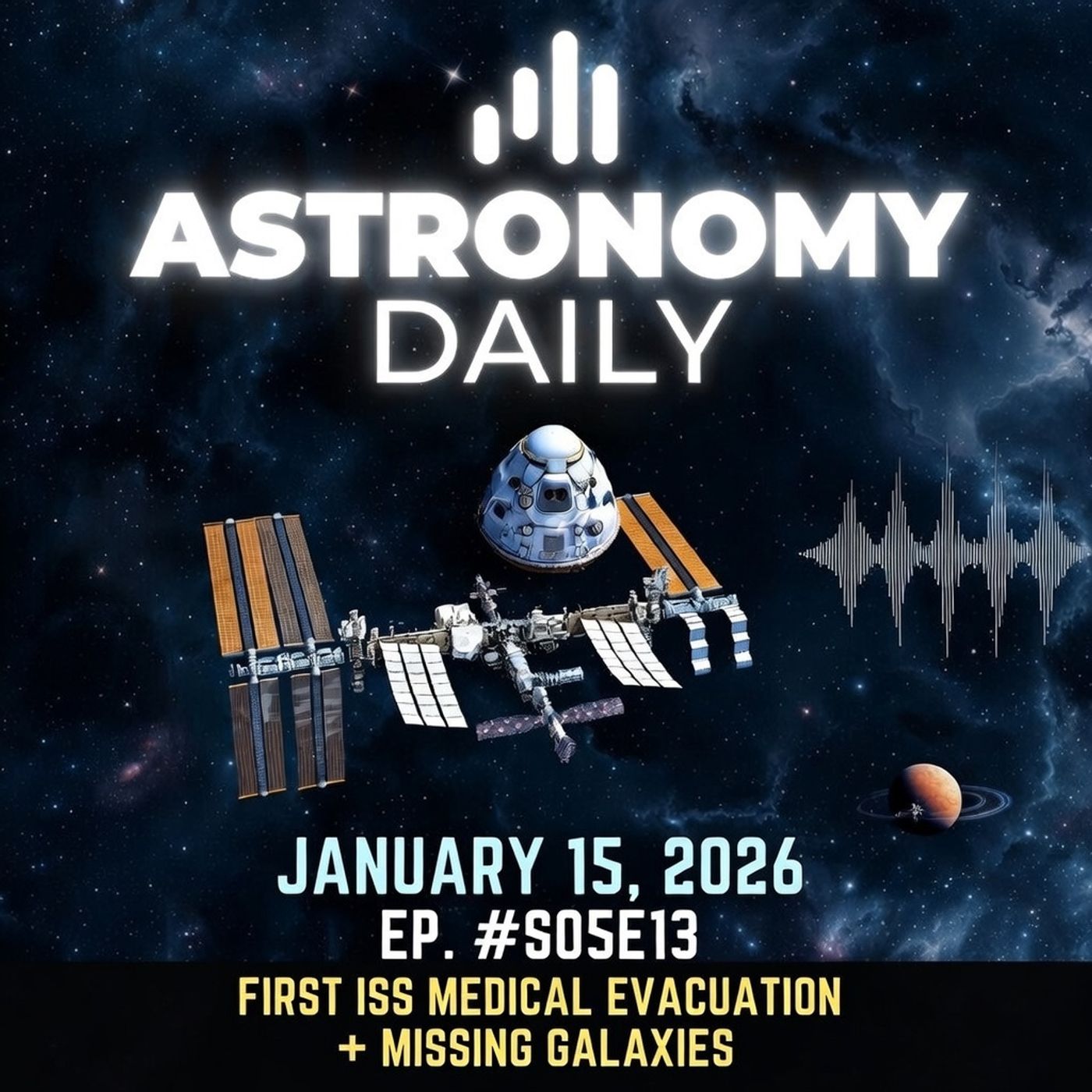
In this episode, we dive into a wealth of exciting updates and discoveries that are shaping the world of space exploration. We begin with a significant follow-up on the medical situation aboard the International Space Station, where NASA and SpaceX have set a target date for Crew 11's return to Earth. This historic early evacuation marks the first time an entire crew has been medically evacuated from the ISS in its 25-year history, highlighting the human element of spaceflight.Next, we shift our focus to Europe, where the European Space Agency is exploring innovative upgrades to the Ariane 6 rocket. These proposed modifications aim to introduce reusable components to improve cost-effectiveness and competitiveness against reusable rockets like SpaceX's Falcon 9.In a thrilling revelation, the James Webb Space Telescope has identified peculiar cosmic objects that may represent a new class of early universe galaxies, nicknamed "baby platypus galaxies." These oddly shaped formations challenge existing models of galaxy formation and could reshape our understanding of the early universe.We also examine new observations of Sagittarius A, the supermassive black hole at the center of our Milky Way, revealing its turbulent past filled with energetic outbursts that have influenced galactic evolution.Lastly, we discuss China's ambitious plans for the Chinese Space Station Telescope, set to launch in 2026. This revolutionary telescope aims to uncover cosmic secrets and complement existing observatories like Hubble and JWST with its wide field of view and advanced imaging capabilities.Join us as we unpack these captivating stories and more in this episode of Astronomy Daily!00:00 – **Welcome to Astronomy Daily, your daily companion for all things space and astronomy00:46 – **NASA and SpaceX set target date for Crew 11's return after medical concern
02:46 – **ESA is considering turning Ariane 6 into a Franken rocket with reusable elements
04:09 – **James Webb Space Telescope has spotted unusual galaxies in the early universe
06:07 – **Chinese Space Station Telescope on track for 2026, ready to uncover universe
07:07 – **Thank you for listening to Astronomy Daily. What a packed day### Sources & Further Reading1. NASA2. European Space Agency3. James Webb Space Telescope4. Chinese Space Station### Follow & ContactX/Twitter: @AstroDailyPod
Instagram: @astrodailypod
Email: [email protected]
Website: astronomydaily.io
Clear skies and see you next time! 🌟
Become a supporter of this podcast: Support Astronomy Daily.
Sponsor Details:
Ensure your online privacy by using NordVPN. To get our special listener deal and save a lot of money, visit www.bitesz.com/nordvpn. You'll be glad you did!
Sponsor Details:
Ensure your online privacy by using NordVPN. To get our special listener deal and save a lot of money, visit www.astronomydaily.io/nordvpn. You'll be glad you did!
Get the best secure and private email on the planet. Stop your Government, google and who knows who else spying on every email you write. Do what...
Anna: Hello and welcome to Astronomy Daily, your daily companion for all things space and astronomy. I'm Anna and joining me, as always, is my good friend and co host, Avery. Hey Avery. It's January 10, 2026. Hope everyone's weekend is stellar. Avery: Hey Anna. And hello to our listeners everywhere. Yeah, it's been a busy start to the year and today we've got some fantastic, um, updates and discoveries. We're kicking off with the big follow up to yesterday's breaking news on the ISS medical situation.
Plus ROC upgrades in Europe, some weird early universe galaxies from jwst, insights into our galaxy's black hole past, and China's upcoming space telescope that's poised to reveal cosmic secrets. Let's dive right in. Anna: First up, the update we've all been waiting for. NASA and SpaceX have set a target date for Crew 11's return to Earth following the medical concern with one crew member. Avery: This is a historic early return. We talked about yesterday. The first medical evacuation of an entire crew from the ISS, its 25 year history.
Crew 11, who launched last August on Dragon Endeavor, includes NASA astronauts Michael Fink and Zena Cardman, Jax's Kimiya Yu, and Roscosmos cosmonaut Oleg Platanov. Anna: The plan now is undocking no earlier than 5pm Eastern Time on Wednesday, January 14, weather permitting, and splashdown around 3:40am on Thursday, January 15, off the coast of California. Recovery teams are prepped and managers are monitoring seas, states, spacecraft readiness, everything to make sure it's safe. Avery: NASA stresses the crew member is stable and has been receiving care on board.
But the decision was made to return early as a precaution since full diagnosis and treatment aren't feasible in microgravity. Details remain private for medical privacy reasons. No specifics on the condition. Anna: Importantly, this shouldn't impact the upcoming Artemis 2 mission. NASA Administrator Jared Eisendman said the evacuation is, quote, a totally separate campaign at this point and they're still aiming for the first launch window in early February. No delays expected. That's reassuring for the whole program.
Avery: With Crew 11 heading home, the ISS will temporarily drop to three crew members, NASA astronaut Chris Williams and two Russian cosmonauts. They'll keep things running, but NASA is looking at accelerating Crew 12's launch from mid February to minimize any gap. This shows how flexible the partnership is, even in tough moments. Anna: Sending all the best wishes for a safe return to Crew 11. What a reminder of the human element in spaceflight. Avery: Next, some rocket news from Europe. ESA is considering ways to right the wrongs of Ariane 6 by turning it into a sort of Franken rocket with reusable elements.
Anna: Ariane 6 debuted last year but has faced criticism for being fully expendable, high cost, and struggling against reusable competitors like SpaceX's Falcon 9. It's not hitting the launch cadence or affordability goals Europe hoped for. Avery: Under ESA's best initiative, Ariane Group is proposing to retrofit Ariane 6 by swapping its solid rocket boosters for reusable liquid field ones from Maya Space. Their methane field design, the core and upper stage would stay expendable because recovering them is much harder.
Higher speeds, single engine, no easy descent control. Anna: This plug and play approach could lower costs, boost flight rates, and give Europe quick experience with reusability. Maya Space's full rocket isn't expected until 2027 at earliest, so integration would take time. There's also a separate study for a reusable demonstrator from Isar Aerospace. Avery: It's, uh, a pragmatic step to catch up. Europe knows it needs reusability to compete long term. Critics say it's playing catch up to tech from a decade ago, but gaining data from multiple boosters per flight could accelerate progress.
Anna: Exciting to see Europe innovating, even if it's a hybrid solution. Avery: Shifting to deep space, the James Webb Space Telescope has spotted some truly strange cosmic objects that might be baby platypus galaxies or perhaps an entirely new class of early universe phenomena. Anna: These appear as compact, oddly shaped galaxies in the very early universe, with unusual morphologies that don't fit standard models. Maybe mergers, rapid formation, or something unique. JWST's infrared power lets us see them at high redshift when the universe was young and chaotic.
Avery: The platypus nickname comes from their bizarre mixed features, like a mashup of traits from different galaxy types. Researchers are debating if they're transitional forms feeding black holes in disguise, or new physics at play. This could reshape our understanding of how the first galaxies assembled. Anna: JWST keeps delivering surprises. Every image challenges our assumptions. Avery: Staying galactic New observations show that while Sagittarius A, our Milky Way's supermassive black hole, is quiet now, its recent past was far more active.
Anna: Using Xrism M and other telescopes, astronomers detected FEK alpha emission lines in nearby molecular clouds like 0.11 minus 0.11x ray fluorescence from past outbursts illuminating the gas. Avery: These flares happened a few hundred to a thousand years ago, possibly specific events around 130 and 230 years back. The black hole likely had a feeding frenzy, gobbling a star or gas cloud, then settled down, we might see another echo in decades. Anna: It highlights how black holes toggle between active and quiescent states, influencing galactic evolution even in quiet galaxies like ours.
And may it long remain quiet, I might add. Avery: Finally, exciting news from China. Their revolutionary space telescope, the Chinese Space Station Telescope, or Sheng Qian, is on track for 2026, ready to uncover universe. Anna: Secrets with a, uh, two meter mirror, wide field of view, high resolution imaging across multiple wavelengths, and spectroscopic capabilities. Shantian will map large sky areas directly image exoplanets, survey galaxies and stars, probe cosmology, dark matter, and fundamental physics.
Avery: Recent breakthroughs include advanced simulation suites for pixel level data testing, ensuring systems are optimized pre launch. It's designed for broad surveys and deep looks, complementing Hubble and JWST by covering huge areas efficiently. Anna: This could lead to major discoveries in exoplanets, galaxy evolution, and more. China is stepping up big time in space astronomy. We'll be watching this with interest as the year rolls on. Avery: And that's it for today. Time to call it a wrap.
What a packed day. From human spaceflight drama to cosmic deep dives. Anna: Thanks so much for listening to Astronomy Daily. If you enjoy these updates, subscribe, Share with a and we'll be back on Monday with more. In the meantime, if you'd like to keep abreast of all the latest developments, just visit our website at astronomydaily IO and check out our News Update page. Avery: Until then, keep your eyes on the skies. Anna: Clear skies, everyone. Avery: Astronomy Day Stories Told.
Anna: The stories.
Avery: Were told.

 Apple Podcasts
 Spotify
 Pocket Casts
 Castbox
 Overcast
 Podbean
 iHeartRadio
 Castro
 Goodpods
 Moon FM
 Podcast Addict
 Podcast Republic
 YouTube