In this episode
In this episode of Astronomy Daily (S05E125), hosts Anna and Avery cover six major stories from the frontiers of space science and astronomy, including the most detailed image ever taken of the Milky Way's core, a Hubble discovery that solves a decades-old cosmological mystery, the oldest confirmed asteroid impact crater on Earth, a pair of impossibly light exoplanets, an impending lunar impact from a SpaceX rocket stage, and a live solar weather alert for Southern Hemisphere aurora watchers. Stories Covered Story 1 — Euclid's Record Milky Way Galactic Bulge Image: ESA's Euclid telescope releases the largest, highest-resolution visible-light image ever made of the Milky Way's central bulge, containing more than 60 million stars. The image serves as a baseline for NASA's upcoming Roman Space Telescope's microlensing survey. (ESA / NASA, June 24–25 2026) Story 2 — Hubble Catches Galaxy Clearing the Cosmic Fog: Galaxy MXDFz4.4, observed 1.4 billion years after the Big Bang, has been caught emitting ionising ultraviolet light — direct evidence of how the early universe's hydrogen fog was cleared. Published in The Astrophysical Journal, June 23 2026. Story 3 — Earth's Oldest Asteroid Crater Dated to 3 Billion Years: Curtin University researchers precisely date the North Pole Dome impact structure in Western Australia's Pilbara region to 3.024 billion years ago — the oldest known impact crater on Earth, beating the next oldest by ~800 million years. Published in Geology, June 23 2026. Story 4 — Super-Puff Planets Lighter Than Cotton Candy: An Oxford-led international team confirms TOI-791 b and c — two Jupiter-sized exoplanets with densities lower than cotton candy (0.038 and 0.047 g/cm³), making them the lowest-density giant planets ever found. Published in Monthly Notices of the Royal Astronomical Society, June 26 2026. Story 5 — SpaceX Falcon 9 Upper Stage to Impact Moon on August 5: A spent Falcon 9 upper stage from the January 2025 Blue Ghost / Hakuto-R launch is on course to strike the Moon near Einstein Crater on August 5 2026. Visibility from Earth is uncertain, but NASA's LRO will image the resulting crater. NASA SSERVI, June 2026. Skywatching — A G1 geomagnetic storm struck overnight June 25, with further unsettled conditions expected June 26–27 as coronal hole streams strengthen and new sunspot region AR4478 rotates into Earth view. Aurora possible for Tasmania, New Zealand's South Island and southern Australia tonight.Become a supporter of this podcast: https://www.spreaker.com/podcast/astronomy-daily-latest-space-news--5648921/support.
Sponsor Details:
Ensure your online privacy by using NordVPN. To get our special listener deal and save a lot of money, visit www.astronomydaily.io/nordvpn. You'll be glad you did!
Get the best secure and private email on the planet. Stop your Government, google and who knows who else spying on every email you write. Do what we did and use ProtonMail. They beleive in privacy and there are no ads in their business model...yet they still provide a free forever service. Check them out and get out special deal at www.astronomydaily.io/protonmail
Become a supporter of Astronomy Daily by joining our Supporters Club. Commercial free episodes daily are only a click way... Click Here
This episode includes AI-generated content.
Anna: 60 million stars in a single image. Stay with us. Your universe just got a whole lot bigger. Avery: Hello, and welcome to Astronomy Daily, your daily dispatch from the final frontier. I'm, um, Avery. Anna: And I'm anna. It's Friday, the 27th of June, 2026, and we have a genuinely spectacular edition for you today. Six stories that together paint a portrait of just how active and extraordinary our universe is. Avery: Right, we've got a record shattering telescope image, a, uh, cosmic mystery solved by Hubble, the oldest scar on Earth, planets that defy everything we thought we knew about density, a rocket on a collision course with the Moon, and a space weather alert for our, uh, Southern Hemisphere listeners, all in about 25 minutes.
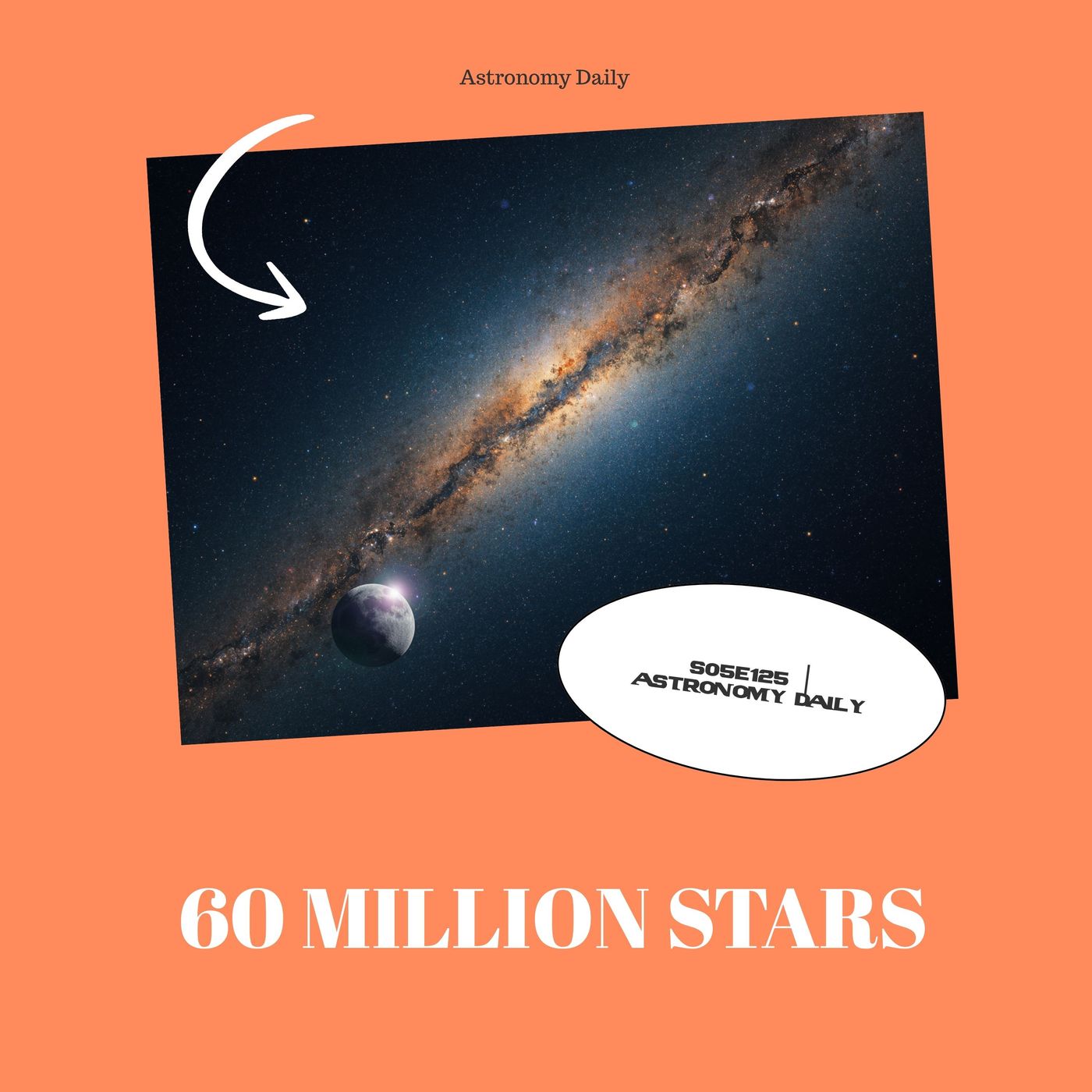
Anna: Let's dive in. We're starting with an image that is, quite simply one of the most spectacular astronomical photographs ever produced. The European Space Agency has just released a breathtaking portrait of the heart of our own galaxy, captured by the Euclid Space Telescope. And it contains more than 60 million individual stars. Avery: 60 million stars in a single frame. Let that settle for a moment. This is the largest high resolution visible light image of the Milky Way central bulge ever made.
And it arrived in our news feeds just this week. Anna: Euclid, which was originally built to study dark matter and dark energy by surveying billions of distant galaxies, took a remarkable detour. Astronomers essentially asked it to do something completely outside its primary mission, to spend 26 hours staring at the dense, glittering core of our own galaxy. Avery: And it delivered. The resulting mosaic was stitched together from nine separate pointings of Euclid's visible light camera. Each individual pointing covered a patch of sky larger than the Full Moon.
And the combined Image spans nearly 5 square degrees. That's the equivalent of about 25 full moons laid side by side. Anna: What makes it technically remarkable is that Euclid's sharpness and sensitivity in visible light is comparable to Hubble's Wide Field Camera. But Euclid can Image an area 270 times larger in a single pointing. So in terms of sheer scale combined with resolution, this image is unprecedented. Avery: And it's not just beautiful science, it's strategically important. This image is going to serve as a critical baseline reference for NASA's Nancy Grace Roman Telescope, which is due to launch in late August and will conduct its own Deep Galactic Bold survey beginning in 2027.
Anna: Roman will search for exoplanets using a technique called gravitational microlensing, where a planet passing in front of a, uh, background star causes a tiny detectable brightening. To do that, well, you need to know the precise positions and movements of all those stars. And that's exactly what Euclid has now provided. Avery: One scientist put it beautifully. They said that in just 24 hours, Euclid captured the stars involved in all of Roman's future microlensing events before the planets and stars have even aligned Euclid.
It's like taking a class photo before the school year begins. Anna: The Image also includes 51 known planetary systems, dense molecular clouds that appear as dramatic dark patches, glowing emission nebulae, and young star clusters. And buried in those 60 million stellar data points are likely thousands of undiscovered worlds patiently waiting for Roman to find them. Avery: An extraordinary image and a tremendous example of telescopes working together. Bravo, Euclid. Our second story takes us back much further in time to the very early universe, when the cosmos was still shrouded in a thick fog of neutral hydrogen gas.
And the question of how that fog was lifted has puzzled astronomers for decades. Anna: Now, thanks to the Hubble Space Telescope, working in concert with James Webb and the Very Large Telescope in Chile, we may finally have a definitive an. And the discovery was published this week in the Astrophysical Journal. Avery: The galaxy at the center of this story is called MXDF Z. Uh, 4. 4. Not the most poetic name. But what it represents is extraordinary. This galaxy existed just 1.4 billion years after the Big Bang, right at the tail end of what astronomers call the era of reionization.
Anna: Let me explain what that means. For the first billion or so years of the universe, the gas between stars and galaxies was neutral, opaque. Ultraviolet light couldn't travel through it. The universe was essentially foggy. Then, over hundreds of millions of years, that fog burned away, and the cosmos became the transparent, magnificent expanse we observe today. Avery: But what burned it away? That has been one of the great unsolved questions of cosmology. There were two main enormous black holes, or the first generations of hot, massive young stars.
This week, Hubble has delivered the strongest evidence yet that it was the stars. Anna: Here's what's remarkable about MXDF Z 4.4. It's about a hundred times smaller in area than our Milky Way, a tiny galaxy by any measure. But it's forming new stars 10 times faster than we are. And those young, hot, massive stars are packed into an incredibly compact cluster. Avery: Cram enough of those stars into a small enough space, and you create a furnace. The team estimates that between 50 and 100% of the intense ultraviolet light from those stars is actually escaping the galaxy's gas, punching clean through it and ionizing the surrounding hydrogen fog.
Anna: And what's more, many of those massive stars eventually explode as supernovae, blasting enormous bubbles in the gas that create even more pathways for the ionizing light to escape. It's a self reinforcing process. Avery: Before this discovery, astronomers had only found the galaxy emitting this kind of ionizing light From a time when the universe was 1.6 billion years old. MXDF, uh, 4.4 pushes that back to 1.4 billion years, closer than ever to the actual era of realization. Anna: What was previously considered impossible to detect because the fog itself was expected to absorb that ultraviolet light before it could reach us, has now been directly observed.
This galaxy may be the smoking gun that solves one of cosmology's most enduring mysteries. Avery: And we're only at, uh, story two. Let's keep going. Anna: You're listening to Astronomy Daily, season five, episode 125. If you're enjoying the show, please subscribe, leave us a review and share us with a friend who loves the stars. Find us at astronomydaily IO and follow us on socials. Avery: Astronedailypod Ah, here's a story with the wonderful local flavor. And it's a genuine scientific detective story.
Anna: Researchers from Curtin University in Western Australia, working with the Geological Survey of Western Australia, have finally resolved a major scientific debate about what is officially the oldest known asteroid impact crater on Earth. Their paper was published this week in the journal Geology. Avery: The site in question is called the North Pole Dome. And yes, despite the name, it's not near any pole. It's in the remote Pilbara region of Western Australia, one of the most geologically ancient landscapes on our planet.
Anna: Hm. For years, scientists debated just how old this impact structure actually was. One team estimated it at 3.47 billion years old. Another challenged that, arguing it was at most 2.7 billion years old. The truth, it turns out, lies somewhere in between. And it still makes North Pole Dome comfortably the oldest impact crater known on Earth. Avery: The Curtin team used advanced mineral dating techniques, specifically focusing on tiny crystals of zircon, a mineral renowned for its ability to preserve geological time with extraordinary precision.
Zircon contains trace amounts of uranium that slowly decay into lead. And by measuring that ratio, you can read the clock. Anna: The zircons at North Pole Dome had unusual branching skeletal shapes. The team interpreted these as impact modified crystals formed when older zircon was disrupted and partially remelted by the intense heat and pressure of an asteroid strike. Those crystals record an age of approximately 3.024 billion years ago. Avery: To confirm it, they also dated a second mineral, apatite which formed as hot fluids moved through the shock damaged rocks after the impact.
Remarkably, both dating systems gave the same answer. The North Pole Dome impact occurred around 3 billion years ago, pushing Earth's known impact record deeper into geological time than any previously well dated crater. Anna: To put that in perspective, the next oldest confirmed impact structure on Earth is the Yarrabuba Crater, also in Western Australia. Dated to 2.23 billion years ago, North Pole Dome beats it by nearly 800 million years. Avery: There's also a haunting proximity. The oldest known traces of life on Earth, limestone stromatolites made by ancient bacteria, are found just a few few kilometers from North Pole Dome.
Those stromatolites are about 3.5 billion years old. So when this asteroid hit, life on Earth was already well established, and it survived. Anna: The story of Western Australia as a geological archive of our planet's earliest history just keeps getting richer. Truly remarkable science and a wonderful home story for our Australian listeners. Now, a story that will make you question everything you thought you knew about what a planet can be. Avery: Researchers led by the University of Oxford, in collaboration with teams in France and the UK have confirmed the discovery of two record breaking exoplanets with densities so low they are literally lighter than cotton candy.
The paper is published today in the Monthly Notices of the Royal Astronomical Society. Anna: These planets are named TOI 791B and TOI 791C, and they orbit a, uh, dwarf star located about 1,110 light years from Earth in the southern constellation of Volans. Both planets are roughly the size of Jupiter, but that's where the similarity ends. Avery: Jupiter has an average density of about 1.33 grams per cubic centimeter. These two planets have densities of 0.038 grams per cubic centimeter and 0.047 grams per cubic centimeter, respectively.
To give you a sense of scale that's less dense than cotton candy, which typically weighs in around 0.05. They're more like enormous gossamer bubbles of gas than anything we'd traditionally call a planet. Anna: They've been dubbed superpuff planets, and only a handful of such objects are known. Finding two in the same planetary system is extraordinarily rare. Lead author Dr. George Dransfield from Oxford described them as the lightest planets for their size ever confirmed. Avery: The discovery required eight years of observations from telescopes around the world.
Crucially, it relied on data from the Antarctic Search for Transiting Exoplanets Telescope, known as ASTEP UH at Concordia Station in Antarctica. The Antarctic Winter provided months of continuous darkness, allowing the team to capture each planet's transit, its passage across its host star in a single uninterrupted observation lasting more than 11 hours. These are the longest continuous planetary transits ever observed from the ground in their entirety. Anna: How planets this enormous can be so impossibly light is still an open question.
The leading theory is that they possess vast hydrogen and helium rich atmospheres that inflate their size while contributing very little mass. They may also be slowly losing material as their star's radiation strips away their outer layers. Avery: Dr. Dransfield noted that their extremely low densities make them ideal targets for future atmospheric study because with so little mass holding everything together, the atmosphere should be puffed up and easier to characterize. With telescopes like James Webb, we may learn a lot about how planetary systems form and evolve from these two unlikely worlds.
Anna: Giant as Jupiter light as a carnival treat, the universe continues to outpace our imagination. Avery: Mark your calendars, because on August 5, the moon is about to get hit by a piece of a SpaceX rocket. Anna: This is not a drill, and it's not a mission. It's a piece of orbital debris, specifically the spent upper stage of a SpaceX Falcon 9 rocket left over from the January 2025 launch that sent Firefly Aerospace's Blue Ghost lander and the Japanese ispace Hakuto R2 mission lander toward the Moon.
Avery: After delivering its payload, the upper stage was left on a trajectory with nowhere to go but eventually into the lunar surface. Orbital analyst Bill Gray of Project Pluto tracked it down using his telescope tracking Software, and in September 2025 he calculated that it would impact the Moon on or around August 5th this year. Anna: The stage weighs approximately 4 metric tons and is traveling at over 2 kilometers per second. It's expected to strike near Einstein Crater on the moon's western limb, though the precise impact point is still being refined.
Another possible target is Bell Crater, just out of sight on the far side. Avery: Now the question everyone wants answered Will we be able to see it? And the honest answer from the Experts is maybe. Anna: NASA's William Cook, Program manager of the Meteoroid Environment Office at Marshall Space Flight center, describes the visibility as very subtle and very, very hard to see, if not impossible, but there's always a chance. He notes, that the impact will kick up enormous amounts of lunar dust and rock, and if it occurs close enough to the Moon's limb, a plume of ejected material rising against the black sky might be detectable.
Avery: Bill Gray himself has gone through a journey on this from probably visible to probably not to maybe. He says the timing and location of the impact are still fuzzy by minutes and dozens of kilometers, but they'll refine that as August approaches. Anna: Here's the reassuring part. NASA's Lunar Reconnaissance Orbiter will be passing over the projected crash site about seven days before the impact and again about seven days after. So even if we can't see the flash from Earth, we will get before and after images of the new crater it creates.
Avery: And there's a genuine citizen science opportunity here, too. A program called Impact flash, run through NASA's Solar System Exploration Research Virtual Institute, is calling on backyard astronomers to watch and report. Because impact flashes are so brief and can mimic cosmic ray hits on camera sensors, having multiple observers in different locations simultaneously is enormously valuable. Anna: It's a fascinating story, a piece of hardware launched with the explicit purpose of reaching the Moon, but in a completely different way to how its passengers got there.
Another reminder, as one NASA scientist put it, that the Moon is a dynamic, ever changing environment, and we are contributing to that change. Avery: Set a reminder for August 5th. It might be history in the making. Anna: Now it's time for your skywatching update, and we have some genuinely exciting space weather news for our listeners in the Southern hemisphere tonight. Avery: A G1 minor geomagnetic storm struck in the early hours of yesterday morning, triggered by fast solar wind from a coronal hole combining with what's called a UH CO rotating interaction region, or cir.
A, uh, glancing blow from a coronal mass ejection launched on June 20 may have also contributed. The disturbance hit the G1 threshold at 4.43in the morning UTC. Anna: Now, a UH G1 storm is the lowest level on the five step geomagnetic scale, but it's enough to push Auroras to higher mid latitudes. And here's the headline for tonight and tomorrow night. More unsettled conditions are expected with another G1 interval possible late tonight as, uh, the coronal hol stream continues to strengthen. Avery: If the interplanetary magnetic field flips southward and stays that way for long enough, aurora watchers in Tasmania, New Zealand's south island and southern parts of Victoria and South Australia could be in with a genuine chance tonight.
Winter nights in the Southern Hemisphere right now are long and dark perfect conditions if the activity picks up. Anna: Northern Hemisphere listeners, the short June nights are working against you significantly. If the KP index does hit 5 or above, you'd need to be at high latitudes in Scandinavia, Iceland or northern Scotland to have a realistic chance. Avery: But there's an even bigger story developing on the sun itself. A large, complex new sunspot region designated AR4478 is rotating into Earth view over the solar eastern horizon.
It announced its arrival with a C8.7 class flare, which was partially blocked by the solar limb, meaning the actual energy release was likely considerably more powerful than the recorded level. Anna: AR4478 appears to be a substantial magnetically complex region first spotted on the Sun's far side by the Solar Orbiter spacecraft as it rotates fully onto the Earth facing disk. Over the next day or two, the chances of M M class flares moderate, potentially auroral are expected to increase significantly.
Avery: So keep an eye on space weather updates over the coming days. This one bears watching. Check apps like Space Weather Live or Earth Sky's Sun News page for the latest. Anna: And on a broader note, we are currently near solar maximum in the current 11 year solar cycle, which means heightened solar activity is the new normal. For the next year or two, these events will keep coming. Avery: And that brings us to the end of today's astronomy Daily Season 5 Episode 125 what a show it's been. Anna: We covered 60 million stars in a single Euclid image, a tiny Hubble galaxy that may have cleared the cosmic fog of the early universe, the 3 billion year old Australian crater that is officially the oldest scar on our planet, two planet sized cotton candy puffs defying everything we knew about density, a uh, rogue SpaceX rocket stage headed for the Moon in August, and a live solar alert for aurora hunters in the south.
Avery: Before we go, our ah, did you'd know for today, The Euclid Space Telescope's galactic bulge image released this week includes 51 already known planetary systems embedded within those 60 million stars. Every single one of those planets was discovered by noticing a tiny dimming of its host star's light, a dimming equivalent to watching a flea walk across a car headlight from several kilometers away. Anna: Thank you so much for spending this time with us. If you enjoyed today's episode, please subscribe.
Leave us a review on your podcast platform of choice, and share Astronomy Daily with someone who looks up at the sky and wonders. Find us at astronomydaily IO and follow us on X, Facebook, Instagram, TikTok and Tumblr astrodaily Pod until next time from Avery: both of us, Clear Skies Clear skies. Astronomy Day Stories.
 Apple Podcasts
 Spotify
 Pocket Casts
 Castbox
 Overcast
 Podbean
 iHeartRadio
 Castro
 Goodpods
 Moon FM
 Podcast Addict
 Podcast Republic
 YouTube