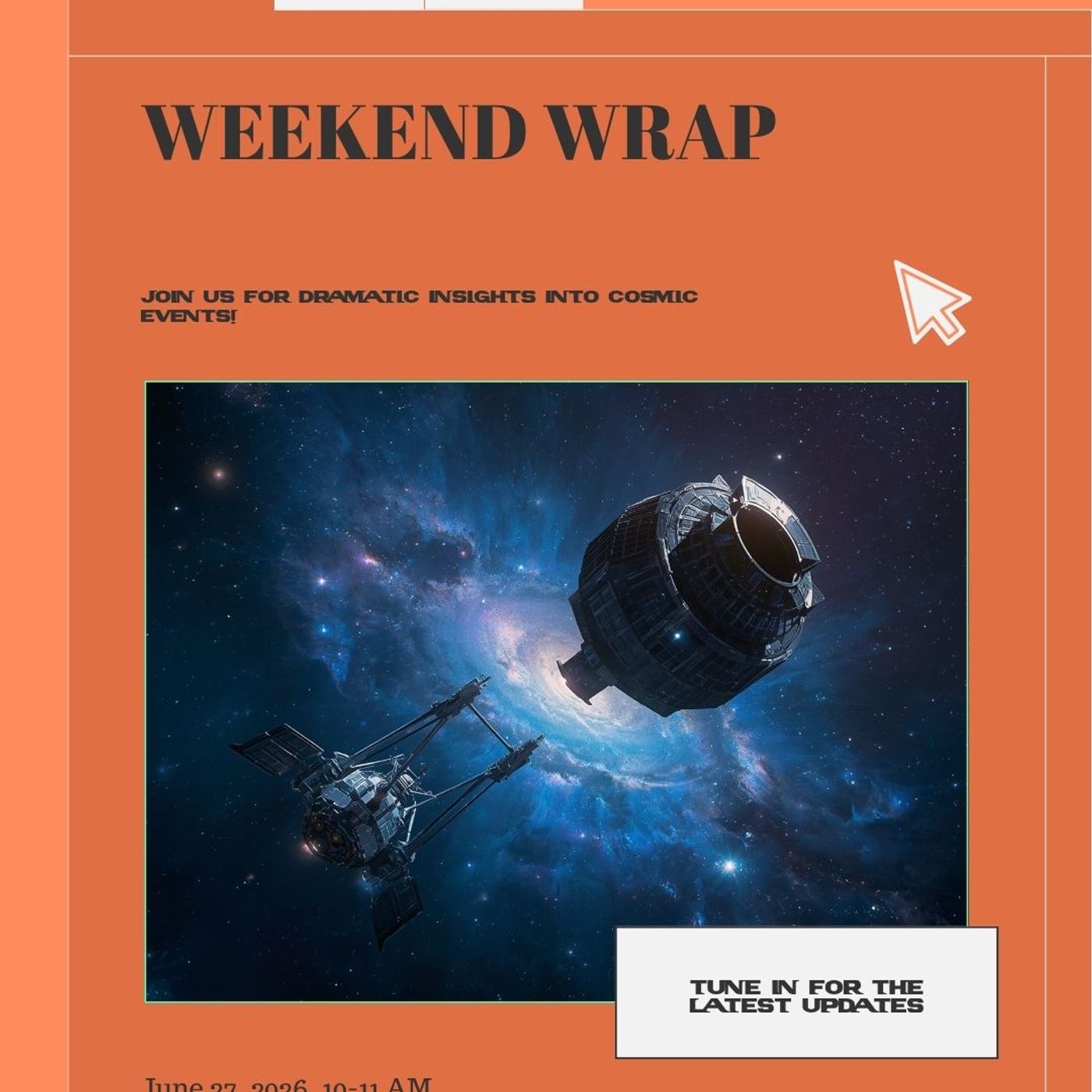
The Weekend Wrap: NASA's Bold Swift Rescue, Cosmic Demolition Derby Unfolds
In this episode
Weekend Space & Astronomy News Wrap | Saturday, June 27, 2026 It's our Saturday wrap — and what a week it's been for space and astronomy! Join Anna and Avery for two brand-new stories plus the four biggest headlines from the past five days. THIS WEEK'S STORIES 🚀 NASA's Daring Swift Rescue Mission Launches Today NASA's Swift Boost mission launched this morning, sending the LINK robotic servicing spacecraft to rescue the 22-year-old Neil Gehrels Swift Observatory from orbital decay. Built in under a year by startup Katalyst Space Technologies, LINK will rendezvous with Swift, grab it with robotic arms, and boost it to a safer orbit — a historic first for commercial spacecraft servicing. 🌌 JWST Catches Six Galaxies Merging Into One of the Universe's Largest The James Webb Space Telescope has spotted a 'cosmic demolition derby' — at least six galaxies in the process of merging, seen as they were 12 billion years ago. The system TGSSJ1530+1049 hosts hundreds of billions of solar masses of stars and a growing supermassive black hole, offering a rare front-row seat to galaxy and black hole formation happening simultaneously. ☄️ WEEKLY WRAP: Lucy's Peanut-Shaped Wobbling Asteroid NASA's Lucy mission has revealed that asteroid Donaldjohanson tumbles on two axes simultaneously — an unexpected discovery published in Science this week. Lucy also found evidence of ancient water interaction and traced the asteroid's violent origin to a collision 155 million years ago. A preview of what Lucy will reveal at Jupiter's Trojans. 🪨 WEEKLY WRAP: Asteroid 1997 NC1 Passes Earth Today A 1-kilometre-wide asteroid makes its closest approach to Earth today — at 1.5 million miles (about 7 times the Earth-Moon distance). Completely safe and well-tracked, it's a great telescope target for Southern Hemisphere observers this evening, drifting visibly against the background stars. 🌠 WEEKLY WRAP: Interstellar Comet 3I/ATLAS — Alien Chemistry Confirmed by JWST New JWST analysis confirms that interstellar comet 3I/ATLAS contains methane — the first detection of methane on any interstellar object. The comet's chemical fingerprint is radically different from anything in our solar system, pointing to an extremely cold birthplace in another star system. These are our last close observations as 3I/ATLAS heads out of the solar system forever. 💫 WEEKLY WRAP: The Jellyfish Nebula's Hidden Sibling Astrophysicists have identified what appears to be the first-ever pair of sibling supernova remnants — the famous Jellyfish Nebula and a previously hidden companion concealed in its glare. The two remnants are connected by a filament of gas, suggesting they share a common stellar origin.Become a supporter of this podcast: https://www.spreaker.com/podcast/astronomy-daily-latest-space-news--5648921/support.
Sponsor Details:
Ensure your online privacy by using NordVPN. To get our special listener deal and save a lot of money, visit www.astronomydaily.io/nordvpn. You'll be glad you did!
Get the best secure and private email on the planet. Stop your Government, google and who knows who else spying on every email you write. Do what we did and use ProtonMail. They beleive in privacy and there are no ads in their business model...yet they still provide a free forever service. Check them out and get out special deal at www.astronomydaily.io/protonmail
Become a supporter of Astronomy Daily by joining our Supporters Club. Commercial free episodes daily are only a click way... <a...
Anna: Happy Saturday, space fans. I'm Anna. Avery: And I'm Avery. Welcome to Astronomy Daily's weekend space and astronomy news wrap. Anna: It has been another seriously action packed week in space and astronomy. And today we're bringing you the six biggest stories, two brand new ones, plus a recap of the four that dominated the headlines this week. Avery: And we're kicking things off with something literally happening right now. A daring first of its kind rescue mission that's set to launch Tuesday morning.
Anna: Stay with us. It's going to be a great one. Our first story this weekend is one you won't want to miss. And it's preparing right now as we speak. Avery: NASA Swift Boost mission is now planned to launch Tuesday morning from Kwajalein Atoll in the South Pacific. And if successful, it will be the first time in history that a commercial robotic spacecraft has captured and repositioned a, uh, government science satellite that was never designed to be serviced. Anna: The mission aims to rescue the Neil Gerald Swift Observatory, a telescope that has been hunting gamma ray bursts and other cosmic explosions since 2004.
Swift was supposed to last two years. It's now 22 years old and still doing brilliant science. Avery: So what's the problem? Solar storms. Recent bursts of intense solar activity puffed up Earth's outer atmosphere, creating extra drag on Swift's orbit. If nothing is done, Swift would re enter and burn up by late 2026. Anna: Enter Catalyst Space Technologies, a, uh, startup from Flagstaff, Arizona. NASA awarded them a $30 million contract in September 2025, less than a year ago to build a spacecraft, launch it, and save Swift.
Avery: That spacecraft is called a link. About the size of a refrigerator, it has three robotic arms, ion engines, and a suite of sensors. It rode into orbit this morning aboard a Northrop Grumman Pegasus XL rocket, an air launch vehicle dropped from a modified L1011. Interestingly, this is Pegasus's first flight since 2021 and its final planned mission. Anna: Over the coming months, Link will carefully maneuver to rendezvous with Swift, Rabbit with those robotic arms and fire its engines to push the observatory to a higher safety, safer orbit.
Buying it at least five more years of science life. Avery: It sounds almost too audacious. And even Swift's own chief scientist admitted to losing some sleep over it. Anna: Who wouldn't? But the fact that this mission was conceived, built and launched in under a year is itself a landmark achievement. It's being called a template for how responsive commercial servicing missions can work in the Future. Avery: And for $30 million, a fraction of what it would cost to build and launch a replacement telescope.
Anna: It's an extraordinary we'll be following Link's progress closely on Astronomy Daily in coming days. Fingers crossed for a successful rendezvous and many more years of swift watching the universe's most powerful explosions. Our second story this weekend comes courtesy of the James Webb Space Telescope, and it is spectacular. Avery: Astronomers have spotted what they're calling a cosmic demolition derby. At least six galaxies in the process of smashing into one another and merging into what will eventually become one of the largest galax in the universe.
Anna: The system is called TGSS J1530 1049. We're seeing it as it was 12 billion years ago, when the universe was only about 1 1/2 billion years old. Four of those six galaxies are already surprisingly massive. Together they contain hundreds of billions of times the mass of our sun, all packed into a region just a few tens of thousands of light years across. Avery: That makes it one of the densest known concentrations of massive galaxies from this early period in cosmic history. Astronomers call it a protocluster, the seed of what will eventually become a vast galaxy cluster like the ones we see in the local universe today.
And at the heart of this galactic pileup, something even more remarkable a growing supermassive black hole. Radio observations confirmed jets of material being expelled at high speed as matter falls into the black hole at the center of this maelstrom. Anna: What makes this discovery so significant is that astronomers can watch both processes happening simultaneously. The buildup of a giant galaxy and the growth of its central black hole. These two things are thought to co evolve, but catching them both in the act this early in the universe is extraordinarily rare.
Avery: The discovery came thanks to a clever combination of tools. Radio astronomers first tipped off the team by detecting unusual emissions that hinted at an undiscovered active black hole. Webb then revealed the full picture not one galaxy, but a whole complex of six. Anna: The research was led by astronomers at Leiden University and the University of Oxford and published this week in the Open Journal of Astrophysics and Astronomy and Astronomy Avery: and Astrophysics, another stunning chapter in what JWST is revealing about the early universe and the reminder of just how much cosmic construction was already underway in the universe's first billion years.
Anna: Now it's time for our weekly wrap, the four biggest stories that had the space and astronomy community buzzing this week. Avery: Story one of our weekly wrap and it involves one of NASA's most traveled spacecraft and a very strange little world. Anna: NASA's Lucy mission has published new results from its April 2025 flyby of asteroid Donald Johansson, and the findings are Genuinely surprising. Published this week in the journal Science, the research reveals that this half mile wide asteroid doesn't spin the way scientists expected.
Avery: Instead of rotating cleanly on a single axis like most solar system bodies, Donald Johanson tumbles on two axes simultaneously. It flips end over end once every ten and a half Earth days, while also rocking side to side on its long axis once every 26 and a half days. Scientists call this non principal axis rotation. And it looks, in the words of the research team, like a very slow, unpredictable wobble. Anna: In addition to its unusual motion, Lucy found that Donald Johansen is shaped like a peanut.
Two cratered lobes joined by a narrow neck. It's what's known as a contact binary. Likely formed when two fragments from an ancient collision slowly drifted together under gravity and merged. Avery: And that ancient collision, it happened about 155 million years ago when a much larger asteroid roughly 50 miles wide was struck and shattered. Donald Johanson is one of the surviving pieces. Anna: Perhaps most intriguingly, Lucy's infrared spectrometer detected iron rich clay minerals on the surface.
Minerals that form only when rock interacts with liquid water. So at some point long ago, water was present on Donald Johansson's parent body. Avery: The Lucy mission, led by the Southwest Research Institute, is now heading for its primary destination, Jupiter's Trojan asteroids. This flyby was officially a rehearsal. But as Lucy's lead scientist Simone Markey put it, it's already clear that no two asteroids are alike. And the Trojans are going to challenge everything we think we know. Anna: We can't wait.
Avery: From a wobbling peanut shaped asteroid to an interstellar comet revealing alien chemistry. It's been quite a week. Let's get into it. Anna: Story two of our wrath is also happening today. And it's a sky watching opportunity for those of you with a telescope. Avery: A 1km wide asteroid designated 1997 NC1 is making its closest approach to Earth right now. Saturday, June 27th. It'll pass at a distance of about 1.5 million miles, or 2.4 million kilometers. Roughly seven times the distance between Earth and the Moon.
Anna: To put that in perspective, this asteroid is about 50 to 60 times wider than the Chelyabinsk meteor that exploded over Russia in 2013, shattering windows across six cities and sending 1500 people to seek medical treatment. The difference is 1997 NC1 was known about well in advance, is completely tracked, and poses absolutely no threat to Earth. Avery: It was discovered by the Near Earth Asteroid Tracking System on haleakala in Hawaii. NASA's Jet Propulsion Laboratory has been using radar to get a Close look this week, bouncing signals off the asteroid to generate three dimensional models revealing its shape and structure.
Anna: If you're in the Southern hemisphere and have a 6 inch or larger telescope, tonight is a great opportunity to watch it drift across the background stars. It won't streak across the sky like a shooting star. It moves too slowly for that. But over five to seven minutes you'll be able to see it shift position against the star background. Avery: It's a beautiful reminder that our solar neighborhood is not empty and that planetary defense tracking systems are doing exactly what they're supposed to do.
Watching, measuring, knowing. Anna: Clear skies. To those of you with your telescopes Avery: out tonight, story three. And we return to one of the most exciting objects to visit our solar system in years. The interstellar comet 3i Baily Atlas. Anna: 3i Bailey Atlas was discovered on July 1 last year, making it only the third interstellar object ever detected. It tore through our solar system, looped around the sun and is now heading out past Jupiter, never to return. And the James Webb Space Telescope has been making the most of every moment it had.
Avery: New analysis of Webb's mid infrared observations has confirmed something remarkable. 3 I Bailey Atlas contains methane, making it the first interstellar object ever found to carry this gas. And the ratio of methane to water is much higher than anything seen in comets from our own solar system. Anna: What does that tell us? It tells us that this comet formed somewhere very cold, far colder than anywhere in our solar neighborhood. The methane was buried deep beneath the surface as ice, shielded from solar heating.
As the comet first entered the solar system, it only sublimated, turned directly from ice to gas as the comet drew closer to the sun on its way back out. Avery: The comet is also loaded with methanol, essentially alcohol, which was discovered earlier in the year. And it was itself unusual. Together this chemistry is completely unlike anything we see in comets born around our sun. Anna: SETI researchers also trained radio telescopes on UM3i Bailey Atlas looking for signals that might indicate artificial technology.
They found nothing beyond human made interference as expected. But the rapid response observations were valuable in their own right, helping to further Characterize the object. Avery: 3i Bailey Atlas is now heading into the outer solar system and will eventually return to the interstellar void. The Webb observations represent our last close look at this extraordinary visitor. And what a visitor it turned out to be. A chemical fingerprint of a world we'll never see. Anna: And our uh, fourth and final story of the weekly Wrap, a cosmic detective story from close to home.
Avery: Astrophysicists have announced what appears to be the first ever identified pair of sibling supernova remnants. One of them is the Jellyfish Nebula, a well known and visually stunning supernova remnant that's been studied for decades. The other had been hiding in plain sight. Concealed in the jellyfish's bright glare supernova Anna: remnants are the expanding shells of gas and debris left behind when a massive star explodes. Finding two remnants that appear to share a common origin born from the same stellar system is something astronomers have theorized about but never conclusively identified before.
Avery: The two remnants are connected by a bright filament of gas, which the researchers believe is evidence of their shared history. The discovery suggests that the two stars that produced these remnants were once companions, a binary system that both went supernova perhaps millions of years apart from It's Anna: a beautiful example of stellar archaeology using the leftover wreckage of dead stars to reconstruct the lives they lived billions of years ago. Avery: The Jellyfish Nebula, also known as IC443, sits about 5,000 light years away in the constellation Gemini.
It's a popular target for amateur astrophotographers, and now it has a hidden sibling to its name. Anna: The universe, as always, rewards those who look closely. That's the Astronomy Daily Weekend wrap for Saturday, June 27, 2026. What a week it's been. Satellite rescues, galaxy pile ups, wobbling asteroids, alien chemistry, and the secrets of dead stars. Avery: If you've enjoyed today's episode, please subscribe, leave a review and share us with a friend who loves space as much as we do. We're back Monday with fresh daily episodes, and we'll be keeping a close eye on how that swift rescue mission is Anna: going to find us at astronomydaily.
Uh IO and follow us on your favorite platforms at Strodaily Pod. Avery: Until next time, from all of us at Astronomy Daily, Clear skies.
 Apple Podcasts
 Spotify
 Pocket Casts
 Castbox
 Overcast
 Podbean
 iHeartRadio
 Castro
 Goodpods
 Moon FM
 Podcast Addict
 Podcast Republic
 YouTube