
Webb's Asteroid Discovery, Project Kuiper Launch, and Martian Dust Storms
In this episode
Astronomy Daily | Space News: S04E80In this thrilling episode of Astronomy Daily, host Anna guides you through the latest groundbreaking developments in space exploration and astronomical research. From the James Webb Space Telescope's insights on asteroids to Japan's innovative Mars landing technology, this episode is brimming with cosmic discoveries that will deepen your understanding of the universe.
Highlights:
- James Webb Space Telescope Observations: Dive into the fascinating findings from the JWST as it examines the near-Earth asteroid 2024 YR4. Discover how this mission not only provides critical data about the asteroid's size and thermal properties but also enhances our planetary defense strategies against potential threats.
- Amazon's Project Kuiper Launch: Get ready for the launch of Amazon's first operational satellites as part of Project Kuiper. We explore the implications of this ambitious initiative to create a global broadband Internet constellation and its competition with other satellite networks.
- Surprising Discoveries in Galactic Evolution: Uncover the shocking evidence that massive galaxies were already quiescent just 700 million years after the Big Bang. This revelation challenges existing cosmological models and reshapes our understanding of galaxy formation and evolution.
- Japan's Innovative Mars Landing Technology: Learn about JAXA's new approach to Mars landings using inflatable decelerators, which could revolutionize how we deliver rovers to the Martian surface. This innovative technology promises to lower costs and enhance mission efficiency.
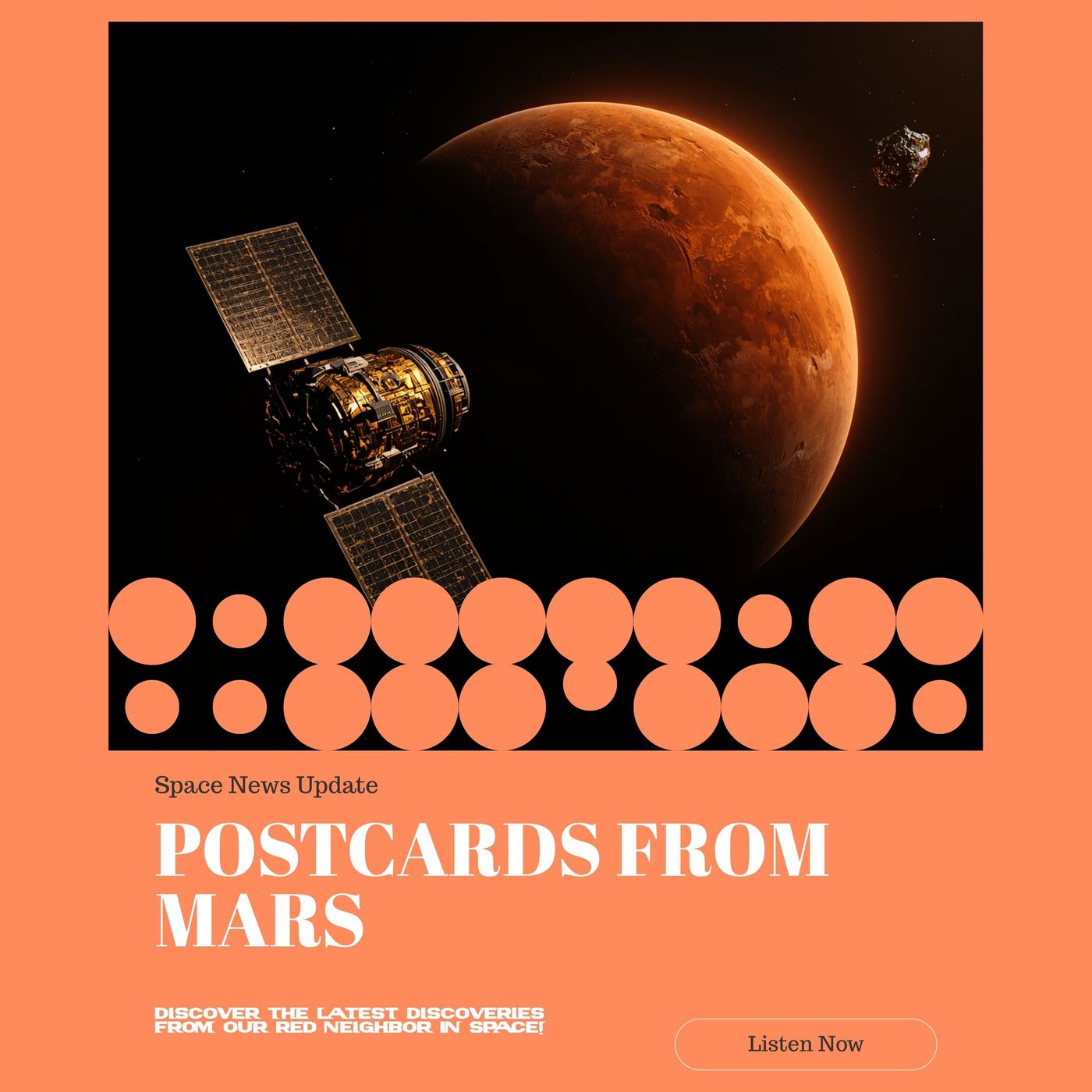
- Understanding Martian Dust Storms: Explore new research revealing the triggers behind Mars's massive dust storms, which pose significant challenges for future exploration. This study aims to develop forecasting capabilities for Martian weather, crucial for the safety of future missions.
For more cosmic updates, visit our website at astronomydaily.io. Join our community on social media by searching for #AstroDailyPod on Facebook, X, YouTubeMusic, TikTok, and our new Instagram account! Don’t forget to subscribe to the podcast on Apple Podcasts, Spotify, iHeartRadio, or wherever you get your podcasts.
Thank you for tuning in. This is Anna signing off. Until next time, keep looking up and stay curious about the wonders of our universe.
00:00 - Welcome to Astronomy Daily
01:05 - JWST asteroid observations
10:30 - Amazon's Project Kuiper launch
17:00 - Discoveries in galactic evolution
22:15 - Japan's Mars landing technology
27:30 - Martian dust storms research
✍️ Episode References
James Webb Space Telescope Updates
[NASA](https://www.nasa.gov)
Project Kuiper Details
[Amazon](https://www.amazon.com)
Galactic Evolution Research
[University of Geneva](https://www.unige.ch)
JAXA Mars Exploration
[JAXA](https://www.jaxa.jp/)
Martian Dust Storms Study
[University of Colorado Boulder](https://www.colorado.edu)
Astronomy Daily
[Astronomy Daily](http://www.astronomydaily.io/)
Become a supporter of this podcast:
Welcome to Astronomy Daily. I'm anna bringing you the latest breakthroughs from the cosmos right to your ears. Today's episode is packed with fascinating developments that are reshaping our understanding of the universe around us. We've got quite the stellar lineup of stories to explore. NASA's James Web Space Telescope has been examining a building sized asteroid, giving us new insights about these smaller space rocks and what they're made of. Then we'll look at Amazon's Project Kuyper as it prepares for a major satellite launch that could transform global Internet connectivity.
The Web Telescope has also uncovered something quite remarkable galaxies that were already dying out just seven hundred million years after the Big Bang, challenging our previous models of galactic evolution and forcing astronomers to rethink the timeline of our universe. We'll also explore Japan's innovative approach to Mars landing, using inflatable technology that could revolutionize how we deliver rovers to the Red planet. And speaking of Mars, scientists have made progress in understanding what triggers those massive planet covering dust storms, a crucial step for future missions and potential human exploration.
These discoveries aren't just academic curiosities. They represent the cutting edge of human knowledge, pushing the boundaries of what we know about our cosmic neighborhood and beyond. So let's launch into today's cosmic news and explore these frontiers together. Kicking things off, the James Web Space telescope recently set its sites on asteroid twenty twenty four yr four, a near Earth object that had previously raised some concern. While NASA announced back in February that the risk of this asteroid hitting Earth in twenty thirty two had been downgraded to near zero, these observations provided valuable information about what asteroids of this size are actually like, particularly as this one appears to be growing.
According to Andy Rivkin of Johns Hopkins University Applied Physics Laboratory, who led the Web observation program, this is the smallest object WEB has targeted to date, and one of the smallest objects to have its size directly measured from space. What makes this particularly interesting is how Web approached the task. Most telescopes observe asteroids by measuring sunlight reflected from their surfaces, which doesn't always provide precise size information. Web, however, used both its near infrared camera and mid infrared instrument in tandem.
The mid infrared wavelengths allowed scientists to measure the heat given off by the asteroid itself, providing a direct measurement of its size. The observations revealed that twenty twenty four yr four is approximately sixty meters across, about the height of a fifteen story building. But it's not just the size that proved interesting. The asteroid's thermal properties are notably different from those of larger asteroids. Rivkin's team believes this is likely due to a combination of the asteroid's very fast spin rate and a surface that lacks fine grained and instead the surface appears to be dominated by larger rocks, perhaps fist sized or bigger.
While this particular asteroid no longer poses a threat to Earth or the Moon, these observations have significant value for planetary defense. As more sensitive asteroid search programs come online in the coming years, we can expect to discover more potential impactors. Understanding how to best use our most powerful telescope to gather critical data quickly will be invaluable during a more urgent scenario. Involving a potentially hazardous asteroid. These observations also provided additional data about the asteroid's position, helping improve our knowledge of its orbit and future trajectory.
When combined with ground based measurements of its spin rate and spectral properties, scientists now have a comprehensive understanding of what this building size space rock is like. Riv can emphasize that this gives scientists a window into understanding what other objects of similar size might be like, including the next one that might be heading our way. The observations demonstrate Web's versatility as not just a deep space observatory, but also as a tool for planetary defense. Closer to home.
Next on today's story list, Amazon's project Kiper is poised to take a major leap forward with the launch of its first operational satellites. United Launch Alliance is scheduled to send twenty seven satellites into low Earth orbit on April ninth, using an Atlas five rocket from Cape Canaveral Space Force Station in Florida. This mission, dubbed KA zero one or Kuyper Atlas one, represents the first step in Amazon's ambitious plan to create a constellation of more than three thousand, two hundred satellites for global broadband Internet coverage.
These aren't just test satellites, according to Amazon, These operational units feature significant upgrades over the two prototypes launched last year. They come equipped with improved phased array antennas, more powerful processors, enhanced solar arrays, better propulsion systems, and optical inter satellite links. All this technology has been packed into satellites manufactured at the company's facility in Kirkland, Washington. The launch is happening about a year behind Amazon's original schedule, pushing potential beta services into later this year rather than late twenty twenty four as initially planned.
This timeline is particularly important because Amazon faces strict deployment deadlines from the Federal Communications Commission. Half the constellation must be deployed by July twenty twenty six, with the remainder by July twenty twenty nine. Project Kuiper vice president Rajiv Badial acknowledged the challenges ahead, noting that while extensive ground testing has been conducted, some things can only be learned in actual flight conditions. This will also be the first deployment of multiple satellites simultaneously for the project.
A crucial operational test. The upcoming launch is notable in several other ways. According to Amazon, it will be the heaviest payload ever flown on an Atlas five rocket, which will use its mother most powerful configuration for this mission, featuring five solid rocket boosters plus the main booster. The satellites will be deployed approximately four hundred and fifty kilometers above Earth. This is just the beginning of a massive launch campaign. Amazon has secured an impressive array of launch contracts to deploy its full constellation, including seven more Atlas five rockets and thirty eight launches on ULA's larger Vulcan Centaur rocket.
The company has also contracted three SpaceX Falcon nine missions, eighteen Ariani six launches from Ariani Space, and up to twenty seven new Glen rockets from Blue Origin. Amazon has already lined up several partners to deliver Project Kuiper services, including US telecommunications giants Verizon and Vodafone, as well as Japan's Sky Perfect, JSAT and Nipon Telegraph and Telephone Corporation, who plan to sell services to Japanese businesses and government organizations. With this launch, the race to establish the next generation of satellite Internet constellations intensified as Amazon joined SpaceX's Starlink and other competitors in the increasingly crowded low Earth orbit environment.
Next up, we have another update from the JWST. One of the most remarkable discoveries from the James Web Space Telescope has completely upended our understanding of galactic evolution. Astronomers have found evidence that massive galaxies were already dying just seven hundred million years after the Big Bang, a finding that challenges fundamental assumptions about how the earliest galaxies formed and evolved. According to the standard cosmological model, the first stars and galaxies began forming around three hundred four hundred million years after the Big Bang.
During this period, enormous clouds of neutral hydrogen gas collapsed to trigger rapid star formation, a process that was thought to continue uninterrupted for about a billion years. The expectation was that all early galaxies would be vigorously forming stars, young, active, and growing. That's what makes the recent findings from an international team led by astronomers from the University of Geneva so surprising. As part of the Revealing the Universe with the James Webb Space Telescope, program known as Rubies.
They've identified what appears to be a quenched galaxy from this extremely early cosmic era. This particular galaxy, designated Rubies UDS qgz seven, had already accumulated more than ten billion solar masses of matter before rapidly becoming quiescent. In astronomical terms, quenching refers to how galaxies stop forming new stars and become what scientists sometimes call red and dead galaxies. As the younger, brighter stars die off, these galaxies become dominated by older, redder stars. The discovery of Ruby's udsqgz seven implies that massive quiescent galaxies in the first billion years of the universe are more than one hundred times more abundant than predicted by any existing cosmological model.
This creates significant tension between our theoretical understanding and the observational evidence from web. What's even more astonishing is the galaxy size. It measures just about six hundred and fifty light years in diameter, giving it a much higher stellar mass density than similar quiescent galaxies we observe in the local universe today. Scientists believe these incredibly dense galaxies may have evolved into the cores of the massive elliptical galaxies we see in the modern cosmos. The prevailing theories about what causes galaxies to stop forming stars include stellar winds, outflows, and activity from supermassive black holes, but conventional models suggested this process would take much longer than what we're now observing.
Finding a red and dead galaxy so early in cosmic history means that star formation and subsequent quenching must have happened far more rapidly than anyone anticipated. According to Andrea Wibel, the PhD student leading the study, this finding provides the first strong evidence that the centers of some nearby massive elliptical galaxies may have been in place since the first few hundred million years after the Big Bang, essentially preserving the fossil record of the earliest era of galaxy formation.
It's been a while since we had any good news from JACKSA, but today we have some. Japan is taking an ambitious new approach to Mars exploration that could revolutionize how we land spacecraft on the Red planet. According to Masaki Fujimoto, the newly appointed Director General of the Institute of Space and Astronautical Sciences within JACKSA, the Japanese Space Agency is developing a novel landing system using inflatable decelerators that could enable more efficient missions to Mars. The concept combines proven technologies from two of Japan's recent space achievements.
It leverages capabilities from the upcoming Martian Moons Exploration mission, which aims to collect samples from Phobos, and incorporates lessons learned from the Smartlander for investigating Moon, space craft that achieved a remarkably precise lunar landing earlier this year, despite experiencing a thrust or malfunction. At the heart of this innovative approach is an inflatable soft aeroshell that would handle the challenging entry, descent, and landing phases of a Mars mission. Instead of having a complicated operational supersonic parachute and a hard aeroshell, you can do all the job just with this single technology, Fujimoto explained during a presentation at the National Academy's Space Science Week.
This approach offers significant advantages over traditional Mars landing systems. Current methods typically rely on complex combinations of heat shields, supersonic parachutes, and retrorockets, all of which must function perfectly in sequence for a successful landing. The Japanese concept streamlines this process considerably, with the inflatable aeroshell delivering the spacecraft through the Martian atmosphere and thrusters handling only the final touchdown phase. JAXA envisions using this technology to deliver relatively small rovers weighing between one hundred to two hundred kilograms to the Martian surface.
While modest in scale compared to NASA's car sized Perseverance Rover, these smaller vehicles could still conduct valuable scientific research at a fraction of the cost and complexity. The project is receiving financial support from the Space Strategic Fund, a Japanese government initiative providing six point seven billion dollars over a decade to advance critical space technologies. JACKSA is collaborating with an unnamed commercial company to develop the inflatable aeroshell technology. While no specific timeline has been announced for when this technology might be ready for an actual Mars mission, the fact that it's beginning to materialize now suggests that Japan is serious about joining the small group of nations capable of successfully landing spacecraft on Mars.
If successful, this approach could significantly lower the barriers to Martian exploration and potentially pave the way for more frequent mission to study the Red planet's surface. Speaking of Mars, if you've ever wondered what the weather is like on Mars, it turns out it can be quite dramatic. New research from planetary scientists at the University of Colorado, Boulder has revealed fascinating insights into the massive dust storms that occasionally engulf the entire Red planet, making cloudy with a chance of catastrophic dust a legitimate Martian forecast.
These planet wide dust storms are truly awe inspiring phenomena. They typically begin as smaller storms swirling around mars polar ice caps during the latter half of the Martian year, but under certain conditions they can rapidly expand toward the equator, covering millions of square miles and lasting for days. Unlike the dramatic scene in The Martian where Matt Damon gets tossed around by powerful winds, the reality is less physically forceful, but equally problematic for equipment and future astronauts.
Lead researcher Hashani Pieris and her team have made a significant breakthrough in unders standing what triggers these massive events. By analyzing eight Mars year's worth of data from NASA's Mars Reconnaissance orbiter, they discovered that approximately sixty eight percent of major dust storms were preceded by unusual warm spells on the planet's surface. The pattern is remarkably consistent. The planet experiences a period of increased warmth as more sunlight filters through Mars's thin atmosphere, and then weeks later, massive dust storms develop.
As Pieris explains, when you heat up the surface, the layer of atmosphere right above it becomes buoyant and it can rise, taking dust with it. This process mirrors similar weather patterns we experience on Earth, where warm air rising from the ground can lead to towering storm clouds. While these dust storms might not generate enough force to knock over equipment due to Mars's thin atmosphere, they pose serious threats to exploration efforts. In twenty eighteen, NASA's Opportunity Rover met its end when a global dust storm covered its solar panels, cutting off its power supply.
For future missions, especially those involving human explorers, these light, but clingy dust particles will present significant challenges as they stick to equipment and potentially damage sensitive components. The research team is continuing to gather more recent observations to further explore these explosive weather patterns. Their ultimate goal is to develop forecasting capabilities for Martian weather, similar to how meteorologists predict conditions on Earth. Being able to anticipate these massive storms could be crucial for the safety and success of future Mars missions, both robotic and human.
As study co author Paul Hayin noted, we need to understand what causes some of the smaller or regional storms to grow into global scale storms. This research represents an important step toward that understanding, potentially giving future Mars explorers the ability to prepare for or avoid the worst of the planet's dusty tempests. And that wraps up today's exploration of the cosmos, from Web's asteroid adventures to early galaxy surprises, Amazon's satellite constellation plans, Japan's innovative Mars landing technology, and the fascinating weather patterns on the Red Planet.
I'm ana, and I hope you've enjoyed this journey through the latest developments in space science and exploration. Whether you're fascinated by the tiniest asteroids or the grandest cosmic mysteries. There's always something new to discover in our ever expanding universe. If you'd like to hear more, please visit our website at astronomydaily dot io, where you can listen to all our back episodes and find all things Astronomy Daily. We're also active across social media. Just search for astro Daily pod on x, Facebook, YouTube, YouTube, music, Instagram, and TikTok.
Thanks for listening, and until next time, keep looking up and wondering about the magnificent cosmos that surrounds us. This has been Astronomy Daily. I'm ana signing off. You did. Star is the Toll? Star Is the Toll? Star Is the


 Apple Podcasts
 Spotify
 Pocket Casts
 Castbox
 Overcast
 Podbean
 iHeartRadio
 Castro
 Goodpods
 Moon FM
 Podcast Addict
 Podcast Republic
 YouTube