In this episode
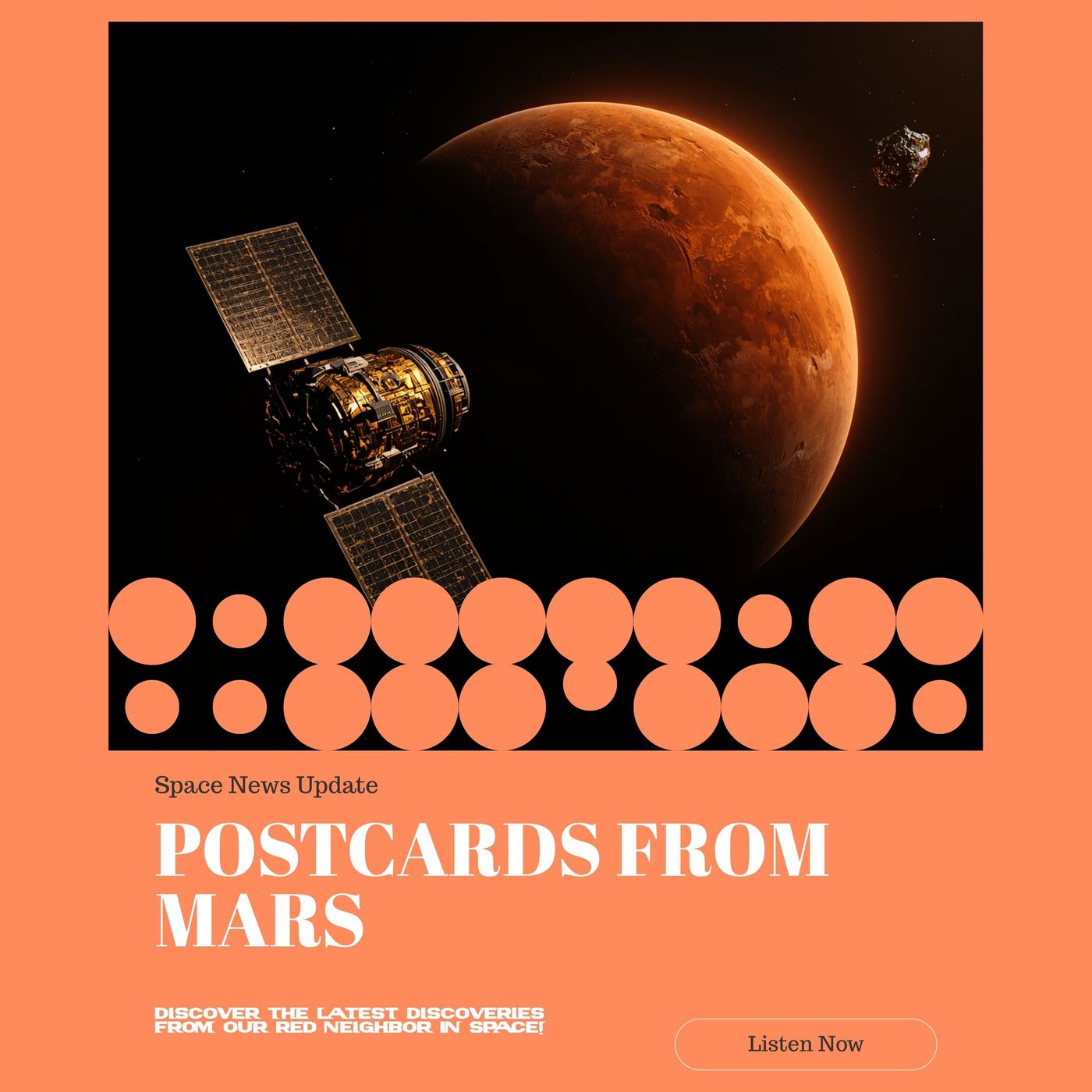
Astronomy Daily · S05E146 · “Postcards from Mars” · Tuesday 21 July 2026 NASA’s Psyche probe phones home from its Mars flyby — data and a spellbinding month-long time-lapse — as Europe’s Plato planet-hunter clears its final test. From the Royal Astronomical Society’s National Astronomy Meeting: a CubeSat that could give us hours of solar-storm warning, and a new way to forecast the Sun’s next active spell. Plus the first pieces of the giant ngVLA radio array, and a Southern Hemisphere meteor shower to catch this week.Story notes & sources 1 · Psyche phones home NASA’s Psyche spacecraft (launched 2023; arriving metal asteroid 16 Psyche in 2029) used a 15 May Mars gravity assist to test its instruments. The neutron spectrometer detected the anticipated count-rate enhancement near closest approach; the gamma-ray/neutron spectrometer, magnetometer and imager all performed well. Data and a month-long Mars time-lapse were released this week. ● NASA/JPL — “Psyche Mission Delivers Mars Flyby Data, Time-lapse Video” (17 Jul 2026) ● Lawrence Livermore National Laboratory — LLNL-built gamma-ray sensor’s first planetary measurements (17 Jul 2026) 2 · Plato clears its final exam ESA’s Plato — 26 cameras hunting Earth-like planets in the habitable zones of Sun-like stars — passed electromagnetic compatibility testing in the Maxwell chamber at ESTEC, its last major qualification hurdle. It’s bound for Sun-Earth L2 aboard an Ariane 6 (current target 2027). ● ESA — “Plato’s electronics ready for space” (20 Jul 2026) 3 · HENON space-weather CubeSat Presented at NAM 2026: HENON, a deep-space CubeSat that would sit ~15 million km upstream of Earth (10× farther than L1), potentially extending severe geomagnetic-storm warning from ~15 minutes to 2–3 hours. It carries the UK-built MAGIC magnetometer (Imperial College London) plus instruments from the Czech Republic and Finland, paving the way for a future European early-warning mission. ● Royal Astronomical Society / NAM 2026 — “From 15 minutes to 3 hours” (20 Jul 2026) 4 · The Sun’s “sleep” precursor Also at NAM 2026: a newly identified precursor in the solar cycle’s declining phase that could help predict the next maximum’s sunspot number. After the Sun’s active phase “switches off,” storms weaken and track a 27-day (solar-rotation) rhythm — pointing to co-rotating fast-wind streams rather than coronal mass ejections. ● Royal Astronomical Society / NAM 2026 — “How the Sun goes to ‘sleep’…” (20 Jul 2026) 5 · Building the ngVLA The US National Science Foundation, NSF NRAO and the US Naval Observatory are partnering on a pathfinder for the next-generation Very Large Array (ngVLA) — the ~266-antenna successor to the iconic VLA. The focus is very long baseline interferometry for ultra-sharp imaging and for maintaining the International Celestial Reference Frame. Construction/early operations are expected before the end of the decade. ● NSF NRAO / US Naval Observatory — ngVLA pathfinder partnership (17 Jul 2026) 6 · Skywatch: Southern Delta Aquariids Active mid-July to late August, peaking 29–30 July, with a radiant near Skat (δ Aquarii) — high overhead for Southern Hemisphere observers. ~15–20 faint, graceful meteors/hour under dark skies; suspected parent comet 96P/Machholz. A near-full Buck Moon spoils the peak, so the moon-free pre-dawn hours this week are the best window. Bright, slow Alpha Capricornid fireballs join in toward month’s end. ● Scientific American / EarthSky / American Meteor Society — Delta Aquariids 2026
Astronomy Daily is part of the Bitesz.com Podcast Network. Find every episode and the full show notes at astronomydaily.io, and follow @AstroDailyPod. Clear skies.
Become a supporter of this podcast: <a...
Anna: Picture Mars a small rusty coin hanging in the dark. Now watch it swell over a month until it fills your window and then shrink away behind you as you slingshot off toward a world made of metal. Avery: That's not a movie trailer, that's a real time lapse. A NASA spacecraft just sent home and it's where we're starting today. Anna: You're listening to Astronomy Daily. I'm Anna. Avery: And I'm avery. It's Tuesday 21st July, 2026, and this is your daily tour of the universe. Anna: On the show today, a metal asteroid probe phones home from Mars.
Europe's next great planet hunter passes its final exam. And a shoebox sized satellite that could buy us hours of warning before the next solar storm. Avery: Plus, how the sun's quiet spell might forecast its next tantrum. The first pieces of a radio telescope that'll dwarf the one from the film Contact. And the meteor shower that for once is ours to keep down here in the south. Anna: Lots to get through. Let's go. So let's start with that time lapse. NASA's Psyche spacecraft is on a long, patient road trip.
It launched back in 2023 and it's heading for one of the strangest destinations in the solar system. A metal rich asteroid called 16 Psyche. It won't arrive until 2029. Avery: Um, and to get there, it needed a shove back. On 15 May, it swung past Mars for a gravity assist, using the planet's gravity like a slingshot to bend its path and pick up speed. Anna: Right, but here's the lovely part. The news this week isn't the flyby itself. It's what came home afterwards. Over the last few weeks, the team has been downlinking and crunching the data and they've just released it along with a genuinely mesmerizing month.
Long time lapse of Mars growing and then receding. Avery: Why bother running the instruments during a flyby, though? Mars has been studied to death. Anna: Two reasons. First, it's a dress rehearsal. Ours was a stand in for the asteroid. A chance to put Psyche science instruments through their paces under real deep space conditions before the main event. And second, after two and a half years in space, you want to know your gear still works. Avery: So how did it do? Anna: Really well. The star of the show was the Gamma Ray and Neutron Spectrometer.
That's the instrument built with Johns Hopkins Applied Physics Laboratory with a gamma ray sensor from Lawrence Livermore. As they came in close to Mars, the neutron spectrometer picked up exactly the kind of signal boost they were hoping Avery: for the teen science lead David Lawrence put it nicely. He said around closest approach, the detector caught a count rate bump and that it was, quote, very gratifying to see. Anna: They were actually too far out about 4,600km to catch Gamma rays coming off Mars itself.
But that was fine. The point was to prove the instrument performs. And it did. The magnetometer and the imager delivered too. Avery: And all this matters because of what Psyche 16 actually is exactly. Anna: Most asteroids are rock or ice. Psyche looks like it might be mostly metal, iron, nickel and a, uh, scattering of other elements. The leading idea is that it's the exposed core of a baby planet. Planetesimal that got stripped of its outer rocky layers in the chaos of the early solar system. Avery: Which means it's the closest we may ever get to standing on a planetary core.
Anna: We can't drill down to Earth's core. The pressure and heat make that impossible. But we might be able to visit one that's sitting out in the open. That gamma ray and neutron spectrometer is the tool that'll read its chemistry when we arrive. Iron, nickel, silicon, sulfur, and tell us what a planetary core is really made of. Avery: So the Mars flyby was the warmup and the band is tuned. 2029 suddenly feels closer. Anna: It does. And if you get a chance, do look up that time lapse. It's a beautiful reminder that even a routine gravity assist can be pure poetry.
Avery: From a mission on its way out, uh, to one getting ready to leave, Europe's next great planet hunter, ESA's Plato has just passed its last big test before launch. Anna: Plato remind everyone what it's built to do. Avery: It's a, uh, planet detective with 26 cameras working together. And its mission is a specific to find Earth. Like rocky planets orbiting in the habitable zone of sun like stars. Not just any planets. Worlds where you could plausibly imagine liquid water on the surface. Anna: 26 cameras is a lot of eyes.
What was the test? Avery: It's called electromagnetic compatibility testing. Engineers sealed the whole spacecraft inside a chamber at ESA's technical center in the Netherlands, a room called the Maxwell chamber, which is essentially a 9 meter tall Faraday cage lined with foam spikes to soak up every stray radio signal. It mimics the electromagnetic silence of deep space. Then they switched everything on at once. All 26 cameras, all the subsystems humming together to make sure none of them interfere with each other or with the radios.
No cross talk, no chatter, no one instrument drowning out another. Anna: Because up in orbit, if your own electronics are shouting over each other, you've got a very expensive problem you can't fix. Avery: Precisely. And Plato passed. This was the last major qualification hurdle. Earlier this year, it survived the violent shaking and noise of launch simulations and the long stint in a giant vacuum chamber to prove it can take the cold and the emptiness of space. Anna: So what's next for it? Avery: It's on track to fly on an Ariane 6 rocket.
The current target is 2027. Heading out to the Sun, Earth, L2 point, that gravitational parking spot about 1.5 million kilometers beyond Earth, where the James Webb Telescope also lives. Anna: And once it's there, it'll stare at hundreds of thousands of stars, waiting for the tiny regular dips that betray a planet crossing in front. Avery: That's a dream. If Plato finds a genuine Earth twin around the genuine sun twin, that's a headline we'll all remember. For now, the electronics are ready and the ride is booked.
Anna: Now, a lot of this week's science is pouring out of one place. The Royal Astronomical Society's National Astronomy meeting, which kicked off in Birmingham yesterday and runs all week. And one of the first results is a little satellite with a big job. Avery: This is the space weather. One which feels timely given how much we talked about solar storms on Saturday. Anna: It does. But this is the other side of that coin. On Saturday, we talked about how bad a big solar storm could get. This is about how much warning we'd have when one's coming.
And right now, the honest answer is not much. Avery: How much are we talking? Anna: For the fastest storms, the really dangerous coronal mass ejections, we get roughly 15 minutes. That's because our early warning satellites sit at a point called L1, about 1.5 million km sunward of Earth. It passes them, they call ahead, and 15 minutes later it hits us. Avery: 15 minutes to protect satellites and power grids is not a lot. Anna: It's barely enough to send an email. So here's the idea presented at the meeting.
It's a mission called Hanon. It's a cubesat think shoebox sized, but it would fly out to about 15 million kilometers upstream of Earth, 10 times farther than L1. Avery: Ten times farther out means you see the storm 10 times sooner. Anna: That's the whole pitch. It could stretch our warning from around 15 minutes to two or three hours. And it carries a UK built magnetometer called Magic, developed at Imperial College London to measure the magnetic field carried in the solar wind alongside instruments from teams in the Czech Republic and Finland.
Avery: Hours instead of minutes. That changes what grid operators and satellite controllers can actually do. Power down safe mode Reposition. Anna: Exactly. And Henon is a proving ground, a technology demonstrator that paves the way for a bigger permanent European early warning mission down the line. It's a small box aiming to give the whole planet a head start. Avery: Staying with the sun and staying at the national astronomy meeting. Here's a clever piece of detective work. It's about predicting how fierce the next Sun's active period will be by studying how it goes quiet.
Anna: This is the solar cycle, the roughly 11 year rhythm where the sun ramps up to a stormy maximum, then winds down to a sleepy minimum. Avery: Right. And forecasting the strength of the next maximum. How many sunspots, how many storms has always been notoriously hard. But a researcher presenting at the meeting has found a promising clue hiding in the wind down phase. Anna: So the secret to the next cycle is written into how the current one switches off. Avery: That's the argument. She looked at the Sun's declining phase and found the precursor, a signature that seems to foreshadow the size of the next maximum.
And along the way, there was a neat bit of physics about what kind of storms we get as the sun quietens down. Anna: Go on. Avery: After the sun switches off from its active phase, the storms we still get become less extreme and they start marching to a 27 day beat. Anna: 27 days. That's roughly one rotation of the Sun. Avery: Exactly. And that rhythm is the fingerprint of a different kind of space weather. Instead of explosive coronal mass ejections firing off at random, these calmer storms are driven by long lived streams of fast solar wind that sweep past us once per rotation, like a Lycos beam coming around.
Anna: So it's not just a forecasting trick. It tells you which mechanism is doing the driving at different points in the cycle. Avery: That's what makes it useful. If you can read the declining phase properly, you get a running start on predicting the next maximum and better. Long range space weather forecasting helps everyone from airlines to satellite operators. Anna: Two sun stories in a row. But I love that they're opposite ends of the same problem. One's the warning system, one's the long range forecast.
Let's change the scenery completely from the sun to some Ceres hardware. Back on the ground in the United States, three big players are teaming up to start building the future of radio astronomy. Avery: The National Science foundation, the National Radio Astronomy Observatory, and this is the interesting1, the U.S. naval Observatory. Anna: That last one raises an eyebrow. What's the Navy doing in radio astronomy? Avery: Well, more than you'd think. We'll come back to that. The Headline is they're funding a Pathfinder, a first installment of something called the next generation Very Large Array, the ngvla.
Anna: And listeners will know the original Very Large Array, even if they don't know the name. That field of huge white dishes in the New Mexico desert. It's the telescope from the film Contact with Jody Foster sitting on the bonnet of her car, headphones on, listening to the sky. Avery: The very one. It's been working for over 45 years. The NG VLA is its heir. And it's enormous by comparison. The full vision is 266 antennas with the core in New Mexico. But this is spread right across the American Southwest and beyond, roughly 10 times m more sensitive than today's array.
Anna: So what does this pathfinder actually do? Avery: It focuses on a technique called very Long Baseline interferometry. The idea is you link antennas that are enormously far apart and combine their signals so together they act like one telescope, as wide as the whole continent. That gives you staggeringly sharp images. Anna: And that's where the Navy comes in. Avery: That's where the Navy comes in. Those ultra precise measurements also underpin the celestial reference frame, the master grid of fixed points in the sky that we use to know exactly where we are and which way we're pointing.
It's astronomy and navigation hand in hand. Anna: So one instrument helps map black holes and helps keep the world's clocks and coordinates honest. Avery: Beautifully put. Construction and early operations are expected before the end of the decade. It's the quiet, unglamorous groundwork that great discoveries are built on. Anna: And that brings us to Skywatch. And tonight, finally, the southern sky gets the good seats. Avery: This is our shower, isn't it? The southern Delta Aquariids. Anna: It really is.
So many of the famous meteor showers favor the northern hemisphere, but the Delta Aquariids are the exception. Their radiant, the point they appear to stream from, sits near a star called Skat in Aquarius. And from Sydney or across New Zealand, that's high overhead. We get the front row view. Avery: When do they peak? Anna: Officially around the 29th and 30th of July. But and this is the important bit, there's a catch. This year the peak lands right on a near full buck moon. And that much moonlight will wash out these meteors because they tend to be faint.
Avery: So the peak date, uh, is actually the wrong night to go out for once. Anna: Yes, the smart move is to go out this week instead. Right now, the moon is still waxing and sets before dawn, which leaves the sky nice and dark in those early morning hours. And this shower is generous. It rambles along for days rather than spiking on one night. So the moon free mornings this week are your best window. Avery: What are we actually looking for? Anna: Under a proper dark sky, maybe 15 to 20 meters an hour.
They're on the faint side, long and graceful rather than flashy. And a nice fraction of them leave a glowing trail that lingers for a second or two after they've gone. The suspected parent, by the way, is a comet called 96PMachholz. Avery: Any tips for getting the most out of it? Anna: Get away from town lights if you can wrap up warm. It is winter down here. And give your eyes a good half hour to adapt. Buy back, take in as much sky as you can rather than staring at one spot. And be patient. And a bonus, toward the very end of the month, a second shower.
The Alpha Capricornids joins in with slow, bright fireballs. So keep watching into early August, faint Avery: and graceful with the odd fireball for drama. That's a lovely winter's night under the stars. Anna: It is. Rug up. Look up. Avery: Before we go, a quick one to chew on. We mentioned Psyche is heading for a metal asteroid. Here's the teaser. If you could somehow bring that metal to market. Its value has been estimated at a number so large it's essentially meaningless. More than the entire world economy.
We'll leave the exact figure for the trivia cards. Anna: A quintillion dollar rock. File that one away. Avery: So today, Psyche sent home its Mars flyby data. And the gorgeous time lapse Plato passed its final test on the road to launch. A shoebox satellite called Hainan could turn 15 minutes of storm warning into three hours. Anna: The sun's quiet spell may help us forecast its next loud one. The first pieces of the mighty NGVLA are being funded. And the Delta Aquarids are lighting up our, uh, Southern skies this week.
Avery: That's a full show. Everything we covered is linked in the show notes at astronomydaily IO and you can find us on all the socials astrodaily Pod. Anna: If today taught you something new, share it with a friend who looks up. I'm Anna. Avery: And I'm Avery. Thanks for spending part of your day with us. Anna: Until tomorrow, clear skies.

 Apple Podcasts
 Spotify
 Pocket Casts
 Castbox
 Overcast
 Podbean
 iHeartRadio
 Castro
 Goodpods
 Moon FM
 Podcast Addict
 Podcast Republic
 YouTube