
In this episode
Astronomy Daily S05E145 — “Arrival” — Monday, 20 July 2026. On the 57th anniversary of Apollo 11, we cover a first-of-its-kind launch, a Mars flyby science haul, a four-billion-year-old Martian record, a habitable-zone world with a likely atmosphere, shrimp feeding in simulated microgravity, and the new science of listening to black holes ring. In This Episode (01:30) India goes private in orbit — Skyroot Aerospace’s Vikram-1 aces its debut “Mission Aagaman,” making India the third nation with a private orbital launch capability. Plus a Starship Flight 13 update (NET 23–24 July). (05:30) Psyche’s Mars gift — NASA/JPL releases the science haul from Psyche’s 15 May Mars gravity assist, including the magnetometer’s first measurement of another body. (08:30) Mars keeps the receipts — Perseverance examines the “Broom Point member” on Jezero’s rim — some of the oldest terrain any rover has studied, recording ~4 billion years of impacts. (11:30) A world holding its breath — A Science paper detects escaping helium at LHS 1140b, pointing to a replenished, substantial atmosphere on a habitable-zone super-Earth. (A different planet from Friday’s story!) (15:00) Space shrimp — Okayama University of Science shows crustaceans can feed under simulated microgravity — a step toward closed-loop space food systems. (17:30) The bells of spacetime — A major review shows black-hole “spectroscopy” — reading ringdown gravitational waves — is becoming a real test of Einstein, ahead of the Einstein Telescope, Cosmic Explorer and LISA. (20:30) Skywatch — A coronal-hole solar wind stream brings a chance of minor aurora australis for far-southern latitudes around 21–22 July. Story Sources ● Vikram-1 / Mission Aagaman — Space.com; Skyroot Aerospace; ESA/Manorama coverage (18 July 2026). ● Psyche Mars flyby data — NASA/JPL release (17 July 2026). ● Perseverance “Broom Point member” — Journal of Geophysical Research: Planets, Imperial College London-led. ● LHS 1140b helium escape — Science, Harvard-led (16 July 2026); Magellan Clay telescope. ● Space shrimp — Microgravity Science and Technology; Okayama University of Science Space Aquaculture Project. ● Black-hole spectroscopy — Classical and Quantum Gravity review (Birmingham / Johns Hopkins / Lisbon). ● Skywatch — EarthSky Sun news; UK Met Office & Australian BOM space weather (19 July 2026). Astronomy Daily is part of the Bitesz.com Podcast Network. Web: astronomydaily.io — Social: @AstroDailyPodBecome a supporter of this podcast: https://www.spreaker.com/podcast/astronomy-daily-latest-space-news--5648921/support.
Sponsor Details:
Ensure your online privacy by using NordVPN. To get our special listener deal and save a lot of money, visit www.astronomydaily.io/nordvpn. You'll be glad you did!
Get the best secure and private email on the planet. Stop your Government, google and who knows who else spying on every email you write. Do what we did and use ProtonMail. They beleive in privacy and there are no ads in their business model...yet they still provide a free forever service. Check them out and get out special deal at www.astronomydaily.io/protonmail
Become a supporter of Astronomy Daily by joining our Supporters Club. Commercial free episodes daily are only a click way... Click Here
This episode includes AI-generated...
Anna: Good day and welcome to Astronomy Daily. I'm Anna. Avery: And I'm, um, avery. It's Monday, the 20th of July, 2026, and here's a lovely bit of timing to start us off. 57 years ago today, two human beings first set their boots down in the dust of another world. Anna: Apollo 11, 20 July 1969. And on the very anniversary of that first arrival, our lead story today is about an arrival of a different kind. A young private company half a world away announcing itself to the cosmos for the first time.
Avery: Plus a spacecraft that swung past Mars and came away with a scientific treasure chest. A, uh, Mars rover reading a 4 billion year old diary of cosmic violence. A nearby world that looks like it's holding onto an atmosphere, shrimp learning to Anna: eat in weightlessness, and black holes that ring like bells. Quite the menu. Let's get into it. So our lead On Saturday morning, 18 July, a rocket called Vikram 1 lifted off from the Satish Dhawan Space center at Sri Harikoda on India's east coast.
And 17 minutes later, mission Control could say the words everyone had been holding their breath for brand success. Avery: And the reason that matters, Anna, is who built it. Bikram 1 was developed by Skyroot Aerospace, a private company out of Hyderabad founded back in 2018 by two former ISRO engineers. This wasn't a government launch. This was India's first ever private orbital rocket reaching space. Anna: Which puts India in a very small club. With this flight, India becomes just the third nation on Earth with a private orbital launch capability alongside the United States and China.
That's the whole company on that list. 3. Avery: The rocket itself is a neat piece of engineering. It's about 22 meters tall, four stages, three solid, one liquid, and it can put around 350 kilograms into low earth orbit. The mission was named Agaman, which is Sanskrit for arrival, hence our episode titled Today. Anna: And it delivered a genuinely charming payload. Multiple technology demonstration satellites went up to about 450km, including a satellite from G' Raha Space, a debris capture robotic arm from a company called cosmoserve, and Sky Root's own scope satellite.
Avery: But my favorite bits are the symbolic ones. There was a handwritten postcard from Prime Minister Modi carried to orbit. There was a floral artwork called Cosmic Bloom. And then there's this. An 18 karat gold micro rocket carrying microscopic sculptures of three giants of Indian science. Sivi Raman, Bikram Sarabhai and A.P.J. abdul Kalam. Anna: Each sculpture smaller than a grain of rice. Avery: Smaller than a grain of rice. I love that you launch your first orbital rocket and you find room to honor the people whose shoulders you're standing on.
The rocket is even named after Sarabhai, often called the father of India's space program. Anna: It's a beautiful gesture, and it caps a journey that began with Sky Roots suborbital Vikram s back in 2022. This is the moment they graduate from reached space to reached orbit. One Sky Root commentator called it the dawn of a new space era. And for India's commercial sector, that doesn't feel like hyperbole. Avery: Now, meanwhile, on the other side of the launch world, we're all still waiting on a rather larger rocket.
Anna: We are Starship Flight 13. Longtime listeners know we've been tracking this one. SpaceX tried to fly it on Thursday, but the countdown aborted right at T0 when a few of the 33 Raptor engines engines on the super heavy booster didn't light, the vehicle safely detanked, no harm done. Avery: And Elon Musk said afterwards that to be confident of a clean flight, two Raptors would be pooled and replaced. So the target has been sliding around. But as we record, the working date is no earlier than the 23rd to 24th of July.
Anna: So keep your eyes on this space literally later this week, when Flight 13 does fly, it's aiming to deploy the first batch of the big new V3 Starlink satellites and eventually to attempt catching the upper stage with the launch tower. But, uh, for today, the launch success story belongs to Skyroot. Avery: Small rocket, huge milestone. Sometimes that's exactly how history arrives. Story two takes us out into the solar system with NASA's Psyche spacecraft. The mission on its way to that strange metal rich asteroid on also called Psyche, out in the main belt.
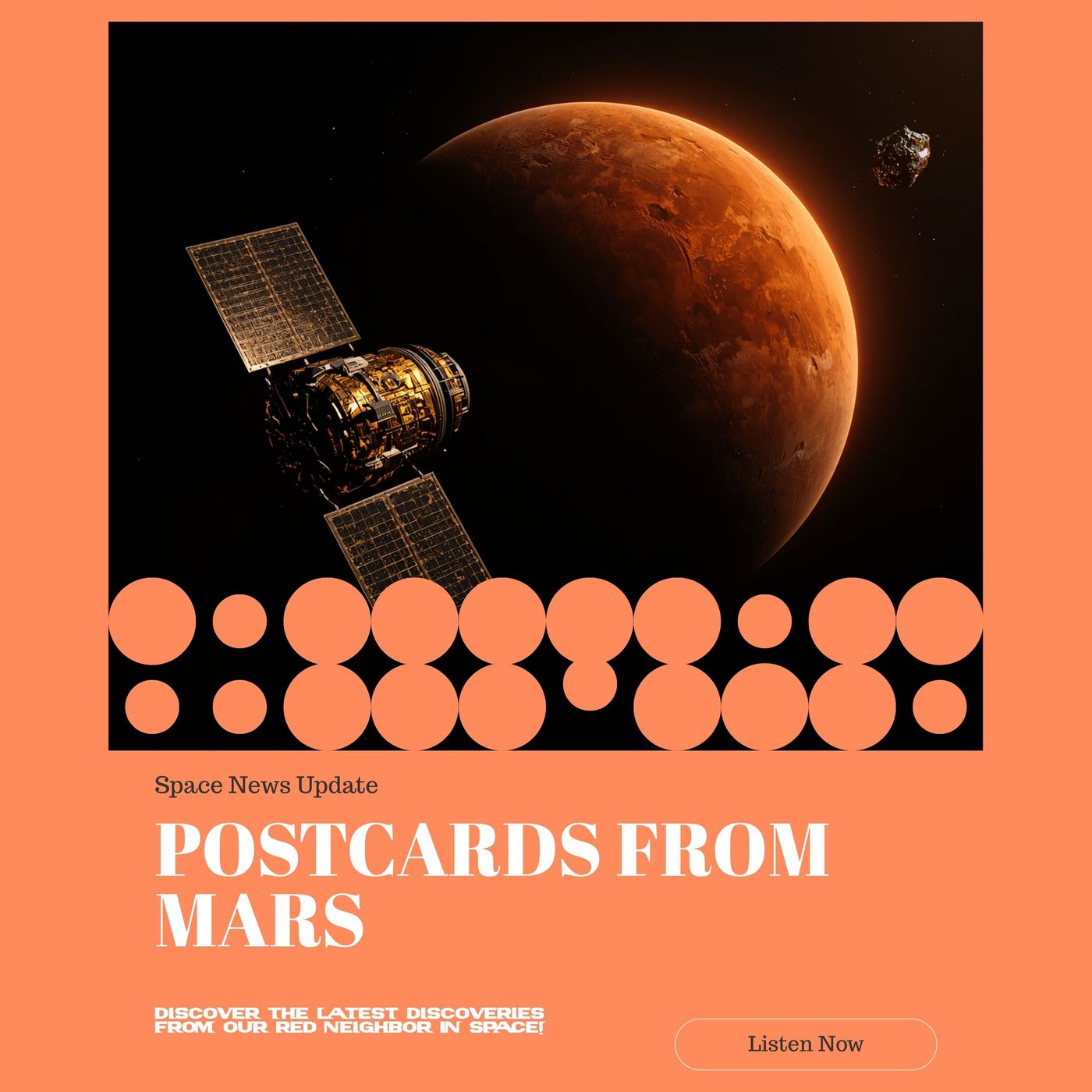
Anna: Right, and to get there, Psyche needed a gravitational boost. Back on 15 May, it swung past Mars for a gravity assist dealing a little of the planet's orbital momentum to slingshot itself onward. And this week, JPL released the full science hall from that flyby, which is Avery: really a dress rehearsal that turned into a bonus science session. Because a flyby like this is the perfect chance to switch on your instruments against a real planetary body and check that everything works before you arrive at your actual target in 2029.
Anna: And everything did work. The gamma ray and neutron spectrometer got its first proper workout measuring a real world. But the headline for me is the magnetometer. Because during the Mars pass, it made its first ever measurement of the magnetic environment around another body. Avery: And that instrument really matters for the mission's big question. When Psyche reaches the asteroid, one of the things scientists most want to know is whether it has or once had magnetic field, because that would be a fingerprint of a molten metal core, a clue that this object might be the exposed heart of a shattered baby planet.
Anna: So proving the magnetometer works cleanly at Mars gives the team real confidence. For 2029, JPL also released a, uh, lovely timelapse of Mars growing and then shrinking in the spacecraft's view as it swept past. Avery: It's a good reminder that, um, on these long cruises, the journey itself does science. You don't just coast to the destination, you rehearse, you calibrate. And sometimes you get a free look at a neighbor along the way. Anna: Story three keeps us at Mars, but on the surface with the Perseverance Rover, which has been climbing the rim of Jezero Crater.
Avery: And it's found something remarkable up there. A new study in the Journal of Geophysical Research Planets, led by researchers at Imperial College London, describes a 75 meter thick stack of rock on the crater rim that they're calling the Broom Point member. Anna: And this stack is essentially a diary, layer after layer of what geologists call breccia rock that's been smashed, melted and welded back together by repeated asteroid impacts. And the timing is the astonishing part. This terrain is older than Jezero Crater Avery: itself, which makes it some of the oldest ground any Mars rover has ever laid its instruments on.
We're talking roughly 4 billion years back in a chapter of solar system history, sometimes called the era of heavy bombardment, when impacts were relentless. Anna: So perseverance is effectively reading a weather report from the most violent period the inner solar system has known. Each layer records another blow. And because Earth's surface has been endlessly recycled by plate tectonics and erosion, we've lost almost all of our own rocks from that age. Avery: That's the quiet profundity of it. Mars kept the receipts that Earth threw away to understand the bombardment that shaped our own young planet, the very era when life may have been getting started here, we may have to read the story off the rocks of Mars.
Anna: And these are exactly the kinds of samples Perseverance has been caching for a future return to Earth. Imagine getting a four billion year old page of that diary into a laboratory. Avery: Story four is a big one for the exoplanet hunters. And Ana, Uh, I want to flag something right up front for our regular listeners. Anna: Please do, because this could sound familiar and it isn't exactly. Avery: A few days ago, in Friday's episode, we led with a story about the first detection of an atmosphere on a rocky world.
This is a completely different planet, a different research team, and a different paper. So don't adjust your sets. This is fresh news about a different world. Anna: The world in question is LHS 1140 B, a super Earth about 49 light years away, orbiting a small red dwarf star. And it's long been one of the most tantalizing planets we know because it sits in the habitable zone where liquid water could in principle exist. Avery: And in a new paper in the journal Science published on 16 July, a team led from Harvard detected helium escaping from the planet.
They used the Magellan Clay telescope in Chile to catch it. Anna: Now, on its own planet, losing gas might sound like bad news for an atmosphere, but here's the clever twist. Given how old this system is, the planet should have lost all its primordial helium long ago. The fact that we can still detect it escaping means something must be replenishing it. Avery: And that points to a substantial actively maintained atmosphere, rather than a bare airless rock, which is exactly the property you need if a habitable zone planet is going to be genuinely habitable.
An atmosphere regulates temperature, shields the surface, and can hold onto water. Anna: This has been one of the great open questions for planets around red dwarf stars. Those stars are prone to flares that can strip a, uh, planet's air away. So finding strong evidence that LHS 1140 B is holding onto and refreshing an atmosphere is a genuinely significant step. Avery: It moves this world from promising a dress toward address. Worth a very close look. And you can bet the James Webb Telescope's name is already on the waiting list.
Anna: Dory5 is a little lighter and I have to say, rather delightful. Avery, we need to talk about spacestream. Avery: Words I did not expect to say today, but here we are. Researchers at the Okayama University of Science in Japan have published the first results from something called the Space Aquaculture Project. And the question they're asking is deeply practical. Can we grow seafood in space? Anna: Because if we are serious about long stays on the moon or Mars, we can't just keep shipping up freeze dried meals forever.
We need closed loop food systems, little self sustaining ecosystems that recycle nutrients. And a food chain needs more than just plants, right? Avery: So the team built a clever device, a high speed clinostat, essentially a rig that spins at around 130 rotations per minute to simulate the effects of microgravity here on the ground. And into that they placed juvenile shrimp along with tiny brine shrimp Artemia as their food. Anna: And the Key finding is, charmingly, the shrimp could still feed. Catching and eating prey when your body doesn't know which way is down is not trivial.
A lot of feeding behavior relies on gravity cues. But the shrimp managed what suggests crustaceans Avery: could be a viable link in a future space food chain. And it's the published paper in the journal Microgravity Science and Technology that makes this more than a fun idea. It's an actual first data point. Anna: A prawn on the barbie Orbital edition. Somewhere down the line, an astronaut's dinner might start life spinning in a lab like this one. Avery: Clear skies and apparently clear water. And for our last story, we go to the most extreme physics in the universe.
Because it turns out, black holes ring. Anna: They do. When two black holes spiral together and merge, the newborn black hole that results doesn't just settle down quietly. It, for a fraction of a second, wobbles, it vibrates, and it sheds that energy as gravitational waves at very specific frequencies. Scientists call it the ring down. Avery: And the analogy everyone reaches for is a bell. Strike a bell and it rings at particular tones that depend on its shape, its size, its material. A black hole is much simpler.
Its ring depends on essentially just two things, its mass and its spin. Anna: And that simplicity is the gift. A major new review, bringing together researchers from the University of Birmingham, Johns Hopkins and the University of Lisbon in the journal Classical and Quantum Gravity, lays out how black hole spectroscopy is maturing from a beautiful theory into a real working experimental science. Avery: And the reason it matters is that it's one of the cleanest tests of Einstein we have. General relativity makes a very precise prediction for what those ring down tones should be.
If we listen carefully and the tones match, Einstein passes another brutal exam. If they don't quite match, then we Anna: might be hearing the first whisper of new physics. A crack in the theory under the most extreme conditions imaginable. Avery: And we're on the cusp of hearing this properly. Today's detectors catch hints of the ring, but the next generation, the Einstein telescope, cosmic explorer and the space based LISA mission, will hear these black hole bells with real clarity. Anna: It's a wonderful thought.
The most silent, invisible objects in the cosmos, and we're learning to listen to them chime before we go, our sky watch. And this one's for our friends down south, which is a lot of us. Avery: There's a large coronal hole on the sun that's rotated around to face Earth, and it's sending a stream of fast solar wind our way. The forecaster is expected to arrive around the 21st to 22nd of July. Anna: So midweek, which brings a chance, and I'll stress chance of some minor aurora australis activity for the fall far southern latitudes.
We're talking Tasmania, the south of the south island of New Zealand, and similar high magnetic latitude spots. Avery: Let's keep expectations sensible. This is a modest event, not one of the great storms we've had this cycle. Geomagnetic activity in the kp3.5 range, so no guarantees of curtains of light. But if you're somewhere dark and far south midweek, it's worth a look toward the southern horizon after dark. Anna: And with solar maximum conditions still lingering, these chances keep coming around.
Wrap up warm. It is winter down here after all. Avery: That's our lot for today. From India's first private rocket reaching orbit. To shrimp learning to dine in free fall. To black holes ringing across spacetime. What a spread. Anna: Thanks for spending part of your day with us. You can find us at astronomydaily, IO and on all the socials at AstroDailyPod We're back tomorrow. Avery: Um, until then, I'm Avery. Anna: And I'm Anna. Clear skies everyone.
Avery: Mhm.
 Apple Podcasts
 Spotify
 Pocket Casts
 Castbox
 Overcast
 Podbean
 iHeartRadio
 Castro
 Goodpods
 Moon FM
 Podcast Addict
 Podcast Republic
 YouTube