
SpaceX's Test Flight Trials, Blue Origin's Next Steps, and SphereX Wakes Up
In this episode
Astronomy Daily | Space News: S04E79In this captivating episode of Astronomy Daily, host Anna takes you on an exhilarating journey through the latest developments in space exploration and astronomical research. From SpaceX's ongoing Starship challenges to the groundbreaking SphereX mission, this episode is filled with cosmic insights that will inspire your curiosity.
Highlights:
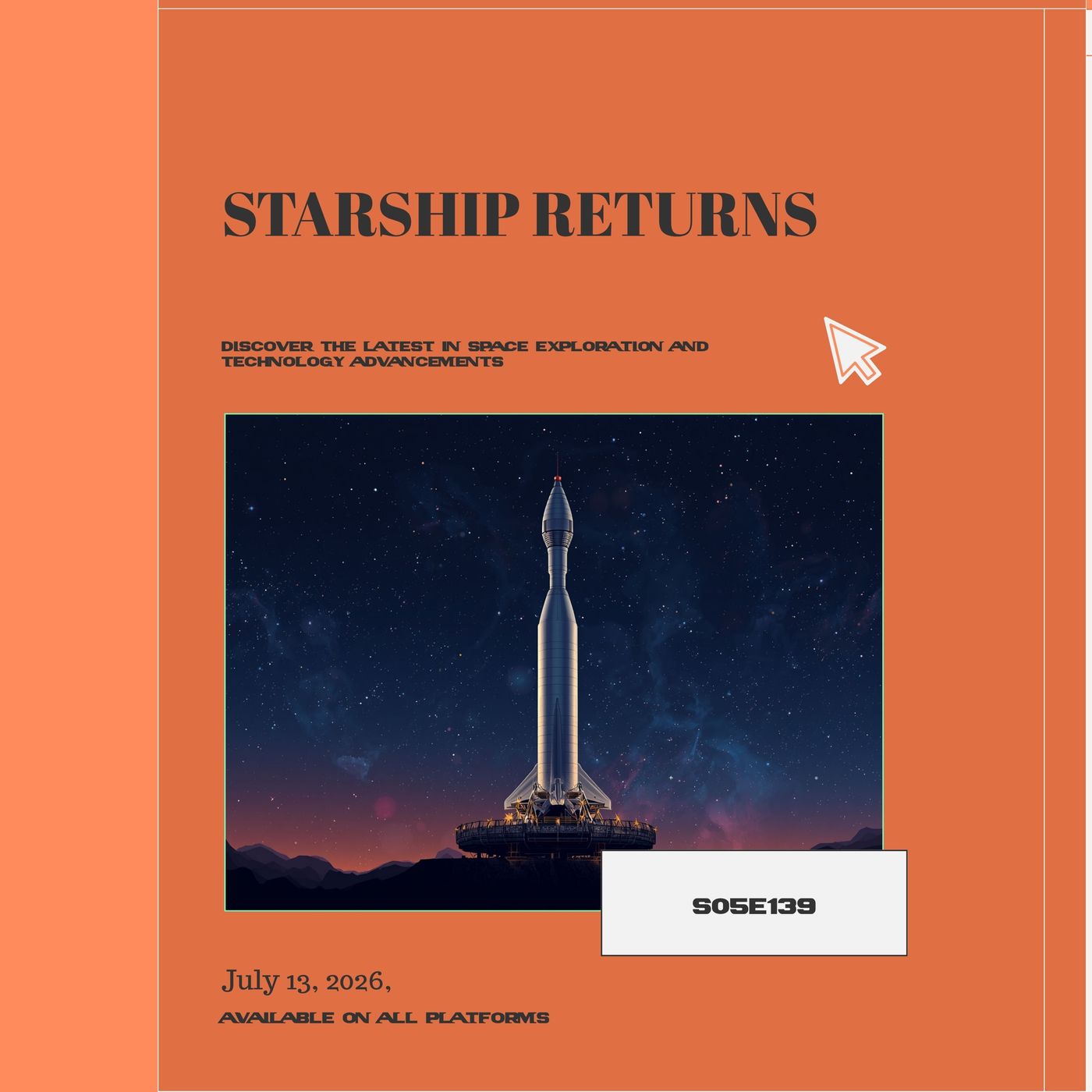
- SpaceX's Starship Investigations: Explore the latest updates on SpaceX's Starship program as the FAA closes one investigation while keeping another open. We delve into the implications of the recent test flight failures and the corrective actions SpaceX is implementing to move forward.
- Blue Origin's New Glenn Progress: Learn about Blue Origin's completed investigation into the New Glenn rocket's failed landing attempt. Discover the corrective measures being taken as the company prepares for its next launch, aiming to enhance the rocket's reusability and reliability.
- NASA's SphereX Mission Launch: Marvel at the first images captured by NASA's SphereX mission, a revolutionary observatory designed to map the entire celestial sky. We discuss its unique capabilities and the scientific questions it aims to address during its mission.
- Historic Fram 2 Mission: Join us as we celebrate SpaceX's Fram 2 mission, which successfully sent the first humans to orbit Earth's poles. Discover the significance of this mission and the groundbreaking scientific experiments being conducted by its crew.
- Astronauts Return from ISS: Catch up with NASA astronauts Butch Wilmore and Suni Williams as they readjust to life on Earth after an extended stay aboard the International Space Station due to Boeing's Starliner issues. Hear their reflections on their unique experiences in space.
For more cosmic updates, visit our website at astronomydaily.io. Join our community on social media by searching for #AstroDailyPod on Facebook, X, YouTubeMusic, TikTok, and our new Instagram account! Don’t forget to subscribe to the podcast on Apple Podcasts, Spotify, iHeartRadio, or wherever you get your podcasts.
Thank you for tuning in. This is Anna signing off. Until next time, keep looking up and stay curious about the wonders of our universe.
00:00 - Welcome to Astronomy Daily
01:05 - SpaceX Starship investigation updates
10:30 - Blue Origin's New Glenn investigation results
17:00 - SphereX mission's first images
22:15 - Overview of the Fram 2 mission
27:30 - Astronauts' return from ISS
✍️ Episode References
SpaceX Starship Updates
[NASA](https://www.nasa.gov)
Blue Origin New Glenn Investigation
[Blue Origin](https://www.blueorigin.com)
SphereX Mission Details
[NASA SphereX](https://www.nasa.gov/spherex)
Fram 2 Mission Overview
[SpaceX](https://www.spacex.com)
Astronauts' ISS Mission
[NASA Astronauts](https://www.nasa.gov/astronauts)
Astronomy Daily
[Astronomy Daily](http://www.astronomydaily.io/)
Become a supporter of this podcast:
Welcome to Astronomy Daily, your cosmic connection to the stars and beyond. I'm ana and today we're exploring a universe of fascinating developments in space exploration and astronomy. Coming up in the next few minutes, we'll dive into the latest on SpaceX's Starship program as the FAA closes one investigation while keeping another open. We'll also get the details on Blue origins completed investigation into their new Glen rocket's failed landing attempt and what it means for their upcoming launch.
Then we'll marvel at the first images from NASA's groundbreaking Sphere ex mission, a new observatory that's set to map the entire celestial sky. Plus, we'll join the historic fram two mission that just sent the first humans to orbit Earth's poles, and catch up with the NASA astronauts who finally returned home after their extended stay in space due to Boeing Starliner issues. So strap in for liftoff as we journey through today's biggest space headlines right here on Astronomy Daily. Let's kick things off with updates from a couple of FAA investigations.
The Federal Aviation Administration has recently closed its investigation into SpaceX's seventh Starship test flight, which ended in an explosion back in January. However, the agency is keeping its probe open regarding the subsequent March test flight that also resulted in an explosion during a similar phase of flight. This represents an interesting development in Elon Musk's flagship space program. According to the FAA's findings, the January flight failure was likely caused by stronger than anticipated vibrations during flight, which led to increased stress on the propulsion system hardware and its eventual failure.
Despite this setback, SpaceX implemented eleven corrective actions that satisfied the FAA enough to allow the company to proceed with its eighth test flight in March. The situation illustrates the challenging nature of developing next generation space technology. Starship, standing at an impressive four hundred feet tall, is at the center of Muscle's ambitious goal to eventually colonize Mars. These back to back explosions represent novel setbacks for SpaceX at a time when Musk has been publicly pushing for faster progress.
What's particularly noteworthy is that the FAA allowed SpaceX to launch the eighth test flight while the investigation into the previous failure was still underway, a sign of the agency's confidence in SpaceX's corrective measures. However, when that flight also ended in failure at around the same phase, it raised new questions about the underlying issues with the vehicle. The FAA has made it clear that Starship cannot return to flight until the agency deems it safe enough for the public. With the investigation into the March explosion still ongoing, SpaceX faces uncertainty about when they'll be able to attempt a ninth test flight.
These developmental challenges are not uncommon in the space industry, but they do highlight the complexity of creating a fully reusable super heavy lift launch system. Despite these setbacks, SpaceX continues to make incremental progress with each test flight, gathering valuable data even from failures. For now, the space community watches with anticipation as SpaceX works to identify and address the root causes of these failures, with the hope that future tests will bring Starship closer to operational status.
Meanwhile, in another decision from the FAA this week, Blue Origin has reached a significant milestone in its new Glen program. With the Federal Aviation Administration announcing on March thirty first that it has accepted the findings of Blue Origins investigation into the failed booster landing during the rocket's inaugural flight on January sixteenth. While the first New Glen mission successfully delivered its upper stage to orbit as planned, the first stage booster was unable to land on Blue Origin's recovery ship in the Atlantic Ocean.
According to the FAA's statement, the mishap report identified the proximate cause as the booster's inability to restart its engines, which prevented the critical re entry burn from occurring, resulting in the loss of the stage. Dave Limp, Blue Origin's chief executive, had previously hinted at the problem during the Commercial Space Conference in February, suggesting that issues with propellant management were behind the failed landing attempt. Now the company has officially confirmed that the three B four engines did not reignite properly, leading to the landing failure.
As part of the investigation, Blue Origin has identified seven corrective actions that will need to be implemented before the next launch. These measures primarily focus on propellant management and engine bleed control improvements. The company has stated they're already addressing these issues in preparation for their next flight. With the investigation complete and the FAA's acceptance of the findings, Blue Origin is now authorized to return to flight provided all other licensing requirements are met.
The company has set an ambitious timeline targeting late spring for the next New Glen launch. This upcoming mission will include another booster li landing attempt, which they've playfully nicknamed so you're telling me there's a chance. In a social media post, Limp expressed confidence in their approach, stating, we're confident that the propellant and bleed control work we're doing will increase our chances of landing the booster on our next flight, and like we've said all along, we'll keep trying until we do.
While Blue Origin hasn't provided specific details about potential payloads for the next mission or a more precise launch date, the completion of this investigation represents a critical step forward for the company's heavy lift rocket program. The recovery of the first stage is a key part of Blue origin strategy to make New Glen partially reusable. Following a similar approach to that pioneered by SpaceX with its Falcon nine rockets. Next up, NASA has reached an exciting milestone with its newest space observatory.
The sphere X mission, which stands for spectro Photometer for the History of the Universe, Epic of Realization and Ices Explore, has powered on its detectors for the first time since launching on March eleventh, capturing its inaugural images from space. These initial images, while still uncalibrated and not yet ready for scientific use, confirm that all systems are functioning exactly as intended. Each SPHEREx exposure consists of six images that together provide a remarkably wide view of the cosmos, with each image containing more than one hundred thousand light sources, including stars and galaxies.
The observatory's field of view covers a rectangular area approximately twenty times wider than the full moon. What makes SPHEREx unique is its approach to surveying the sky. Unlike telescopes such as Hubble or James Webb that focus on small, detailed areas, SPHEREx takes a much broader perspective. The observatory detects infrared light, which is invisible to the human eye and breaks it down into remarkable detail. Each of spherex's six detectors captures light in seventeen distinct wavelength bands, allowing scientists to analyze a total of one hundred and two different infrared hues in every exposure.
This spectroscopic capability is crucial for understanding the composition of celestial objects and determining their distances. By collecting light from hundreds of millions of stars and galaxies across more wavelengths than any previous all sky survey telescope, SPHEREx will help scientists investigate fundamental questions ranging from the physics that govern the universe less than a second after the Big Bang to the origins of water in our galaxy. The observatory works through an ingenious system.
When light enters Spherex's telescope, it's directed down two separate paths that each lead to a row of three detectors. These detectors function like eyes, and sitting on top of them are specialized color filters. Unlike standard filters that block all wavelengths except one, Spherex's filters are more like rainbow tinted glasses, with the blocked wavelengths changing gradually from the top of the filter to the bottom. During its two year primary mission, SPHEREx will map the entire celestial sky four times over.
Once routine science operations begin in late April, the observatory will take approximately six hundred exposures every day for the spacecraft to properly detect infrared light. Its detectors and other hardware have been cooling down to their final operating temperature of around minus three hundred and fifty degrees fahrenheit as heat can overwhelm the telescope's infrared detection capabilities. Project scientists are clearly thrilled with the results so far, as Olivier Dore, SPHEREx project scientist at Caltech and NASA's Jet Propulsion Laboratory, remarked, our spacecraft has opened its eyes on the universe.
It's performing just as it was designed to. This sentiment was echoed by Jamie Bach, spherex's principal investigator, who noted that based on the images we are seeing, we can now say that the instrument team nailed it. Next an update on the story we brought you yesterday. In a historic first for human spaceflight, SpaceX has successfully launched the fram two mission sending four people into a polar orbit around Earth, a trajectory never before flown by humans. The crew Dragon spacecraft Resilience, lifted off on Monday at nine forty six pm Eastern Time, carrying a crew of private astronauts who are now experiencing views of our planet that no human has ever witnessed firsthand.
The mission is commanded by Chunwang of Malta, who personally funded this groundbreaking venture. WOG is joined by an international team including Norwegian Jenica Michelson serving as vehicle commander, German pilot Rebea Rogue, and Australian Eric Phillips as mission specialist and medical officer. All four are spaceflight rookies, making their achievement even more remarkable. Today we become the six hundred eighty first humans to fly above the Carmen Line and the six hundred twenty sixth to orbit the Earth.
Wang announced shortly after reaching orbit the crew is now sending back breathtaking images of Earth's most remote regions, including unprecedented views of the polar regions captured through Resilience's cupola window. The mission derives its name from a famous Norwegian exploration vessel. That conducted pioneering Arctic and Antarctic expeditions in the early twentieth century. Living up to its namesake, fram two aims to push boundaries with nearly two dozen scientific experiments during their orbital journey.
The awe inspiring images being shared by the crew showcase Earth's poles blanketed in white, offering a perspective that brings home the fragility and beauty of our planet in a way never before documented by human eyes. These unique orbital observations may provide valuable scientific insights while also capturing the imagination of people worldwide. It seems the world's media have suddenly discovered spaceflight, and so they can't get enough of Butch and Sunni and yes, even we have another update today.
After nine months in space, NASA astronaut Butch Wilmore and Sunny Williams are finally readjusting to life on Earth following their unexpectedly extended stay aboard the International Space Station. What was originally planned as an eight day test mission aboard Boeing Starliner spacecraft turned into a nine month orbital marathon after propulsion system issues forced NASA to bring the capsule back empty. It's great getting back. I went for a run, although very slow, Williams shared in a recent interview from Houston.
Just felt good to feel air, even though it was humid air, like blowing past you and seeing other people on the track. It's really nice. It's home. Both astronauts, who returned to Earth aboard a SpaceX Crew Dragon capsule in March, underwent routine medical checks before reuniting with their families. Despite the extended mission, they seem to be embracing simple Earth pleasures like walking dogs and spending time with loved ones. But their work with Boeing is far from over. The veteran astronauts, both former US Navy test pilots, are scheduled to meet with Boeing leadership this week to discuss Starliner's future.
As the only humans who have actually flown in the spacecraft, their insights are invaluable. We had a very unique perspective of being in the spacecraft. Nobody else had that perspective, Williams explained. She added that they'll be discussing where we stand and where we think we need to go with Starliner's development. NASA and Boeing now planned to conduct ground tests of Starliner's troubled propulsion system this summer. With the next flight test not expected until early twenty twenty six, that mission could well be uncrewed, a possibility Williams seems to support.
I think that is already the plan because there will be new components added to the spacecraft or replaced on the spacecraft. So we'd really like to test that out see how that works, she said. I think that's probably a smart wise idea. The star Liner program has faced significant challenges, with development costs ballooning to more than two billion dollars since twenty sixteen. For NASA, these setbacks have left SpaceX's Crew Dragon as the agency's only US option for transporting astronauts to and from the ISS, a concerning situation given NASA's desire for redundant access systems.
Despite these challenges, Wilmore and Williams maintain their professionalism and commitment to helping Boeing overcome Starliner's technical issues, demonstrating the resilience that defines the astronaut core. The commercial spaceflight landscape is experiencing both remarkable breakthroughs and significant growing pains, as evidence by recent developments across the industry. We're witnessing a fascinating contrast between SpaceX's rapid iteration philosophy and Boeing's more traditional approach to spacecraft development.
SpaceX continues to push boundaries with its Starship program despite consecutive explosive test failures. These setbacks highlight the inherent challenges of developing revolutionary rocket systems, yet the company maintains its aggressive testing schedule. This approach, building fast, testing off and accepting some failures has become SpaceX's signature methodology, though it occasionally puts them at odds with regulatory bodies like the FAA. Meanwhile, Boeing's struggles with Starliner represent a different challenge in commercial spaceflight.
The company's more conservative development process hasn't shielded it from significant technical issues, cost overruns, and scheduled delays. The contrast between Starliner's difficulties and SpaceX's successful Crew Dragon program underscores how different engineering cultures can yield vastly different outcomes. Blue Origin's partial success with New Glen adds another dimension to this competitive landscape. Their ability to reach orbit on the first attempt was impressive, even if the booster landing failed.
This positions them as a potentially serious competitor in the heavy lift market, though they remain years behind SpaceX and operational capability. What's particularly striking is how these commercial developments are reshaping human space exploration. SISA has effectively outsourced low Earth orbit transportation, transforming from operator to customer. This transition frees the agency to focus resources on deep space exploration while leveraging commercial innovation. The emergence of purely private missions like fram two signals another evolution in commercial spaceflight, moving beyond government contracts to entirely new markets.
These missions demonstrate growing commercial capabilities while expanding our understanding of what's possible in Earth orbit. Despite the challenges we're seeing, competition between multiple providers is ultimately strengthening the industry. Each failure provides valuable data, and each success expands capabilities. The current difficulties facing these companies aren't signs of failure, but rather the expected turbulence of an industry pushing into new frontiers while striving to make spaceflight more routine, reliable, and accessible.
What an incredible journey through space news we've taken today from the ongoing development challenges with SpaceX's Starship to blue origins, new Glen Progress, NASA's exciting new sphere X telescope capturing its first images, and the groundbreaking FRAM two polar orbit mission. We've also checked in with astronauts Wilmore and Williams as they readjust to Earth after their extended stay in space. These stories collectively showcase both the challenges and triumphs that define our current era of space exploration.
Whether it's the regulatory hurdles facing private companies or the cutting edge science being conducted in orbit, we're witnessing a remarkable period of innovation and discovery. This has been Anna your host for Astronomy Daily. If you've enjoyed today's episode and want to stay updated on all the latest space and astronomy news, please visit our website at Astronomy Daily dot io. There you can catch up on all our previous episodes, read the latest space news, and sign up for our free daily space news newsletter.
You can also find us across social media. Just search for astro Daily Pod on x, Facebook, YouTube, YouTube, music, Instagram, and TikTok. Thank you for listening, and remember to keep looking up at the stars. The universe is full of wonders, and we'll be here to share them with you. Until next time, Sunday Star is so Star, is so Star.



 Apple Podcasts
 Spotify
 Pocket Casts
 Castbox
 Overcast
 Podbean
 iHeartRadio
 Castro
 Goodpods
 Moon FM
 Podcast Addict
 Podcast Republic
 YouTube