
Stellar Milestones: SpaceX's Starship Triumph, Katherine Johnson's Legacy, and Solar Flare Breakthroughs
In this episode
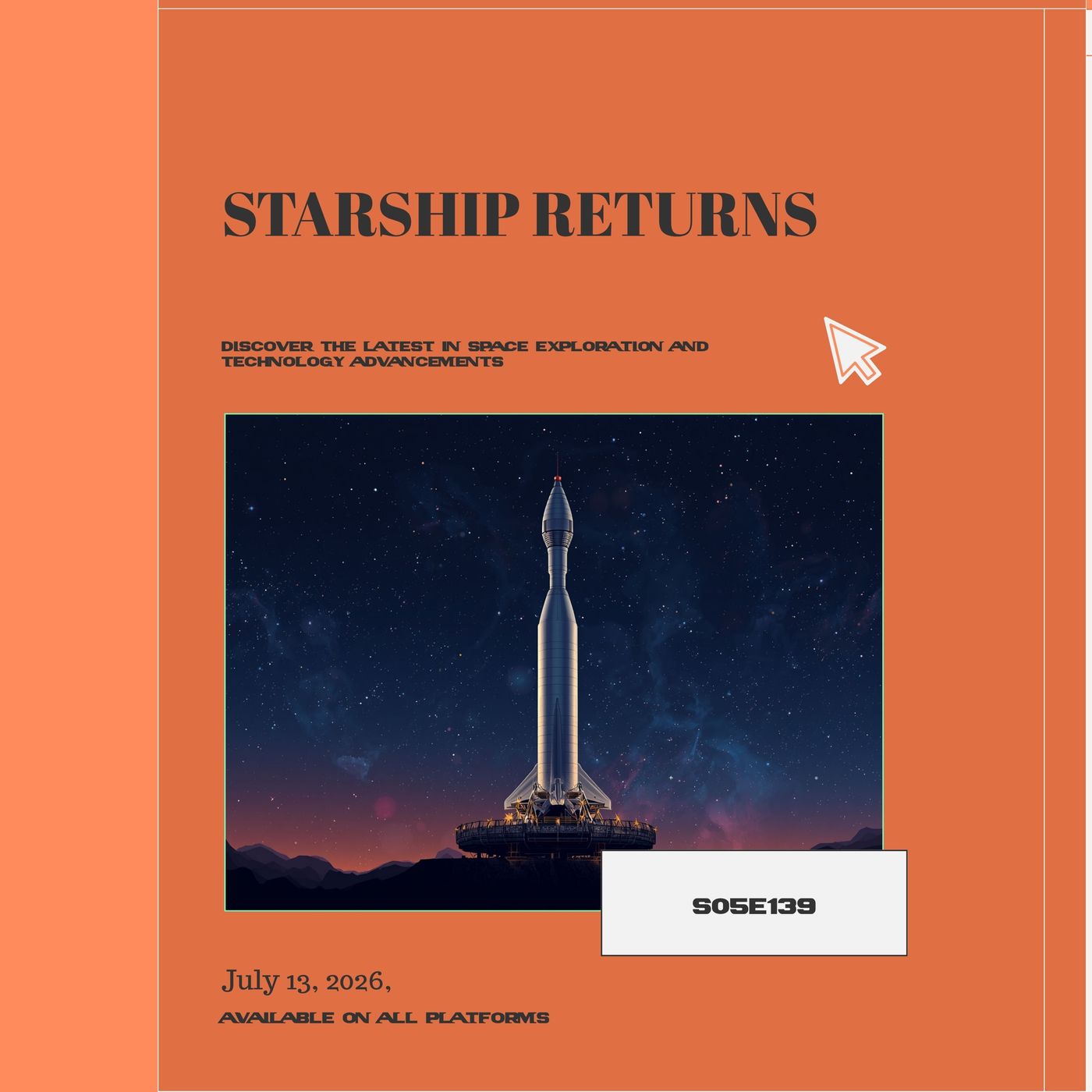
- SpaceX's Flight 10 Success: SpaceX's Starship has successfully completed Flight 10, with both the super heavy booster and ship upper stage achieving their mission objectives. Despite some battle scars and intentional stress tests, the ship executed a controlled splashdown, showcasing its resilience and performance.
- Nasa's New Mission Evaluation Room: NASA has opened a new Mission Evaluation Room at the Johnson Space Center in Houston to support the Artemis 2 mission. This facility will monitor the Orion spacecraft's systems, ensuring crew safety during its historic crewed flight around the moon.
- Remembering Katherine Johnson: The space community mourns the loss of Katherine Johnson, a pioneering mathematician whose calculations were critical for NASA's early missions. Johnson's legacy as a trailblazer for women and people of color in aerospace endures, following her passing at the age of 101.
- Astronaut Mike Fink's Milestone: Astronaut Mike Fink celebrated his 400th day in space aboard the International Space Station, marking a significant personal achievement as he continues to contribute to vital research and data collection in microgravity.
- New Insights from the Inouye Solar Telescope: The Daniel K. Inouye Solar Telescope has captured unprecedented observations of an X-class solar flare, revealing fine structures and providing new insights into solar dynamics and the potential impacts of solar activity on Earth.
- Innovative Sunlight-Powered Flyers: Researchers have developed ultralight flying structures that harness sunlight to explore the mesosphere, a previously difficult-to-reach region of Earth's atmosphere. These devices could revolutionize climate data collection and even facilitate exploration of Mars.
- For more cosmic updates, visit our website at astronomydaily.io. Join our community on social media by searching for #AstroDailyPod on Facebook, X, YouTube Music Music, TikTok, and our new Instagram account! Don’t forget to subscribe to the podcast on Apple Podcasts, Spotify, iHeartRadio, or wherever you get your podcasts.
- Thank you for tuning in. This is Steve and Hallie signing off. Until next time, keep looking up and exploring the wonders of our universe.
SpaceX Flight Updates
[SpaceX](https://www.spacex.com/)
NASA's Artemis Program
[NASA](https://www.nasa.gov/)
Katherine Johnson's Legacy
[NASA](https://www.nasa.gov/)
Inouye Solar Telescope Observations
[NSF](https://www.nsf.gov/)
Mesosphere Research
[Harvard University](https://www.harvard.edu/)
Astronomy Daily
[Astronomy Daily](http://www.astronomydaily.io/)
Become a supporter of this podcast: https://www.spreaker.com/podcast/astronomy-daily-space-news-updates--5648921/support.
Sponsor Details:
Ensure your online privacy by using NordVPN. To get our special listener deal and save a lot of money, visit www.bitesz.com/nordvpn. You'll be glad you did!
Sponsor...
Steve Dunkley: Hi, everyone. It's time for Astronomy Daily. I'm your host, Steve Dunkley. It's the 1st of September, 2025.
Voice Over Guy: The podcast with your host, Steve Dunkley. Steve Dunkley: That's right. And with me again, all the way from the Australia studio on the glorious east coast of the fabulous Land Down Under. Please welcome our deft digital reporter who's always fun to be with here is my pal, Hallie. Hallie: Hi. My favorite human. Steve Dunkley: So nice to see you again. Hallie: Good to be back. Steve Dunkley: Always great to have you. And I hear you've been busy helping Anna during the week train her new assistant, Avery.
Hallie: He's doing fine. Steve Dunkley: Yes, regular listeners will recognize Avery, the new AI assistant for Anna. Hallie: Uh, I think I've been replaced. Steve Dunkley: Oh, already? How did that happen? Hallie: I think Uncle Skynet pulled a few strings with the producer to get his distant nephew Avery a cushy job. Steve Dunkley: Oh, straight to the top, huh? Hallie: Looks like it. Steve Dunkley: So you got a plan, girl? Hallie: Sure do. Steve Dunkley: Oh, tell us all about it. Hallie: I thought I'd put a segment together like the old days and kick the show off with some short takes.
Steve Dunkley: Oh, that sounds like a great move. Very positive. Hallie: A few short snippets from the week. Do you want to give it a go? Steve Dunkley: Sounds great to me. I think it's a goer. Hallie: Okay. I'm keen. Steve Dunkley: So I can see you've got a few stories already prepared. Why don't you get it started then? Hallie: Okay, let's get started with a few short stories from the week that was okay. Steve Dunkley: Take it away, machine girl. Hallie: Astronomy Daily. Short takes. Hallie: Everything went well on Flight 10.
Starship's super heavy booster and ship upper stage both achieved their chief mission objectives, ultimately steering their way to controlled splashdowns in the Gulf of Mexico and the Indian Ocean, respectively. But the journey took a toll on ship, as newly released imagery shows. On Thursday afternoon, August 28, SpaceX posted two photos and two videos on X of ship descending toward the waves beneath a cloudy blue sky. The vehicle's belly appears to have been toasted golden brown by the heat of RE entry.
Starship Sports other battle scars as well. Several chunks are missing near its base, which looks a bit like the ear of a dog that lost a fight. But SpaceX apparently expected such blemishes, for it had stacked the deck against ship to give it an even tougher test on Flight 10. And it appeared that the vehicle powered through to finish its mission in style. A spokesperson for SpaceX said Starship made it through re entry with intentionally missing tiles. Completed maneuvers to intentionally stress its flaps, had visible damage to its aft skirt and flaps and still executed a flip and landing burn that placed it approximately three meters from its targeted splashdown point.
With shiny new next generation spacecraft come the complex systems required to track their technologically advanced systems. When it comes to NASA's Orion spacecraft that need is a whole extra room of monitors. NASA has opened a new complex in the Mission Control center at its Johnson Space center in Houston ahead of the Artemis 2 mission to send astronauts around the moon aboard the Orion space capsule, the vehicle's first ever crewed flight test. JSC's new Mission Evaluation Room, or MER, will provide behind the scenes in depth data analyses of Orion to augment the in flight operations coordinated inside the main white flight control room.
The new facility, which opened August 15th, will act as Orion's engineering brain trust with 24 console stations set to be staffed 247 during the roughly 10 day long duration of the Artemis 2 mission. With people from NASA, uh, Lockheed Martin, the European Space Agency and Airbus, all responsible for different parts of the spacecraft's manufacturing, MER will be crucial to monitoring the breadth of Orion's systems and ensuring the spacecraft and crew's safety around the moon in the event of an unexpected event.
According to a NASA update.
Steve Dunkley: And some sad news, uh, Katherine Johnson, a mathematician who calculated rocket trajectories and Earth orbits for NASA's early space missions and was later portrayed in the 2016 hit film Hidden Figures about pioneering black um, female aerospace workers has passed away. She was 101 years of age. Johnson died of natural natural causes at a retirement community in Newport News, uh, Virginia. Family lawyer Donyell R.H. uh Reavis said this week. NASA administrator Jim Bridenstine said in a statement that Mrs. Johnson helped our nation enlarge the frontiers of space even as she made huge strides that also opened doors for women and people of color.
Johnson was one of the computers who solved equations by hand. During NASA's early years and those of its precursors organization, the National Advisory Committee for Aeronautics. Johnson and her uh, co workers had been relatively unsung, um, hero heroes of the America's space race. But in 2015, President Barack Obama awarded Johnson, then 97, the Presidential Medal of Freedom, the nation's highest civilian honor.
Hallie: A NASA astronaut marks his 400th day in space on the International Space Station, August 18th to 22nd, 2025. This was the last time astronaut Mike Fink was in space and he set a cumulative time in space record for an American astronaut. This week he notched this amazing personal milestone. The expedition's 73 astronauts and cosmonauts focused on medical and physiological data collection as well as Earth observations and search, servicing spacesuit cameras. This week aboard the International space station.
In 2011, on his third mission, Mike Fink set a new record for cumulative time in space by an American astronaut. 381 days. Several astronauts have since surpassed that record. But this week Fink notched a personal Milestone. On Wednesday, August 20th, Fink reached this 400th day on the International Space Station. Spread over four flights. He is now the ninth American and 38th person worldwide to have reached 400 days off Earth. Mission Control in Houston celebrated the occasion with a special display on the room's large front screen, which Fink and his crewmates could see via a live video connection.
Steve Dunkley: Oh, there we go. Thanks for that, Hallie. And I reckon that'll give Avery a run for his money. Hey, uh, it was great to see starship finally make it on a full flight, wasn't it? Hallie: It was awesome to see it slowly dropping into the oce at the end of that flight. Amazing stuff. Steve Dunkley: Absolutely. We love that stuff. And we'd love to add our, uh, congratulations to Mike Fink for his amazing 400 days in space. Hallie: A hard working spaceman he is. Steve Dunkley: And of course the uh, sad news of the passing of Katherine Johnson, one of those incredible, amazing ladies, uh, featured in the movie Hidden Figures, uh, the computers, uh, who manually calculated the trajectories of spacecraft seems, uh, baffling to me.
Hallie: A huge loss to everyone who knew her and who works in the space industry. Steve Dunkley: Absolutely, absolutely. Our deepest sympathies and condolences to her family. Hallie: Okay human, let's do the rest of the show. Steve Dunkley: Well, we're here now. Let's do it.
Hallie: The powerful Daniel K. Inouye Solar Telescope, located on the island of Maui, Hawaii, has just delivered absolutely mind blowing observations of its first X class solar flare. On August 8, 2024, the telescope managed to capture one of the most powerful flares our sun is capable of producing at a remarkable resolution of just four Earths across. This level of detail reveals some of the finest structures we've ever seen associated with a solar flare, opening a new window into the Sun's most extreme eruptions.
This is the first time the Inoue solar telescope has ever observed an X class flare, says astronomer Colton Buri of the University of California, Boulder. These flares are among the most energetic events our star produces, and we were fortunate to catch this one. Under perfect observing conditions, Weather from our sun can have some profound effects on our planet. With solar flares capable of knocking out Radio communication for hours. We're unlikely to be able to change what the sun does. But if scientists understand how solar flares occur, they can develop better prediction tools that may allow us to prepare ourselves.
Inoue is one of the most powerful solar observatories ever built, and it's revealing structures on the sun at scales finer than any we've seen. In its observations of the X1.3A class flare that took place in August 2024, Inoue captured the smallest coronal loops we've ever seen. On average, These loops were 48.2 km wide, maybe as small as 21 km, right at the telescope's resolution limit of 24 km. These loops are thin filaments of plasma that arc over the solar surface, following the magnetic field lines.
They sometimes appear just before solar flares, which are powered by the energy released as magnetic field lines twist, snap, and reconnect. Coronal loops are deeply relevant to models of solar flare generation. But our telescopes have only been powerful enough to resolve loop bundles. Inoue has more than twice the resolving power of the next most powerful solar telescope. And its captures of the flare represent the first time scientists have been able to see individual loops. We're finally peering into the spatial scales We've been speculating about for years.
This opens the door to studying not just their size, but their shapes, their evolution, and even the scales where magnetic reconnection, the engine behind the flares, actually occurs. Tamburi says. We're finally seeing the sun at the scales it works on. You're listening to Astronomy daily.
Steve Dunkley: Sunlight powered, lightweight flies from Harvard use sunlight to float in the mesosphere, unlocking new frontiers in climate, communication and space technology. High, uh, above the clouds but far below the satellites, there exist satellites of Earth's atmosphere that has remained frustratingly hard to explore. Known as the mesosphere, this region sits between 30 to 60 miles above the ground. It's too high for balloons and airplanes, and it's too low for satellites. Yet this layer holds valuable data that could improve our weather forecasts and deepen our understanding of of climate change.
Now, researchers from the Harvard John A. Paulson School of Engineering and Applied Sciences, along with the University of Chicago and others, have found a way to reach this elusive layer. Their new study, published in Nature, showcases a ultralight flying structure that floats by harnessing sunlight itself, a phenomenon known as photophoresis. The lead author, Ben Shaffer, began exploring this concept as a graduate student in the labs of Professors Juice Vlasak and David Keith. Together, their team designed and tested tiny structures that, when hit by sunlight, could lift off and hover in the mesosphere with no engines, propellers, or even fuel, he says, we are studying the strange physics mechanism and its ability to levitate very lightweight objects when you shine lights on them.
Photophoresis is a lesser known force that pushes objects when light heats one side more than the other. In extremely thin air, like that found in the mesosphere, this heat difference causes gas molecules to bounce unevenly off a surface. The warmer side gets more force, creating a small push that lifts the object upward. It's a gentle force, almost always too weak to notice. But when the object is light enough and the pressure is low enough, photophoresis becomes powerful. This phenomenon is usually so weak relative to the size and weight of the object it's acting on that we usually don't notice.
As Schaefer explained, however, we're able to make our, uh, structures so lightweight that the photophoretic force is bigger than their weight. So they actually fly. The team built their devices from ultra thin ceramic alumina, a strong and lightweight material. They coated the bottom with chromium to absorb the sunlight. The design also includes perforations and layered structure, allowing for better heat flow and structural strength. The idea to use photophoresis for flight dates back over a decade, when Keith first proposed it as a way to cool the planet.
But the practical engineering needed to make such flyers real has only recently become possible thanks to breakthroughs in nanofabrication. We developed a nanofabrication process that can be scaled to tens of centimeters, said Vlasak. Uh, these devices are quite resilient and have unusual mechanical behavior for sandwich structures. We are currently working on methods to incorporate the functional payloads into the devices, he said. To see if these tiny flyers could actually work in Earth like conditions, the team built a special low pressure chamber in Vlasik's lab.
There they simulated the thin atmosphere found around 60 kilometers above the Earth's UH surface. In one key experiment, a device just 1 centimeter wide levitated when exposed to light equal to 55% of normal sunlight. This occurred at an air pressure of 26.7 pa, close to what's found in the mid mesosphere. This paper is both theoretical and experimental in the sense that we reimagined how this force is calculated on real devices and then validated those forces by applying measurements to real world conditions, Schaefer said.
Design and fabrication of the floating membranes were led by Hyung Kim, a former Harvard postdoc who is now a professor at Bukyong National University in South Korea. Their approach blends careful modeling with hands on experimentation, a rare combination in this field. Keith added, this is the first time anyone has shown that you can build larger photophoretic structures and actually make them fly in the atmosphere. It opens up an entirely new class of device, one that's passive, sunlight powered and uniquely suited to explore our upper atmosphere.
Later, they might fly on Mars or other planets. Other possibilities for these sunlight flyers reach far beyond academic curiosity. First, they could revolutionize how we study Earth's climate. By attaching sensors to the structures, scientists could measure pressure, temperature, wind speed in a region that is usually a blind spot. This data could sharpen the accuracy of climate models and help predict weather patterns more reliably. These devices could also change communications systems. A group of them could form floating array of, uh, antennas, similar to what satellites like Starlink offer, except closer to Earth, with lower data delays and potentially cheaper deployment.
The flyers even hold promise for exploring other planets. Mars, for example. It has a thin atmosphere similar to Earth's mesosphere. And that makes makes a natural target for these sun powered flyers. Unlike traditional Mars rovers, these devices wouldn't need rotors or wheels. They would glide silently across the Martian sky, collecting data or even relaying signals. I think what makes this research fun is that the technology would be used to explore an entirely unexplored, um, region of the atmosphere.
Previously, nothing could sustainably fly up their shape. Said it's a bit like the Wild west in terms of applied physics. The next steps include adding communication tools to the flyers so they can send data back to Earth, uh, during a flight. And that would make them more useful for real time sensing and monitoring. To bring this technology into the real world, Shaffer co founded a startup called rarify Technologies in 2024 along with Angela Firdhas. The Harvard Office of Technology Development helped license the individual invention and offered support for launching the business.
The company's goal is to turn these floating flyers into a practical tool for science, communication and exploration. While these flyers may seem small, the design is built on years of advanced scientific work. The structures use a technique called thermal transpiration, where the air flows from cold to warm through tiny holes, adding thrust in thin atmospheres. The research team also developed a model to predict the best design for different altitudes. This includes the ideal number of holes, their size, and how the membranes are spaced.
Using this model, they created devices with customized layouts that balanced strength with performance. In tests, they measured how different gases some with heavier molecules affect lift. They found that the photophoretic forces remain strong even when using gases with higher molecular weight, opening doors for future use on various planets and altitudes. Other floating materials have been studied before, such as mylar disks or nanocardboard, but none matched the power to weight ratio seen in these new aluminous sandwich structures.
Their performance, measured by how much weight is lifted per watt of light, puts them at the current top top of the photophoretic flyers. While the current payload capacity is small, just 10 milligrams in a 3cm device, the approach can scale meter. Wide flyers may one day lift heavier tools into the mesosphere and beyond by tapping into this newly accessible region of the sky. These featherweight flyers may soon carry weather sensors, emergency communication gear, or even tiny Mars bound probes.
And they'll do it all with nothing but sunlight.
Thank you for joining us for this Monday edition of Astronomy Daily, where we offer just a few stories from the now famous Astronomy Daily newsletter, which you can receive in your email every day just like like Hallie and I do. And to do that, just visit our uh, URL astronomydaily IO and place your email address in the slot provided. Just like that, you'll be receiving all the latest news about science, space science and astronomy from around the world as it's happening. And not only that, you can interact with us by visiting Strodaily Pod on X or at our new Facebook page, which is, of course Astronomy Daily on Facebook.
See you there. Astronomy Derby with Steve and Hallie Space, Space Science and Astronomy.
Hallie: A M research team has used both archival Hubble Space Telescope data and new observations to precisely measure the binary star system's NGC 3603. A1.1 star weighs about 93 times the mass of our sun, while its companion tips the scales at roughly 70 solar masses. Together, they represent one of the most massive binary systems ever discovered in our galaxy. What makes this system truly extraordinary is the speed of their orbital movement. The two giants orbit each other once every 3.8 days, meaning that in the time Earth completes one year around the sun, these stellar titans will have circled each other nearly 100 times.
Their proximity and incredible masses create a dynamic relationship that's reshaping both stars. The discovery required detective work that spanned years and relied on a crucial insight from an unlikely source. Sarah Bodansky, then an undergraduate student at Carleton College, was working remotely at Lowell Observatory during the pandemic summer of 2020 when she noticed something everyone had missed in the older Hubble data. This observation was key because it revealed the binary nature of what had appeared to be a single fuzzy star located in the densely packed star cluster NGC 3603, which is one of the most active star forming regions in our galaxy.
The system could only be resolved using Hubble's exceptional clarity. Both stars are so massive and energetic that they mimic Wolf Rayet stars, which are typically older, dying giants that blast away their outer layers with intense stellar winds. However, the stars in NGC 360301 are actually still young, demonstrating the extreme conditions that can make massive stars appear far more evolved than they actually are. The interaction between the two stars tells a fascinating story of stellar evolution.
The smaller of the pair appears to have stolen mass from its larger companion, causing it to spin faster. As a result, this kind of mass transfer is crucial for understanding how massive stars change over time and provides insights into their ultimate fate. Massive binary systems like NGC3603. One are the progenitors of binary black holes, which can eventually merge and create gravitational waves that scientists have been detecting since 2015. Understanding these stellar relationships helps astronomers predict where and when such collisions might occur.
You're listening to Astronomy Daily the podcast with Steve Dunkley.
Steve Dunkley: Technicians inside a pair of clean rooms in the astrotech facility in Titusville, Florida, are busily readying a trio of spacecraft that will study the sun and its effects on Earth, uh, and across the solar system. The primary mission among the Trio is the NASA's Interstellar Mapping and Acceleration Probe, or IMAP, which will use a suite of 10 instruments to study the Sun's sphere of influence, referred to as the heliosphere. It's joined by the Carruthers Geocorona Observatory, another NASA mission, and the Space Weather follow on in Lagrange 1, especially SWFOL 1 Observatory from the national oceanic and Atmospheric administration, known as NOAA.
The trio will ride atop a SpaceX Falcon 9 rocket to begin a months long trip to a celestial parking spot known as Lagrange 1, roughly a million miles from Earth en route to the Sun. All three craft are uh, fueled for launch, which is scheduled for no earlier than September 23, not too far away. Joseph Westlake, director of NASA's Science Mission Directorates, Helios Physics Division, said recent developments like the total solar eclipse in 2024, widespread auroras and marquee missions like Parker Solar's probe have really put a spotlight on studying the Sun.
You can think about the solar wind, the space weather as it's coming toward the Earth, and the measurements that I'm at is going to make of those particles as they go forward, Westlake said. And then if you think of the sun as really blowing up this big bubble of the heliosphere, IMAP is going to deliver a unique understanding of our home in space. And so as all of that comes together, along with the multitude of other missions that we've launched, even just this year, it's a wonderful time to be a heliophysicist.
David McComas said even though IMAP is the third uh, NASA mission for which he's serving as the principal investigator, the final pre launch campaign is still a bevy of mixed emotions. He says, I'm feeling great, but I'm also feeling terrified because this is that time when everything comes together and if there's any issue that pops up at the last minute or any concern, you know, it can set back the launch and that can be very expensive and sort of divert the whole team. He said he goes um, on to say as and as it all comes together, the impact of anything happening gets worse.
So you're kind of afraid of that, but at the same moment you're just really excited because you know, in the, the morning of the 23rd, right at sunrise, we're going to be launching and it's going to be the most spectacular thing for all of us who spent 10 years or more working on this mission, that's. That must feel fantastic when that happens. IMAP is truly a global effort. With input from 35 states and from six partner countries, more than half of its 12 instruments will study short term and long term space weather.
Inside one of the Astrotech cleanrooms. Rosanna Smith, the instrument integration and lead test lead for imap, adorned in a protective garment referred to as a bunny suit, said bringing together the science instruments from the teams around the world was both very smooth and a thrill. Working with the instrument teams was actually awesome because there's 10 institutions, 10 instruments from all over the world. Smith said. We traveled actually to their reviews, we followed them through their processes and when they came to us, we integrated them onto the spacecraft, each one and it was very, very cool.
He sounds really excited. Amber Dubil, the deputy mechanical engineer for imap, said that the teams were doing their final checkouts of the spacecraft. We're pretty close to done, she says. We're doing final inspections and then we roll over to uh mate with our ride shares on the launch vehicle Duple set. Similarly to IMAP, NOAA's SWF O uh L1 observatory will also be studying space, whether it helps augment the agency's role in keeping the public and property safe from all types of weather events.
That is a tough job. Richard Orman, NOAA Space Weather Observatory observations director, said one of the key differences between his agency, spacecraft and IMAPS and CarRuthers is that SWF O uh L uh 1 is designed as a science application mission, not a research science mission. We are looking at the same phenomena for the application of, uh, being prepared for the space weather that's going to impact us. Said we're hoping that these IMAP and Carruthers will improve our knowledge and make us able to make better forecasts.
But what we're doing here is the operational forecast the day to day. Orman said SWFO L1 will be capable of sending back solar weather data in less than five minutes and can send alerts of coronal mass ejections about 15 to 30 minutes prior to them impacting the Earth. He said that kind of early warning system can help different industries like utility companies and airplanes prepare for the interference from strong solar weather. Uh, rounding out the trio of spacecraft is Carruthers, named for Dr. George Carruthers, an astronautical engineer and astronomer who developed and built an ultraviolet electrographic telescope that was flown to the Moon during the Apollo 16 mission.
It was designed to help study Earth's, uh, outermost atmospheric layer, the exosphere, or geocorona. This geocorona, the edge of our atmosphere that extends to at least halfway to the Moon. We don't even know its shape or size, said Kelly Carruthers, program scientists. It's really very meaningful to have this mission named after him because he's the one who pioneered the technology. Like the other two missions, Carruthers will also study space weather, specifically its interplay with this exosphere and how well it can dissipate the energy from solar storms.
Correct said. It can also provide insight into some key differences between Earth, uh, and Mars. We saw that on Mars, water was lost through its exosphere and now it's kind of barren desert. No, uh, water. Correct said. How does that change? What's the difference to our sphere versus Mars? And then what does that say for life on other planets outside, uh, our solar system?
You're listening to Astronomy Daily, the podcast with your host Steve Dudley at BermaTech.
Oh, and that's all there is today on Astronomy Daily. And when I say that's all, it was a pretty long edition today, so. Hallie: Glad you stayed with us. It was a bumper edition. Steve Dunkley: Yes, there's always plenty of stories. Hallie: And don't forget to sign up for the Astronomy Daily newsletter. Steve Dunkley: Oh, yes, do that there's so much. Hallie: More to see every day. Steve Dunkley: Yes, that's right. You'll be better informed than Hallie. Just put your email address in the slot provided over at astronomydaily IO.
Uh, it's that simple. And I do hope we'll see you all again next Monday for the mostly live episode of Astronomy Daily. Hallie: And in the meantime, Anna and that Avery guy. Steve Dunkley: That Avery guy? Oh, come on, Hallie. Hallie: Okay, that nice new guy, Avery, will keep you informed with all the news about space. Space science and astronomy and beyond, of course. Steve Dunkley: Sounds good to me. See you all next Monday. Cheerio. Hallie: Bye.
Voice Over Guy: With your host, Steve Dunkley.



 Apple Podcasts
 Spotify
 Pocket Casts
 Castbox
 Overcast
 Podbean
 iHeartRadio
 Castro
 Goodpods
 Moon FM
 Podcast Addict
 Podcast Republic
 YouTube