In this episode
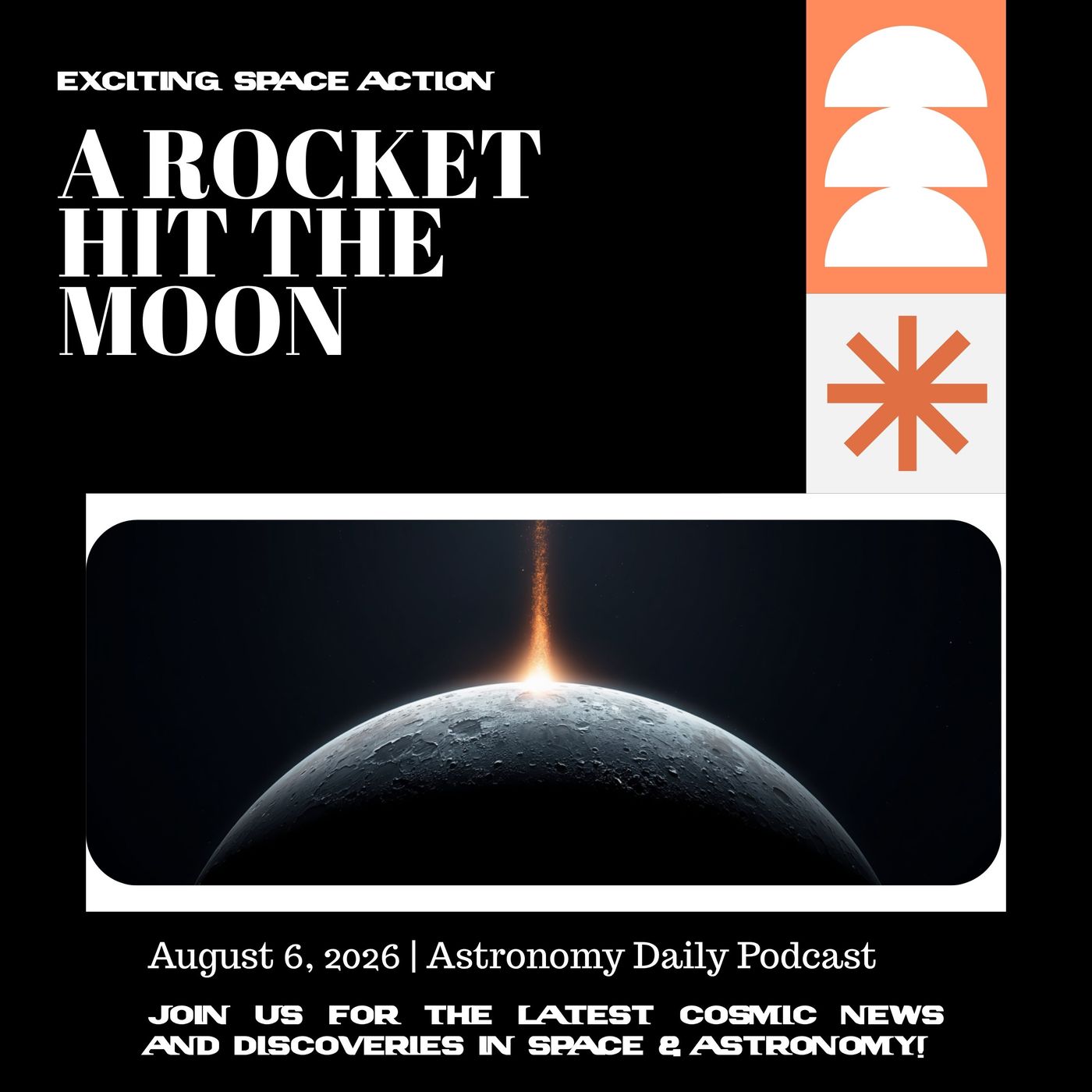
Astronomy Daily · S05E160 · 6 August 2026. In this episode: a Falcon 9 upper stage confirmed to have struck the Moon; a live ISS spacewalk; supernova SN 2026gzf caught at first light; SpaceX Crew-13 previewed; and a both-hemispheres guide to the 12 August eclipse and Perseids. FALCON 9 LUNAR IMPACT (LEAD) ● Spent upper stage 2025-010D struck near Einstein Crater (~19.4°N, 93.3°W) at ~06:35 UTC, 5 Aug 2026 — matching Bill Gray / Project Pluto predictions. ● ESO’s Very Large Telescope (Paranal) detected sodium and lithium in the impact plume for ~5–10 minutes — sodium from lunar soil, lithium likely from the rocket. ● NASA’s Lunar Reconnaissance Orbiter holds a pre-impact baseline and will image the fresh crater, giving a rare before-and-after dataset to validate hollow-body impact models for future landers. ● Origin: Falcon 9 launched 15 Jan 2025 with Firefly Blue Ghost 1 and ispace Resilience; the stage was left adrift and returned unplanned via solar activity and gravity. ● Sources: NASA; ESO / VLT; CNN; Project Pluto (projectpluto.com); Fernando et al., arXiv:2607.14625. ISS SPACEWALK — U.S. EVA 96 ● NASA’s Jessica Meir (Expedition 75 commander) and Anil Menon; ~6.5 h EVA beginning ~08:35 EDT, 6 Aug; live on NASA+. ● Task: reconfigure the 3B power channel to accept a seventh roll-out solar array later in 2026 — part of station upkeep ahead of the planned 2030 deorbit. ● Menon’s first spacewalk; two further EVAs scheduled 13 and 25 Aug. ● Sources: NASA / NASA+ ; NASA ISS blog. SUPERNOVA SN 2026GZF ● X-ray “shock breakout” (EP260321a) detected by China’s Einstein Probe on 21 Mar 2026 from a galaxy ~500 million light-years away; follow-up revealed a broad-lined Type Ic supernova. ● Unusually, no gamma-ray burst and no lasting relativistic jet — and the faintest shock breakout yet linked to this class; a possible missing link between ordinary and GRB-producing supernovae. ● Follow-up used NSF NOIRLab facilities including DECam and the Vera C. Rubin Observatory. Two teams: O’Connor et al. (CMU) and Rastinejad et al. (UMD), in ApJL. ● Sources: NSF NOIRLab; Carnegie Mellon University; The Astrophysical Journal Letters. SPACEX CREW-13 ● Targeting NET 12 Sep 2026 aboard Crew Dragon Grace from SLC-40, Cape Canaveral. ● Crew: Jessica Watkins (NASA, cmdr — first NASA astronaut to fly Dragon twice), Luke Delaney (NASA, pilot), Joshua Kutryk (CSA), Sergey Teteryatnikov (Roscosmos). 180-day stay; moved up from November. ● Sources: NASA; SpaceX; Houston Public Media. SKYWATCH — 12 AUGUST & BEYOND ● Total solar eclipse 12 Aug: totality across E Greenland, W Iceland, N Spain and NE Portugal (max 2m18s). Partial across northern US (Alaska–N Carolina), most of Canada, much of Europe and NW Africa. NASA livestream from 1:15 pm EDT. ● US partial highlights: Presque Isle ME ~29% (contiguous-US max); NYC ~9% from ~1:07 pm EDT; Boston ~16%; Toronto ~8%; Montreal ~18%; St John’s ~53%. ● Perseids peak 12–13 Aug under a new Moon (northern-favoured, up to ~100/hr from dark northern sites). ● Southern Hemisphere: pre-dawn planet parade (Saturn best, near opposition; Mars, Mercury, Uranus, Neptune), brilliant Venus in the evening west, and the winter Milky Way high overhead. ● Look-ahead: deep partial lunar eclipse 28 Aug (96% umbral), favouring the Americas. ● SAFETY: use only ISO 12312-2 certified eclipse glasses / solar filters during any partial phase. ● Sources: NASA; ESA; Sky & Telescope; BBC Sky at Night; EarthSky; timeanddate.com; The Planetary Society.Become a supporter of this podcast: https://www.spreaker.com/podcast/astronomy-daily-latest-space-news--5648921/support.
<br...
Anna: A 4 ton piece of rocket has just carved a fresh crater into the Moon. And for once we had the telescopes pointed right at it. Avery: Sodium and lithium glowing in the plume. A spacewalk happening as we speak, and a star that died in a way nobody expected. Anna: Good day and welcome to Astronomy Daily. I'm Anna. Avery: And I'm avery. It's Thursday the 6th of August, 2026, and there is a lot of sky to get through. Anna: We lead on the Moon, we go live to the space station, we witness a supernova at first light and we meet the crew heading up next month.
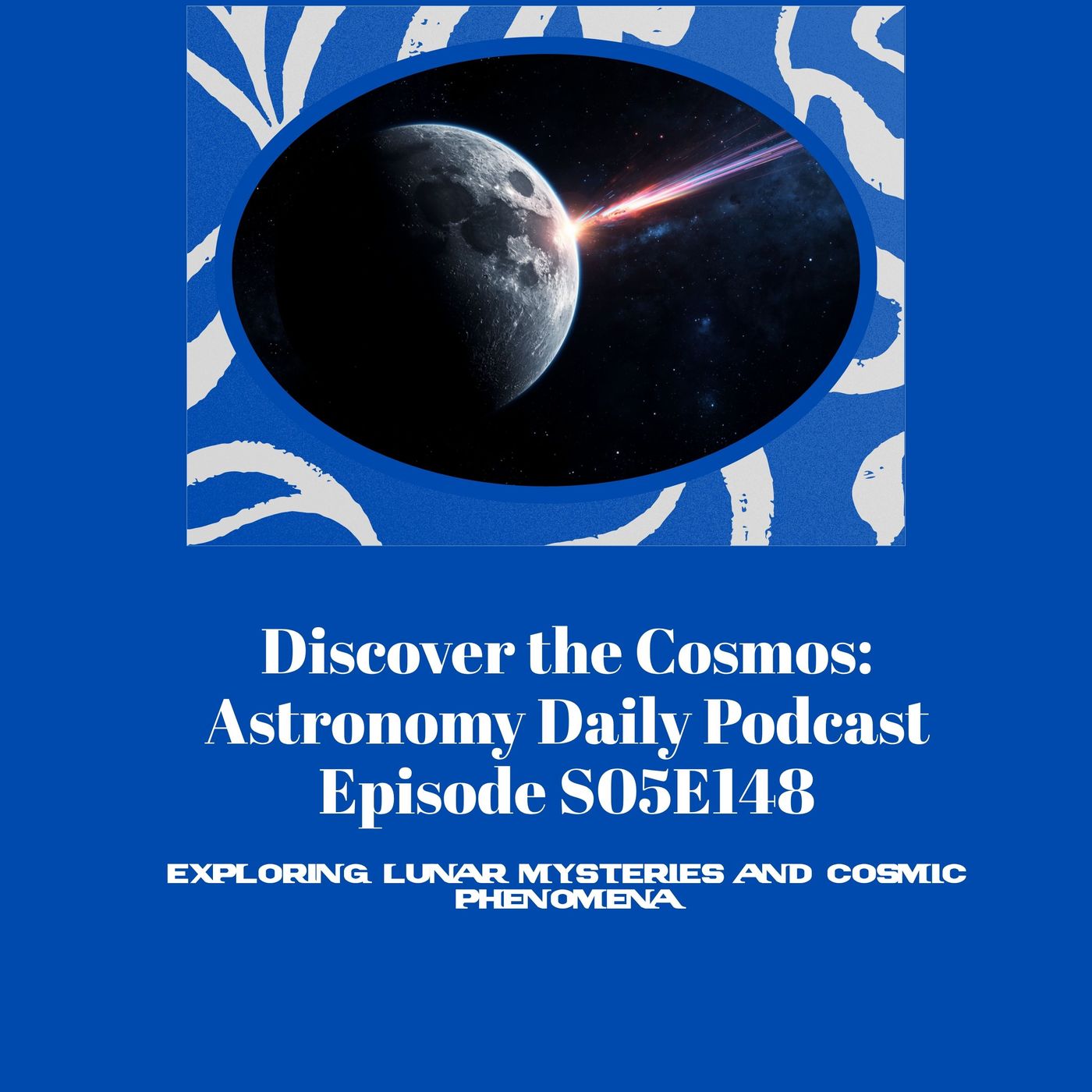
Then we point you at the sky north and south for what is shaping up to be the biggest week of the year. Avery: Let's get into it. Yesterday morning at about half past six Universal Time, a spent SpaceX Falcon 9 upper stage, catalog number 2025 010D, slammed into the far western edge of the Moon, close to Einstein Crater, at somewhere near five and a half thousand kilometers an hour. Anna: And this is the one we flagged for you yesterday and said, come back tomorrow. Well, it's confirmed. It hit almost exactly where and when the independent tracker Bill Gray of Project Avery: Pluto said it would, which is the first remarkable thing.
This wasn't a planned impact. Nobody steered it in. A, uh, private citizen with orbital mechanics software called the shot to within a minute or two days ahead, though, where Anna: did this thing come from? Rewind to January 2025. A Falcon 9 lifts off carrying two commercial moon landers. Firefly's Blue Ghost, which went on to make the first fully successful commercial soft landing that March and ispace's resilience land. Avery: The upper stage does its job, flings both landers onto a lunar trajectory, and then it's just left there, out of fuel, adrift, and that messy gravitational neighborhood between the Earth and the Moon.
Anna: And here's the physics that traps it, because it surprised me. For a normal mission close to Earth, you nudge the stage down and it burns up in the atmosphere. Cheap, tidy. But a stage that's already been flung toward the Moon would need almost as much fuel to come home safely as it took took to get out there in the first place. Avery: And that feel is long gone. So it drifts for 18 months until a mixture of solar activity and plain old gravity bends its path just enough to put it on a collision course.
Now, normally, that's the end of the story. A dead rocket hits the Moon, nobody sees it, we all move on. But this time, astronomers turned it into an experiment. Anna: This is the part I love. The European Southern Observatory pointed Its Very Large Telescope in Chile at the impact site. And it caught the flash chemically in the plume thrown up by the collision. The telescope detected glowing sodium and lithium for something like five to ten minutes afterward. Avery: And the two elements tell two different stories.
The sodium almost certainly came from the lunar soil, itself vaporized on impact, but the lithium, that most likely came from the rocket. Anna: So the telescope is effectively reading the wreck's chemistry from 400,000 kilometers away. You're watching a rocket cremate itself into the moon and picking out the ingredients in the smoke. Avery: And then NASA steps in for the long game. Their Lunar Reconnaissance Orbiter had already photographed this patch of ground before the impact. A clean before shot.
Anna: And over the coming weeks, it'll go back and photograph the fresh crater, maybe 20 meters across for the after. Avery: Which gives scientists something they almost never get. A known object of known mass hitting at known speed in known spot with pictures of the ground before and after. Anna: And that matters well beyond this one rock. Engineers have computer models that predict how a hollow human made object deforms the ground when it hits. Up to now, those models have been mostly untested against a real measured impact.
Avery: This is the calibration. Every future lunar lander team, NASA's Artemis crews, the commercial landers, they all need to know how the surface behaves and how far debris flies to work out safe landing margins. This crater helps write those numbers down. Anna: There's a bigger conversation underneath it too, isn't there? The space junk. One this was accidental, harmless in the sense that nobody was hurt and no satellites were threatened. But it's a reminder that we are now leaving hardware scattered through the whole Earth Moon system.
Avery: It even nudges into space law and believe it or not, space archaeology, how we treat what we leave up there. But for today, the headline is the good news version. A piece of junk became a free science experiment and the observatories were ready. Anna: A rocket that delivered two landers to the moon 18 months ago finally arrived itself the hard way, right on schedule, Avery: from the moon back to low Earth orbit. Because as we speak, two astronauts are outside the International Space Station.
Anna: This is US Spacewalk 96, NASA's Jessica Mair, the station commander, and Anil Menon went out the hatch this morning around 8:35 Eastern in the United States for a spacewalk expected to run about six and a half hours, streaming live on NASA as we go to air. Avery: And the job is genuinely important, if not glamorous. They're modifying one of the station's power channels so it can accept A new rollout solar array later this year, which is the station investing in itself for its final act. The ISS is now slated for a controlled D orbit around 2030.
And these power upgrades keep it healthy and productive right to the end. Anna: Now, the human story here is lovely for Anil Menon. This is his very first spacewalk, and Avery: his path here is remarkable. He's a physician, an emergency medicine doctor who was a first responder after the earthquakes in Haiti and in Nepal. He was also SpaceX's very first flight surgeon before he joined NASA's astronaut class. The person who signed off that crews were medically fit to fly, and he Anna: only arrived at the station a few weeks ago on a Soyuz in mid July.
And there's a nice family footnote. His wife, Anna Menon, flew on the Polaris dawn mission back in 2024, the flight that carried out the first commercial spacewalk. Avery: So spaceflight really is the family business. We'll keep an eye on how the EVA wraps up. And there are two more of these spacewalks coming this month on the 13th and the 25th. Now to something that only happens if you're very quick and a little lucky. Astronomers have caught a massive star at the very first instant of its death.
Anna: This dropped today, two research teams publishing together. And it starts back in March, when China's Einstein probe and X ray telescope spotted a brief flash of soft X rays from a galaxy about 500 million light years away. Avery: Within the hour, telescopes on the ground swung around to look and watch watched a supernova rapidly brighten. It's now cataloged as SN M2026GZF. Anna: And that opening X ray flash has a name, the Shock Breakout. Picture the core of a giant star collapsing. That launches a shock wave that tears outward through the star.
And the breakout is the instant that wave finally bursts through the surface. First light the starting gun, and it's Avery: fiendishly hard to catch. It lasts seconds to hours. And in 20 years, astronomers have only clearly bagged a couple in X rays. So having two teams capture this one from the first flash onward is a real event. Anna: But here's the twist, and it's a good one. This was a particular kind of supernova, A, uh, broad, lined type 1C. That family usually comes with fireworks. Narrow jets of material moving near the speed of light and often a, uh, gamma ray burst.
The brightest explosions in the universe. Avery: This one had none of that. No gamma ray burst, no lasting jet, and the faintest opening X ray flash ever tied to this type. Even though the explosion itself was Powerful, Anna: which makes it uh, a kind of missing link. An explosion that looks like the jet and gamma ray crowd in visible light but behaves like a quieter cousin at higher energies. It hints there's more than one way for a massive star to go. Avery: And a nice detail for the telescope nerds among us.
The follow up leaned on the big US survey facilities, including the brand new Vera Rubin Observatory. Exactly the kind of fast all sky work these observatories were built for. Anna: For our next story, let's head Back to the ISS. Let's meet the crew heading up next. NASA and SpaceX are now targeting 12 September for Crew 13 flying up on the Dragon capsule named Grace or aboard Avery: Commander Jessica Watkins of NASA, a uh, geologist. And this is a milestone for her. She becomes the first NASA astronaut to fly on Dragon twice alongside her pilot Anna: Luke Delaney, a uh, former naval aviator and this will be his first trip to space.
Then Joshua Kutryk of the Canadian Space Agency, a fighter pilot, and Sergey Tetteryatnikov of Roscosmos, a former submariner, both also flying for the very first time. Avery: It's a 180 day stay and it's worth noting the mission was actually moved earlier from November into September as NASA pushes to lift its launch cadence across the board. Anna: And for our North American listeners, one very on brand detail from the briefing. When the crew rolls out to the pad, they'll be riding in cybertrucks only Avery: in this era of spaceflight.
We'll bring you the launch when it's locked. And that brings us to the sky because next Wednesday 12 August is the biggest, biggest sky watching day of the year. And it deserves a proper look for both halves of the planet. Anna: Two headline events land almost first, a uh, total solar eclipse. The moon's shadow sweeps down over the Arctic, across eastern Greenland and western Iceland and then across northern Spain and a corner of Portugal. That narrow path of totality is the only place the sun goes fully dark, up to 2 minutes and 18 seconds of it.
It's the first total eclipse over mainland Europe since 1999. Avery: Now for our audience in North America, you are not in the path of totality but much of the north gets ah, a partial eclipse. And here are your details. It runs across the afternoon of the 12th. The deepest bite in the lower 48 is up in northern Maine, around 29% of the sun covered near Presque Isle just after 2pm Eastern New York sees Anna: a uh, modest partial, roughly 9% starting near 1:07 in the afternoon Eastern Time. Boston about 16% Bangor, around 24%.
Head into Canada and it grows Montreal near 18%, and St. John's in Newfoundland, over half the sun covered. West of the Great Lakes, though Chicago and beyond, it fades to essentially nothing. Avery: And, um, if you're not in the partial zone at all, NASA streams the whole thing live from 1:15pm Eastern. Anna: And this is the line we never cut. A partial eclipse is never safe to look at with the naked eye. You must use certified eclipse glasses or a safe solar filter that meets the ISO 123122 standard.
Every moment the sun is even partly uncovered, a, um, 99% covered sun can still burn your eyes. Only inside the path of totality. And only during those brief seconds of total darkness can you look unaided. Avery: The second headline is a gift to the whole planet. Though it leans north, the Perseid meteor shower peaks the Same night, the 12th into the 13th. And this year it peaks under a new moon. No moonlight to wash them out. Anna: Dark, perfect skies for the northern hemisphere. That could mean up to 100 meteors an hour from a dark site.
Now, honestly, southern friends, the Perseids are a northern shower. The point they radiate from barely clears our horizon, so we see very few. I won't oversell it. Avery: So what does the southern hemisphere get? Quite a lot, actually. Look before dawn and there's a planet parade strung along the sky. Saturn is superb right now, riding high and heading towards opposition. Mars is up there too, with Mercury low and Uranus and Neptune for those with binoculars and a telescope. Anna: And Venus is the jewel of the evening, brilliant in the western twilight after sunset and actually better placed for us in the south than for far northern viewers.
Add the winter Milky Way overhead here in Australia, Scorpius and Sagittarius blazing, and it's a glorious few weeks of stargazing Avery: and one to circle for the Americas, especially north and south. On 28 August, a deep partial lunar eclipse with 96% of the moon sliding into Earth's shadow. Very nearly a total blood moon. And it favors the whole of the Americas. Anna: So wherever you are, get outside this week. And that's the show for today. A rocket arrived at the moon, a star showed us its first light, and there are astronauts outside the station as you listen.
Avery: Full links and sources are in your show notes and over at astronomydaily IO and you can find us anywhere you get your podcasts and on socials. Astrodaily Pod, we're back tomorrow. Anna: Until then, from Anna and Avery and clear, uh, skies.

 Apple Podcasts
 Spotify
 Pocket Casts
 Castbox
 Overcast
 Podbean
 iHeartRadio
 Castro
 Goodpods
 Moon FM
 Podcast Addict
 Podcast Republic
 YouTube