The Sun's Hidden Power, Atmosphere on a Nearby Planet, and Starship's Five-Act Drama
In this episode
Astronomy Daily — The Weekend Space and Astronomy News Wrap | Saturday 18 July 2026 | S05E144 Anna and Avery wrap the biggest week in space news this year: brand-new research warning that extreme solar storms may hit harder than our models assume, and the delightful news that South African rooibos tea seeds are headed for the International Space Station — plus the four stories that defined the week, from the first atmosphere ever found on a rocky habitable-zone world to Starship's dramatic T-0 abort and Monday's retry. Story Sources • Solar storms underestimated — Nature (DOI: 10.1038/s41586-026-10757-4); phys.org; Space.com • Rooibos in Space — South African Rooibos Council / MaxIQ Space / SANSA announcement; phys.org; News24 • LHS 1140 b atmosphere — Science; Space.com (as covered S05E143) • Starship Flight 13 — SpaceX / Space.com launch coverage (arc across S05E139–E143; retry NET 20 July) • Omega Centauri black hole — Hubble/JWST astrometry study (as covered S05E141) • Pluto landslides & Charon tectonics — New Horizons imagery studies (as covered S05E142) Visit astronomydaily.io for our full archive. Follow @AstroDailyPod. Astronomy Daily is part of the Bitesz.com Podcast Network.Become a supporter of this podcast: https://www.spreaker.com/podcast/astronomy-daily-latest-space-news--5648921/support.
Sponsor Details:
Ensure your online privacy by using NordVPN. To get our special listener deal and save a lot of money, visit www.astronomydaily.io/nordvpn. You'll be glad you did!
Get the best secure and private email on the planet. Stop your Government, google and who knows who else spying on every email you write. Do what we did and use ProtonMail. They beleive in privacy and there are no ads in their business model...yet they still provide a free forever service. Check them out and get out special deal at www.astronomydaily.io/protonmail
Become a supporter of Astronomy Daily by joining our Supporters Club. Commercial free episodes daily are only a click way... Click Here
This episode includes AI-generated content.
Anna: Welcome to Astronomy Daily and our weekend space and astronomy news wrap for Saturday, the 18th of July, 2026. I'm Anna. Avery: And I'm Avery. Every Saturday, we bring you two brand new stories, plus the four biggest headlines from the week that was. And honestly, Anna, what a week it was. Anna: It really was. Coming up, new research suggesting we may have been underestimating just how hard the sun can hit us. A planet 48 light years away that turns out to have air. A week of high drama at Starbase.
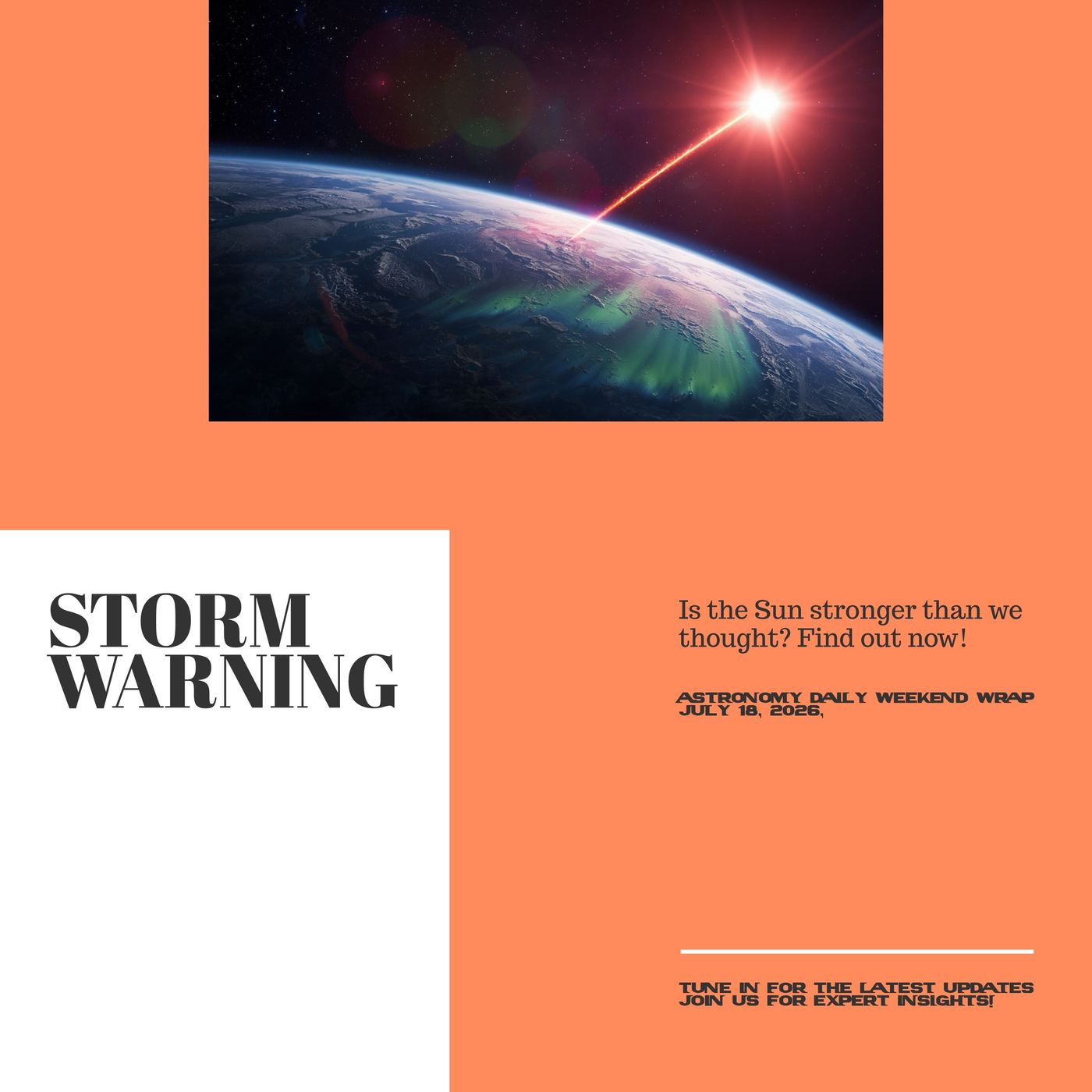
A hidden black hole in the Southern Hemisphere's favorite star cluster, Landslides on Pluto. And to finish the most delightful space story of the week involving a cup of tea. Avery: Only on this show does that sentence make sense. Let's get into it. Our, uh, lead story this weekend is one of those quiet papers with very loud implications. New research published in the journal Nature suggests the most powerful solar storms to strike Earth may pack a bigger punch than scientists realized, because the limit we thought Nature had built in may never have existed at all.
Anna: Set this up for us, Avery. What limit are we talking about? Avery: So, for decades, space weather scientists have observed something reassuring in the data. As the solar wind, that stream of charged particles flowing off the sun, gets stronger during a storm, the electrical currents it drives through the upper atmosphere increase up to a point. And then the response seemed to flatten out, saturate, as if the Earth had a ceiling on how badly it could react no matter how hard the sun pushed.
Anna: Which would be very good news for anyone who owns a satellite or a power grid. Avery: Exactly. That assumed ceiling has been quietly baked into risk models for extreme space weather. But the new study, led by Dr. Nithin Cividas of NASA's Goddard Space Flight center, with co author Dr. Maria Wallach of Lancaster University, asked a deceptively simple. Is that saturation real physics, or is it an artifact of how we've been measuring the solar wind? Anna: And the answer? Avery: Very likely an artifact.
The team analyzed more than a million solar wind measurements from spacecraft orbiting much closer to Earth, where the solar wind actually meets our magnetic field. And in that data, the electrical currents in the upper atmosphere just kept climbing as a solar wind got stronger. No flattening, no sealing. Anna: The paper's title gives away the mechanism, doesn't it? Regression to the mean. It's a statistical effect. Essentially, when you average noisy measurements of extreme events, the extremes get smoothed away.
And that smoothing can masquerade as a physical limit. Avery: Right. The ceiling was in the maths, not the magnetosphere. And if there's no upper limit to our planet's response. Then the rare monsters, the so called once in a thousand year geomagnetic storms could hit satellites, gps, communic and power grids harder than current estimates predict. Anna: It's worth saying clearly this is not a prediction that a catastrophic storm is coming. Wallach herself makes the point that these extreme cases are rare, which is fortunate, but it also means we have very little data on them.
Avery: And there's a timeliness to this because the sun is still near the peak of its roughly 11 year activity cycle. For our listeners across Australia and New Zealand, that's the same solar activity that has delivered those spectacular Aurora australis displ over the past couple of years. Anna: The aurora is the beautiful face of space weather and this paper is a reminder that the same physics has a much less charming side. We'll come back to Aurora watching in our Skywatch segment a little later.
Now to our weekly highlights, the four stories that defined the week. And if you only heard one episode this week, I hope it was Fridays because it carried what might just be the story of the year. For the first time, astronomers have detected an atmosphere around a rocky Earth like planet in the habitable zone of its Avery: star LHS 1140B, 48 light years away, which in galactic terms is barely down the street. Anna: As we covered on Friday's show, the detection was published in the journal Science.
The team found helium escaping from the planet's atmosphere and that escaping envelope is the fingerprint that told them an atmosphere is there at all. Rocky planet, habitable zone, confirmed atmosphere. That combination has never been ticked off before on any world anywhere, and the Avery: researchers believe the planet probably holds a substantial amount of water too. With the greenhouse atmosphere you have conditions that could plausibly support liquid water at Anna: the surface, with the lead author being very careful, as we stressed on Friday, to say nobody is claiming this planet has life.
What they're claiming is a the first rocky temperate world where we can even ask the question with real data. Avery: Every generation of astronomers gets one or two first time in history moments. This week we got one. If you missed the full story, it's Friday's episode. So 5e143. In your feed right now, highlight number two and it's less a story than a soap opera. Starship Flight 13 gave us a full five act drama this week. Anna: Walk us through it, Avery. Because we covered a new twist Almost Avery: every day, Act 1 Monday we previewed the flight with SpaceX, aiming for midweek and the first functional Starlink V3 satellites.
Real working satellites this time, not the mass simulators of earlier flights. Act 2 Tuesday, the launch slipped to ah, Thursday after a successful 33 engine static fire. Act 3 Wednesday, the FAA formally closed its flight 12 mishap investigation, clearing the path. Act 4 Thursday, the countdown reached zero Anna: and then stopped there the abort at T0. As we reported on Friday's show, some of the super heavy booster's Raptor engines failed to ignite and the vehicle's computers called an automatic abort.
Just as the engines lit, Elon Musk said two Raptors would be removed and replaced. Avery: Which brings us to Act 5 and um, this part's new. Since yesterday's episode, SpaceX has restacked the two stages at Starbase. And Flight 13 is now scheduled for Monday evening, July 20th, US time, which Anna: means Tuesday morning for most of our Australian and New Zealand listeners. And it means we should have the results for you on Tuesday's show. The story that ate this week is about to headline next week, too.
Avery: Third time lucky? We'll find out Monday. Anna: Highlight number three takes us to the Southern Hemisphere's crown jewel, Omega Centauri, the biggest and brightest globular cluster in the entire sky. As we covered on Wednesday's show, astronomers have found the first confirmed stellar mass black hole hiding among its 10 million stars. Avery: Found not by seeing it, you can't see it, but, uh, by watching stars move precisely. Anna: Using years of Hubble and James Webb astrometry, the painstaking measurement of stellar positions, the team tracked stars being swung around by something massive and invisible.
The motions point to a stellar mass black hole, the first of its kind confirmed in the cluster. Avery: And what made Wednesday's episode special for our audience is that this isn't some faint smudge in a telescope catalog. Uh, Omega Centauri is a naked eye object from Australia and New Zealand. At this time of year, you can walk outside on a clear July evening, look up and see the fuzzy star Anna: that holds this black Hallie million suns packed into a ball you can cover with your thumbnail. And now we know at least one of them left a black hole behind.
It's riding high in our winter sky right now. And we'll tell you exactly where to look. In the Skywatch segment, our final highlight Avery: is the double bill from Thursday's two discoveries from the Pluto system 10 years after New Horizons flew past. Proving that flyby is still the gift that keeps on giving. Anna: First, Pluto itself. Researchers combing through New Horizons imagery found evidence of landslides down steep crater walls, the first ever identified on Pluto. And some are enormous large enough, as we said on Thursday, to bury entire cities on Earth.
Avery: Landslides on a world where the bedrock is water ice and the surface temperature sits around minus 230 degrees Celsius. Even in deep freeze, Pluto's geology is alive enough to move mountainsides. Anna: And then part two of the double bill. Pluto's giant moon Charon, where scientists showed that its network of tectonic fractures preserves a record of its ancient space spin down as, uh, Charon's rotation slowed over billions of years, locking one face permanently toward Pluto, the stresses cracked its crust in patterns we can still read today.
Avery: A fossil record written in fractures. Ten years after a nine year journey and a nine hour flyby, the Pluto system is still handing us front page science. Not bad for a world some people try to demote out of the headlines. Anna: And now the story I've been saving all episode because it's brand new, it's historic and it's about tea. Avery: The finest sentence ever spoken on this Anna: program announced on Thursday. Seeds from South Africa's famous Rovioche plant are going to the International Space Station this October.
They will be the first indigenous South African species and the first seeds from the African continent ever to go to space. Avery: Robios for listeners who haven't tried it, it's that lovely Swedish caffeine free red tea grown in the Cederberg region north of Cape Town and pretty much nowhere else on Earth. Anna: The mission is a partnership between the South African Robios Council, the space education company Max IQ Space and the South African Space Agency. The seeds travel in a sealed nanolab aboard an ISS resupply flight, spend at least six weeks exposed to microgravity and space radiation and return to Earth around December or January.
Avery: And here's the part I love most. When they come back, the space flown seeds will be planted alongside ground control seeds. And the scientists doing that comparative study tracking germination, growth, resilience and yield are school students. Kids from the Cederberg region, the very region where Robios grows. Monitoring the plans of over 18 months. Anna: Kids from the birthplace of Robios running a real space biology experiment on their own hometown plant. If that doesn't launch a few careers in science, nothing will.
Avery: It also joins a genuinely important research thread. Lettuce, peas and soybeans have all flown on the station as we work out how to grow food beyond Earth. Robios is hardy, drought adapted and packed with antioxidants. Honestly, if humanity's going to the moon and Mars, somebody should absolutely be bringing the tea. Anna: A story with warmth in every sense. We'll follow the seeds when they fly in October. Avery: Time for Skywatch what to look for from the Southern Hemisphere this week the Anna: Moon is returning to the evening sky as a waxing crescent after Tuesday's new Moon, low in the west after sunset and climbing higher each night with beautiful Earthshine on the unlit portion in these early days.
It slit past brilliant Venus and the star Regulus late this week and the pairing is still worth a look as Avery: twilight fades but the Moon young and setting early, the evenings stay gloriously dark and that means the winter Milky Way. The galactic core in Sagittarius and Scorpius is virtually overhead in the mid evening from Australia and New Zealand. Right now from a dark site, it's the finest naked eye sight in nature. Anna: And while you're under it, find Omega Centauri, the very cluster from Wednesday's Black hole story.
Look to the southwest in mid evening in the constellation Centaurus above the Southern Cross. To the naked eye it's a soft, fuzzy star in binoculars it swells into a glowing ball of ancient suns. Avery: Saturn rises late in the evening and stands high in the predawn sky for early risers, with Mars still tracking through Taurus near the red star Aldebaran in the dawn twilight. Anna: And given today's lead story, keep an eye on the aurora alerts. We're near solar maximum and one good coronal mass ejection can light up southern skies from Tasmania and the South Island.
The Aurora australis is the friendly reminder of everything we discussed at the top of the show. Avery: And that's the week that was in space and astronomy. A sun with fewer limits than we thought, a rocky world with air, a rocket with one more chance on Monday, a black hole you can point at, landslides on Pluto and tea leaves headed for orbit. Anna: For all the show notes, links to every story and our full episode archive, visit astronomydaily IO and you'll find us across social media. AstroDailyPod we're back Monday with all the news, including, we hope, a starship launch.
Avery: Until then, thanks for spending part of your weekend with us. I'm Avery. Anna: And I'm Anna. Clear skies everyone. Avery: Astronomy Day stories we told.
Anna: You. Avery: Mhm.


 Apple Podcasts
 Spotify
 Pocket Casts
 Castbox
 Overcast
 Podbean
 iHeartRadio
 Castro
 Goodpods
 Moon FM
 Podcast Addict
 Podcast Republic
 YouTube