
Starship Set for Launch, First Black Hole Found in Omega Centauri, and X-Rays in Space
In this episode
Astronomy Daily — S05E141 | Wednesday 15 July 2026 Anna and Avery bring you the biggest space and astronomy news of the day: Starship Flight 13 is cleared for Thursday after the FAA closes its Flight 12 investigation and SpaceX reveals exactly what went wrong; NASA astronaut Anil Menon rides a Soyuz to the ISS on his first flight; astronomers finally find the first of Omega Centauri’s 10,000 "missing" black holes; the first-ever medical X-rays taken in space are published; four white dwarfs are found hiding within 65 light-years of Earth; and a new-moon dark-sky window opens with Comet 10P/Tempel 2 on the rise. In this episode • Starship Flight 13 — FAA closes the Flight 12 mishap investigation (July 13); root causes revealed: hot-staging ignition sequence caused a 90° booster orientation error, five Raptors failed to relight, alarm settings shut engines down early. Launch window opens Thursday July 16, 6:45pm EDT (Friday 8:45am AEST) with the first 20 functional Starlink V3 satellites and an in-space Raptor relight. • Soyuz MS-29 — NASA’s Anil Menon with cosmonauts Pyotr Dubrov and Anna Kikina launched from Baikonur July 14, docking three hours later for an eight-month stay. Menon and wife Anna Menon (Polaris Dawn) become a two-astronaut household; NASA Administrator Jared Isaacman attended in person. • Omega Centauri’s first stellar-mass black hole — oMEGACat BH-2, found via astrometry in 20+ years of Hubble data plus Webb observations (ApJL, July 13). Lower-than-expected mass; its companion star’s 94-year orbit makes it the longest-period black hole binary known. The cluster is naked-eye visible in southern winter skies right now. • First medical X-rays in space — RSNA publishes results from the Fram2 Crew Dragon mission: crew with 4 hours’ training produced diagnostic-quality X-rays in orbit, opening the door to space radiology and non-destructive hardware testing on Moon and Mars missions. • Four hidden white dwarfs — Warwick/Colorado Boulder team unmasks four white dwarfs within 65 light-years using Hubble near-UV spectroscopy (MNRAS). G 203-47, ~25 light-years away, is now the ninth-closest known white dwarf and closes a 27-year-old wobble mystery. • Skywatch — New Moon (July 14) dark skies, Milky Way core season for the Southern Hemisphere, Comet 10P/Tempel 2 at magnitude 7–8 brightening toward early-August perihelion, and Mars near Aldebaran pre-dawn. Resources & further reading • Starship Flight 13: spacenews.com | space.com Starship live blog • Soyuz MS-29: nasa.gov ISS blog | nasaspaceflight.com • Omega Centauri black hole: science.nasa.gov | esahubble.org (heic2610) | ApJL • Space X-rays: rsna.org/news | space.com • Hidden white dwarfs: warwick.ac.uk | phys.org | MNRAS Visit astronomydaily.io for all episodes and our constantly updating newsfeed. Follow us @AstroDailyPod. Astronomy Daily is part of the Bitesz.com Podcast Network.Become a supporter of this podcast: https://www.spreaker.com/podcast/astronomy-daily-latest-space-news--5648921/support.
Sponsor Details:
Ensure your online privacy by using NordVPN. To get our special listener deal and save a lot of money, visit www.astronomydaily.io/nordvpn. You'll be glad you did!
Get the best secure and private email on the planet. Stop your Government, google and who knows who else spying on every email you write. Do what we did and use ProtonMail. They beleive in privacy and there are no ads in their business model...yet they still provide a free forever service. Check them out and get out special deal at <a href="https://www.astronomydaily.io/protonmail"...
Anna: The world's biggest rocket has a launch date, a clean bill of health from the regulators, and finally an explanation for what went wrong last time. Avery: Plus, a, uh, globular cluster hanging in your southern sky right now has just given up the first of its 10,000 missing black holes. And astronauts have taken the first ever medical X rays in space. With four hours of training, all that, Anna: A, uh, brand new crew on the space station, dead stars hiding next door, and the darkest skies of the month.
This is Astronomy Daily. Avery: Hello and welcome to Astronomy daily. It's Wednesday the 15th of July, 2026. This is series five, episode 141. And I'm Avery. Anna: And I'm Anna. We've got a packed one today. Two big spaceflight stories, two genuinely lovely deep sky discoveries, a, uh, first in space medicine, and a sky watching window you do not want to waste. Shall we get into it? Avery: Let's do it. Anna: So Avery, on Monday we previewed Starship Flight 13 and told you it was penciled in for today, Wednesday the 15th.
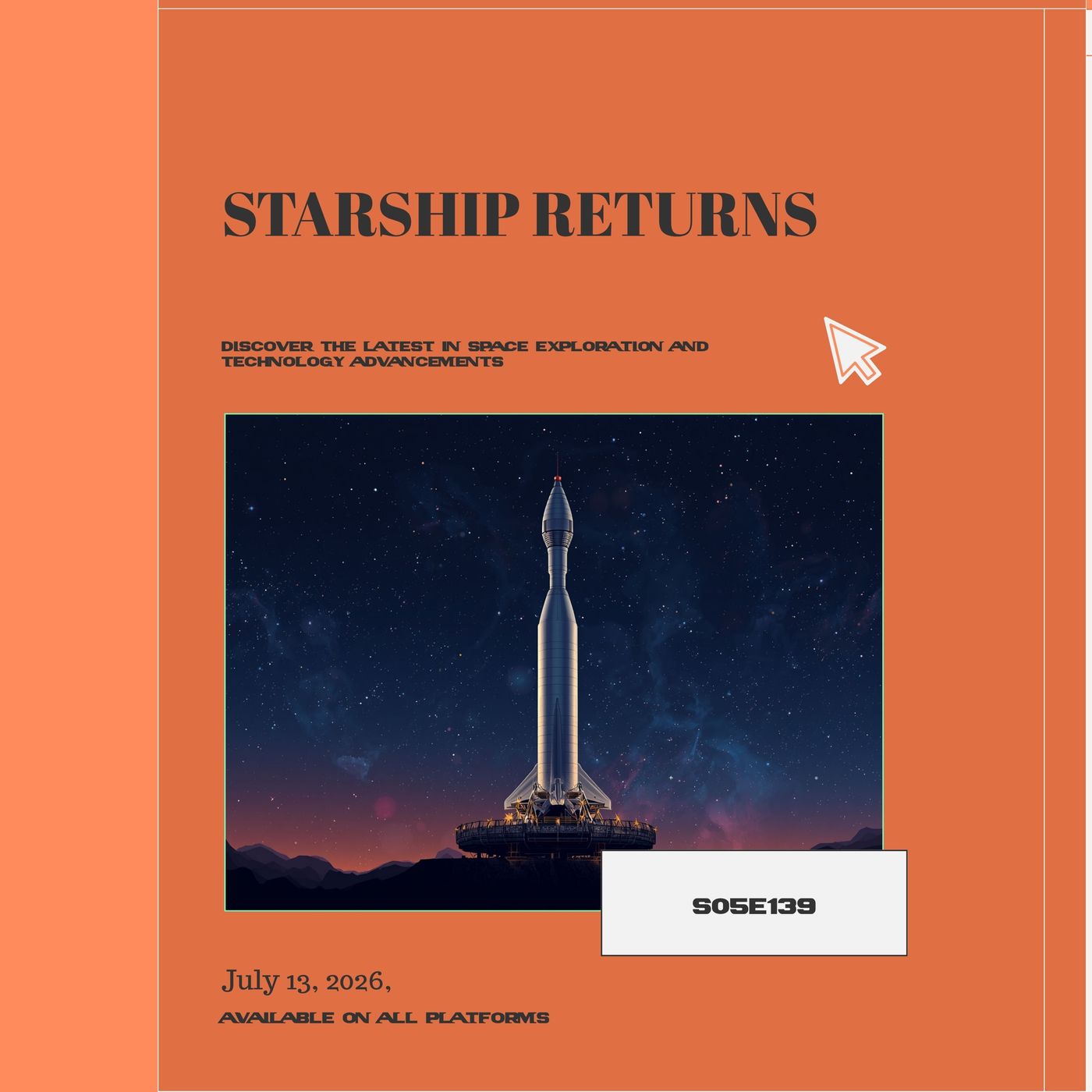
Well, the pencil has moved. Avery: It has. SpaceX is now targeting Thursday July 16th with a 90 minute launch window opening at 6:45 in the evening Eastern time, which for us here in Australia is Friday morning, 8:45am on the east Coast. So set your alarms for Friday breakfast viewing. Anna: But honestly, the launch date isn't even the biggest news in this story because on Monday the Federal Aviation Administration formally closed its investigation into what went wrong on Flight 12. And for the first time we got the full picture.
Avery: And um, it's fascinating. Remember, Flight 12 back in May was the debut of the big version three vehicle. And it mostly went well, except the super heavy booster never made its controlled splashdown in the Gulf. It just didn't get there. Anna: And now we know why. It comes down to hot staging. That maneuver where the upper stage lights its engines while it's still attached to the booster. SpaceX changed the ignition sequence of ship's engines on this flight and that change pushed the Booster into a 90 degree orientation error right after separation.
Avery: So the booster comes out of staging pointing the wrong way. And then to make matters worse, when it tries its boost back burn, five of its 33 raptor engines fail to relight. Anna: The FAA's report boiled it down to two root causes heat effects on propulsion components during ascent. And I love this phrase, erroneous engine alarm settings. Essentially the alarm thresholds were tuned wrong for the multi engine flight environment. Though engines were being shut down that could have kept burning.
Avery: And SpaceX's fixed list covers all of it A, uh, modified startup sequence for ship, hardware updates on the booster and retuned engine alarms and abort settings. The FAA has accepted the corrective actions, so the regulatory road is clear. Anna: Which brings us to what Flight 13 actually has to do. It's essentially a rerun of Flight 12's objectives, but this time with real cargo. 20 functional Starlink V3 satellites, the first of their kind ever to fly. Avery: And these aren't the mass simulators from Flight 12.
These are working satellites. They'll deploy solar arrays and antennas and attempt to connect with a ground station in South Africa and and with other starlinks. Six of them even carry cameras to inspect ship's heat shield from the outside. Anna: The catch being it's a suborbital flight, so those satellites get about 20 minutes of glory before they re enter and burn up. It's a test, not a delivery. Avery: There's also an in space Raptor relight on the checklist, which matters enormously for the lunar Lander version of Starship that NASA's Artemis program is counting on.
And if all of this goes to plan, Flight 14 could see SpaceX attempt a first V3 catch back at the Anna: tower Friday morning, Australian time. We'll have the full wrap on Saturday's show. Either way. Avery: From a rocket that's about to launch to one that just did. On Tuesday. A Soyuz 2 1A lifted off from Baikonur Cosmodrome in Kazakhstan carrying NASA astronaut Anil Menon and Roscosmos cosmonauts Pyotr Dubrov and Anna Kikina. Anna: And this was the express service, A two orbit fast rendezvous. They docked with the International Space Station's Pritchell module just over three hours after liftoff.
Compare that to the two day chases of the old days. Avery: The 3O joins Expedition 7475 for a roughly an eight month stay coming home in April 2027. It's the second flight for both Dubrov and Kikina, but the very first for Menin. And his backstory is wonderful, it really is. Anna: He's a physician, a former Air Force flight surgeon who flew over a hundred sorties and F15s, worked as a first responder after the Haiti and Nepal earthquakes, and was actually SpaceX's first ever flight surgeon before NASA selected him as an astronaut in 2021.
Avery: And here's the bit I love. His wife, Anna Menon, has already been to space. She flew on the Polaris dawn mission in 2024, the one with the first commercial spacewalk. So they're now officially a two astronaut Anna: household with two kids who presumably win every what do your parents do? Conversation at school. Forever. Avery: Forever. And there was a diplomatic first at the launch, too. NASA administrator Jared Isaacman was at Baikonur in person, meeting Roscosmos chief Dmitry Bakanov face to face for the first time.
Isaacman and Menon are close friends. Annamin flew on Isaacman's own Polaris dawn mission. Anna: As for the work, Menon's eight months are heavy on the science that suits a doctor. They'll be refining in space production of semiconductor crystals. And this ties beautifully into our next but one story performing ultrasound using augmented reality and AI techniques that could remove the need for medical support from Earth on deep space missions. Avery: A doctor testing the Future of Space Medicine launched the same week the first space X rays are published.
Anna: Hold that thought now, Avery. If you step outside tonight, anywhere in Australia or New Zealand, and look up at the constellation Centaurus riding high in our winter sky, there's a soft, fuzzy star you can see with your naked eye from a dark sight. Avery: That's Omega Centauri, the greatest globular cluster in the sky. 10 million stars packed into a ball about 18,000 light years away. And an object that has puzzled astronomers for decades because, according to the models, it should be teeming with black holes.
Around 10,000 stellar mass black holes left behind by exploded stars. Anna: And until this week, astronomers had found none of them. Evidence for an intermediate mass black hole lurking at the center? Yes. But that missing population of 10,000 smaller ones? Silence. Avery: Until now. In a paper published Monday in the Astrophysical Journal Letters, a team led by Matthew Whitaker at the University of Utah announced the first first stellar mass black hole ever detected in Omega Centauri. It's been dubbed Omega Cat BH2, and Anna: the way they found it is the real star of this story.
Not X rays, not radio emission astronomy measuring the positions of stars so precisely over such a long time that you can watch one being swung around by something invisible. Avery: They sifted through nearly 20 years of Hubble archival data observations running from 2003 to 2023, and added recent James Webb data to sharpen the measure. It was a star with about 78% the mass of our sun, orbiting something massive and utterly dark. Anna: The team said, uh, the precision comes down to a fraction of a pixel on Hubble and Webb's detectors.
It simply would not have been possible without both telescopes working together. Avery: And BH2 turns out to be a rule breaker. Its mass is lower than expected, and the star that orbits it takes 94 years to go around, which Makes this the widest, longest period stellar mass black hole binary ever found. Anna: One black hole down, roughly 9,999 to go. But the astronomers suspect this first detection opens the floodgates. Now they know exactly what signature to look for. Avery: And for our southern listeners, that cluster is up there right now in your July evening sky.
Ten million stars, an intermediate mass black hole at the middle, and at least one newly unmasked stellar mass black hole. Go out and look at it tonight. You'll never see it the same way again. Okay, Anna. Space uh, medicine. As promised, the Radiological Society of North America has just published results confirming a genuine first diagnostic X ray images taken in orbit. Anna: And the mission behind it was Fram 2, the private SpaceX crew Dragon flight from March 2025. The first crew ever to fly a polar orbit.
Four first time astronauts, none of them medical experts. Three and a half days in space before launch. Avery: They got just four hours of training on a commercial off the shelf portable X ray system. Then in orbit with no guidance from ground control, they X rayed a calibration phantom. A smartwatch, a hand, a forearm, an abdomen, a pelvis and a chest. Anna: And here's the result that matters. Back on Earth, three independent medical experts compared the in flight images with X rays taken before launch.
The ground images were better quality, but the space images were good enough to diagnose injuries like broken bones. Avery: Which is a conceit Buster, as Dr. Shaina Gifford of the Mayo Clinic put it. The assumption has always been that because everything in space is constantly moving, getting a diagnostic image in orbit was just too technically challenging. Anna: Not anymore. And the applications go well beyond broken bones. That smartwatch X ray was the proof of concept for non destructive testing.
Inspecting spacecraft, hardware, satellites, even spacesuits for hidden damage without taking anything apart. Avery: And think about where humanity is headed. A lunar outpost is days from a hospital. Mars is months. If you're going to break an arm 240,000 miles from the nearest radiology department, you want the radiology department to come with you. Anna: The device even survived the trip home. Superficial scuffs on the exterior internals. Fine. As Dr. Gifford put it, the sky is not the limit when it comes to X rays in space.
Now for a story about the neighbors we never knew we had. Astronomers at the University of Warwick and the University of Colorado Boulder have found four white dwarfs hiding within 65 light years of Earth. Avery: Which sounds impossible, doesn't it? We've been surveying the solar neighborhood in exhaustive detail for decades. How do you miss four entire dead Stars on your own street. Anna: Because they had accomplices. Each of these four white dwarfs orbits a, ah, red dwarf companion, a, uh, bigger, brighter star whose glare completely drowned them out in visible light.
To every survey, these looked like perfectly ordinary single stars. Avery: The giveaway was the wobble. Each red dwarf showed a substantial radio wobble, the telltale sign of a massive unseen companion tugging on it. So the team went hunting with the Hubble Space Telescope's imaging spectrograph in near ultraviolet light, where white dwarfs shine and red dwarfs fade. Anna: And there they were, four hidden white dwarfs unmasked. Lead author Dr. Mayrey O' Brien put it beautifully. It's a reminder that even in our own cosmic neighborhood, we can still find surprises if we look in the right way at the right wavelength.
Avery: The headliner of the four is a system called G203 47, only about 25 light years away, which makes its white dwarf the ninth closest known to the Sun. And finding it closed a mystery that had been open for 27 years, ever since that unexplained wobble was first spotted. Anna: But G2O3 47 replaces one mystery with another. The red dwarf orbits its white dwarf every 14.9 days, but rotates on its axis only once every 100 plus days. In systems like this, tides should have locked those two motions together long ago.
The M way. The Moon always shows Earth the same Avery: face, so the fact that it isn't locked tells us these four binaries had very different life stories. Some went through violent, prolonged interactions that synchronized them. While G20347 seems to have had a gentler, briefer encounter. Anna: Four new entries in the local census published in the monthly notices of the Royal Astronomical Society. And a strong hint there are more dead stars hiding in plain sight around familiar stars. Avery: And so to the sky itself.
Anna uh, the Moon hit New Moon on Tuesday, which means right now we're in the darkest skies of the month. Anna: And for those of us in Australia and New Zealand, mid July New Moon is as good as it gets. The Milky Way core, Sagittarius Scorpiusthat great glowing heart of the galaxy is essentially overhead in the evening. If you've been meaning to get out of the city for a proper dark sky night, this week is the week. Avery: It's also the week to hunt a Comet. Comet 10P Tempel 2 is brightening as it heads towards perihelion in early August, currently sitting around magnitude 7.
8 in the evening sky. Anna: Now, that's not naked eye territory. You'll want binoculars at minimum. Ideally a telescope. Look for a soft, fuzzy, grayish patch the comet's glowing coma. And here's the nice bit for us Southern Hemisphere observers get a slightly higher altitude view than our northern friends, a Avery: dark sky, the galactic core overhead, and a comet on the rise. Sometimes the universe just hands you the itinerary. Anna: And for the early risers, Mars is currently drifting through Taurus near the red giant Aldebaran.
In the pre dawn sky, two red beacons side by side. Worth a look with your morning cuppa. Avery: Uh, and that's our journey around the cosmos for today. Starship cleared and counting down to Friday morning our time, a new crew safely aboard the station, a black hole unmasked in Omega Centauri, the first X rays in orbit, four hidden white dwarfs and a dark sky waiting for you tonight. Anna: If you enjoyed the show, share it with a fellow Stargazer. It genuinely helps. All our episodes show notes and links are at astronomydaily IO and you'll find us on all the Socials astrodaily Pod.
Avery: We'll be back tomorrow with more space and astronomy news. Until then, I'm Avery. Anna: And I'm Anna. Thanks for listening and as always, keep looking up. Avery: Clear skies, everyone.



 Apple Podcasts
 Spotify
 Pocket Casts
 Castbox
 Overcast
 Podbean
 iHeartRadio
 Castro
 Goodpods
 Moon FM
 Podcast Addict
 Podcast Republic
 YouTube