S03E135: Starliner vs. Crew Dragon, Polaris Dawn's Delay, and Chandrayaan-3's Lunar Revelations
In this episode
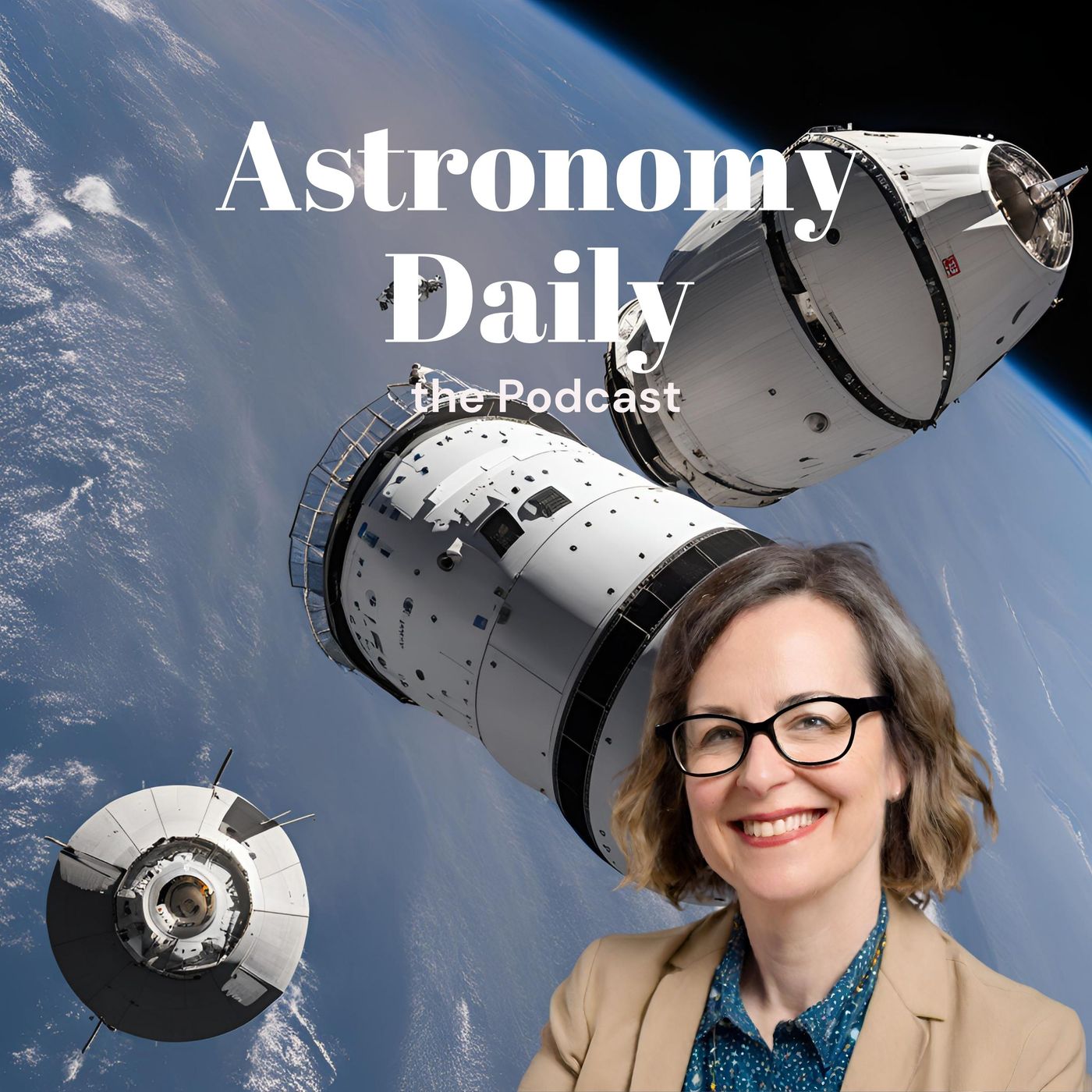
Welcome to Astronomy Daily, your go-to Podcast for the latest news and discoveries in the field of space and Astronomy. I'm your host Anna, and we have some fascinating stories lined up for you today. From NASA's upcoming decision on Boeing's Starliner to the historic private spacewalk planned by SpaceX's Polaris Dawn mission, we've got the latest updates that will keep you on the edge of your seat. We'll also delve into groundbreaking findings from India's Chandrayaan-3 mission, discuss the finale of ESA's Cluster mission, and explore new simulations about the chances of a collision between the Milky Way and Andromeda galaxies. Stay tuned. It's going to be an exciting episode.- **NASA's Decision on Boeing's Starliner**: NASA is gearing up to make a significant decision this Stuart regarding whether astronauts Butch Wilmore and SUNY Williams will return to Earth using Boeing's troubled Starliner spacecraft or SpaceX's reliable Crew Dragon. This announcement holds particular weight given the numerous challenges the Starliner has faced throughout its mission.
- **Polaris Dawn Mission: Historic Private Spacewalk**: SpaceX has announced a slight delay in their much-anticipated Polaris Dawn mission. Originally set to lift off on August 26, the launch is now scheduled for no earlier than August 27. This shift allows the team to complete some additional pre-flight checkouts to ensure everything is in perfect order for this groundbreaking mission.
- **Chandrayaan-3 Mission: New Lunar Discoveries**: Next up, the Pragyan rover, part of India's Chandrayaan-3 mission, has been actively exploring the moon's south pole, providing fascinating insights into our celestial neighbor. Launched last summer, the Vikram lander made a successful touchdown, allowing the Pragyan rover to embark on its scientific expedition. So far, Pragyan has been diligently collecting and analyzing soil samples, a task that has yielded data bolstering theories about the moon's fiery origins.
- **ESA's Cluster Mission Finale **: ESA's historic Cluster mission is coming to a close after an impressive 24 years of service. Launched back in 2000, the Cluster mission has provided invaluable data on Earth's magnetic environment, or magnetosphere.
- **Milky Way and Andromeda: Collision or Near Miss?**: Here's a story that could rewrite the textbooks. Astronomers have long held the belief that our home galaxy, the Milky Way, will inevitably merge with our neighboring Andromeda galaxy within the next 5 billion years. This anticipated cataclysmic event has been a staple of astronomical forecasts, predicting an eventual fusion of the two galaxies into a new elliptical supergalaxy called Milkomeda. However, new simulations present a more nuanced picture, suggesting that the likelihood of this colossal collision could be a mere 50% over the next 10 billion years.
To catch the latest in Space and Astronomy News, simply visit our website at astronomydaily.io
For more Space & Astronomy News podcasts, visit our HQ at bitesz.com
Sponsor Links:
Nordpass
NordVPN
Malwarebytes
Proton Mail & Security
Become a supporter of this podcast: <a...
Welcome to Astronomy Daily, your go to podcast for the latest news and discoveries in the field of space and astronomy. I'm your host, Anna, and we have some fascinating stories lined up for you today. From NASA's upcoming decision on Boeing Starliner to the historic private space walk planned by SpaceX's Polaris Dawn mission. We've got the latest updates that will keep you on the edge of your seat. We'll also delve into groundbreaking findings from India's Chandrian three mission, discuss the finale of ES's Cluster mission, and explore new simulations about the chances of a collision between the Milky Way and Andromeda galaxies.
Stay tuned, it's going to be an exciting episode. NASA is gearing up to make a significant decision this Saturday regarding whether astronauts Butch Wilmore and Sunny Williams will return to Earth using Boeing's troubled Starliner spacecraft or SpaceX's reliable Crew Dragon. This announcement holds particular weight given the numerous challenges the Starliner has faced throughout its mission. The Starliner launched its first crude test flight in June a critical milestone needed to gain NASA's approval for routine astronaut transport.
However, what was intended to be an eight day mission has stretched out over several months due to technical glitches, the capsule experience leaks, and thruster failures, raising serious concerns over its safety and reliability. NASA Administrator Bill Nelson is expected to attend the critical Agency level review meeting. Boeing has been working tirelessly to reassure NASA that Starliner is safe, presenting new test data in an attempt to validate the spacecraft's integrity. However, given the history of mishaps, NASA is treading cautiously weighing Boeing's data against its own stringent safety benchmarks.
Making things even more intense for Boeing is the fact that they've incurred losses of about one point six billion dollars on the Starliner program, according to securities filings. Comparatively, SpaceX's crew Dragon has already completed several successful missions to the ISS, placing Boeing in a tight spot if NASA decides to proceed with Starliner, Butch Wilmore and Sonny William could be heading home in the spacecraft within the next month, opening up the ISS docking port for an upcoming SpaceX mission.
If, however, NASA opts for the safer route, the astronauts will return via SpaceX's Crew Dragon, though not until February twenty twenty five. This backup scenario would mean Starliner would attempt to return to Earth without any human occupants, further delaying Boeing's ambitions and crude spaceflight. It's a nerve racking moment for everyone involved, particularly for Boeing, as this decision could significantly impact their future in the competitive field of space exploration. So stay tuned for NASA's decision this Saturday.
Whether it's Starliner or Crew Dragon, the choice will not only bring home two veteran astronauts, but also influence the future direction of commercial space travel. In other news today, SpaceX has announced a slight delay in their much anticipated Polaris Dawn mission. Originally set to lift off on August twenty sixth, the launch is now scheduled for no earlier than August twenty seventh. This shift allows the team to complete some additional pre flight checkouts to ensure everything is in perfect order for this groundbreaking mission.
Now what makes Polaris Dawn so special. Funded by billionaire and philanthropist Jared isaac Mann, this mission is poised to achieve several historic firsts for starters. It's the first mission in history to feature a private space walk. Yes, you heard that right. Private astronauts will be taking a walk in space, a feat previously reserved for government astronauts within the confines of national space programs. Isaac Man himself will serve as the mission commander, a role he's not unfamiliar with.
His previous mission, Inspiration four, was the first all civilian mission to space, and it successfully helped raise two hundred and fifty million dollars for Saint Jude Children's Research Hospital. This time around, the Polaris Dawn mission aims to push the boundaries of private space exploration even further. The mission will start from Launch Complex thirty nine A at NASA's Kennedy Space Center in Florida, using a SpaceX Falcon nine rocket. The launch window opens at three thirty eight am ed TIS on August twenty seventh, and the mission will extend over five days.
Two days into orbit, the Polaris Dawn crew will conduct their historic spacewalk, lasting approximately two hours from cabin to pressurization to repressurization. But that's not all. This mission is just the first of three planned launches under Jared isaac Mann's Polaris program. These missions aim to further private space exploration and scientific research. Future missions might even include providing maintenance and support for NASA's legacy missions like the Hubble Space Telescope and potentially the first crude launch of SpaceX's Starship spacecraft.
So while the launch has been postponed by just a day, the excitement and promise of what lies ahead for the Polaris Dawn mission continue to soar. Stay tuned for more on this thrilling endeavor in the realm of private space exploration. Next up, the Pragian Rover, part of India's Chandrion three mission, has been actively exploring the Moon's south pole, providing fascinating insights into our celestial neighbor. Launched last summer, the Victrim Lander made a successful touchdown, allowing the Pragian rover to embark on its scientific expedition.
So far, Pragian has been diligently collecting and analyzing soil samples, a task that has yielded data bolstering theories about the Moon's fiery origins. The rover used its alpha particle X ray spectrometer and impressive twenty three times to probe the Moon's regolith. It turns out all twenty three samples consisted predominantly of feroan anorthosite, a type of rock often linked with magma activity. This uniformity across the sampled soil adds credence to the theory that the Moon's surface was entirely molten shortly after its formation.
The scientific consensus suggests that a massive impact event is responsible for this intense heat. More specifically, the collision with a celestial body named Thea likely resulted in vast quantities of Earth's crust being launched into space. This material eventually coalesced to form the Moon, explaining why moon rocks are so chemically similar to those found on Earth. As the Progian rover continues its mission, each new piece of data provides more depth to our understanding of the Moon's geological history.
The findings not only enhance our knowledge of lunar conditions, but also contribute valuable information that aids future lunar missions, with the Chandrian three missions solidifying India's position as a key player in space exploration. The work done by Pragin may pave the way for even more ambitious lunar endeavors. As geologists and planetary scientists analyze this new data, we can look forward to unraveling more mysteries of the Moon, helping us better understand the dynamic processes that shaped our solar system.
ESA's historic Cluster mission is coming to a close after an impressive twenty four years of service. Launched back in two thousand, the Cluster mission has provided invaluable data on Earth's magnetic environment, or magnetosphere. This powerful magnetic shield is crucial for life on Earth as it protects us from the relentless barrage of particles from the Sun known as the solar wind. One of the mission's significant contributions is in hancing our understanding of space weather, which refers to the impact solar wind has on our planet.
Although the magnetosphere deflects most of the solar wind, some of it still penetrates, causing phenomena like the Northern and Southern lights and occasionally disrupting power supplies, radio communications, and satellites. Before Cluster, space weather was a bit of a mystery, but thanks to its extensive observations, we have a much clearer picture of these solar interactions now as the mission comes full circle, ESAY is planning an innovative and eco friendly end for the four satellites that make up the Cluster mission, Rumba, Salsa, Samba, and Tango.
The first of these, Salsa is set to re enter Earth's atmosphere in a controlled manner on September eighth, twenty twenty four, over the South Pacific Ocean's uninhabited area. This targeted re entry is a pioneering effort by ESA to ensure a clean and safe conclusion to the mission, setting a new standard for sustainable space exploration. The choice to direct Salsa's descent so precisely is part of essay's broader efforts to mitigate the growing problem of space debris. Without intervention, the satellites would eventually re enter the atmosphere unpredictably, possibly over more populated areas, thus contributing to space junk.
By controlling the reentry, ESA aims to minimize this risk and prevent the Cluster mission's end from adding to the existing space debris. Cluster wasn't initially designed to last this long, or to end in such a meticulously planned way. Originally, it was envisioned as a two year mission to study the Sun Earth interaction. However, due to its groundbreaking discoveries and ongoing scientific relevance, the mission was extended several times. Salsa's controlled re entry will mark an end to its science operations, but it won't be the only cluster satellite making this final journey.
The remaining three satellites, Rumba, Samba, and Tango, will also be maneuvered for similar targeted re entries over the coming years. This phased approach will help reduce the risk of collisions with other satellites or the Earth itself. ESA's commitment to a sustainable space environment is not only about cleaning up after its missions, but also about using these moments as learning opportunities. Watching how these satellites break up as they re enter the atmosphere provides valuable data that can help future missions be even more efficient and less likely to contribute to space debris.
As we bid farewell to this trailblazing mission, ESAY is already looking ahead. The next big project on the horizon is the Solar Wind Magnetosphere Ionosphere Link Explorer, or SMILE. This new mission, in collaboration with the Chinese Academy of Sciences, aims to build on Cluster's legacy and delve even deeper into the mysteries of Earth's magnetosphere. So while the Cluster mission may be ending, its impact will resonate for years to come, not only in the scientific data it has gathered, but also in the sustainable practices it has pioneered.
Here's to Cluster's incredible journey and the bright future of space exploration it has helped pave the way for now. Here's a story that could rewrite the textbooks. Astronomers have long held the belief that our home galaxy, the Milky Way, will inevitably merge with our neighboring Andromeda Galaxy within the next five billion years. This anticipated cataclysmic event has been a staple of astronomical forecasts, predicting an eventual fusion of the two galaxies into a new elliptical supergalaxy called Milkomeda.
However, new simulations present a more nuanced picture, suggesting that the likelihood of this colossal collision could be a mere fifty percent over the next ten billion years. Situated approximately two point five million light years from Earth. The Andromeda galaxy or Messier thirty one, is the closest large galaxy to the Milky Way. Early predictions dating back to nineteen twelve, based on the motion of Andromeda deciphered from its emitted light, indicated that the galaxy is hurtling toward the Milky Way at a speed of sixty eight miles per second one hundred and ten kilometers per second.
Later studies fortified the theory of an impending head on collision, leading to an elegant cosmic dance culminating in a merger. But just how certain is this fate. Recent work led by astronomer Till Swala of the University of Helsinki and Finland has upended the conventional narrative. Utilizing the latest and most precise data from the Gaya and Hubble space telescopes, Swala and his team integrated the gravitational influences of nearby smaller galaxies into their simulations. These previously overlooked factors drastically alter the gravitational dynamics between the Milky Way and Andromeda, resulting in a coin flip scenario for a collision over the next ten billion years.
The addition of the triangulum galaxy M thirty three, the third largest member of our galactic neighborhood, into the simulation, increased the chances of a merger. Conversely, incorporating the large Magellanic Cloud and its perpendicular orbit to the Milky Way Andromeda system decreased the likelihood of a collision, adding another layer of complexity to the scenario. Should the galaxies avoid a direct collision, they might still pass close enough to disrupt each other's outer regions, flinging stellar material into intergalactic space.
Such misted connections could result in a radically different evolutionary path for both galaxies. Although the prospect of a devoid collision might breathe new life into our galaxy's future, it remains a compelling half and half probability. If the Milky Way and Andromeda do collide billions of years from now, astronomers surmise that the event will be relatively calm despite its astronomical scale. The vast distances between stars mean they will largely pass by each other without direct collisions, though gravitational interactions will reshape both galaxies.
Our Solar system, for example, might get flung into a distant galactic arm. The stars will leave behind magnificent trails, and gas clouds will merge to ignite bursts of new star formation. Regardless of the eventual outcome, the visualization of a cosmic ballet unfolding on such an immense scale captivates the imagination. Fortunately for us, any imaginable chaos will unfold over billions of years, far beyond the life expectancy of our Sun and more intimately, our planet. As we await more data from missions like Gaya, which continues to refine our understanding of galactic motions and masses, we're reminded once more of the ever changing nature of our universe.
Whether Milkamta forms or the Milky Way dances independent of Andromeda, one things for sure, the cosmos will continue to surprise and amaze us. That's all for today's episode of Astronomy Daily. I'm anna, and thanks so much for joining us on this cosmic journey. If you found today's stories intriguing, head over to our website at Astronomy Daily dot io. There you can sign up for our free daily newsletter. Catch up on all the latest space and astronomy news with our constantly updating news feed and listen to all our back episodes and don't forget.
You can also find us on social media. Just search for Astro Daily Pod on Facebook, x YouTube and TikTok. We'd love to hear your thoughts and continue the conversation there. Until next time, keep looking up at the stars. Sunny Day Star is a Star is st


 Apple Podcasts
 Spotify
 Pocket Casts
 Castbox
 Overcast
 Podbean
 iHeartRadio
 Castro
 Goodpods
 Moon FM
 Podcast Addict
 Podcast Republic
 YouTube