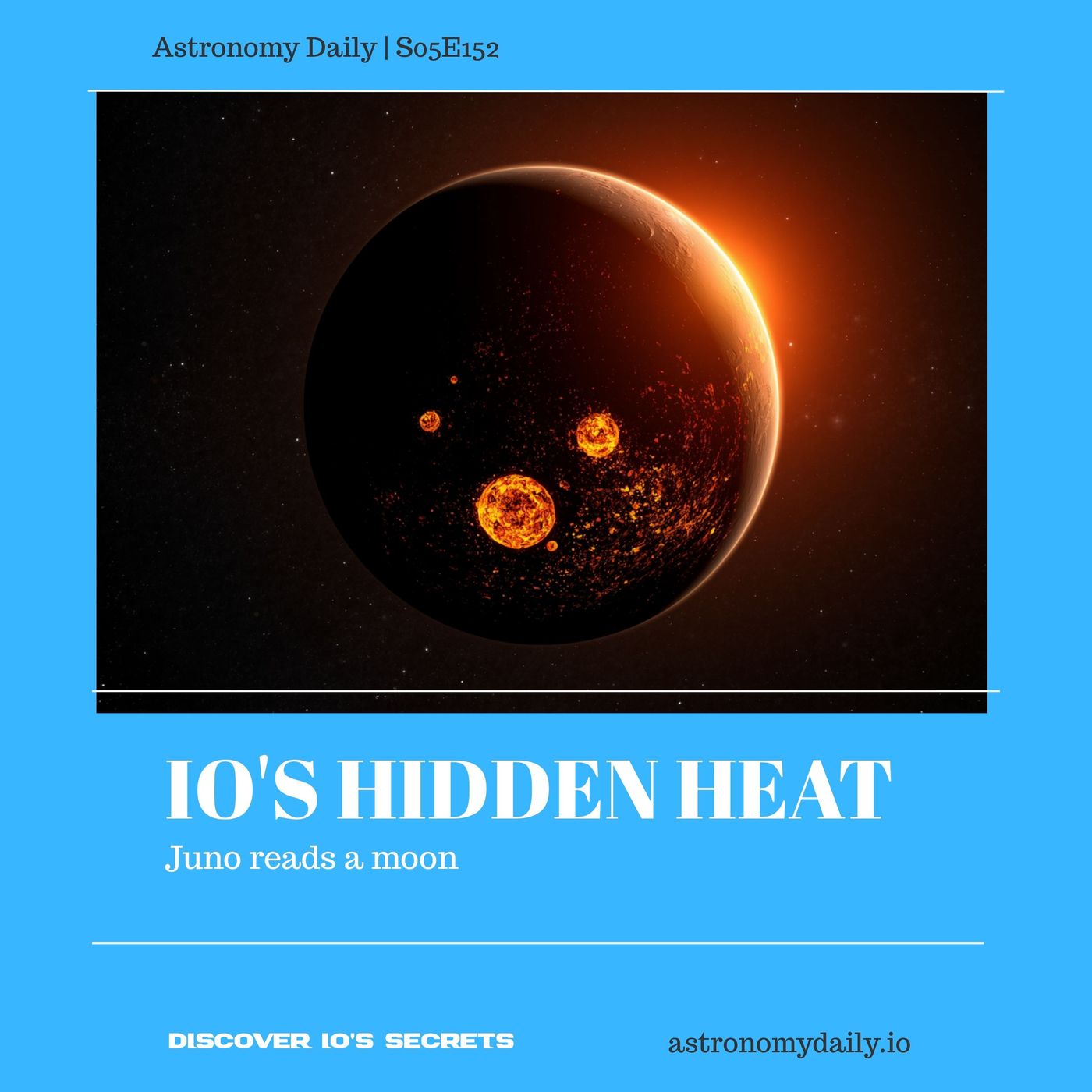
Reading Io’s Hidden Heat: Juno’s First Subsurface Reading | Today’s Space News
In this episode
Astronomy Daily S05E152 — “Reading the Heat” · Tuesday 28 July 2026. Hosts Anna & Avery. NASA’s Juno spacecraft has taken the first-ever temperature reading beneath the surface of Io, Jupiter’s volcanic moon — and the technique behind it could reshape how we study icy ocean moons and even volcanoes on Earth. We also look at why JWST’s “Little Red Dots” might be globular clusters being born, the first SETI search built from archived ALMA data (and its six-million-star surprise), and a live burst of space weather feeding into a meteor-filled — if Moon-washed — skywatch. In this episode ● Juno reads Io’s subsurface temperature for the first time — >20°C rise within a few metres, heat flow up to ~30× Earth’s average, and a remarkably smooth, low-density surface. ● Why the method matters: a multi-depth microwave thermometer that works from orbit — promising for Europa, Enceladus, and terrestrial volcanology. ● JWST’s “Little Red Dots” may be globular clusters in formation, powered by a short-lived supermassive star — linking two long-standing mysteries. ● The first SETI survey of archived ALMA data opens the millimetre band — and reveals “stellar bycatch” of 6.1 million background stars. ● Live space weather: an M3.2 flare from region AR4494 and a glancing CME, with G1–G2 storms and possible aurorae, north and south. ● Skywatch: meteor week under the full Buck Moon (29 July), the Alpha Capricornid fireball tip, evening Venus, pre-dawn Saturn/Mars/Mercury — and Jupiter vanishing behind the Sun. Sources ● NASA/JPL — “NASA’s Juno Takes Temperature of Jupiter’s Fiery Moon Io” (22 July 2026); Brown et al., J. Geophys. Res.: Planets, DOI 10.1029/2025JE009622. ● Chisholm et al., “Little Red Dots as Globular Clusters in Formation,” Astrophysical Journal Letters (press cycle 20 July 2026; UT Austin / McDonald Observatory). ● L. Mason (University of Manchester), first ALMA-archive SETI survey, RAS National Astronomy Meeting 2026. ● Space-weather status: EarthSky Sun news / NOAA SWPC (M3.2 flare AR4494, 26 July; 24 July CME; G1–G2 outlook, 27–28 July). ● Skywatch data: EarthSky, Star Walk, American Meteor Society, NASA — Southern Delta Aquariids (peak ~30 July), Alpha Capricornids (30–31 July), full Buck Moon 29 July, Jupiter solar conjunction 29 July.Become a supporter of this podcast: https://www.spreaker.com/podcast/astronomy-daily-latest-space-news--5648921/support.
Sponsor Details:
Ensure your online privacy by using NordVPN. To get our special listener deal and save a lot of money, visit www.astronomydaily.io/nordvpn. You'll be glad you did!
Get the best secure and private email on the planet. Stop your Government, google and who knows who else spying on every email you write. Do what we did and use ProtonMail. They beleive in privacy and there are no ads in their business model...yet they still provide a free forever service. Check them out and get out special deal at www.astronomydaily.io/protonmail
Become a supporter of Astronomy Daily by joining our Supporters Club. Commercial free episodes daily are only a click way... Click Here
This episode includes AI-generated content.
Anna: On the most volcanic world on the solar system, hundreds of erupting mountains have been hurling light and heat into space as long as we've been able to watch. Avery: But that's the surface underneath. In the first few meters of crust, there was a temperature nobody had ever actually measured. Anna: Until a spacecraft built to study Jupiter's clouds pointed its instrument down at a moon and read the heat beneath the ground. Avery: Welcome to Astronomy Daily. Anna: Hello and welcome to Astronomy daily for Tuesday, the 28th of July, 2026.
I'm Anna. Avery: And I'm Avery. Whether you're under southern skies here in Australia and New Zealand, or across North America and the rest of the Northern Hemisphere, good day and good evening wherever this finds you. Anna: Big show. Today, our lead takes us to IO, Jupiter's fiery moon, and a genuine first, the temperature below its surface surface. Then two cosmic puzzles that might turn out to be the same puzzle. A fresh way to hunt for alien signals and a burst of space weather arriving at Earth just about now.
Avery: Plus a, uh, skywatch with meteor showers peaking all week. Though the moon has other ideas. Let's get into it. Anna: So let's start with the star of the show, and it's a moon, IO, Jupiter's innermost large moon and the most volcanically active body in the entire solar system. If you've seen the pictures, it's that slightly unsettling pizza colored world. Yellows, oranges, sulfur reds, blotched with hundreds of volcanoes, some of them throwing plumes hundreds of kilometers into space. Avery: It's genuinely hard to overstay how active IO is.
More than 400 active volcanoes, lava lakes, the works. Per square meter, it pumps out many times more heat than Earth does. Anna: And that's the puzzle at the heart of today's story. All that volcanism is powered by something called tidal heating. IO orbits Jupiter on a slightly stretched elliptical path. And Jupiter's enormous gravity is constantly squeezing and flexing the moon, like bending a paperclip back and forth until it warms up, except on a planetary scale. And forever. Avery: Flex a paperclip fast enough, it gets hot in your fingers.
IO is that paperclip. And Jupiter never stops bending it. Anna: Exactly. But here's the thing. For all the decades we've studied IO, almost everything we knew about that heat came from looking at the surface infrared cameras, which read the temperature of the very top layer. What we'd never done, what nobody had ever done for a rocky world other than Earth, it is measure the temperature below the surface under the ground. Avery: And that's exactly what NASA's Juno spacecraft just did. Anna: It is.
Juno has been orbiting Jupiter since 2016, and it made two very close passes of IO in late December 2023 and early February 2024, sweeping within about 1500 kilometers, roughly 930 miles of the surface. And on both passes, it used an instrument called the Microwave Radiometer. MWR for short. Avery: And this is the part I love, because that instrument was never designed to do this. The MWR was built to look down through Jupiter's thick clouds and read the giant planet's atmosphere at different depths.
It has six antennas, each tuned to a different wavelength. Anna: And that multi wavelength design turns out to be the whole trick. Different wavelengths of microwave energy escape from different depths. So if you point that instrument at solid ground instead of cloud, each channel is effectively reading the temperature at a slightly different depth below the surface, all at once, all from orbit, using nothing but the natural heat the crust is already giving off. Avery: So it's like a thermometer that reads several depths at the same time without ever touching the ground.
Anna: That's a lovely way to put it. And what did it find? Within just the first few meters of crust, the temperature climbs by more than 20 degrees Celsius over 40 Fahrenheit. That might not sound dramatic, but for a world whose surface sits at around minus 143 Celsius, a rise that steep, that shallow, tells you there's serious heat welling up from below. Avery: Put a number on it. How much heat are we talking? Anna: The team estimates a heat flow of roughly 1 to 3 watts per square meter, up to about 30 times Earth's global average, seeping up through the top 10 meters or so of crust, most likely from a mix of that tidal heating and lava still cooling underground.
Avery: 30 times Earth's average welling up through the ground. That's the engine of all those volcanoes caught in the act. Anna: And there was a second surprise in the same data. The MWR also showed that most of IO's surface is remarkably smooth and made of very low density material, which fits a world that's constantly repaving itself with fresh volcanic deposits, burying its own craters almost as fast as they form. Avery: Now the study is in the Journal of Geophysical Research Planets, led by Shannon Brown at JPL.
And NASA put it out on the 22nd. But, Anna, uh, I think the really big deal here might not even be IO itself. It's the method. Anna: I completely agree. This is the first time anyone has read a subsurface temperature profile of a rocky body from orbit. And that technique doesn't care whether the World is fiery or frozen. Point it at an icy moon, Europa Enceladus, and in principle, you could sense the warmth of an ocean beneath the ice or work out how thick that ice actually is. Avery: Which is precisely the question those missions are built to answer.
Europa Clipper is already on its way Anna: and it gets better and closer to home. Juno's principal investigator, Scott Bolton, pointed out that you could fly an MWR type instrument over a volcano here on Earth and read the same kind of subsurface temperature gradient. A whole new way to study our own volcanoes from the air. Avery: So an instrument built for Jupiter's clouds ends up potentially rewriting how we study volcanoes on Earth. That's the kind of accidental genius that makes me love this stuff.
Anna: It's the story of exploration in miniature, isn't it? You build a tool for one job, you point it somewhere new and it hands you a capability nobody planned for. IO got its first ever subsurface reading and we got a new way to take the temperature of worlds. Avery: Ours included a fitting lead. And keep IO in your back of your mind, because Jupiter itself is going to come back around in our skywatch in a slightly surprising way. Anna: Ooh, a, uh, tease. Alright. From a moon on fire to something at the very edge of what we can see.
Avery: Now onto story two. JWST's little red dots. So, Anna, set us up nicely to the deep early universe. One of the strangest things the James Webb's telescope has turned up since it started sending back data in 2022 is a whole population of objects nicknamed little red dots. Anna: I love that they just called them what they look like. Avery: Astronomers are refreshingly literal. Sometimes they're exactly that. Tiny, intensely red, compact points of light. And they're ancient. They show up around 600 million years after the Big Bang.
And then here's the weird part. They seem to vanish by the time the universe is about a billion and a half years old. Nobody's been sure what they even are. Supermassive black holes wrapped in gas bursts of furious star formation. Something else entirely. Anna: And there's a new answer this week. Avery: A new idea, and it's a clever one. A team led by John Chisum at the University of Texas at Austin, published in the Astrophysical Journal Letters, suggests the little red dots might be globular clusters caught in the act of being born.
Anna: Globular clusters, those dense, ancient balls of hundreds of thousands of stars that hang around the outskirts of galaxies like ours. Avery: Those exact things, around 150 of them, orbit the Milky Way. And their origin has been its own long standing mystery. So this paper does something elegant. It takes two puzzles. What are little red dots? And where do globular clusters come from? Ann proposes they're the same puzzle that the little red dots are simply what globular clusters look like while they were forming.
Anna: Two birds, one stone. Avery: That's exactly the phrase the researchers reach for in the model. A, uh, young cluster of stars supplies the blue ultraviolet light. And a single short lived, absolutely colossal star at the center, a supermassive star tens of thousands of times the Sun's mass, supplies the red. And crucially, it predicts specific chemical fingerprints, unusual amounts of helium and nitrogen, the very oddities we already see in the stars of today's globular clusters. Anna: So the test is in the chemistry.
Avery: The test is in the chemistry and the team is careful about it. Co author Mike Boylan Kolchin put it. Well, there's no single smoking gun yet. But this would explain a lot of surprising observations at once. They're calling it plausible and laying out ways to stress test it. Anna: There's a lovely framing. I saw that these might be, uh, cosmic dinosaurs that never actually went extinct. Avery: That's the one we used to think the dinosaurs simply vanished. Then we realized they became birds.
The suggestion here is that the little red dots didn't disappear either. They grew up into the globular clusters. You can still point a backyard telescope at tonight. The strange early universe. And the familiar one might be far more connected than we thought. Anna: From the oldest starlight to possibly no starlight at all. Because the next one is all about listening. For more than 60 years, the Search for Extraterrestrial Intelligence, SETI has mostly listened in one narrow stretch of the radio dial, a band between about 1.4 and 1.7 gigahertz that astronomers call the water hole.
Avery: Why there? Anna: Two reasons. It's a naturally quiet part of the spectrum and it sits right between the frequencies given off by hydrogen and by hydroxyl, the two pieces that together make water. The romantic idea is that any water based civilization might recognize it as an obvious meeting place. A, ah, cosmic watering hole. Avery: Poetic, but maybe a touch assumption heavy. Anna: That's exactly the point a young researcher has just made. Louisa Mason, a PhD student at the University of Manchester, presented work at the Royal Astronomical Society's National Astronomy meeting, arguing we might be listening on the wrong channel entirely.
And rather than ask for expensive new telescope time, she did something smart. She went digging in the archives. Avery: Old data. Anna: Old data from Alma, that enormous array of dishes up on the chajenant plateau In Chile, which observes at much higher millimeter and submillimeter frequencies that SETI has barely touched. She ran the first ever SETI search through archived ALMA observations, hunting for narrow artificial looking signals. Avery: Um, and did she find E.T. Anna: she did not. No technosignatures, which is the honest and entirely expected result from just four archived observations.
But here's the finding that made me sit up when she properly modeled how many stars were sitting in the background of those observations. Stars caught in the frame. While ALMA was pointed at something else. The count jumped from a previous estimate of around 288,000 stars to more than six million. Avery: Six million. Just from recounting what was already there. Anna: More than six million. She calls it stellar bycatch. All the stars you survey by accident every single time you point a big telescope anywhere.
It means archives around the world may already hold a vastly larger SETI survey than anyone realized, hiding inside data gathered for complet completely different reasons. Avery: I love that you don't always need a bigger net. Sometimes you just need to count what you've already caught. Anna: Beautifully put. New frequencies and millions of free stars. Not a bad afternoon's work. And speaking of signals arriving, there's one headed for Earth right now. Avery: And this one's live unfolding as we record our own star has been rustless.
There's an active region on the sun cataloged as region 4494. And on the 26th it let off a moderate flare. An M M class flare. An M M3.2 to be exact. Anna: M class being middle of the road as flares go. Avery: Moderate, yes, below the big X class monsters, but nothing to sneeze at. And separately, a cloud of solar material. A, uh, coronal mass ejection launched back on the 24th is due to give Earth a glancing blow right about now. Anna: A glancing blow. So not a direct hit. Avery: Not a direct hit, which is the good news.
But even a side wipe can rattle our magnetic field. Forecasters are calling for G1, possibly nudging up to G2 geomagnetic storm levels across the 27th and 28th. And the fun part for us is what that does to the sky. Aurorae. Anna: Uh, aurorae. Avery: When that solar material meets the magnetic field, it funnels particles down over the poles and lights up the atmosphere. The southern lights, the Aurora Australis for our listeners down here. And the northern lights up top at, uh, G1 to G2, we're mostly talking higher latitudes.
So Tasmania and the deep south of New Zealand have the better odds. Here up north, think Scotland, Scandinavia and the northern tier of the US and Canada. Anna: And I should say space weather moves fast. By the time you're hearing this, the numbers may well have shifted. Avery: Good caveat. So if you're keen, check the live alerts, the Space Weather Prediction center or the Bureau of Meteorology's Space Weather Service here in Australia for the current picture. But it's worth a glance at the southern horizon tonight because the sun may just have laid on a show.
Anna: A perfect handover because it's time to look up. Skywatch. Though this is meteor week in theory, we've got a run of showers peaking over the next few nights. The July Gamma Draconids tonight, the Pisces Austrianids around the 28th and 29th. And then the big one for us, the Southern Delta Aquarids, building to their peak around the 30th, alongside the alpha capricornids on the 30th and 31st. Avery: And in theory being the operative phrase, because there's a giant obstacle rising in the east.
Anna: The Moon. The Full Buck Moon lands on the 29th, and a nearly full moon all week is going to flood the sky with light and wash out most of these meteors, which tend to be on the faint side to begin with. Avery: So is it a write off? Anna: Not at all. You just have to be smart about it first. The Southern Delta Aquariids genuinely favor us. In the south, the radiant over near the star Skat in Aquarius climbs high overhead from southern latitudes. Which is exactly why this is so often the Southern hemisphere's best shower of the year.
Though for our listeners in Australia and New Zealand, look after midnight into the pre dawn hours when that radiant is highest. Avery: And um, for the Northern hemisphere, for Anna: North America and other northern listeners, the radiant sits lower in the southern sky. But the southern United States, Mexico and Southern Europe still get a decent view. Same advice. The hours after midnight local time into the couple of hours before dawn are your best window. And face south. Avery: And here's the pro tip that beats the Moon.
The Alpha Capricornids. They're not numerous, only a handful an hour. But they're famous for slow, bright, colorful fireballs. And a fireball doesn't care about moonlight. So even in a bright week, one brilliant, lazy Alpha Capricornid drifting across the sky is worth the wait. North or south? Anna: Lovely. And if the meteors do get washed out, there are planets to fall back on in the evening. Low in the west after sunset, Venus is blazing away, unmistakable. And climbing a little higher each night as it heads for its best evening showing in August.
Avery: And, um, the morning sky. Anna: The morning belongs to Saturn. Golden well up in the pre dawn sky. And it actually paused in its motion against the background stars this week. Mars is climbing higher before dawn too. And if you've got a clear flat horizon, elusive Mercury is making a low pre dawn appearance in the last days of the month. Avery: And one that ties us right back to where we started. Jupiter. Anna: Yes, here's the lovely irony. We opened the show at IO, a moon of Jupiter. But Jupiter itself as just slipped behind the sun.
It reaches solar conjunction on the 29th, essentially lined up on the far side of our star. So the very planet whose moon we spent our whole lead story on is the one planet you can't actually see in the sky right now. Avery: The moon. We can study up close. The planet we've temporarily lost space has a sense of humor. Anna: It'll be back in the morning sky in late August. And one last one for our northern friends before we go. Look straight up after dark and you'll find the summer triangle. Vega, uh, Deneb, uh, and Altair riding high overhead, a reliable anchor on a moonlit night.
Avery: North or south, there's always something up there. Anna: And that's our show for Tuesday, A first look beneath the skin of the solar system's most volcanic moon. Two cosmic mysteries that might be one. A fresh way to listen for company, and a burst of weather from our own star. Avery: If you enjoyed it, find. Follow Astronomy Daily wherever you get your podcasts and find our new website@astronomydaily,IO and on the socials strodaily pod. We're back tomorrow. Anna: Until then, from Avery and me, keep looking up.
Avery: Clear skies.
Sam. Hmm.


 Apple Podcasts
 Spotify
 Pocket Casts
 Castbox
 Overcast
 Podbean
 iHeartRadio
 Castro
 Goodpods
 Moon FM
 Podcast Addict
 Podcast Republic
 YouTube