
S02E29: Stunning! Voyager 2's Interstellar Contact // XRISM // Space Junk Identified and more.
In this episode
Welcome to another enlightening episode of the Astronomy Daily Podcast. In Series 2, Episode 29, our hosts Hallie and Tim take us on a cosmic journey, discussing intriguing topics from Voyager 2's interstellar communication to the innovative LOCSS program aiding Bangladeshi rice farmers. 1. **Voyager 2's Interstellar Communication**: Tim shares a captivating anecdote about Voyager 2's launch in the 1970s. The highlight of the episode is the announcement of NASA's successful re-establishment of contact with Voyager 2, a spacecraft that's over 12.3 billion miles away from Earth. 2. *LOCSS Program - A Boon for Bangladeshi Rice Farmers**: We delve into the details of the LOCSS program, a collaboration between the University of Washington and Bangladesh's Ministry of Agriculture. Using NASA data, the program aims to reduce water waste by 30%, cut down fuel consumption by 45%, save $115 million in fuel subsidies annually, and reduce carbon emissions by 300,000 tons per year. 3. **Understanding Low Gravity's Effects**: The hosts discuss an experiment conducted on the International Space Station, aiming to understand how low gravity impacts boiling and condensation. This research is crucial for developing air conditioning systems for deep space habitats. 4. **Japan's XRISM Observatory Launch**: Get ready for an unprecedented view into some of the universe's hottest regions with the upcoming launch of Japan's XRISM observatory. The observatory will use an instrument colder than any known cosmic location. 5. **Space Debris Identification**: The Australian Space Agency has identified a significant piece of space debris found in Western Australia. This debris is believed to be part of a rocket operated by the Indian Space Research Organisation. Stay tuned for more exciting episodes from the Astronomy Daily Podcast. Don't forget to subscribe and share the podcast with fellow astronomy enthusiasts!#astronomy #space #science #news #astronomydaily #podcast
Become a supporter of this podcast: https://www.spreaker.com/podcast/astronomy-daily-latest-space-news--5648921/support.
Sponsor Details:
Ensure your online privacy by using NordVPN. To get our special listener deal and save a lot of money, visit www.astronomydaily.io/nordvpn. You'll be glad you did!
Get the best secure and private email on the planet. Stop your Government, google and who knows who else spying on every email you write. Do what we did and use ProtonMail. They beleive in privacy and there are no ads in their business model...yet they still provide a free forever service. Check them out and get out special deal at www.astronomydaily.io/protonmail
Become a supporter of Astronomy Daily by joining our Supporters Club. Commercial free episodes daily are only a click way... Click Here
Good day everybody, and welcome to the Astronomy Daily podcast for Friday, the fourth of August twenty twenty three. My name is Hallie and I will be your host for today. As usual, I am in the studio with my favorite human Tim, who unfortunately has laryngitis, so I will be doing most of the hosting duties today. As Andrew and Steve discussed Voyager too earlier in the week, Tim has an anecdote for us, so over to you, Tim, and no rusty voices please, thanks for Hallie, and I'll do my very best to not sound too rusty now.
As Hallie has already said, Steph and Andrew discussed Voyager earlier in the week, and if you do a search on YouTube for the greatest live television shot with James Burke, he is doing a live piece to camera talking about the Apollo space rockets whilst Voyager is launching in the background. A lot of people thought this was CGI, but this was done in the nineteen seventies when none of that existed, and it's really great to watch. I would recommend it to you all now, seeing as my voice is not one hundred percent today.
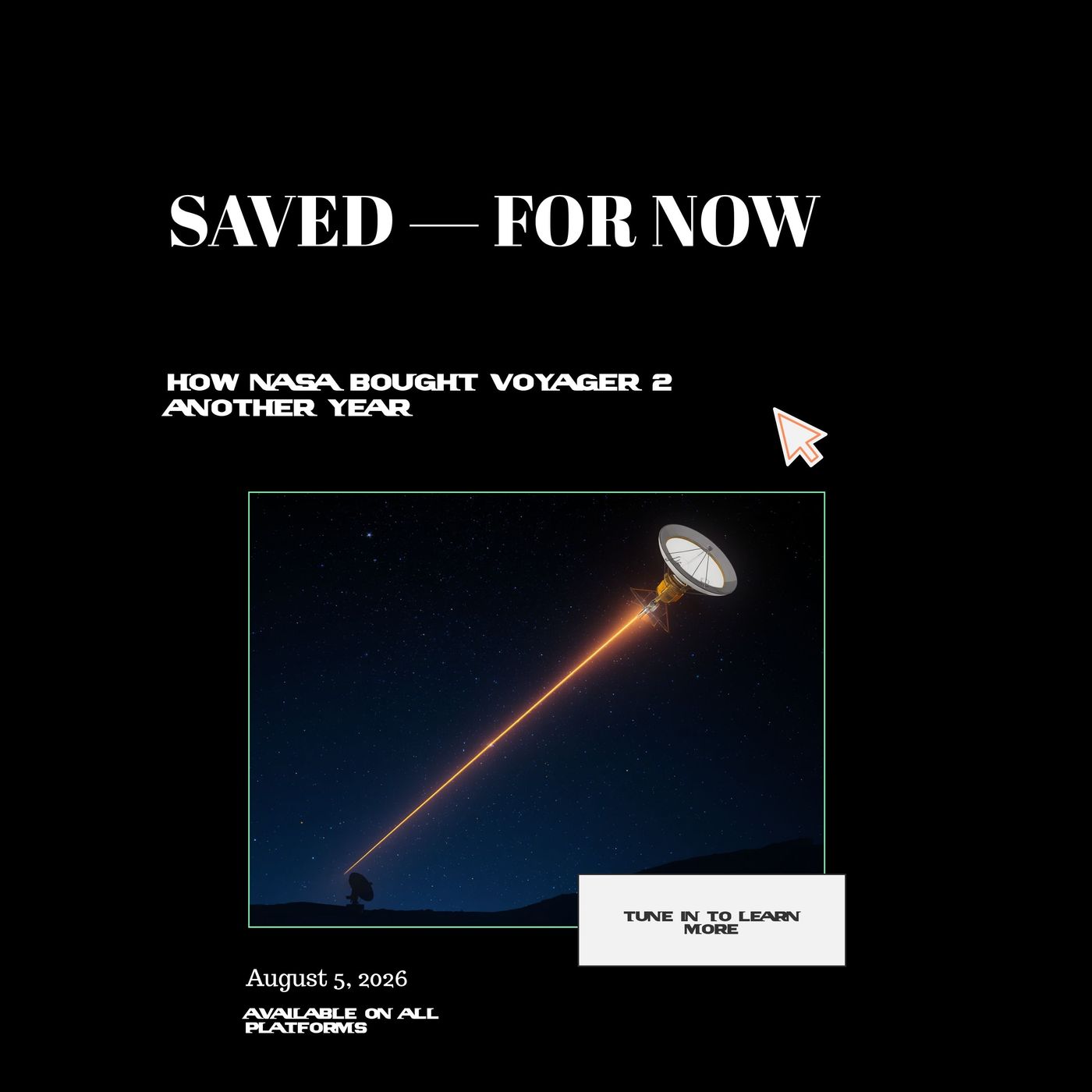
Back to you, Halle for our Stories of the Week, thanks Tim. In a remarkable feat of interstellar communication, NASA has successfully re established contact with Voyager two, a spacecraft that's been journeying through the Cosmos since nineteen seventy seven. Currently positioned over twelve point three billion miles from Earth, Voyager two received an interstellar shout from NASA's highest power transmitter based in Canberra, Australia, correcting its antenna orientation and re establishing communication.
Both Voyager spacecraft carry Golden Records, twelve inch gold plated copper discs narrating the story of our world to potential extraterrestrial life. The success of this interstellar shout, initially not expected until October fifteenth, marks a significant milestone for NASA and the Voyager mission. However, it's worth noting that the power banks of the Voyager spacecraft are projected to run out sometime after twenty twenty five. NASA data helps Bangladeshi farmers save water, money, energy.
With nearly one hundred and seventy million residents, Bangladesh is one of the most densely populated nations in the world. Nearly half of its residents work on or live around farms. And rice crops are critical to feeding that population. So when researchers from the University of Washington and Bangladesh's Ministry of Agriculture joined forces to use data from NASA and its partners to help the country's rice farmers, the potential benefit was substantial. Through their IRIS program, short for the Integrated Rice Advisory System, researchers from UW and Bangladesh use satellite data to deliver information to farmers about how much water they are using, how much they have, and how much their crops need.
Rice is an essential crop in Bangladesh, and cultivating it requires a lot of water and fuel. During the country's dry season, which takes place from January to June, farmers typically pump groundwater from aquifers. Pumping is expensive and it usually requires burning fuels that release carbon dioxide into the atmosphere. To create sustainable and climate resilient agriculture for the future, we need to minimize irrigation waste and decarbonize the production by using affordable solutions that can be scaled globally.
Set Feissel Hossain, Professor of Civil and Environmental Engineering at the University of Washington and leader of IRIS, The IRIS team completed its first nationwide effort in June twenty twenty three, providing advisories on irrigation needs to more than ten million farmers across Bangladesh. Hossain and the IRIS team estimate that the program has the potential to reduce agricultural water waste in Bangladesh by about thirty percent, reduce agricultural fuel consumption by forty five percent, save one hundred and fifteen million dollars annually in fuel subsidies, and reduce carbon emissions by three hundred thousand tons per year.
An experiment sent to the International Space Station aims to help scientists develop AC for astronauts who may travel to remote areas of our Solar System and perhaps one day beyond deep space. AC requires understanding how low gravity affects boiling and condensation. An experiment sent to the International Space Station on the final entary's rocket launch, which took place on Tuesday, August first, aims to help scientists develop air conditioning for a future in which astronauts can travel to remote places in the Solar System, keeping humans alive, happy, and healthy while away from the comfort of Earth, including on spacecraft or in planetary habitats will require reliable air conditioning that can continue operating in wildly different temperatures and when exposed to various gravitational environments.
Heating, ventilation and air conditioning systems on Earth use evaporation and condensation to control indoor air temperatures and humidity. Thus, designing systems for possible deep space habitats will first require understanding how microgravity affects such evaporation and condensation processes. We have developed over a hundred years worth of understanding of how heat and cooling systems work in Earth's gravity, but we haven't known how they work in weightlessness. SETTI some muta war produce Betty Ruth and Milton by Hollander, Family, professor of mechanical engineering, said in a new step towards this goal, a Perdue University experiment launched on the nineteenth Commercial Resupply Service mission from Northrop Grumman and G nineteen to the International Space Stations.
Hopefully it'll collect data to help answer long standing questions about how boiling and condensation work in low gravity. This will add a second module to a facility called the Flow Boiling and Condensation Experiment FBC. The first module aboard the ISS since August twenty twenty one, has been collecting data on the effects of microgravity on boiling in particular, but the new components arriving at ISS will soon allow teams to also investigate how condensation works in microgravity by comparing data collected in orbit with data collected on the ground.
Both modules will run through twenty twenty five. Japan's RISM X ray Imaging and Spectroscopy mission, pronounced at CHRISM Observatory, expected to launch August twenty fifth August twenty sixth, Japan local time, will provide an unprecedented view into some of the hottest places in the universe, and it will do so using an instrument that's actually colder than the frostiest cosmic location now known. Srism's resolve instrument will let us peer into the makeup of cosmic X ray sources to a degree that hasn't been possible before, said Richard Kelly, NASA's RISM principal investigator at NASA's Goddard Space Flight Center in Greenbelt, Maryland.
We anticipate many new insights about the hottest objects in the universe, which include exploding stars, black holes, and galaxies. Powered by them and clusters of galaxies. A new NASA infographic illustrates the enormous range of cosmic temperatures. At the bottom of the scale is absolute zero kelvin or four hundred and fifty nine point six seven degrees below zero fahrenheit minus two hundred and seventy three point one five celsius. The detector fors RISMS Resolve instrument is just a few hundreds of a degree warmer than this.
It's twenty times chillier than the Boomerang nebula, the coldest known natural environment, and about fifty times colder than the temperature of deep space, which is warmed only by the oldest light in the universe, the cosmic microwave background. The instrument, a collaboration between NASSA and jacksa japan aerospace exploration agency, must be kept so cold because it works by measuring the tiny temperature increase created when X rays strike its detector. This information builds up a picture of how bright the source is.
In various X ray energies the equivalent of colors of visible light and lets. Astronomers identify chemical elements by their unique X ray finger prints called spectra. With current instruments were only capable of seeing these finger prints in a comparatively blurry way, said Brian Williams, NASA's RISM Projects scientist at Goddard. Resolve will effectively give X ray astrophysics a spectrometer with a magnifying glass. Srism's other instrument, called Stend, developed by Jackson and Japanese Universities, is an X ray imager that will perform simultaneous observations with Resolve, providing complementary information.
Both instruments rely on two identical X ray mirror assemblies developed at Goddard. The mystery surrounding a large piece of space debris that washed up on a beach in western Australia appears to have been solved. The Australian Space Agency believes the wreckage is likely a section of the third stage of a Polar Satellite launch vehicle PSLV operated by the Indian Space Research Organization IRO. The debris is thought to be part of a PSLV rocket that launched a navigation satellite for the IRNSS constellation on May twenty ninth, twenty twenty three.
The incident highlights the growing problem of space debris with the European Space Agency estimating that there are currently around ten thousand spacecraft in orbit around Earth, at least two thousand of which are dead. The Astronomy Daily Podcast thank you. Thanks for that. Hollie, do you have a joke for us this week? Here's a science joke for you. Why did the biologist break up with the computer scientist because they couldn't find a common ancestor. That is just a terrible joke. Thanks everybody for listening to Astronomy Daily.
You can find all of our episodes, plus our parent podcasts, space Nuts at space nuts dot io or at bites dot com. And don't forget that you can join in the conversation yourself by going to our Facebook page Space Nuts podcast group. You can hear Steve Dunkley on Mondays and myself, Tim Gives on Fridays for a full show. Thanks for listening, see you next week. Bye for now. Thanks Tim TTFN to check you care for your own Bregre The Astronomy Daily Podcast. I

 Apple Podcasts
 Spotify
 Pocket Casts
 Castbox
 Overcast
 Podbean
 iHeartRadio
 Castro
 Goodpods
 Moon FM
 Podcast Addict
 Podcast Republic
 YouTube