In this episode
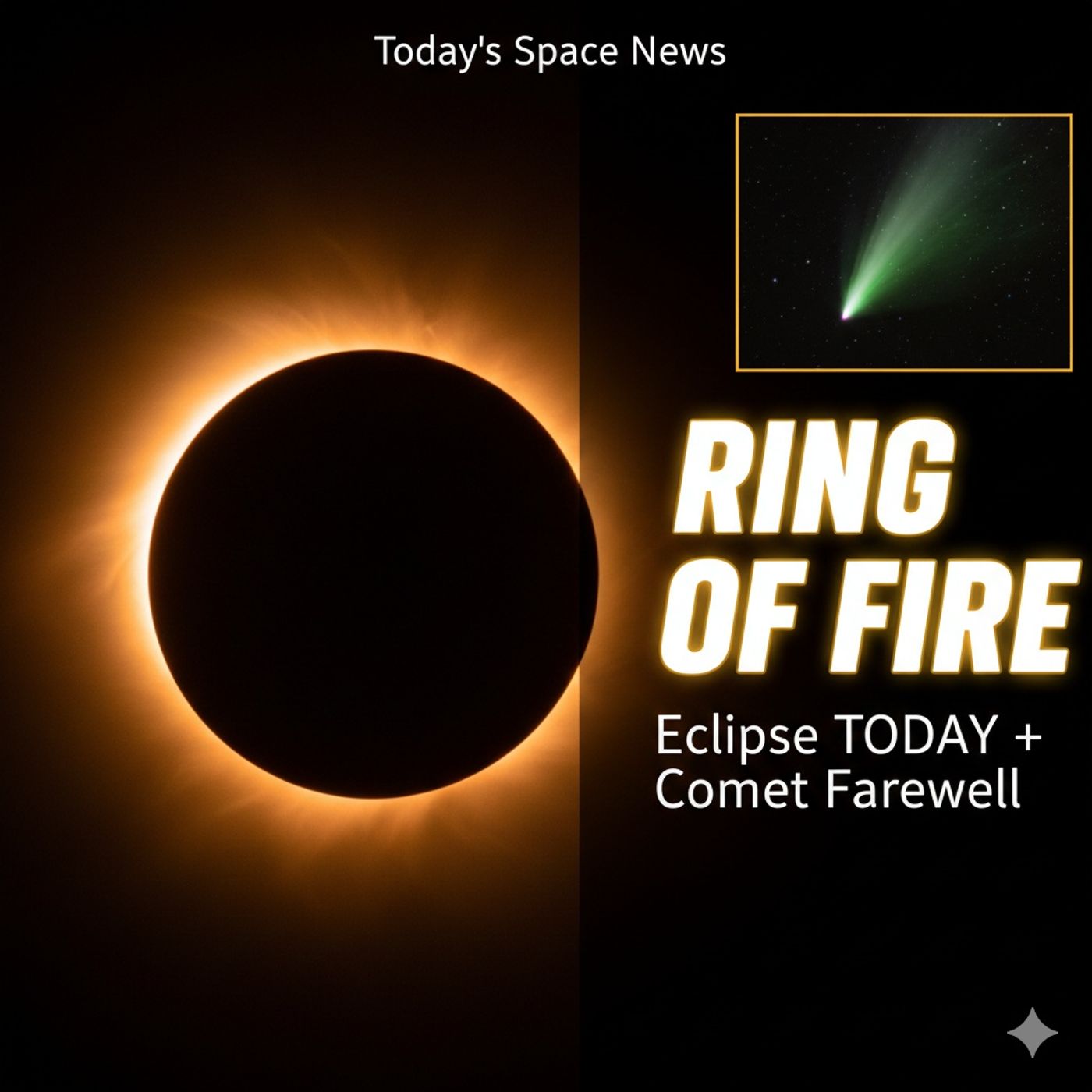
Astronomy Daily — S05E41 | Tuesday 17 February 2026 Ring of Fire, Farewell Comet, and the Smell of Rotten Eggs in Space Two celestial events happen TODAY — an annular solar eclipse transforms the Antarctic Sun into a ring of fire, and a rare hyperbolic comet makes its closest pass to Earth before leaving the solar system forever. Plus, JWST uses the smell of rotten eggs to solve a major exoplanet mystery, NASA performs a CT scan on the northern lights, a startup plans to fuel rockets with water, and we preview why 2026 is the dawn of a golden age of eclipses. In This Episode: • Ring of Fire solar eclipse over Antarctica — happening today, February 17, with up to 96% of the Sun covered and a 616km-wide path of annularity • Comet Wierzchoś (C/2024 E1) makes its closest approach to Earth today at 151 million km — a one-way trip out of the solar system, never to return • JWST detects hydrogen sulfide in giant exoplanets orbiting HR 8799, proving they formed like planets, not brown dwarfs — published in Nature Astronomy • NASA’s BADASS and GNEISS twin rocket missions launch from Alaska to “CT scan” the electrical circuitry of the aurora • General Galactic, led by ex-SpaceX engineer Halen Mattison, reveals plan to make rocket fuel from water — satellite test in October 2026 • 2026: A golden age of eclipses begins — total lunar eclipse March 3, total solar eclipse over Europe August 12, and much more ahead Hosted by: Anna & Avery Produced by: Huw at Bitesz.com Website: astronomydaily.io Social: @AstroDailyPod across all platforms Network: Bitesz.com Podcast NetworkBecome a supporter of this podcast: https://www.spreaker.com/podcast/astronomy-daily-latest-space-news--5648921/support.
Sponsor Details:
Ensure your online privacy by using NordVPN. To get our special listener deal and save a lot of money, visit www.astronomydaily.io/nordvpn. You'll be glad you did!
Get the best secure and private email on the planet. Stop your Government, google and who knows who else spying on every email you write. Do what we did and use ProtonMail. They beleive in privacy and there are no ads in their business model...yet they still provide a free forever service. Check them out and get out special deal at www.astronomydaily.io/protonmail
Become a supporter of Astronomy Daily by joining our Supporters Club. Commercial free episodes daily are only a click way... Click Here
This episode includes AI-generated content.
Speaker 1: Good day, stargazers, and welcome to Astronomy Daily, episode forty one of season five. I'm Anna and I'm.
Speaker 2: Avery, and what a day will be alive and looking up? Anna, It's Tuesday, February seventeenth, twenty twenty six, and we have not one, but two celestial events happening today.
Speaker 1: That's right. The Sun is about to be turned into a ring of fire over Antarctica, and a comment that may never return is making its closest pass to Earth as we speak. Plus we've got JWST solving an identity crisis for some massive exoplanets, NASA doing CT scans on the Northern Lights, and a startup that wants to fuel rockets with water. And a preview of why twenty twenty six might just be the greatest year of eclipses in a generation.
Speaker 2: Let's not waste a single second. Let's dive right.
Speaker 1: In, so Avery, We've been building up to this for weeks, and today is finally the day. Right now, as many of our listeners are tuning in, an annular solar eclipse is tracing its path across Antarctica.
Speaker 2: And I know some of our listeners might be thinking, didn't we just cover this, and yes, we've talked about it in recent episodes, but today is the day, and there's something truly special happening down at the bottom of the world.
Speaker 1: Let's recap the essentials. An annular eclipse happens when the Moon passes directly between the Earth and the Sun, but because the Moon is at a more distant point in its orbit, it doesn't completely cover the Sun's disk. Instead, you get this breath taking ring of brilliant sunlight surrounding the dark silhouette of the Moon.
Speaker 2: The ring of fire, and today's ring will last up to two minutes and twenty seconds for anyone lucky enough to be standing in the path of annularity. At the moment of greatest eclipse, which occurs at twelve twelve UTC, the Moon will cover approximately ninety six percent of the Sun's surface.
Speaker 1: Now ninety six percent sounds like almost everything, but here's the important thing. It's not a total eclipse. The sky won't go dark. You absolutely must keep your solar eclipse glasses on for the entire event. There's no moment where it's safe to look at the Sun with the naked eye.
Speaker 2: The path of annularity itself is actually quite wide, for eclipse standards about six hundred and sixteen kilometers across, but it's crossing some of the most remote territory on Earth. We're talking about the Antarctic mainland and the surrounding Southern Ocean. So realistically, the only people seeing the full ring of fire today are researchers at a handful of Antarctic stations.
Speaker 1: However, the partial phases of the eclipse are visible from a much wider area. Observers in southern Argentina, southern Chile, southeastern Africa, Madagascar, and Mauritius will all see the Moon take a bite out of the Sun to varying degrees.
Speaker 2: And here's something that I think really elevates today's event. This eclipse kicks off the first eclipse season of twenty twenty six. Eclipse seasons are these brief windows, typically about thirty four days long, when the geometry of the Sun, Earth, and Moon aligns just right for eclipses to occur, and they usually come in pairs.
Speaker 1: Exactly so less than two weeks from now, on March the third, we get a total lunar eclipse, a blood moon, visible from North America. And that's just the beginning for twenty twenty six, which we'll come back to later in the show.
Speaker 2: For anyone wanting to follow along today, there are several live streams available, and we'll have links in our show notes even if you can't see it from where you are. This is a wonderful moment to appreciate the clockwork precision of our solar system.
Speaker 1: Am sticking with things happening literally today, let's talk about Comet C twenty twenty four e one, better known as Comet weird Chosh, which is making its closest approach to Earth right now.
Speaker 2: This is one of those stories where the science and the poetry really come together beautifully. This comment was discovered back in March twenty twenty four by Polish astronomer Casper Weirtoch using the Mount Lemon survey in Arizona, and today it passes within about one hundred and fifty one million kilometers from Earth, roughly the same distance as Earth is from the Sun, so.
Speaker 1: It's not exactly a close shave, but it's still a significant astronomical moment. What makes this comment truly special is that it's on a hyperbolic orbit. For our listeners who aren't familiar with that, term. It means the comet's trajectory isn't a closed loop. It's not coming back.
Speaker 2: Ever, or at least not for over two hundred thousand years, and even that's optimistic. Scientists believe it originated in the Orc cloud, that vast icy shell at the outer edges of our solar system, and it's now getting a gravitational slingshot that will send it how into interstellar space. This is genuinely a once in a civilization event.
Speaker 1: NASA's Astronomy Picture of the Day featured Comet Versos today with a thirty minute exposure taken from Chile, showing a gorgeous five degree long ion tail and three separate dust tails. The comet also has a vivid green coma, which scientists believe is linked to carbon bearing compounds, likely diatomic carbon, fluorescing under ultraviolet sunlight.
Speaker 2: The James Webb Telescope actually observed this comet last year when it was still far out at about seven astronomical units from the sun. They found that it's activity is primarily driven by carbon dioxide rather than carbon monoxide, which is interesting because it suggests the comet may have lost its near surface COO early in its evolution.
Speaker 1: Now, in terms of actually seeing it at magnitude seven point eight to eight point two, you're going to need bens at minimum, ideally a small telescope. It's currently in the constellation Sculptor, quite low in the southwestern sky after sunset. Southern hemisphere observers have the far better view today.
Speaker 2: Northern hemisphere observers don't despair. Over the coming days, the comment will climb a bit higher, and by around February twenty third it should be a more accessible target as it passes near some galaxies in Cetus, but it will be fading by then. If you can get out tonight with some optics, it's worth the effort. You're quite literally saying goodbye to something the human race will never see again.
Speaker 1: All right, let's travel one hundred and thirty three light years away to the constellation Pegasus, where the James Webb telescope has just settled one of exoplanet's science's most persistent mysteries.
Speaker 2: And the key to solving it. Hydrogen sulfide, the molecule that gives rotten eggs their delightful aroma. Published in Nature Astronomy, a team from UCLA and U see San Diego use JWST to study HR eight seven nine nine system, which hosts four enormous gas giant planets, each between five and ten times the mass of Jupiter.
Speaker 1: Now, these planets have been known since two thousand and eight, and they're actually directly visible through telescopes, which is remarkable in itself. Most exoplanets are detected indirectly. But because they're so massive, and because they're so far from their star between fifteen and seventy times Earth's distance from the Sun, scientists have long debated if they're truly planets or something else entirely.
Speaker 2: Specifically, are they planets or brown dwarfs. Brown dwarfs are sometimes called failed stars, objects that form through gravitational collapse of a gas cloud like a star, but never got massive enough to sustain hydrogen fusion. The traditional mass boundary is around thirteen Jupiter masses, but that's a bit arbitrary.
Speaker 1: What really matters is how they formed. Did they form like planets through core accretion, building up a solid core from dust and rock that then attracted gas, or did they form like stars through the rapid collapse of a dense pocket of gas.
Speaker 2: And this is where the rotten eggs come in. The team detected hydrogen sulfide in the atmospheres of these three worlds Hr eight, seven, nine, nine, C, D, and E. Now why is sulfur the key? Because at the vast distances these planets orbit their star, sulfur can only exist in solid form within the protoplanetary disc. It cannot be in the gas phase. So if they're sulfur in these planet's atmospheres, it had to have been gobbled up as solid material during the planet's formation.
Speaker 1: That's the smoking gun for core accretion. These worlds massive as they are formed the same way Jupiter did, just on a much grander scale. Previous studies looking at carbon and oxygen couldn't distinguish between the two formation pathways because those elements can come from either gas or solids.
Speaker 2: The researchers also found that these planets are enriched in heavy elements compared to their hostar by factors of roughly two to nine times. The estimate the four planets together contain around six hundred earth masses of heavy material. That's an extraordinary amount of solid material.
Speaker 1: And this phrases a really fascinating question. How big can a planet get if objects ten times Jupiter's mass can form through Cora accretion, where exactly is the line between the biggest planets and the smallest brown dwarfs.
Speaker 2: Lead researcher Jerry Swan from UCLA put it beautifully. He said, the technique they used to separate the light from these incredibly faint planets ten thousand times fainter than their star, will eventually be applicable to studying earth like worlds. He said. Finding an Earth analog is the holy grail, and we might be twenty to thirty years away from getting the first spectrum of an earth like planet and searching for biosignatures.
Speaker 1: The future of exoplanet science built on the foundation of smelly gas.
Speaker 2: Who would have thought thing closer to home now? Well, relatively speaking. NASA launched two groundbreaking sounding rocket missions from Alaska earlier this month, and the results are already exciting the science community.
Speaker 1: These launched from the Poker Flat Research Range near Fairbanks, and they had two of the best mission acronyms I've ever encountered. The first is Badass, the Black and Diffuse Auroral Science Surveyor and yes that's the real name.
Speaker 2: Launched February ninth, Badass reads an altitude of about three hundred and sixty kilometers and was specifically designed to study a phenomenon called black auroras. These are these strange dark structures that appear as apps or voids drifting within the brighter diffuse aurora like someone has taken an eraser to parts of the Northern Lights.
Speaker 1: What's happening physically is that electrons, instead of streaming down into Earth's atmosphere the way they do in normal auroras, are shooting upward into space. Scientists don't fully understand why this reversal happens, and Badass was designed to gather data on exactly that.
Speaker 2: Then on February tenth, NASA launched the GNEISS mission. That's the Geophysical Non Equilibrium Ionoscire Science System. This one used two rockets launched just thirty seconds apart, flying side by side through the same aurora along different slices.
Speaker 1: And here's the clever bit. Each rocket ejected four sub payloads, giving them multiple measurement points inside the aurora. Simultaneously, the rockets also sent radio signals through the surrounding plasma to a network of eleven ground receivers. The way the plasma altered, those radio wives allowed scientists to map the plasma density, revealing where electrical currents can flow.
Speaker 2: Principal investigator Christina Lynch from Dartmouth College described it as essentially doing a CT scan of the plasma beneath the aurora in the same way a medical CT scan uses X rays passing through different body tissues to reconstruct the three D image. NIE uses radio waves passing through auroral plasma to reconstruct the electrical environment in three dimensions.
Speaker 1: Both missions reported that all instruments performed as expected and returned high quality data. This is particularly satisfying for the Badass team because the same mission was on the launch pad at Poker Flat last year, but the required auroral conditions never materialized before the launch window closed.
Speaker 2: Understanding how auroral currents work isn't just pure physics. Those currents shape how energy from space spreads through earth upper atmosphere. Where the current fans out, the atmosphere heats up, which can affect satellite drag, GPS accuracy and radiocommunications. With our increasing dependence on space based technology, this research has very practical implications.
Speaker 1: Now for something that sounds like science fiction but is heading for a real World test later this year. A startup called General Galactic, led by former SpaceX engineer Hallan Madison, is developing technology to use water as rocket fuel.
Speaker 2: And before anyone thinks we're talking about some kind of perpetual motion scam, the science here is sound. The core concept uses electrolysis, splitting water molecules into hydrogen and oxygen, and then using those gases in two different propulsion systems.
Speaker 1: Right For chemical propulsion, you burn the hydrogen and oxygen together, which produces high pressure thrust, much like a conventional rocket engine. For electrical propulsion, you ionize the oxygen and accelerate it using a magnetic field, creating plasma thrust. Madison describes that second type as very very low thrust. People jokingly like to call it a burp in space, but.
Speaker 2: Even a burp in space can be useful for precise maneuvers and station keeping. The real game changer here isn't the propulsion technology itself, but the fuel source. Water is one of the most abundant resources we found on other worlds. There's water ice on the Moon, on Mars, on asteroids. If you can turn that water into fuel, you've essentially created the infrastructure for cosmic refueling stations.
Speaker 1: That's exactly Madison's long term vision. He's talking about building a refueling network that connects Earth, the Moon, and Mars. As he puts it, everybody wants to go build a Moon base or a Mars base. Who's going to pay for it? How does it actually work? His answer is to make the economic viable by using in situ resources.
Speaker 2: Now, there are real challenges to overcome. Water has to be purified, electoralized, and stored efficiently, and the whole system has to be lightweight enough for space applications. There's also concerns about ionized oxygen potentially affecting satellite electronics, but the team is pushing ahead with a proof of concept.
Speaker 1: And that proof of concept is coming soon. General Galactic is planning to launch an eleven hundred pound satellite on a SpaceX Falcon nine rocket in October twenty twenty six. That satellite will test both the chemical and electrical propulsion systems using water as fuel in actual space conditions.
Speaker 2: If it works, it could fundamentally change the economics of spaceflight. Mathison plans. They're talking about billions of dollars in savings even with current operations and trillions in new economic growth as the infrastructure scales up. Those are bold claims, but the underlying phis is solid. We'll be watching that October launch very closely.
Speaker 1: So we open the show with today's annular eclipse, and we mentioned that it kicks off an eclipse season, but I think it's worth zooming out and looking at the bigger picture because twenty twenty six is shaping up to be an absolutely extraordinary year for eclipses.
Speaker 2: It really is. So let's run through what's coming first. Up, as we mentioned on March the third, we get a total lunary eclipse that's a blood moon, and it will be visible across North America, which is fantastic news for our listeners in that part of the world.
Speaker 1: Then we get to August twelfth, and this is the big one, a total solar eclipse, not annular, but total, with its path of totality crossing the Arctic, Greenland, Iceland and Spain, and observers across much of Western Europe and North America will see a partial eclipse.
Speaker 2: For anyone in the UK, this is particularly exciting. The BBC Sky at Night magazine and the Royal Observatory Greenwich are both flagging this as the best solar eclipse visible from the UK since nineteen ninety nine. Viewers in London will see the Moon touch the edge of the Sun's disc at six seventeen pm BST, and.
Speaker 1: It doesn't stop there. The astronomical community is talking about a genuine Golden age of eclipses beginning right now. Between twenty twenty six and twenty twenty eight. We're looking at three total solar eclipses and three Ring of Fire eclipses in just three years. That's an extraordinary run.
Speaker 2: So if today's Antarctic Ring of Fire has you feeling a bit left out because you couldn't see it, don't worry. There is so much more to come. Start planning now for August twelfth, and make sure you're subscribed to Astronomy Daily because we'll be covering every single one of these events.
Speaker 1: This is going to be an epic year for eclipse chasers.
Speaker 2: And that brings us to the end of another packed edition of Astronomy Daily. What a day, anne an eclipse, a comment, farewell, rotten eggs, solving planetary mysteries, seet scans of auroras, water powered rockets, and a Golden Age of eclipses beginning right now.
Speaker 1: If you enjoyed today's episode, please do subscribe wherever you get your podcasts, leave us a rating and a review, and share us with anyone you know who loves looking up. You can find us at Astronomydaily dot io, on YouTube, and across all social media platforms at astro Daily Pod and.
Speaker 2: Don't forget we're part of the Bytes dot com podcast network, where you'll find plenty of other great shows to keep you entertained.
Speaker 1: And informed until next time, Keep your eyes on the skies.
Speaker 2: Clear skies. Everyone, Sunday Stars Start. The story is control over
 Apple Podcasts
 Spotify
 Pocket Casts
 Castbox
 Overcast
 Podbean
 iHeartRadio
 Castro
 Goodpods
 Moon FM
 Podcast Addict
 Podcast Republic
 YouTube