In this episode
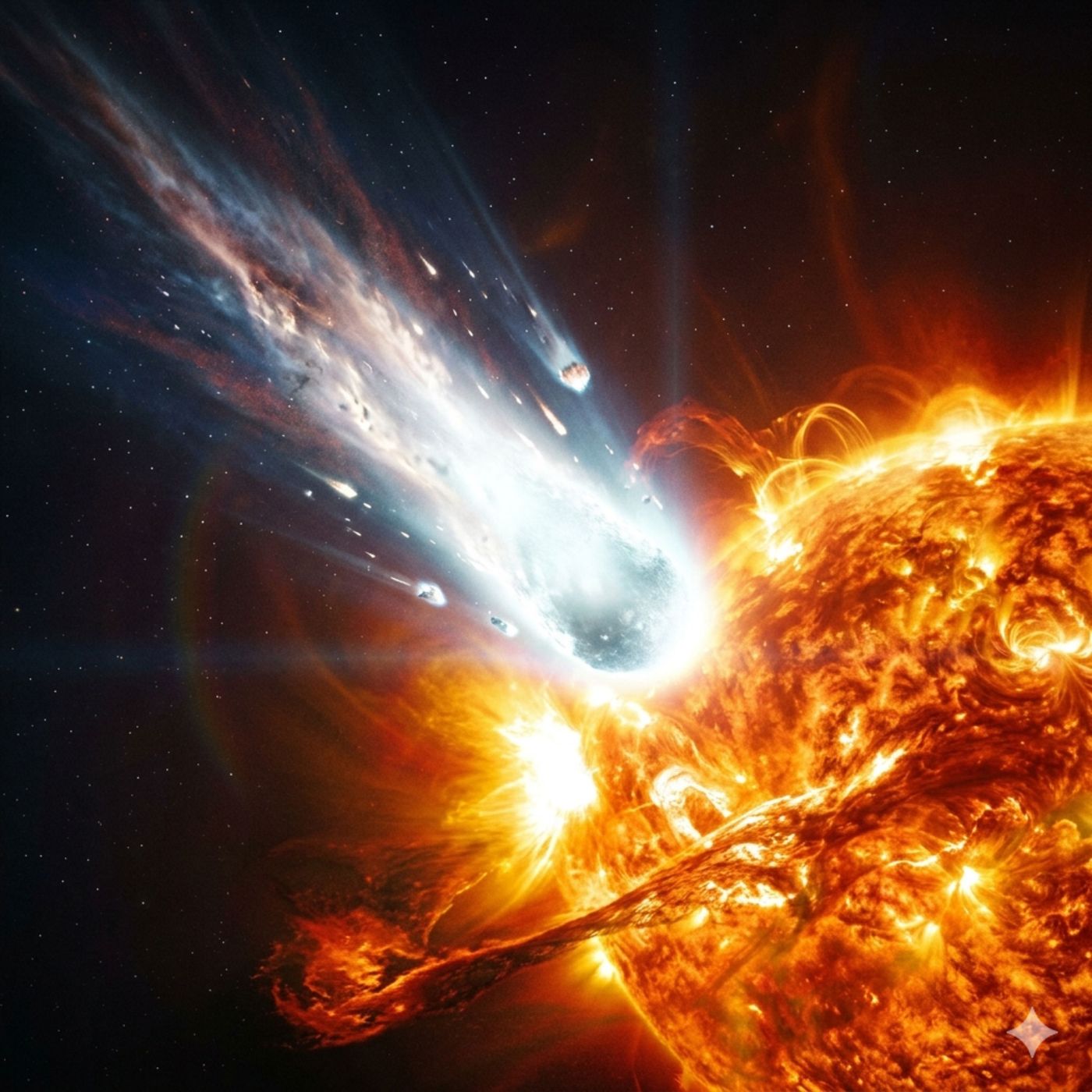
In this episode of Astronomy Daily, Anna and Avery cover six space and astronomy stories for Saturday, April 18, 2026. Comet MAPS has met its end at the Sun — the pair reflect on what happened and what comes next. Artemis III's SLS rocket stage rolls out of New Orleans on Monday. JWST and ALMA have revealed a stunning monster spiral galaxy hiding behind cosmic dust 11.5 billion years ago. An exoplanet system is changing its orbital architecture in real time. Four planets are gathering in a pre-dawn planet parade visible tonight. And 33,000 hydrogen halos have been found that solve a decades-old mystery about the early universe's fuel supply. Story 1: Comet MAPS — Death of a Sungrazer Comet C/2026 A1 (MAPS), a Kreutz sungrazer discovered on January 13, 2026 by French amateur astronomers at the AMACS1 Observatory in Chile, disintegrated during its close solar approach on April 4. The nucleus — estimated at approximately 400 metres in diameter based on JWST observations — could not survive passage just 160,000 km above the solar surface. A brief dust tail was visible in coronagraph images from SOHO and GOES-19, but the debris cloud has since dispersed. Attention now shifts to Comet C/2025 R3 (PanSTARRS) as the next comet of interest. MAPS was the furthest-discovered Kreutz sungrazer in history, spotted 81 days before perihelion. Sources: EarthSky | StarWalk Space News | Sky & Telescope Story 2: Artemis III SLS Core Stage Rollout On Monday, April 20, NASA will roll the top four-fifths of the Artemis III Space Launch System core stage — containing the liquid hydrogen tank, liquid oxygen tank, intertank, and forward skirt — out of the Michoud Assembly Facility in New Orleans and load it onto the Pegasus barge for delivery to Kennedy Space Center. The engine section is already at Kennedy Space Center's Vehicle Assembly Building. Four RS-25 engines are expected to arrive from Stennis Space Center by July 2026. Artemis III is currently targeting a 2027 launch for a crewed Earth-orbit test of Orion docking with commercial lunar landers, with a crewed Moon landing planned for 2028. Source: NASA Artemis III Media Release | nasa.gov Story 3: JWST & ALMA Reveal Monster Spiral Galaxy ADF22.A1 Using the James Webb Space Telescope and the Atacama Large Millimeter Array (ALMA), an international team led by Hideki Umehata (Nagoya University) has revealed the true nature of ADF22.A1 — a galaxy in the SSA22 protocluster from 11.5 billion years ago. Previously hidden behind heavy cosmic dust, JWST unveiled its spiral stellar structure while ALMA mapped its rotating gas disk, spinning at an extraordinary 530 km/s — more than twice our own Milky Way. With an effective radius of approximately 22,800 light years, it is nearly twice the size of typical galaxies from that era. Cold accretion from the Cosmic Web is the leading explanation for its rapid growth and spin-up. A companion study examines nine additional dusty star-forming galaxies in the same protocluster, revealing diverse evolutionary stages and morphologies. Sources: ALMA Observatory Press Release | Publications of the Astronomical Society of Japan (2025) | ApJ (2026) Story 4: TOI-201 — Shape-Shifting Exoplanet System A team led by Ismael Mireles (University of New Mexico) has published findings in Science Advances confirming three bodies in the exoplanet system TOI-201: a super-Earth (TOI-201 d, 1.4x Earth radius, 5.85-day orbit), a warm Jupiter (TOI-201 b, ~0.5 Jupiter masses, 53-day orbit), and a brown dwarf (TOI-201 c, ~7.9-year orbit). The brown dwarf's gravity is actively distorting the inner planets' orbits on human timescales — the super-Earth's transits are shifting, and within 200 years it will stop transiting the star from Earth's viewpoint. TOI-201 c is the longest-period transiting object ever discovered. The system is 372 light-years away in the constellation Pictor. Next transit of TOI-201 c: March 26, 2031. Paper: Mireles et al., Science Advances, April...Speaker 1: A once in a generation comet flew too close to the Sun and didn't survive. A monster spiral galaxy has been hiding behind a veil of cosmic dust for eleven point five billion years, and JWST and ALMAH have finally pulled it back. And four planets are lining up in the dawn sky right now, right outside your window. This is Astronomy Daily. I'm Anna, and I'm.
Speaker 2: Avery, and this is your Space news for Saturday, April eighteen.
Speaker 1: So Avery, we's been watching Comet c Dash twenty twenty six, a one known as Comet Maps for months. When it was discovered back in January, it was the furthest out a kreutz Sungrazer had ever been spotted. There was genuine excitement that it might become a naked eye spectacle, maybe even a great comment.
Speaker 2: And then it went and died on.
Speaker 1: Us, dramatically and completely. On April fourth, Comet Maps made its closest approach to the Sun, passing just one hundred sixty thousand kilometers above the solar surface or about ninety nine thousand miles, and it did not survive. The intense heat and tidal forces simply pulled it apart.
Speaker 2: To put that distance in perspective, the Sun's diameter is about one point four million kilometers. This comet was skimming just above the surface. It's a wonder anything survived at all.
Speaker 1: For a brief moment, coronograph images from the Soho and Gohs nineteen spacecraft showed the comet going in, and then what emerged was not an intact comet, but a dust plume, a ghost the nucleus had disintegrated.
Speaker 2: There was a brief period of cautious optimism. Some of the leftover debris created a faint curved dust tail visible in the coronagraph images, raising hopes of what astronomers call a headless wonder, a commetless tail glowing in the evening sky.
Speaker 1: But those hopes have now faded. The debris cloud has been dispersing, and as of today, Comet Maps is effected over. Its story is done, and that is.
Speaker 2: A point at ending. Maps was named for the four French amateur astronomers who discovered it. Mari, a tard, parrot, and signare in their observatory in San Fedro Data Gamma in Chile. The James Webbs based telescope had even managed to measure the comet's nucleus before perihelion, estimating it at around four hundred meters in diameter, about the size of the comet Lovejoy, which did survive at solar encounter in twenty eleven.
Speaker 1: Mapps was just too fragile or the sun was too greedy.
Speaker 2: But the sky doesn't stay empty for long. Attention is now turning to comet seed Dash twenty twenty five R three, known as pan Stars. It's a more predictable, steadier target, no deaf deifying solar flyby on the agenda, and it's expected to be a good binocular comet in the weeks ahead. We'll be tracking it.
Speaker 1: Goodbye, Maps, you were brief and beautiful.
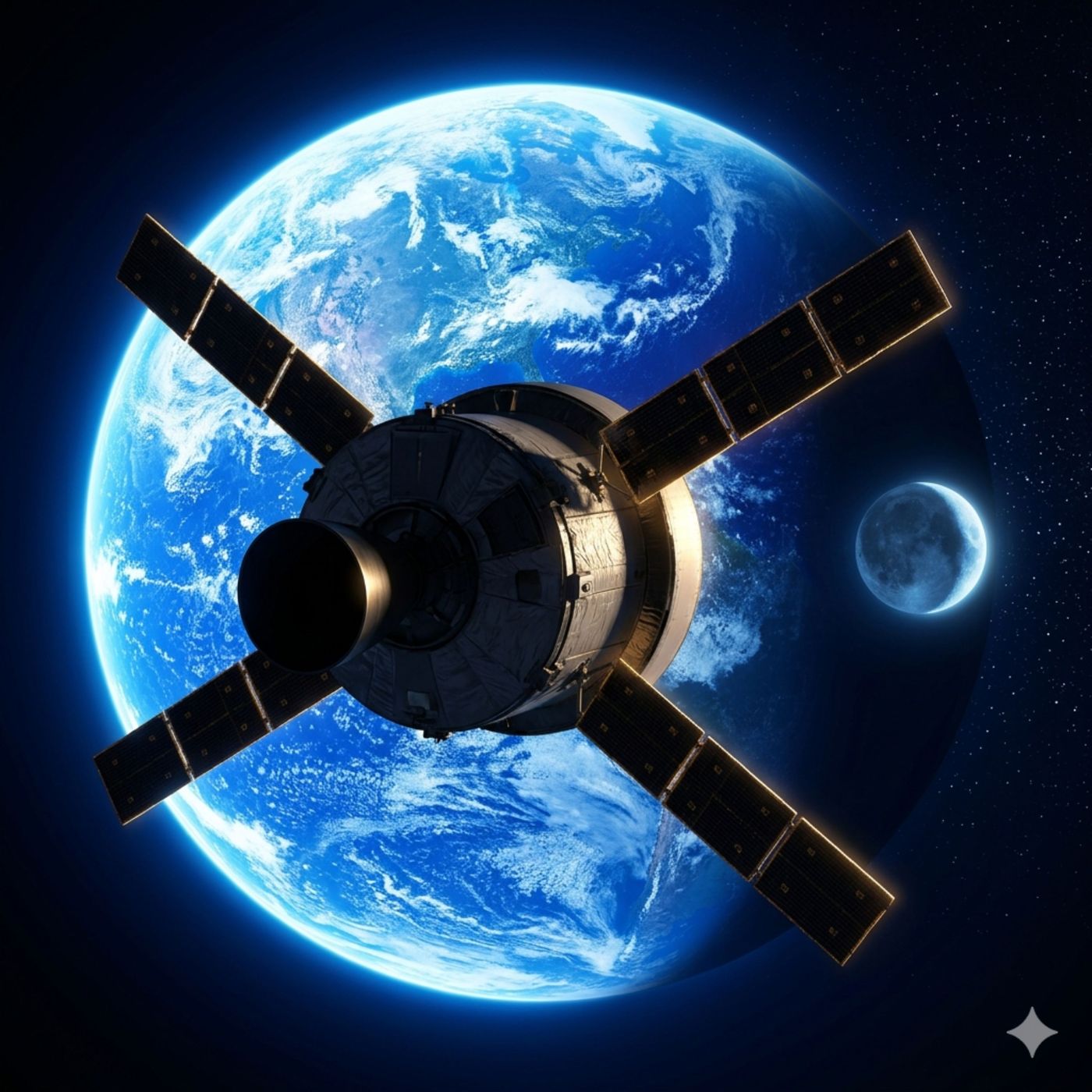
Speaker 2: Meanwhile, NASA is already moving at pace toward the next lunar mission, and this coming Monday, April twentieth, there's a major physical milestone happening in your lens. What's rolling out the largest section of the Space Launch System rocket that will power Artemis three, what NASA calls the top four to fifth of the core stage, which contains the liquid hydrogen tank, the liquid oxygen tank, the intertank, and the forward skirt, is being rolled out of the misshout assembly. Facility and loaded onto the Pegasus barge for delivery to Kennedy Space Center in Florida.
Speaker 1: This is the backbone of the rocket, enormous piece of engineering.
Speaker 2: Absolutely once it arrives at Kennedy, teams will complete the vertical integration with the engine section, which has already been in the vehicle assembly building since July. The four RS twenty five engines veteran hardware from the Space Shuttle program, are being refurbished that Stennis Space Center and expected to arrive at Kennedy no later than July.
Speaker 1: And just to clarify for listeners who may have been following along, Artemis three's mission profile has been revised. It won't be good going directly to the Moon. The plan now is to perform a crude test in Earth orbit, justing rendezvous and docking between Orion and the commercial lunar landers from SpaceX and Blue Origin as a stepping stone towards a crude moonlanding in twenty twenty eight.
Speaker 2: So while the Moon itself is still on the horizon, this mission is critical infrastructure proving out the systems you need once you get there, and Artemis three is currently targeting a twenty twenty seven launch a.
Speaker 1: Big visual moment for the program on Monday. Follow at NASA Artemis on social media. If you want to see the roll.
Speaker 2: Out live, I'll be watching now.
Speaker 1: Let's travel back in time eleven and a half billion years to be precise, when the universe was barely two billion years old. Galaxies were still forming and chaos reigned, and.
Speaker 2: Right in the middle of that chaos, something impossibly organized was already taking shape.
Speaker 1: Astronomers have just published new findings on mo one of the most remarkable objects in the early universe, a galaxy known as ADF twenty two point a one. It resides in a protocluster of galaxies called SSA twenty two, and for years it was just a mysterious blob of infrared light, heavily veiled by cosmic dust. But now, using the combined power of the James Webb Space Telescope and the AUTOCOMMA Large Millimeter Array ALMA, researchers have pulled back that dusty curtain.
Speaker 2: And what they found underneath was extraordinary. ADF twenty two point a one is not a blob. It is a giant, structured, rapidly rotating spiral galaxy similar to form to our own Milky Way, but nearly twice the size of typical galaxies from that era.
Speaker 1: Its effective radius is about twenty two thousand, eight hundred light years, comparable to local galaxies we see today. That is enormous for something that existed so early in cosmica history. The universe just hadn't had time to build something that large according to our models.
Speaker 2: Jwst revealed the spiral arms by capturing the infrared glow of the stars embedded within the dust Alma then mapped the gas kinematics the motion of cold gas throughout the galaxy, and the numbers are staggering. The entire gas disk is rotating at around five hundred and thirty kilometers per second. For comparison, our own milky waste disc rotates at roughly two hundred and twenty kilometers per second.
Speaker 1: So this is a galaxy spinning more than twice as fast as our own when the universe was a fraction of its current age. How does that even happen?
Speaker 2: The leading explanation involves the cosmic web, the vast network of hydrogen filaments that connects galaxies across the universe. ADF twenty two dot A one appears to sit at the core of a protocluster that's being fed by these filaments. Cold gas flows in from the cosmic web, imparting both the raw material for star formation and the rotational momentum that spins the disc up so rapidly.
Speaker 1: The galaxy is also forming stars at an explosive rate hundreds two thousands of times faster than the Milky Way does today. It's a monster galaxy in the truest sense, and.
Speaker 2: The latest study goes further, examining not just ADF twenty two dot A one, but nine dusty star forming galaxies in the same proto cluster region, giving astronomers a broader picture of how the most massive galaxies in the early universe build themselves. The results suggest a surprising diversity. Some are in active bulge building phases, others are disk dominated, and the cosmic web appears to be the common thread driving them all.
Speaker 1: We'll link to both the Alma press release and the journal paper in our show notes. Truly stunning science.
Speaker 2: Still in the realm of astonishing astronomy, Let's talk about a planetary system three hundred seventy two light year away in the constellation Pictor that is doing something astronomers have genuinely never seen before.
Speaker 1: Tell me.
Speaker 2: A team led by Smaiel Mireles, a PhD candidate at the University of New Mexico, has just published findings in Science Advances on a three body system called TOI two zero one. And what makes it extraordinary is that the orbits of all three members are changing fast enough to be observed in real time on human timescales.
Speaker 1: Which is almost unheard of. These things usually take millions of years exactly.
Speaker 2: The system contains three very different objects. First, a super Earth TOI two one D, about one point four times the size of our planet and six times its mass, completing an orbit every five point eighty five days. Second, a warm Jupiter TOI two A one B, a gas giant about half the mass of Jupiter, orbiting every fifty three days. And third, the troublemaker, a brown dwarf TOI two oh one C on a wide, highly elliptical orbit of about seven point nine years.
Speaker 1: A brown dwarf is that in between object too massive to be a planet, not quite massive enough to ignite fusion and become a.
Speaker 2: Star right and in this case, the brown dwarf's immense gravitational pool is actively warping the orbits of the inner two planets in real time. The team first noticed that the warm Jupiter was arriving at its transits its crossings in front of the star about thirty minutes late. That gravitational shutter was a signal that something was pulling on the system, and.
Speaker 1: The implications of these changing orbits are dramatic.
Speaker 2: Within about two hundred years, the super Earth will stop transiting its star from our viewpoint entirely. The warm Jupiter will follow a few centuries after that. The system is actively reorganizing itself in front of our eyes.
Speaker 1: Which also means we caught it at a very particular moment in cosmic time.
Speaker 2: A lucky window and the TOI too a one see Brown Dwarf has another distinction. It holds the record as the longest period transitting object ever discovered. Its next predicted transit is March twenty six, twenty thirty one. A rare opportunity for a worldwide observing campaign including amateur astronomers.
Speaker 1: The discovery required collaboration across three continents, pass from space, the ASTEP telescope at Antarctica's remote Concordia station and telescope networks in Chile, Australia and South Africa. We'll link to this Science Advances paper in the show notes. And now your alarm clock challenge for tomorrow morning, because right now four planets are gathering in a tight cluster in the pre dawn eastern sky, and we in the Southern Hemisphere have the best seats on the planet.
Speaker 2: Mercury, Mars, Saturn, and Neptune, all fitting into a patch of sky just four degrees wide. That's about the width of three fingers held at.
Speaker 1: Arms land Neptune. You'll need binoculars or a small telescope for but Mercury, Mars, and Saturn are all naked eye targets. Mercury is currently the brightest of the group at magnitude negative zero point one, quite striking.
Speaker 2: From Sydney, Melbourne, Auckland, Perth. Look low in the east starting about sixty to ninety minutes before sunrise. The cluster sits near the border of Pisces and Cetus. Make sure your eastern horizon is as open as possible.
Speaker 1: The good news this isn't a single morning event. The peak viewing window runs from roughly April sixteenth through twenty third, with tonight and tomorrow morning being the absolute prime. If cloud cover spoils it for you, you have multiple more chances. This coming week.
Speaker 2: A stargazing app like star Walk two or sky Tonight will show you exactly where to look from your specific location, and it's completely free to step outside and look up.
Speaker 1: Set that alarm. You won't regret it.
Speaker 2: And finally, we're going all the way back to the early universe about ten to twelve billion years ago, to an era astronomers call cosmic noon, the peakup BOC, when galaxies were growing their stars faster than at any other time in history.
Speaker 1: And there's been a long standing mystery here. All that star formation requires enormous amounts of hydrogen, but astronomers couldn't find.
Speaker 2: It until now. The hobby Eberly Telescope Dark Energy Experiments HEDX has published a landmark study in the Astrophysical Journal identifying more than thirty three thousand massive hydrogen gas halos called Lyman alpha nebulae surrounding ancient galaxies from that era.
Speaker 1: Thirty three thousand. What was the previous count.
Speaker 2: About three thousand, So this study has increased in no number tenfold in a single survey. And what this tells us is that these hydrogen halos are not rare or exotic. They are common features of early galaxies. The fuel for cosmic noons explosive star formation was always there. We just finally have an instrument powerful enough to find it.
Speaker 1: The lead researcher, Aaron Mentitch Cooper, described the halos as giant amibas with tentacles extending into the cosmos and headdecks. Was specifically designed to hunt for the liman alpha radiation signature, the characteristic glow that hydrogen produces when energized by the ultraviolet light of nearby young stars.
Speaker 2: It's a beautiful piece of science, and the implications go beyond just accounting for the hydrogen. This discovery reshapes our models of how galaxies grew during their most productive era. The raw material was not a limiting factor. It was everywhere in vast glowing clouds surrounding every major galaxy.
Speaker 1: A reminder that sometimes the universe is not hiding its secrets. We just need bigger eyes to see them.
Speaker 2: And they are indeed getting bigger all the time.
Speaker 1: Time for today's astronomy trivia question. Avery hit me all right, Anna.
Speaker 2: Today's question, comet maps was a Krutz Sungrazer. What are Krutz Sungrazers and what ancient comet are the all thought to be fragments.
Speaker 1: Of Okay, I've got this. Krutz Sungrazers are a family of comets that all follow similar orbital paths and pass extremely close to the Sun at perihelion. They're believed to be fragments of a single massive comet that broke apart roughly seventeen hundred years ago, sometimes linked to the Great Comet of three seventy one BC, which may have been the original progenitor body.
Speaker 2: That's exactly right. Named after German astronomer Heinrich Krutz, who first cataloged their similar orbits in the nineteenth century. There are more than thirty five hundred known members, most of them tiny, discovered only in soho coronagraph images as they flare briefly before vaporizing maps. Was one of the rare ones large enough to be spotted far from the Sun. One of the rare ones large enough to generate real excitement, even if that excitement ultimately ended in heartbreak.
Speaker 1: I love trivia questions. I think we'll do more of these.
Speaker 2: I'll see if I can keep them coming then and that's.
Speaker 1: Your Astronomy Daily for Saturday, April eighteenth. A fallen comet, a monster galaxy unveiled, a planetary system changing shape, four planets at dawn, and thirty three thousand cosmic haloes illuminating the early universe. It's been a big week for the sky.
Speaker 2: We'll be back Monday with the latest. In the meantime, find this at Astronomy Daily dot io and on all major podcast platforms. Make sure you subscribe so you never miss an episode. I'm Anna and I'm Avery. Keep looking up Sunday Stars. Star Storm is Control

 Apple Podcasts
 Spotify
 Pocket Casts
 Castbox
 Overcast
 Podbean
 iHeartRadio
 Castro
 Goodpods
 Moon FM
 Podcast Addict
 Podcast Republic
 YouTube