
NASA's Historic Artemis 3 Crew, Early Launch for Roman Telescope, and a Solar Storm Spectacle
In this episode
In today's episode, Anna and Avery cover six major stories: NASA's historic Artemis III crew announcement, the official August 30 launch date for the Roman Space Telescope, a G3 geomagnetic storm delivering northern lights to mid-latitudes, a worrying air leak aboard the International Space Station, the fallout from Blue Origin's New Glenn explosion and its impact on NASA's Moon programme, and JAXA's H3 rocket attempting a redemption launch tonight. Stories Covered • BREAKING: NASA announces the four-person crew for Artemis III at Johnson Space Center -- a mission redesignated as a low-Earth-orbit docking rehearsal, paving the way for the Artemis IV Moon landing in 2028. • NASA officially sets August 30, 2026 as the launch date for the Nancy Grace Roman Space Telescope -- eight months ahead of schedule. Roman will survey the sky 100x wider than Hubble, targeting dark energy, dark matter and exoplanets. • A cannibal coronal mass ejection -- two merged CMEs -- arrives at Earth triggering a G3 geomagnetic storm, with auroras visible to mid-northern latitudes on June 8-9. • Crew aboard the ISS briefly shelters in the docked SpaceX Dragon on June 5 as a worsening air leak in the Russian Zvezda module's PrK transfer tunnel prompts precautionary evacuation procedures. • NASA seeks an alternative launch vehicle for Blue Origin's Blue Moon lander following the catastrophic May 28 New Glenn explosion at Cape Canaveral, which destroyed LC-36 and threatened the autumn cargo lander demonstration flight. • JAXA launches the H3 rocket (H3-30 variant) tonight from Tanegashima on a test flight -- Japan's first large rocket powered entirely by liquid engines -- following the December 2025 failure that lost the QZS-5 navigation satellite. Links & Further Reading NASA Artemis III crew announcement: nasa.gov Roman Space Telescope launch update: science.nasa.gov/blogs/roman Space weather updates: spaceweather.com | earthsky.org/sun ISS status blog: blogs.nasa.gov/spacestation Blue Origin New Glenn updates: spaceflightnow.com JAXA H3 launch: global.jaxa.jpBecome a supporter of this podcast: https://www.spreaker.com/podcast/astronomy-daily-latest-space-news--5648921/support.
Sponsor Details:
Ensure your online privacy by using NordVPN. To get our special listener deal and save a lot of money, visit www.astronomydaily.io/nordvpn. You'll be glad you did!
Get the best secure and private email on the planet. Stop your Government, google and who knows who else spying on every email you write. Do what we did and use ProtonMail. They beleive in privacy and there are no ads in their business model...yet they still provide a free forever service. Check them out and get out special deal at www.astronomydaily.io/protonmail
Become a supporter of Astronomy Daily by joining our Supporters Club. Commercial free episodes daily are only a click way... Click Here
This episode includes AI-generated content.
Anna: Hello and welcome to Astronomy Daily. I'm Anna. Avery: And I'm, um, Avery. You're listening to season five, episode 115. And our team has lined up quite a Tuesday for us today. Anna: They really have. We've got a historic crew announcement from NASA, a brand new launch date for the most powerful Wide Field telescope ever built, A solar storm that put on a light show over much of the Northern Hemisphere, a space station emergency and and more. Avery: And we'll close out with the rocket comeback story that's happening right now tonight as we record this.
So stay with us all the way to the end. Anna: This is Astronomy Daily. Let's get into it. Avery: Our lead story today is breaking news and it's big. Earlier this morning at 11:00am, um, Eastern Time, NASA held a live event at Johnson Space center in Houston and officially announced the four person crew for Artemis 3. Anna: Now, some of our listeners might be wondering, Artemis 3, isn't that the moon landing? And the answer is it was and then it wasn't. And now the crew is finally official. Avery: Let me explain what Artemis 3 actually is now.
Back in February this year, NASA Administrator Jared Isaacman made a big announcement. Artemis 3 would no longer be the mission to land humans on the moon. Instead, it's been redesignated as a low Earth orbit docking demonstration. Anna: Think of it as NASA's version of Apollo 9. In 1969, before Apollo 11 landed on the moon, NASA sent Apollo 9 to test the lunar module in Earth orbit, practicing every rendezvous and docking maneuver they'd need. Artemis 3 is doing exactly the same thing half a century later.
Avery: This is critical work. You cannot send astronauts to dock with the lander on the moon if you haven't proven those docking systems were closer to home first. The Artemis program takes no shortcuts. Anna: So who's going? That's the big news from this morning. The crew names were officially unveiled during the Johnson Space center broadcast just hours ago. As we record this episode, full details are on NASA's website and we'll link everything in the show notes. Avery: What we can say is that NASA has been looking for astronauts with exceptional spacewalk experience, piloting skills, and hands on time with Artemis hardware.
The crew of Artemis II, which splashed down in the Pacific on April 10, demonstrated those qualities spectacularly. And today's announcement sets the stage for what comes next. Anna: And what comes Next after Artemis 3 is Artemis 4, which has now become the mission carrying the first human boots back on lunar soil since Apollo 17 in December 1972 that is currently targeted for early 2028. Avery: So today is a Milestone day. A crew has a name. The next chapter of human space exploration has faces on it.
Anna: History in the making. We'll have full crew coverage and follow up in tomorrow's episode as the world reacts. Avery: Our second story comes with a launch date. And it's sooner than almost anyone expected. NASA has officially set August 30, 2026 as the launch date for the Nancy Grace Roman Space Telescope. Anna: That is eight months ahead of the agency's previous commitment to flying no later than May 2027. This is a genuine success story in a program that has had its share of delays and budget pressures over the years.
Avery: So what is Roman and why are astronomers so excited? The Roman Space Telescope is a wide field infrared observatory, and its defining feature is sheer width. Its Wide field instrument has a field of view at least 100 times larger than the Hubble Space Telescope. 100 times. That is not a small difference. Where Hubble peers deep into tiny slivers of sky, Roman will sweep vast areas in a fraction of the time. It's been designed to image approximately 1 billion galaxies over its primary five year mission, with a possible five year extension after that.
Anna: Its primary scientific targets are dark energy, dark matter and exoplanets. On the exoplanet side, Roman will conduct a gravitational microlensing survey expected to discover more than a thousand new worldsplanets that would be completely invisible to any other current telescope. Avery: Engineers are currently packing Roman at NASA's Goddard Space Flight center in Maryland, ready for shipment down to Kennedy Space center in Florida. Once there, it'll move into the Payload Hazardous Servicing Facility for a thorough inspection, power testing, launch rehearsals, and the loading of about 290 gallons of hydrazine propellant.
Anna: It will launch on a SpaceX Falcon Heavy from Kennedy. Given Falcon Heavy's track record and the level of preparation the Roman team has put in, the space community is feeling genuinely optimistic. Avery: And this is an important distinction from Webb, which we talk about often. Webb looks deep but narrow. Roman will survey wide and fast. The two telescopes are complementary. Roman will identify extraordinary targets that Webb can then follow up on in painstaking detail. Anna: Think of it as Roman casting the net and Webb examining what's in it.
Together, they are the most powerful pair of space observatories humanity has ever operated simultaneously. Avery: August 30th is the date. Mark your calendars from the far future Anna: to the very recent past. Our third story is about what the sun did to us this week. And the answer is it threw a cannibal at us. Avery: A cannibal. Coronal mass ejection to be precise. And yes, that is the actual scientific term. Let us explain. Anna: It started with an M M class solar flare from active sunspot region AR4461.
On June 6, that flare launched a coronal mass ejection, a huge cloud of magnetized plasma toward Earth. So far that's not unusual. The sun does this regularly. Avery: What made this one special was that a second faster CME erupted not long after that second ejection caught up with and merged with the first, creating a combined more powerful event. When a faster CME overtakes a slower one and they combine, scientists call it a cannibal CME. Anna: The merged cloud arrived at Earth on June 8, and both NOAA and the UK Met Office had already issued a G3.
That's strong geomagnetic storm watch. To put that in context, the scale runs from G1 up to G5. Extreme G3 means Aurora displays are possible as far south as mid northern latitudes. Think Oregon, Illinois or Northern England. Avery: For our uh, listeners in Australia and New Zealand, you'd want to be watching from the southern island of New Zealand or Tasmania to catch the aurora australis during an event like this. And even then it's a close call. But the Northern hemisphere had quite the show on the 8th.
Anna: The geomagnetic activity was still elevated into today June 9th, with a G2 watch remaining in place. And there's a delicious coincidence here. June 9th is also the night of the Venus Jupiter conjunction. The two brightest planets appearing less than 2 degrees apart in the western sky after sunset. So people who went outside to watch the conjunction may also have caught a glimpse of the aurora. Avery: The sun is currently very active. There are multiple sunspot regions on the Earth facing side right now and a large coronal hole rotating into an Earth directed position, meaning further geomagnetic activity in the days ahead is possible.
Keep your eyes on the sky folks. Space weather is being generous this week. Anna: Moving on to the International Space Station and a story that caused hearts to race last Friday at uh, just 1:00pm UTC. On June 5th, NASA ordered the crew aboard uh, the ISS to don spacesuits, shelter inside the docked SpaceX Dragon spacecraft and prepare for potential evacuation. Avery: To be clear from the outset, the crew was safe and within about two hours they received the all clear to return to normal operations.
But the reason this happened is something the ISS program has been managing for years and it is getting harder to manage. Anna: The issue is the Zvezda service module, specifically a transfer tunnel section called the prk. It's part of The Russian segment of the station, and it has been developing cracks and small atmospheric leaks since 2019. Roscosmosthat's the Russian space agency has been applying sealants and mitigation measures continuously. But the cracks keep developing. Avery: On June 5, new leaks were found in the tunnel during what was meant to be a more extensive repair operation.
Russian crew members paused the repair work to assess the new measurements. And NASA, out of an abundance of caution, ordered the four non Russian crew members to shelter in the Dragon. Anna: The repair assessment eventually allowed them to stand down. NASA says they are continuing to monitor the situation very closely, working with Roscosmos on a solution. But this is an aging station. It's been continuously inhabited for over 25 years now, built beginning in November 1998, and the structural pressures are real.
Avery: The current plan is to operate the ISS through the end of 2030 with a controlled deorbit and destructive re entry in early 2031. Whether the PRK tunnel can be kept sealed and safe for another four plus years is one of the more pressing questions facing the program right now. Anna: For now, the crew is safe and working, but this story will be one to watch. Avery: Story five brings us up to speed on the fallout from Blue Origin's catastrophic rocket explosion, and it is having significant ripple effects on NASA's entire lunar program.
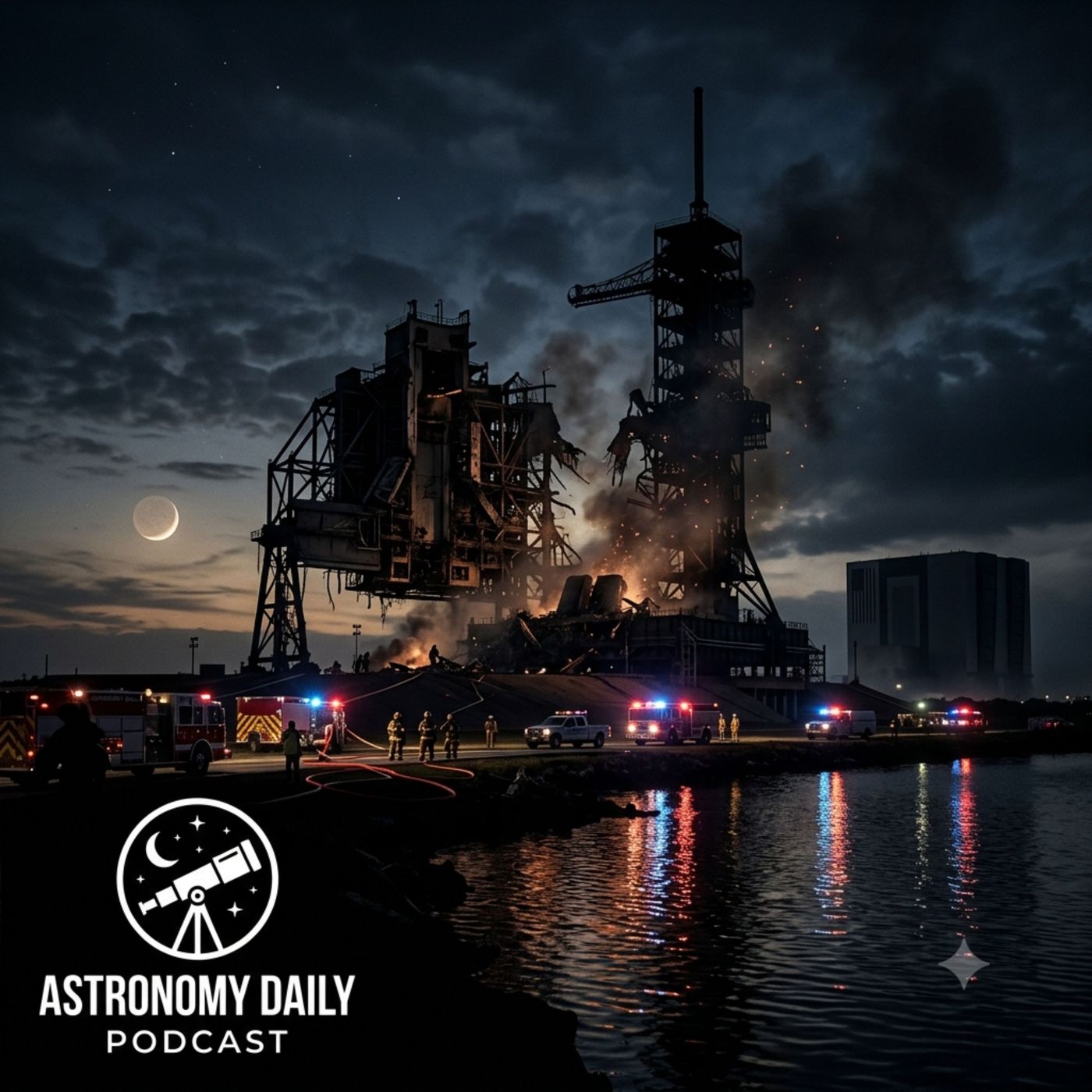
Anna: Here's the background for listeners who may have missed it. On May 28, Blue Origin's new Glenn rocket exploded during a static fire test AT Launch Complex 36 at Cape Canaveral Space Force Station. A, uh, static fire test is when you ignite the engines while the rocket is still on the pad, bolted down to check their performance ahead of a real launch. Avery: The explosion was enormous, visible from more than a hundred miles away. The rocket was destroyed. The transporter and erector holding it in place was wrecked.
A lightning tower was demolished. The main gantry suffered structural damage. Satellite images captured the full scorched extent of the destruction. Anna: No one was injured, which, given the scale of the explosion, is remarkable. Blue Origin CEO Dave Limp has said the pad can be repaired faster than initially feared. Key infrastructure, including the propellant tanks, water tower and storage systems, survived intact. He's committed to having another new Glenn ready for launch before the end of 2026.
Avery: That is an ambitious timeline, though, and the consequences for NASA's lunar program are serious. Blue Origin was supposed to launch its Blue Moon Mark one cargo lander, an uncrewed demonstrator intended to deliver a NASA Paylo to the moon this autumn. Um, as the inaugural mission of the Moon based program. Anna: With New Glenn out of action and LC 36 in ruins, NASA Administrator Jared Isaacman is now describing what he calls a whole of government response. The agency is actively seeking an alternative launch vehicle for the Blue Moon lander, decoupling it from New Glenn entirely for now.
Avery: And um, there's a direct connection to Artemis 3, the crew we just told you about in story one. Artemis 3 is meant to dock with both the SpaceX Lander variant and Blue Moon Mark 2 in Low Earth orbit. If Blue Origin's hardware isn't flight proven before then, that mission profile becomes significantly more complicated. Anna: Administrator Isaacman has said he remains optimistic about a crewed lunar landing in 2028 using whatever landing craft is available. But the road to the moon just got a bit bumpier.
And for our final story, something that is actually happening right now tonight as we broadcast this episode. The Japan Aerospace Exploration Agency is attempting to launch its H3 rocket from Tanegashima Space Center. Avery: This is a comeback story and JAXA really needs it to work. The H3's last flight was a painful one. Back in December last year, the rocket attempted to launch carrying a quasi Zenith satellite navigation satellite, part of Japan's own regional GPS style positioning network. The mission ended in failure when the QZS5 satellite separated from the rocket prematurely during stage separation and fell into the ocean.
Anna: The cause was eventually traced to adhesive strips in the payload support structure peeling off. DAXA has made modifications to the satellite payload section to address exactly that failure mode and sensors have been installed to monitor the fix during flight. Avery: Tonight's launch is a test flight rather than an operational mission. The rocket is carrying a dummy main payload called the vehicle evaluation payload 5 or VEP 5, along with a small collection of real satellites from universities and research organizations.
Anna: What makes this version of the H3 particularly interesting is its engine configuration. This is the H3.3 variant. It uses three liquid fuel LE9 engines in the first stage and no solid rocket boosters at all. That makes it Japan's first large rocket powered entirely by liquid propulsion. It's a significant milestone for the country's launch capability and its ambitions to compete in the global commercial launch market. Avery: The launch Tonight opens at 9:53am M Japan Standard Time on June 10, which is 8:53pm Eastern Time on June Nint.
So for our uh, listeners in Australia and the Pacific, you may actually be able to watch the livestream this morning. Anna: DAXA has had an impressive H3 track record. Overall, the vehicle has successfully flown multiple times. Tonight is about proving the fix works, restoring confidence and getting back to the serious business of building Japan's independent access to space. Avery: We're rooting for them. Go H3. Anna: And that is your Astronomy Daily for Tuesday, June 9, 2026. What a day it has been.
Avery: A new Artemis crew, a telescope ready to show us a billion galaxies, a solar storm painting the sky green, a space station holding its breath, a moon program rebuilding after disaster, and the rocket about to attempt its redemption. Anna: Bass never sleeps, and neither do we. Well, almost never. Tomorrow's episode will have full reaction and detail on the Artemis 3 crew announcement. You won't want to miss it. Avery: If you enjoyed today's show, please subscribe, leave us a review and share Astronomy Daily with someone who loves the cosmos as much as we do.
You'll find those at astronomydaily, IO and everywhere. You get your podcasts from Anna and M from Avery. Keep looking up. Anna: This has been Astronomy Daily the stormy Avery: day the stories be told,
The stories the song.


 Apple Podcasts
 Spotify
 Pocket Casts
 Castbox
 Overcast
 Podbean
 iHeartRadio
 Castro
 Goodpods
 Moon FM
 Podcast Addict
 Podcast Republic
 YouTube