In this episode
- Mysterious Interstellar Object 3i Atlas: The interstellar object 3i Atlas is back in the spotlight, exhibiting strange behavior that has scientists puzzled. With non-gravitational acceleration and focused jets forming an anti-tail, its upcoming close approach to Earth on December 19th has prompted coordinated space defense drills among various nations, raising intriguing questions about its true nature.
- SOHO's 30th Anniversary: Celebrating 30 years of operation, the Solar and Heliospheric Observatory (SOHO) has not only revolutionized solar science but has also discovered over 5000 comets, making it the most prolific comet hunter in history. Its resilience and contributions to understanding space weather have been invaluable.
- AI in Spacecraft Propulsion: Artificial intelligence is fundamentally transforming spacecraft propulsion systems. Through reinforcement learning, AI is optimizing engine performance in real-time, particularly in complex systems like nuclear thermal propulsion and fusion research, paving the way for more efficient travel across the solar system.
- Hypersonic Space Gun: Longshot Space Technologies is developing a hypersonic space gun, a kinetic launch system designed to fire payloads into orbit at Mach 23. This innovative approach could dramatically reduce launch costs and revolutionize space logistics, although it is limited to ruggedized cargo.
- Geminid Meteor Shower Preview: The Geminid meteor shower is set to peak on December 13th, offering ideal viewing conditions with a waning crescent moon. Stargazers can expect to see between 120 and 150 meteors per hour, with the chance to witness the colorful streaks originating from the asteroid 3200 Phaethon.
- Voyager 2's Uranus Mystery Solved: A decades-old mystery regarding Voyager 2's observations of Uranus has been revisited. New research suggests that the intense radiation belt detected during its flyby in 1986 was influenced by a solar wind structure, confirming a temporary solar storm effect far out in the solar system.
- For more cosmic updates, visit our website at astronomydaily.io. Join our community on social media by searching for #AstroDailyPod on Facebook, X, YouTubeMusic, TikTok, and our new Instagram account! Don’t forget to subscribe to the podcast on Apple Podcasts, Spotify, iHeartRadio, or wherever you get your podcasts.
- Thank you for tuning in. This is Avery and Anna signing off. Until next time, keep looking up and exploring the wonders of our universe.
3i Atlas Observations
[NASA](https://www.nasa.gov/)
SOHO Achievements
[ESA SOHO](https://soho.nascom.nasa.gov/)
AI in Propulsion Research
[Journal of Propulsion and Power](https://arc.aiaa.org/loi/jpp)
Hypersonic Launch System
[Longshot Space Technologies](https://www.longshotspace.com/)
Geminid Meteor Shower
[American Meteor Society](https://www.amsmeteors.org/)
Voyager 2 Uranus Findings
[Southwest Research Institute](https://www.southwestresearchinstitute.org/)
Become a supporter of this podcast:
Avery: Welcome to Astronomy Daily, the podcast that brings you the biggest news from across the cosmos. I'm Avery. Anna: And I'm Anna. We have a fascinating show for you today. We'll be looking at our mysterious interstellar object friend that's prompting secret space drills. Avery: We're also celebrating the 30th anniversary of a legendary solar observatory. And diving into how AI is revolutionizing spacecraft propulsion. Anna: Plus a hypersonic space gun. Preview of one of the best meteor showers of the year.
And we'll solve a decades old mystery from Voyager 2's journey to Uranus. Avery: Anna. Uh, let's start with something that has the astronomical community buzzing. The interstellar object known as 3i Atlas is back in the spotlight. Anna: It certainly is, Avery. This object, which came from outside our solar system, is exhibiting some very strange behavior. Scientists have noted what they call non gravitational acceleration. Avery: Meaning it's changing speed in a way that can't be explained by the pull of the sun or planets.
Anna: Exactly. And it's not outgassing like a typical comet. Instead, it seems to have these strange focused jets pointing away from the sun, forming an anti tail. It's a real puzzle. Avery: And this puzzle is getting some serious attention. There have been a series of coordinated but very quiet space defense drills involving the ESA, Japan, the U.S. australia and several other nations. Anna: That's right. The official line is that they are standard preparedness exercises. Uh, but the timing is conspicuous, especially with 3i atlas.
Closest approach to Earth happening on December 19th. Avery: It adds a layer of intrigue, especially when you consider some of the more out there theories. Anna: You're thinking of Avi Loeb's hypothesis. Avery: I am. He suggested that 3i Atlas might not be a single object, but a primary craft accompanied by a swarm of smaller probes. Now that is pure speculation, of course. Anna: Pure speculation. But it highlights just how little we understand about this visitor. Whatever its nature, its strange dynamics and the heightened military interest mean that countless telescopes will be tracking it very, very closely in the coming weeks.
Avery: Well, from a mysterious newcomer to a celebrated veteran, our next story is about a truly remarkable achievement. Happy 30th anniversary to the Solar and Heliospheric Observatory, or SOHO. Anna: An incredible milestone. When SOHO launched, its primary mission was scheduled to last just two years. Thirty years later, it's still providing invaluable data about our star. Avery: It really is the definition of resilience. It survived multiple technical crises that nearly ended the mission. Yet the team on the ground always found a way to bring it back online.
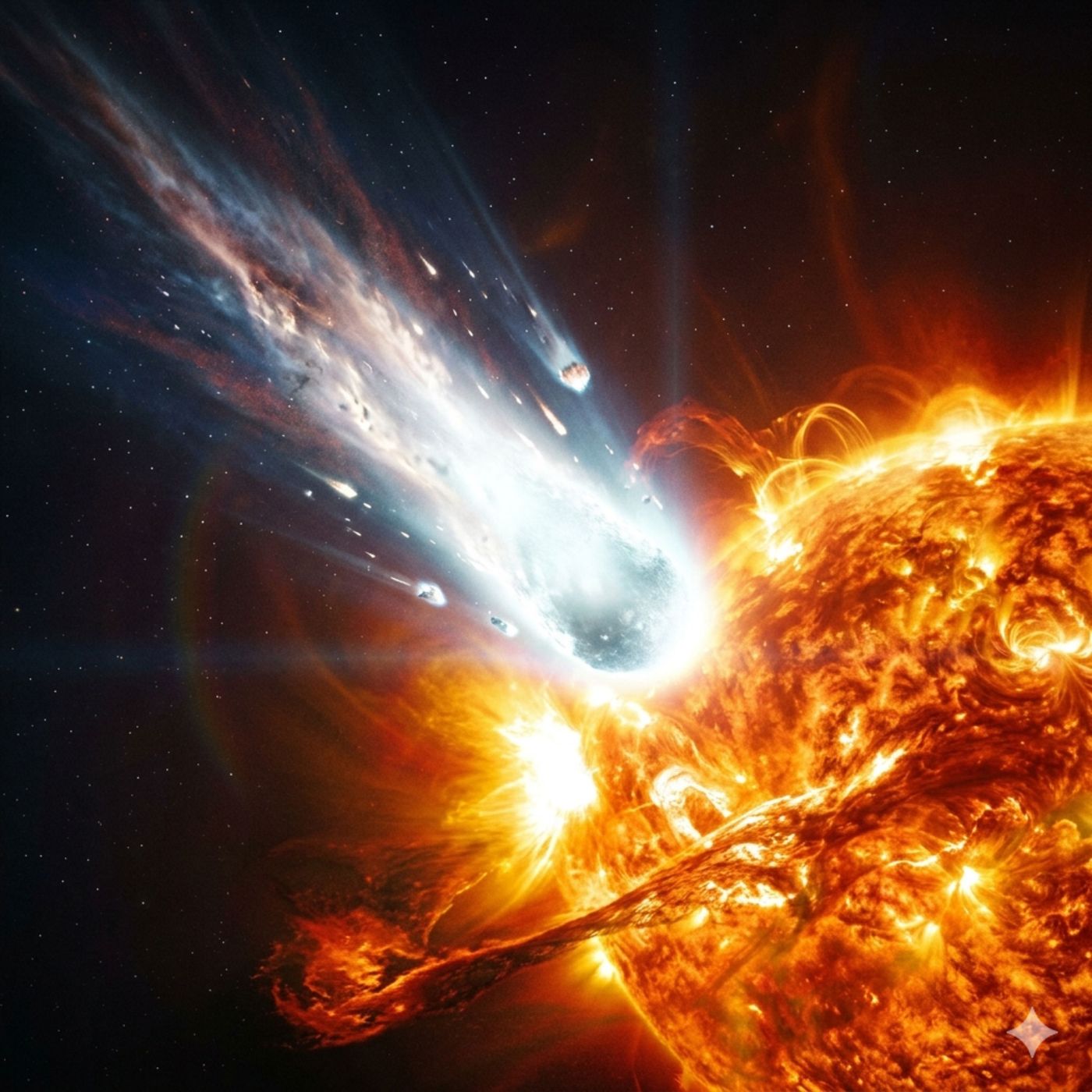
Anna: Right. And its contributions have been monumental. SoHo completely revolutionized solar science and our understanding of space weather. The images and data it provides are the foundation of modern solar forecasting, which is critical for protecting our satellites and power grids. Avery: Absolutely. But it has another completely unexpected legacy, doesn't it? For a satellite designed to look at the sun, it's found an incredible number of comets. Anna: It's the most prolific comet hunter in history, and it's not even close to.
Avery: Is it a case of being in the right place at the right time, or is there another reason why it's so prolific? Anna: It's because of its wide, uninterrupted view of the Sun's corona. It spots so called sun grazing comets that are otherwise invisible to us. As of this year, the official count is over 5000 comets discovered by SOHO. Avery: That's just amazing. 5000 comets as a side project. SOHO is a true workhorse of space exploration and a testament to brilliant engineering. Anna: Speaking of brilliant engineering, our next story looks at the future of getting around the solar system.
Avery artificial intelligence is starting to fundamentally change how we design and operate spacecraft propulsion systems. Avery: This is fascinating stuff. It's not just about AI pilots like in the movies. This is about AI making the engines themselves smarter and more efficient. Anna: That's the core of it. Researchers are using a technique called reinforcement learning, where an AI runs millions of simulations to discover, uh, the most efficient ways to operate an engine, often finding solutions that a human engineer might never think of.
Avery: So what kind of advanced systems are benefiting from this? Anna: We're seeing it applied to next generation concepts like nuclear thermal propulsion, both fission and the more complex fusion based designs. These engines are incredibly powerful, but also incredibly complex to manage. Avery: So just what can AI help with? A lot. I would imagine. Anna: AI can optimize the fuel flow, temperature and thrust in real time. It's also being used to tackle one of the biggest challenges in fusion research, managing the superheated plasma.
In concepts like the polywell, a compact fusion device, AI is learning how to best configure the magnetic fields to confine the plasma, which is a massive step forward. Avery: So AI is becoming a design partner. It's not just running the machine, it's helping to perfect the machine's very operation. This could be the key to unlocking faster, more efficient travel across the solar system. Anna: We'll keep an eye on this and report back on any developments. But. But it sounds exciting. Avery: From the digital frontier of AI, we go to something that sounds decidedly more analog.
Anna. Uh, what is a hypersonic space gun? Anna: It sounds like something out of Jules Verne novel, doesn't it. But it's a very real concept being developed by a company called Longshot Space Technologies. They are building a kinetic space launch system. In simple terms, it's a massive grid gun designed to fire payloads directly into orbit. Avery: You're kidding. How does that even work? Anna: The system uses a huge piston, uh, driven by compressed gas to launch a projectile at incredible speeds.
We're talking Mach 23, or about 28,400 kilometers per hour. The projectile would carry a small hardened satellite or other cargo. Avery: I can't even imagine the forces involved. The heat and the acceleration must be astronomical. Anna: They are. That's the biggest challenge. The payload would experience about 10,000 GS of acceleration and intense atmospheric heating. So this isn't for launching astronauts or delicate telescopes? Avery: Definitely not. So it's for hardened cargo only. Anna: Exactly.
Things like fuel, water, building materials, or ruggedized military satellites. But here's the payoff. Longshot believes they can get the cost of launching a kilogram of Cargo to just $10. Avery: $10? That's compared to thousands of dollars per kilogram on a traditional rocket. That's a complete game changer for space logistics. Anna: It is, and that's why it's attracting serious interest from both venture capital and military agencies. If they engineering challenges, this space gun could revolutionize how we supply future operations in orbit and beyond.
Avery: All right, let's bring our focus back to our own night sky. For all our stargazing listeners out there, one of the best celestial shows of the year is just around the corner. Anna: That's right. The Gemini meteor shower is set to peak on the night of December 13th into the morning of the 14th. And this year, the conditions are just about perfect. Avery: What makes this year so good? Anna: The moon. It will be a waning crescent, which means it won't rise until the early hours of the morning.
And its light won't wash out the fainter meteors. We'll have beautifully dark skies for most of the night. Avery: Fantastic. So what can people expect to see? Anna: Under ideal conditions, you could see between 120 and 150 meteors per hour at the peak. The radiant, the point they appear to come from is near the the star Castor in the constellation Gemini. Avery: And Geminites are known for being a bit slower. Anna: Right. Avery: It makes them easier to spot. Anna: Yes. They enter the atmosphere at about 22 miles per second.
That sounds fast. But it's slower than many other showers, which can lead to longer, more graceful streaks across the sky. They are also often brightly colored, and. Avery: Um, they have a really interesting origin. Anna: They do. Unlike Most meteor showers, which come from the debris trail of a comet. The Geminids originate from an asteroid called 3200 Phaethon. It's a bit of a mystery how this rocky body produces so much debris. Avery: So what are your tips for viewers? Anna: Find a location away from city lights, dress warmly, lie back on a blanket or a chair and just look up.
You don't need a telescope or binoculars. Just give your eyes about 20 minutes to fully adapt to the dark and enjoy the show. And for our final story today, we are revisiting a cold case from the outer solar system and solving a mystery that's nearly four decades old. Avery: This has to be about Voyager 2's flyby of Uranus in 1986. I remember reading that it found something unexpected in the planet's radiation belts. Anna: That's the 1. Voyager 2 detected an incredibly intense belt of high energy electron radiation, far more powerful than models had predicted.
For decades, scientists couldn't quite explain why it was so strong. Avery: And after all this time, there's a new explanation. Anna: There is? A team at the Southwest Research Institute revisited the old Voyager data. They proposed the intense radiation wasn't caused by Uranus alone. Instead, it was a case of being in the right place at the right time. Avery: So what was happening? Anna: The team believes a huge structure in the solar wind called a uh CO rotating interaction region was passing through the Uranian system just as Voyager 2 flew by.
Avery: A uh co rotating what now? Anna: Think of it as a massive shockwave in the solar wind where fast moving solar particles overtake slower ones. This interaction creates powerful high frequency plasma waves like Whistler waves. These waves were the perfect frequency to grab electrons already trapped in Uranus's magnetic field and accelerate them to incredible speeds, creating that intense radiation belt Voyager saw. We see similar events happen near Earth, but this is the first time we've confirmed it happening so far out in the solar system.
Avery: So it was a temporary storm caused by the sun that Voyager just happened to fly through. That is a brilliant piece of cosmic detective work. Anna: You betcha. Avery: And that's a wrap. From mysterious interstellar visitors and hypersonic cannons to celebrating a 30 year old hero of astronomy. And finally solving a cold case from Uranus. What an episode it really was. Anna: That's all the time we have for today on Astronomy Daily. We'd like to thank you all for tuning in. Avery: Join us next time as we continue to explore the wonders of the universe.
Until then, clear skies everyone. And remember to get out there and look up.
Anna: Mhm.
The stories.
Were told.
 Apple Podcasts
 Spotify
 Pocket Casts
 Castbox
 Overcast
 Podbean
 iHeartRadio
 Castro
 Goodpods
 Moon FM
 Podcast Addict
 Podcast Republic
 YouTube