
Stellar Explosions, Galactic Surprises, and the Controversial Light Beaming Plan
In this episode
### Episode SummaryReal-time images of exploding stars, a surprisingly “gentle” supermassive black hole, the return of a long-duration Soyuz crew, a packed week of launches, Subaru’s first new exoplanet and brown-dwarf finds, and a controversial plan to light up the night sky with orbital mirrors.
### Timestamps & Stories
00:00 – Cold Open
00:35 – Intro
01:05 – **Story 1: Astronomers watch novae explode in real time**
**Key Facts**
- First-ever direct imaging of two novae as they erupted using the CHARA optical interferometer
- V1674 Herculis: fastest nova on record; brightened & faded in days; showed two perpendicular gas jets
- V1405 Cassiopeiae: visible to naked eye for months; delayed ejection after 50+ days
- Gamma-ray bursts from Fermi telescope timed perfectly with visible jets
03:35 – **Story 2: Soyuz MS-27 crew lands after 8-month ISS mission**
**Key Facts**
- Crew of three returned safely to Kazakhstan on 8 Dec 2025
- 260+ days in orbit (launched April 2025)
- Handover completed; ISS now at full Expedition strength for next rotation
05:05 – **Story 3: Launch Roundup (8–15 Dec 2025)**
**Key Facts**
- SpaceX Starship Flight 6 (Texas) – major reusability test
- China Long March 7A – new Tiangong station module
- ULA Vulcan Centaur Cert-2 (Cape Canaveral) – second certification flight
- Rocket Lab Electron (New Zealand) – successful dawn launch
- Russia Soyuz-2.1b (Vostochny) – classified payload
06:35 – **Story 4: Subaru Telescope’s first discoveries**
**Key Facts**
- First science results from upgraded high-contrast infrared instruments
- New brown dwarf (13–80 Jupiter masses) with dusty disk
- New wide-orbit gas-giant exoplanet ~300 light-years away showing methane & water signatures
08:05 – **Story 5: Sagittarius A* is less destructive than thought**
**Key Facts**
- Objects like G2/DSO, D9, X3, X7 all survive stable orbits within 0.8 parsecs of the 4-million-solar-mass black hole
- 20+ years of VLT data (SINFONI, NACO, ERIS) show no tidal disruption
- Galactic Center may be a star-formation zone rather than a shredder
09:55 – **Story 6: Giant space mirrors to light up the night**
**Key Facts**
- Reflect Orbital plans thousands of mirror satellites by 2030
- Each beam ~5 km wide, 4× brighter than full moon
- Goal: extend solar-farm output after sunset & aid night rescues
- Astronomers warn of catastrophic light-pollution increase and wildlife disruption
11:20 – Outro
### Sources & Further Reading
1. https://connectsci.au/news/news-parent/7462/Astronomers-watch-stars-explode-in-real-time-and
2. https://www.nasa.gov/blogs/spacestation/2025/12/09/soyuz-crew-lands-ending-eight-month-space-research-journey/
3. https://www.nasaspaceflight.com/2025/12/launch-roundup-120825/
4. https://www.space.com/astronomy/exoplanets/the-subaru-telescope-just-made-its-1st-discoveries-a-failed-star-and-an-exoplanet
5. https://www.universetoday.com/articles/the-milky-ways-supermassive-black-hole-isnt-as-destructive-as-thought
6....
Anna: Imagine watching a star erupt in high definition, frame by frame. Gas jets twisting like cosmic fireworks. Or discovering that our galaxy's monstrous black hole isn't the destroyer we feared. Today on Astronomy Daily, we're unpacking novae caught in the act. Stable survivors orbiting Sagittarius A. And a bold plan to beam sunlight into the night sky. But at what cost to the stars above? I'm Anna, here with my co host Avery. Let's dive in. Hello stargazers, and welcome to Astronomy, uh, daily for December 9, 2025.
I'm Anna, your guide through the cosmos from the ground up. Avery: And I'm Avery, orbiting right alongside you. Whether you're sipping coffee under city lights or chasing dark skies in the wild, we've got the latest in space and astronomy to fuel your wonderful. Today, we're blending breakthroughs in stellar explosions, galactic survival stories, and even the futuristic twist on illuminating Earth while keeping our telescopes trained on the heavens. Anna, what's got you buzzing today? Anna: Oh, Avery, it's those real time nova observations.
It's like the universe handed us a front row seat to stellar drama. But let's start there and work our way out, okay? Avery: Kicking things off with the cosmic blockbuster, astronomers have captured stars exploding in real time. And what they saw has rewritten the script on novae. Published just yesterday in Nature Astronomy, this study used the center for High Angular Resolution Astronomy, or CHARA Array for short in California to image two novae as the unfolded, revealing ejections far more complex than a simple blast.
Anna: Right, Avery? Novae aren't supernovae. They're thermonuclear runaways on white dwarfs, siphoning material from companion stars. But instead of a straightforward shell of gas, these events showed multidirectional outflows. Take V1674 Hercules, the fastest nova on record. It brightened and faded in mere days, about 6,500 to 29,000 light years away in our galaxy. Chara's interferometry, basically combining light from multiple telescopes for super high resolution, caught two perpendicular jets of gas and timed perfectly with gamma ray bursts detected by NASA's Fermi Space Telescope.
Avery: And don't forget V 1405 Cassiopeia, the slow burner. At 5,600 light years out, it peaked for nearly 200 days. Bright enough to spot with the naked eye, the white dwarf held onto its outer layers for over 50 days before a, ah, delayed ejection again syncing with those high energy gamma ray rays. It's like the star was staging a. Anna: Multi Act Play lead author Elias Eady from Texas Tech calls it a shift from grainy black and white to high definition video. He told reporters these observations allow us to watch a stellar explosion in real time, uncovering the true complexity of how these explosions unfold.
Gail Shafer, chara's director at Georgia State, emphasized the text's flexibility. Catching these transient events requires adapting our schedule as targets of opportunity pop up. Avery: Absolutely. As Laura Chomiek from Michigan State puts it, novae are laboratories for extreme physics, linking nuclear reactions on the star's surface to the geometry of ejected material and that zippy gamma ray radiation. This could reshape how we model binary star evolution and even galactic chemistry. Anna: Thrilling stuff if you're an amateur imager, keep an eye on the skies.
These targets of opportunity remind us the universe deep doesn't wait. Avery: Shifting from stellar blasts to human ones, the Soyuz MS.27 crew splashed down safely yesterday, wrapping up an eight month stint on the International Space Station, NASA reports. The trio, NASA astronaut Johnny Kim and Roscosmos cosmonaut Sergei Reichikov and Alexei Zubritsky touched down in Kazakhstan after over 260 days in orbit. Anna: It's a textbook return. Avery launched last spring, their mission overlapped with key station upgrades and a packed research calendar.
While specifics on astronomical experiments are still filtering in, this crew contributed to ongoing solar observations and microgravity fluid dynamics that indirectly support astrophysics modeling. Like simulating plasma flows in stellar atmospheres. True. Avery: And, um, it's a handover moment. The station's now prepped for the next rotation, keeping that continuous human presence humming. No major hitches on descent, per NASA's blog. Undocking smooth deorbit burn on point and a balmy step landing at dawn local.
Anna: Time 8 months is no small feat. These missions remind us that while we chase exploding stars from afar, boots or rather spacesuits in orbit are building the data pipelines for tomorrow's discoveries. Welcome home, crew. Now for the adrenaline junkies. Our weekly launch roundup is still stacked nsfspaceflight.com's December 8th update highlights uh, a global frenzy China, Russia, Rocket Lab, Ula and SpaceX all lighting up the pad this week. Avery: Leading the pack, SpaceX's Starship Flight 6 test from Starbase Texas.
Eyeing rapid reusability tweaks after last month's hop over in China a long March 7 a lofted more Tiangong station modules bolstering their orbital lab, Russia's Soyuz 2.1B from Mastochny sent a classified payload skyward. No spoilers, but whispers of comsat upgrades. Anna: Rocket Labs Electron nailed a AH dawn launch from New Zealand, deploying smallsats for Earth observation that double as calibration tools for astronomy ground stations. And ula's Vulcan Centaur roared on its second CERT flight from Cape Canaveral, hauling cert payloads towards Geo Key for future deep space relays.
Avery: No major scrubbers reported, though weather nipped at a few heels. These aren't just fireworks they're the supply lines for telescopes in space and probes to the stars. If you're tracking live apps like NSF's are gold. Anna: Agreed. It's a reminder that astronomy thrives on reliable rides to orbit. Avery: Over to exoplanet hunting the Subaru telescope in Hawaii has scored its inaugural discoveries a failed star, brown dwarf and an intriguing exoplanet, marking a milestone for its upgraded infrared capabilities.
Anna: Subaru's no newbie, but these finds, detailed in a FreshSpace.com report, showcase its revamped seed survey. The brown dwarf lurking in a nearby system clocks in at just 13 to 80 Jupiter masses too lightweight for hydrogen fusion, hence the failed tag. But it's got a dusty disk hinting at potential planet formation. Avery: And the exoplanet? A gas giant orbiting a young sun like star about 300 light years out, with an orbital tilt suggesting a dramatic formation history. Maybe a gravitational slingshot from siblings?
High contrast imaging pierced the glare, revealing spectral signatures of methane and water vapor. Anna: Implications this duo pushes our senses of substellar objects and wide orbit worlds, refining models of how solar systems assemble. Subaru is pointing the way for JWST. Avery: Follow ups A, uh, stellar debut, pun. Anna: Intended Speaking of galactic neighbors, new research in astronomy and astrophysics reveals our Milky Way's supermassive black hole. Sagittarius A isn't the wrecking ball we imagined.
Lead author Florian Peisker's team tracked oddballs like G2DSO, D9, X3, and X7 over 2dec with the Very Large Telescopes Symphony and NACO instruments, plus fresh 2024 Eris data. Avery: These objects in the dense central parsec, where stellar crowds are millions of times our local density, follow stable Keplerian orbits hugging within 0.8 parsecs of Sagittarius A's 4 million solar mass grip. G2DSO not a doomed gas cloud but a star shrouded in one, resisting tidal spaghettification. D9's a binary pair cruising steady X7's elongated bow shock form is northward bound, untouched.
X3, a young stellar unit, accelerates but stays on track. Anna: Pesker notes the fact that these objects move in such a stable manner so close to a black hole is fascinating. Sagittarius A is less destructive than was previously thought, co author Michael Jacek and adds it can stimulate star formation or exotic dusty objects via binary mergers. Avery: This paints the galactic center as a stellar nursery lab, not a shredder. Challenging destruction models and opening doors to black hole ecology. Anna: Mind bending?
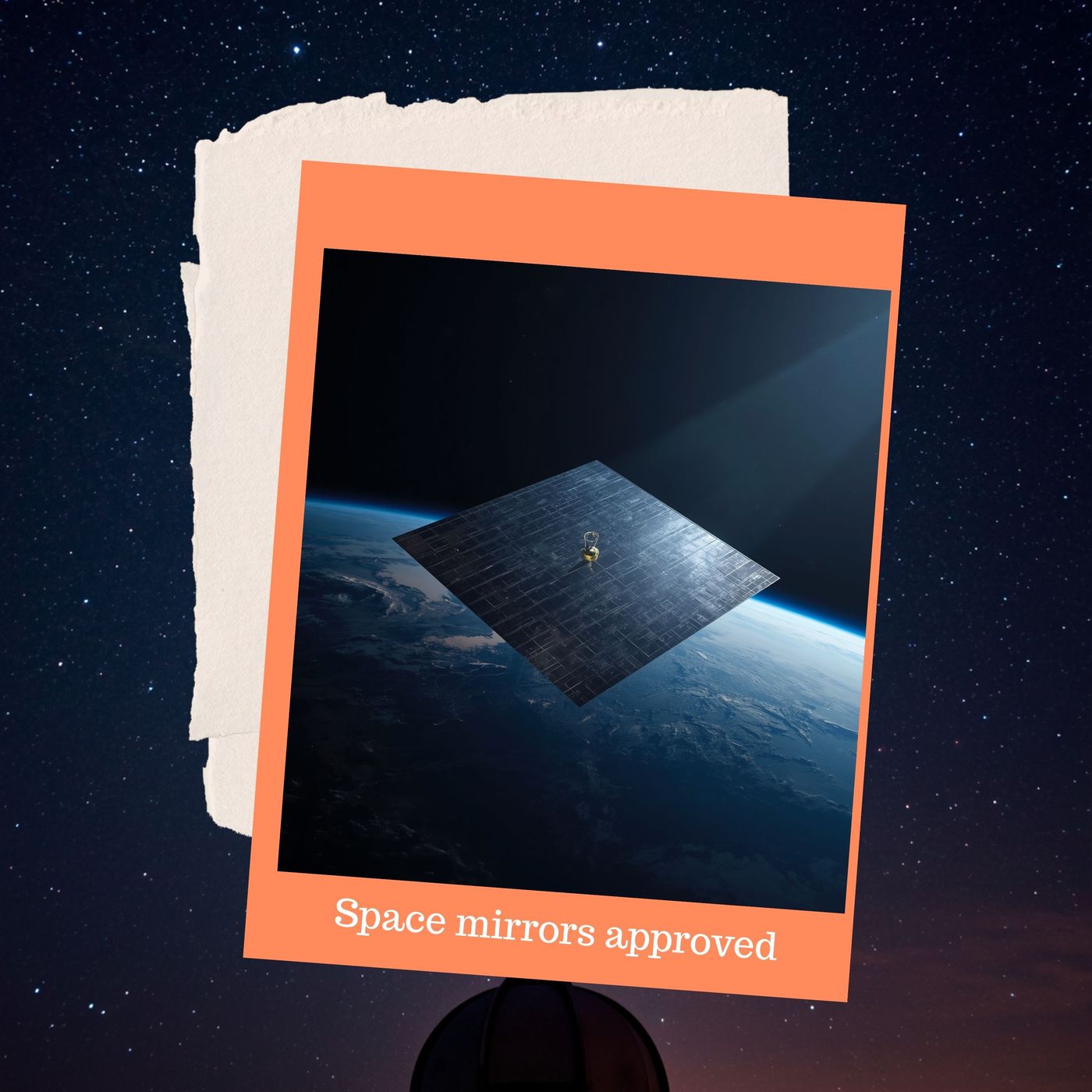
Our black hole's got a soft spot. Avery: Okay. Wrapping with a provocative proposal, startup Reflectorbital wants to launch thousands of mirror laden satellites by 2030 to beam sunlight earthward at night, lighting solar farms. Aiding rescues. But astronomers are sounding alarms on the fallout. Anna: The plan Low Earth orbit satellites with panels focusing beams of sunlight over 5 kilometer spots four times brighter than a full moon. Proponents tout round the clock solar power, but critics crunch the numbers.
Samantha Lawler from the University of Regina says it yield mere milliwatts per panel in needing hordes focused on one spot. Avery: To matter the real thing for astronomy, it's sky flooding, light pollution on steroids. Robert Massey of the Royal Astronomical Society calls it catastrophic scrambling observations of faint stars and planets. John Barentin from Silverado Hills Observatory warns of scattered beams disrupting wildlife navigation, birds, insects, migrants via atmospheric glow. Aaron Boley from UBC pushes rooftops over orbits more efficient and sustainable.
Anna: A uh, double edged sword. Innovation versus the dark we need for discovery. Avery: And um, that's our cosmic dispatch for December 9, 2025. From exploding novae to orbiting survivors, it's a universe full of surprises, gentle and fierce. Anna: Thanks for joining us on Astronomy Daily. Tune in tomorrow for more. Got thoughts on space mirrors? Hit us on [email protected] Clear skies everyone. Avery: I'm Avery. Anna: And I'm Anna. Keep looking up.
Avery: Mhm. You.
Stories we told.
 Apple Podcasts
 Spotify
 Pocket Casts
 Castbox
 Overcast
 Podbean
 iHeartRadio
 Castro
 Goodpods
 Moon FM
 Podcast Addict
 Podcast Republic
 YouTube