Asteroid Flybys, Cosmic Mysteries, and the Search for the Universe's Ghost Signals
In this episode
Today on Astronomy Daily: Japan's Hayabusa2 pulls off a nail-biting high-speed asteroid flyby, James Webb finds the same unexplained chemical mystery on Titan AND Pluto, a neutrino detector may have caught the universe's oldest supernova echo, a wild new theory tries to solve the black hole information paradox, we wrap up the weekend's aurora action, and we look at when NASA's New Horizons might finally cross into interstellar space.Monday, July 6, 2026 1. Hayabusa2's Flyby of Asteroid Torifune • JAXA's Hayabusa2 spacecraft flew within ~800 metres of near-Earth asteroid (98943) Torifune on July 5, 2026, at a relative speed of about 5.25 km/s (~18,000 km/h). • This is an extended-mission flyby, not a sample return — Hayabusa2 already delivered Ryugu samples to Earth in December 2020. • Purpose: engineering demonstration of high-precision navigation relevant to planetary defense (asteroid deflection technology). • Torifune is roughly 450 metres across. Next stop for Hayabusa2: rendezvous with asteroid 1998 KY26 in 2031. • Source: JAXA/ISAS, Nikkei Asia, phys.org (July 5, 2026). 2. Mystery Molecule Found on Both Titan and Pluto • James Webb Space Telescope data reveals an unexplained absorption feature at ~5.11 micrometres on the surfaces of Titan (Saturn's largest moon) and Pluto. • Evidence points to a surface origin rather than atmospheric origin, based on limb-vs-disc-center comparison on Titan. • Candidate compounds include allenes, but no confirmed identification yet. • Pluto's absorption line is roughly three times broader than Titan's at the same central wavelength. • Study led by Dr. Bruno Bézard's team (Paris Observatory); posted to arXiv June 11, 2026 — not yet peer-reviewed. 3. Super-Kamiokande's Hint of the Diffuse Supernova Neutrino Background • Super-Kamiokande collaboration presented results at Neutrino 2026 (UC Irvine) after analyzing ~5,000 days of data. • Found a statistically significant excess of events between 13.3–81.3 MeV — consistent with the long-predicted Diffuse Supernova Neutrino Background (DSNB). • Significance: 2.6-sigma (~99.5% confidence) — below the 5-sigma discovery threshold, so described as an 'indication,' not a confirmed detection. • If confirmed, DSNB would offer a new way to study the cosmic history of core-collapse supernovae via neutrinos rather than light. 4. A Theoretical Fix for the Black Hole Information Paradox • New theoretical study proposes black holes stop evaporating just before vanishing completely, leaving a stable Planck-scale remnant (~9×10⁻⁴¹ kg). • Mechanism: a repulsive force from spacetime torsion in a 7-dimensional Einstein-Cartan model, active at extreme (Planckian) densities. • Proposal: quantum information is preserved via long-lived 'vibrations' in the remnant's internal torsion field. • This is a theoretical/mathematical proposal, not an observational result. Researchers: Pinčák, Pigazzini, Pudlák, Bartoš. 5. Weekend Geomagnetic Storm / Aurora Wrap-Up • X1.1 solar flare (June 30) and associated CME triggered a G3 (strong) geomagnetic storm around July 3–4, 2026. • Aurora borealis visible as far south as Utah, Colorado, and Nevada in the continental US. • NOAA SWPC reports conditions easing to unsettled/G1 levels through July 6 as CME effects wane. 6. Forecasting New Horizons' Crossing Into Interstellar Space • SwRI researchers (lead: Dr. Jonathan Gasser) combined solar wind forecasting with heliosphere models to predict New Horizons' termination shock crossing. • Forecast window: 2029–2040, with possible multiple crossings as the heliosphere expands/contracts with the solar cycle. • New Horizons is currently ~66 AU from the Sun. Voyager 2 crossed its termination shock at 84 AU in 2007, with a 46% solar wind speed drop. • New Horizons...
Anna: Hello and welcome to Astronomy Daily. I'm Anna. Avery: And I'm avery. It's Monday, July 6th, and we've got a properly stacked show for you today. Anna: We're talking a, uh, nail biting asteroid flyby from Japan. A genuine cosmic mystery on two different worlds, and a hint that we might finally be hearing the universe's oldest ghost signal. Avery: Plus a black hole theory that could rewrite the rulebook. A, uh, look back at the weekend's aurora action, and a very long range weather forecast for the edge of the solar system.
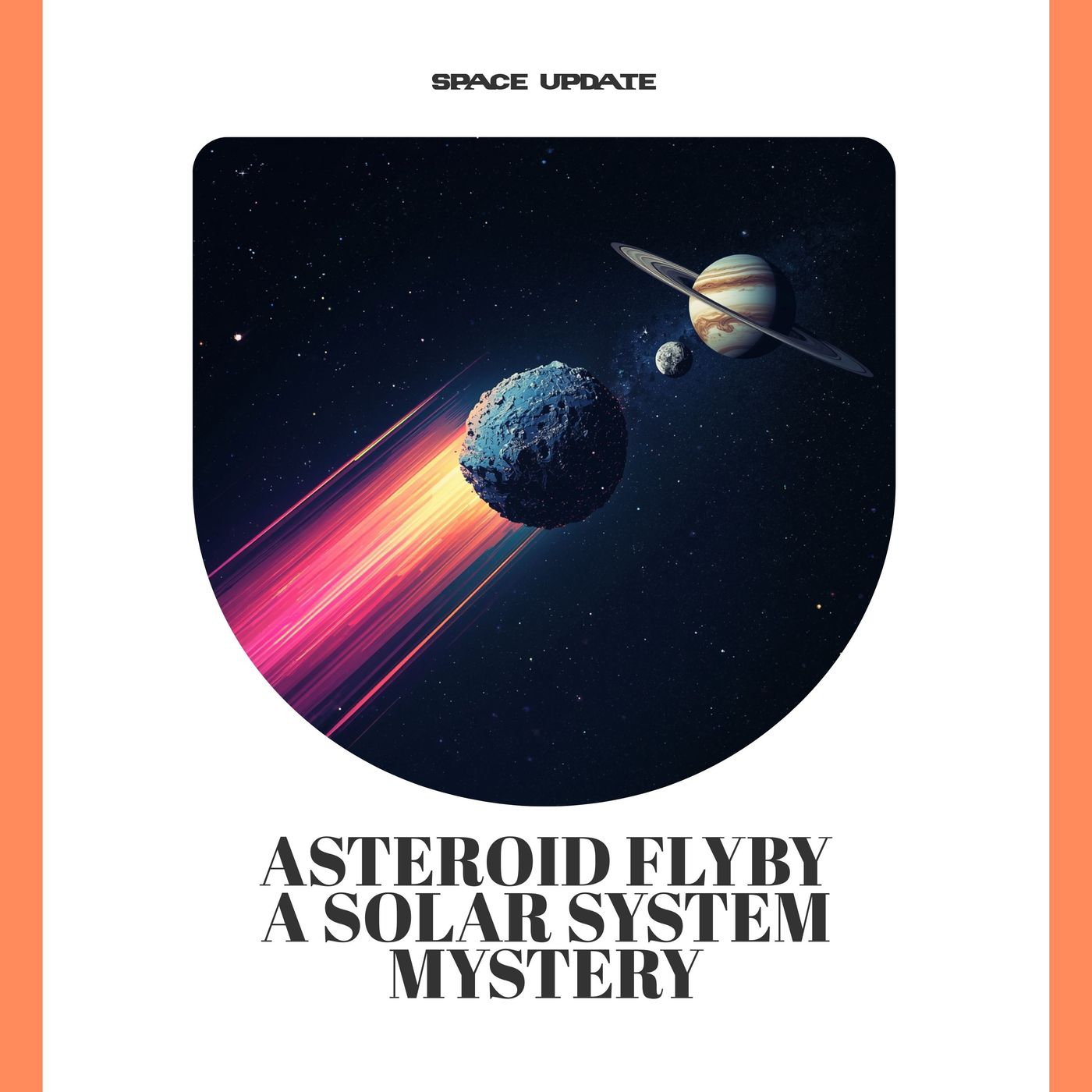
Anna: All that right after this. Avery: Let's kick off in Japan, where Mission Control had a genuinely nervous Sunday night. Anna: This is Hayabusa2. Yes, the same spacecraft that brought samples back from asteroid Ryugu in 2020. It's been on an extended mission ever since because it turned out to have fuel to spare. Avery: And on July 5, Japan time, it did something it was never really designed to do. A high speed flyby of a near Earth asteroid called Toroph, passing within about 800 meters at, uh, more than 18,000 kilometers an hour.
Anna: 800 meters at that speed. Jaxa described it like trying to shoot a coin somewhere between Okinawa and Hokkaido. Avery: The spacecraft's cameras were never built for a flyby like this. Hayabusa 2 is a rendezvous spacecraft designed to hover close to an asteroid for months, not scream past one in a heartbeat. Anna: So this whole encounter is really an engineering demonstration first, science second. Avery: And the reason it matters, beyond the wow factor, is planetary defense. If humanity ever needs to nudge a hazardous asteroid off course, we need to know how these bodies behave up close.
Do they act like solid rock? Or more like a loose pile of rubble? That changes everything about how you'd deflect one. Anna: JAXA confirmed the spacecraft is healthy. The flyby went to plan, and cameras captured imagery of Torophone's shape, texture and temperature that scientists are poring over now. Avery: Torophone itself is only about 450 meters across. No sample returned this time. This one's, uh, a look and go. Hayabusa2's next big date is 2031, when it rendezvous with a completely different target, the small, fast spinning asteroid 1998 KY26.
Anna: So think of Sunday as a dress rehearsal. A spacecraft already passed its day job, still finding ways to be useful. Avery: Our next story is one of those lovely we genuinely don't know what this is moments in astronomy. Anna: Researchers combing through James Webb Space Telescope data have found an unexplained absorption feature, basically a dick in the light spectrum, sitting at exactly 5.11 micrometers uh, and Avery: they found it twice. Once on Saturn's big moon, Titan, and Anna: once on Pluto, which is odd, because Titan and Pluto are about as different as two icy worlds get.
Titan has a thick nitrogen methane atmosphere, methane lakes, actual rain. Pluto has a wisp of an atmosphere and is bitterly cold and airbound in name only. Avery: The team led by Bruno Bizard at the Paris Observatory checked whether the signal could just be coming from the atmosphere rather than the surface. And on Titan at least, the absorption was actually weaker at the edge of the disk, where you'd expect an atmospheric signal to be stronger that points to the surface as the source. Anna: They've ruled out the usual common ices, straightforward hydrocarbons, the nitrogen photochemistry products you'd expect.
The closest match so far is a class of molecules called Allenes, but it's not confirmed. Avery: And, and here's the twist. Anna: On Pluto, the same absorption line is about three times broader than on Titan, even though it sits at the same wavelength. So whatever it is, it's behaving differently on each world. Avery: This result is still a preprint, so it hasn't cleared peer review yet. But the researchers are calling it one of the more compelling, unassigned features they've seen. Solve this one, and you learned something new about organic chemistry happening in the deep freeze on two worlds at once.
Next story three takes us underground, literally, to the Super Kamikande Neutrino Detector in Japan. Anna: Every second, somewhere in the universe, a massive star reaches the end of its life and collapses into a supernova. Each one of those explosions flood space with neutrinos, ghostly particles that barely interact with anything. Avery: Physicists have long predicted that all of those neutrinos from every supernova across the entire history of the universe should add up to a very faint, constant background hum.
The diffuse supernova neutrino background, or DSNB, for short. Anna: It's never been detected until maybe now. The Super Kamikande collaboration presented results this week at the Neutrino 2026 conference in California. After combing through nearly 5,000 days, that's about 13 and a half years of data. Avery: They found a statistically significant excess of events in the expected energy range. The confidence level works out to about Anna: 99.5%, which sounds enormous, but in particle physics terms, it's still short of the gold standard five sigma threshold needed to call it a discovery.
So the team is very deliberately calling this an indication, not a confirmation. Avery: Still, if it holds up with more data, this would be a whole new way of studying the history of the universe's. Supernovae. Using particles instead of light, it could tell us how often massive stars have exploded over cosmic time and how black holes and neutron stars formed a background Anna: hum from every dying star that ever lived. Not bad for a Monday Sticking with Avery: big theoretical ideas, Story four is a fresh attempt to solve one of physics's most stubborn headachesthe Black Hole Information paradox.
Anna: Quick Refresher Stephen Hawking showed in the 1970s that black holes very slowly radiate energy and in theory eventually evaporate completely. The paradox is what happens to all the information about everything that ever fell in. Quantum mechanics says information can't just vanish, so where does it go? Avery: A new theoretical study proposes an answer using a seven dimensional model of spacetime built on something called Einstein Cartan geometry with torsion basically letting spacetime twist as well as bending.
Anna: The researchers found at extreme densities right at the Planck scale, that twisting produces a, uh, repulsive force strong enough to halt the final stage of Hawking in operation completely. Avery: Instead of vanishing, the black hole would freeze into a stable leftover object, a remnant with a predicted mass of around 9 times 10 to the -41 kilograms. Genuinely tiny. Anna: And the proposal is that this remnant acts like a permanent archive with the black hole's information encoded in long lived internal vibrations.
Rather than being lost, it's squarely in Avery: fascinating but far from settled territory. This is a theoretical framework, not an observation, but it's a serious attempt to answer a 50 year old question. And it comes with a neat bonus. The same geometry might also help explain why fundamental particles have, uh, uh, mass in the first place. Anna: Two birds, one seven dimensional stone Next up, a quick check in on the sky show from the weekend for anyone who missed it or is still out chasing it.
Avery: Saturday's X1 solar flare and its coronal mass ejection slammed into Earth's magnetic field as forecast, pushing geomagnetic activity up to G3. Strong storm levels through July 3rd and 4th. Anna: Aurora Borealis was reported as far south as Utah, Colorado and Nevada in the US with some lovely July 4th fireworks and Aurora combo shots doing the rounds online. Avery: NOAA AH Space Weather Prediction center says activity has been easing since with conditions dropping to unsettled to G1 levels through today the 6th as the effects of last week's CMEs fade out.
Anna: So if you're in a high latitude spot, Southern Hemisphere included, tonight's still worth a glance skyward. But don't expect a repeat of Saturday's fireworks. The main event has passed. Avery: Our last story is a lovely bit of long range Weather forecasting Except the weather is solar wind and the destination is interstellar space. Anna: NASA's New Horizons, the spacecraft that gave us our first close up look at Pluto in 2015 and then flew past the Kuiper Belt object Arrokoth in 2019, is still out there, still working currently around, uh, 66 astronomical units from M the Sun.
Avery: Researchers at the Southwest Research Institute, led by Dr. Jonathan Gasser have combined solar wind forecasting with helios heliosphere models to predict when New Horizons will cross. Determination Shock the first plasma boundary marking the edge of the Sun's influence before the true edge of the heliosphere further out. Anna: Their answer? Somewhere between 2029 and 2040, which is, let's be honest, a pretty wide window. Avery: But that's because the heliosphere isn't a fixed shell. It swells and shrinks with the solar cycle, expanding during solar maximum and contracting during solar minimum.
New Horizons might even cross the boundary more than once if the shock front M moves back and forth across the spacecraft's path. Anna: For context, Voyager 2 crossed its termination shock back in 2007 at 84 astronomical units and measured a sharp 46% drop in solar wind speed right at the boundary. Avery: If New Horizons gets there, it'll become only the third spacecraft in history to cross into that outer frontier after Voyager 1 and 2. Not bad for a mission that was just supposed to visit Pluto.
Anna: A whole new frontier. And we might get to watch it happen live sometime in the next decade or so. Avery: And that's a wrap on Today's episode. An asteroid 5i a, uh, shared mystery on two icy worlds, a possible whisper from every supernova that ever happened, a theoretical black hole afterlife, some leftover aurora, and a decade long forecast for the edge of the solar system. Anna: If you enjoyed the show, please do leave us a rating and review. It genuinely helps other space fans find us. Avery: I'm Avery.
Anna: And I'm Ana. We'll see you next time on Astronomy Daily. Clear skies, everyone.
Avery: Sam m.


 Apple Podcasts
 Spotify
 Pocket Casts
 Castbox
 Overcast
 Podbean
 iHeartRadio
 Castro
 Goodpods
 Moon FM
 Podcast Addict
 Podcast Republic
 YouTube